The Manager Training That Actually Reduces FEHA Lawsuits
FEHA / EEO Defense

Many FEHA lawsuits do not start with a deliberate act of discrimination by senior leadership. They start with a manager who does not recognize a protected complaint, delays escalation, dismisses a concern as "just joking," or changes an employee's schedule after the employee complained.
Training to prevent FEHA lawsuits starts with managers because they are often the first to hear complaints, approve accommodations, enforce schedules, document performance, and decide whether to escalate issues to HR.
This guide explains what California supervisor training for FEHA prevention must cover, what California law requires, which manager behaviors pose the greatest risk, and how employers can build a training program that strengthens their litigation defense.
What California Supervisor Training Requires and What Employers Miss
California Government Code §12950.1 requires employers with five or more employees to provide harassment-prevention training. The requirements, expanded by SB 1343, include:
Employee Type | Training Duration | Frequency | Deadline for New Hire / New Supervisor |
|---|---|---|---|
Supervisors/managers | 2 hours | Every 2 years | Within 6 months of assuming the supervisory role |
Non-supervisory employees | 1 hour | Every 2 years | Within 6 months of hire |
Temporary/seasonal workers | 1 hour | Per engagement | Within 30 days of hire or 100 hours worked |
Training records must be retained for at least two years.
What most employers miss: The legal requirement is not just duration and frequency. California law specifies that the training must be effective, interactive, delivered by a qualified trainer, and must cover specific content categories. A video-only program that lacks required interactivity, compliant content, qualified training standards, and completion documentation may not satisfy California's training requirements.
Failure to provide compliant training can create enforcement risk, weaken the employer's litigation position, and become evidence in a FEHA failure-to-prevent claim. It should not be treated as a paperwork issue.
Why Supervisor Training Specifically Is the Legal Battleground
Non-supervisory employees must be trained, but supervisor training is where many FEHA defenses are strengthened or weakened.
Under California FEHA, employers can be strictly liable for actionable harassment committed by supervisors. That means the employer may face liability even if senior leadership was unaware of the conduct before the complaint.
Training does not erase that strict-liability rule. But it can still matter in litigation. Documented, compliant, effective supervisor training can help show that the employer took reasonable steps to prevent and correct harassment, discrimination, and retaliation. That evidence may support defenses to failure-to-prevent claims and may help reduce damages under California's avoidable consequences doctrine.
The practical takeaway for employers is simple: a training certificate alone is not a defense. A defensible program includes clear reporting rules, manager escalation duties, complaint-handling procedures, anti-retaliation instructions, and records demonstrating that the training occurred.
Watch: John Fagerholm explains how one complaint in California can cost an employer $100,000 or more and what FEHA actually exposes your business to. 🎬 One Complaint Can Cost You $100K+ | CA Employers Must Know This (FEHA)
What Supervisor Training Must Cover to Work in Defense
This is the gap most training programs miss. There is a significant difference between training that meets the minimum regulatory standard and training that functions as a litigation defense.
Required content under California FEHA supervisor training (SB 1343 / Gov. Code §12950.1):
The statutory sexual-harassment prevention topics include abusive conduct, gender identity, gender expression, sexual orientation, and complaint/reporting obligations.
Abusive conduct/workplace bullying (AB 2053), a standalone requirement
Supervisor-specific obligations: duty to report, duty to investigate, duty to take corrective action
Supervisors should understand that individual employees, including managers, may face personal liability for harassment under FEHA.
Practical, workplace-specific scenarios, not abstract definitions
Your company's internal complaint procedure requires managers to know exactly how to direct complaints
What litigation-informed supervisor training adds:
Basic Compliance Training | Litigation-Defense Training |
|---|---|
Defines harassment categories | Shows how courts evaluate "severe or pervasive" conduct |
Explains the reporting obligation | Covers what happens when a manager fails to report |
General policy overview | Walks through the interactive process for accommodations |
One-size-fits-all scenarios | Industry- and role-specific examples |
Certificate generated | Documented record: trainer qualifications, attendee signatures, timestamps |
Covers harassment | Also covers retaliation, recognition, and accommodation obligations |
The difference between the two columns can affect whether the employer can show reasonable prevention efforts, rebut failure-to-prevent allegations, and reduce damages exposure.
If the issue is already a harassment complaint, prevention training is only one part of the defense. Employers need to evaluate the complaint, the manager's response, the investigation record, and the risk of retaliation. Read our guide on sexual harassment claims against California employers.
The Manager Behaviors That Most Commonly Trigger FEHA Claims
Training to prevent FEHA lawsuits must address specific manager behaviors, not just legal definitions. These are the patterns that generate the most California FEHA claims:
Minimizing or dismissing complaints.
A manager who responds to a harassment report with "that's just how he is" or "they were joking around" is creating documented evidence of the employer's failure to take corrective action. The response to every complaint must be prompt and taken seriously, regardless of the manager's personal assessment.
Informal retaliation after a complaint.
Schedule changes, reduced shifts, reassignment, exclusion from meetings, or subtle changes in treatment after an employee makes a complaint, even if unintentional, may be argued as adverse action under FEHA. Managers must be explicitly trained that any change in treatment following a complaint will be scrutinized.
Delay in escalating complaints.
FEHA requires prompt review and appropriate investigation of complaints. A manager who sits on a complaint for two weeks before escalating it has already weakened the employer's defense. Training must include clear timelines: what escalation looks like, who receives it, and how fast.
Conducting their own informal investigation.
A manager who questions the accused employee, collects statements from coworkers, or otherwise "handles it" without HR involvement, even with good intentions, creates evidentiary problems and potential claims of bias.
Making accommodation decisions without HR.
A manager who denies, delays, or informally grants a disability or pregnancy accommodation without following the interactive process can create separate FEHA exposure. Managers must know they do not have the authority to make accommodation decisions alone.
"It Only Happened Once" Is No Longer a Safe Manager Response
Managers often minimize complaints because the conduct occurred once, involved a single comment, or seemed like a personality conflict. That approach is risky under California law.
In Bailey v. San Francisco District Attorney's Office, the California Supreme Court confirmed that a single severe incident may be enough to support a hostile work environment claim under FEHA. The employer takeaway is not that every isolated comment creates liability. The takeaway is that managers cannot dismiss a complaint simply because it happened once.
Supervisor training should teach managers to escalate complaints immediately, document what was reported, avoid retaliation, and allow HR or counsel to determine the appropriate response.
For how retaliation claims specifically layer on top of underlying FEHA complaints, read Retaliation Claims in California: How Employers Defend Business Decisions
Building a Training Program That Actually Holds Up
A compliant, litigation-defensible California supervisor FEHA prevention training program requires all of these elements:
1.
Qualified trainer.
California requires trainers to be licensed California attorneys with FEHA / Title VII experience, HR professionals with at least 2 years of harassment prevention experience, or instructors supervised by qualified legal counsel. A well-meaning HR generalist without this background does not satisfy the standard.
2.
Interactive delivery.
California law requires interactivity: questions, exercises, scenario responses. A video the manager watches without engagement does not qualify. Training must require active participation and verification of completion.
3.
Company-specific content.
Training that references your actual complaint procedure, your managers' actual reporting chain, and scenarios relevant to your industry carries more legal weight and is more effective at changing behavior.
4.
Documented completion records.
For every training session: date, duration, attendee names and signatures, trainer name and qualifications, and content covered. These records must be retained for at least 2 years. In litigation, they are among the first documents requested in discovery.
5.
Consistent scheduling.
Every 2 years for all employees. Within 6 months of a new supervisory hire or promotion. Gaps in the training record hand opposing counsel a ready-made argument that your compliance was incomplete.
6.
Post-training acknowledgment.
Signed manager acknowledgment that they understand the complaint procedure, their reporting obligations, and their personal liability exposure creates an additional evidentiary record that cuts against claims of ignorance.
For how pregnancy and leave obligations specifically, which managers routinely mishandle, create FEHA exposure, read Your Employee Just Announced a Pregnancy. Here's What California Law Requires You to Do
What Employers Are Asking Online About Supervisor Training and FEHA Risk
FEHA risk often starts with manager-level uncertainty: "Does a supervisor have to report harassment?" "What happens if the CEO refuses training?" "How should HR respond when management ignores accommodation issues?" "How do we prove training was completed?"
Reddit discussions by HR professionals, managers, and small-business operators show that many FEHA problems begin before a lawsuit, when the employer is still deciding how to train, escalate, document, or respond.
1) HR managers are asking what happens when leadership refuses harassment training.
In one California HR thread, an HR manager said the CEO had not completed required harassment training since 2019, even though California training is mandatory every two years. The concern was not just compliance; the HR manager specifically worried that the company would have “no defense” if sued.
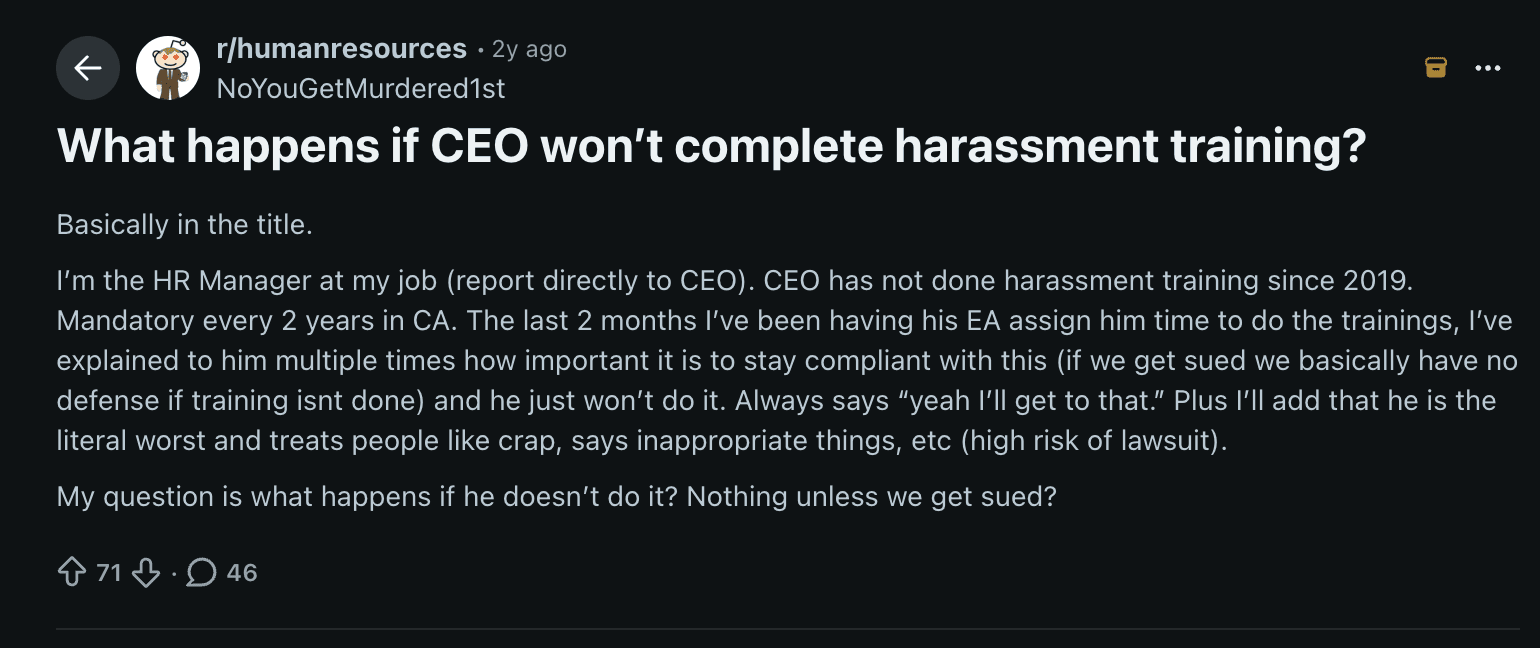
Training obligations apply to leadership, too. Employers should track completion, escalate missed training, document repeated reminders, and avoid treating executive noncompliance as optional.
2) Supervisors are asking whether they have a duty to report harassment and retaliation.
In one California AskHR thread, a supervisor asked whether they had a legal duty to report harassment and retaliation that had been shared with them, even though it involved someone else and occurred before they joined the company.

Supervisor training should clearly explain what must be escalated, who receives the report, and how quickly the supervisor must act. Managers should not be left to decide alone whether a complaint is "serious enough."
The larger lesson for employers: if supervisors, HR managers, or executives are unclear about training, reporting, accommodation, or investigation duties, that uncertainty can become evidence in an FEHA case. California supervisor training for FEHA prevention should answer these questions before a manager has to respond in real time.
FAQs
What is training to prevent FEHA lawsuits?
What does California supervisor training for FEHA prevention require?
Does supervisor training prevent FEHA liability?
How long should employers keep harassment-prevention training records?
What manager behaviors most often create FEHA risk?
Conclusion
Training to prevent FEHA lawsuits only works when it's built around what actually happens in litigation, not what merely satisfies the minimum regulatory standard. California supervisor training for FEHA prevention must cover complaint obligations, personal liability, accommodation duties, and specific manager behaviors that lead to claims.
It must be delivered by a qualified trainer, documented thoroughly, and structured to support the Faragher-Ellerth affirmative defense. A certificate alone is usually not enough to prove the employer took reasonable preventive steps. A defense is what you build before the complaint arrives.
DefendMyBiz represents California employers only. If you want to know whether your current training program would hold up in FEHA litigation, or you need to build one that will, book your complimentary 15-minute consultation or call (818) 418-6625.
Disclaimer: The above content is for informational purposes only. This is not legal or tax advice. Laws, IRS guidance, and withholding requirements can change, and outcomes depend on specific facts. You are advised to contact a qualified attorney for any legal advice.