Should You Settle or Fight This DLSE Claim? A Framework for California Employers
California DLSE / Labor Commissioner Defense

A DLSE wage claim notice arrives. You have deadlines, a scheduled settlement conference, and a decision to make. Most guidance online is written for the employee who filed the claim, not for the employer responding to it.
Knowing how to respond to a DLSE claim means more than filling out paperwork on time. It means understanding what the California DLSE wage claim process actually costs at each stage, what a Berman hearing victory requires, when the settlement conference is your best opportunity, and when fighting through to the hearing is the right call.
The answer is not the same for every claim. This framework helps you figure out which one applies to yours.
What You're Facing: The DLSE Process in Brief
The California Division of Labor Standards Enforcement (DLSE), the Labor Commissioner's Office, handles wage-and-hour disputes between employees and employers through an administrative process designed to be fast, informal, and accessible to workers. For employers, "fast and informal" means compressed timelines and limited procedural protections.
The California DLSE wage claim process follows this sequence:
Stage | What Happens | Employer Window to Act |
|---|---|---|
Claim filed | Employee files DLSE Form 1. You receive Notice of Claim. | Preserve all records immediately and contact the employer's defense counsel. |
Settlement conference | Informal conference with DLSE deputy; both sides present their position | Best opportunity to resolve the claim on controlled terms |
Berman hearing | Formal administrative hearing; evidence, witnesses, decision issued | Full preparation required; the ODA can become enforceable if not appealed |
ODA issued | Order, Decision, or Award, enforceable as a court judgment if not appealed | Generally, 15 days from the certification of service by mail, or 20 days if served out of state, to appeal |
Appeal (Superior Court) | De novo trial, Berman hearing result carries no weight | Bond = full award amount; attorney fee risk is significant |
The DLSE process is designed to be informal, fast, and accessible to workers. For employers, that means documentation often matters more than narrative. When records are missing, incomplete, or inconsistent, the employer has less ability to rebut the employee's version of events.
The DLSE process is not just procedural. Each stage creates different leverage, evidence issues, and settlement pressure. Read our guide on DLSE litigation strategy and Labor Commissioner proceedings.
The Appeal Trap: Why Berman Hearing Matters
Before deciding whether to settle or fight, employers need to understand what happens after an unfavorable Order, Decision, or Award.
If the employer appeals, the matter moves to the Superior Court for a de novo hearing, meaning the court hears the case again with evidence and witnesses. The prior DLSE result does not simply get reviewed like a traditional appeal.
That appeal carries several employer-specific risks:
The employer generally must post a bond or cash deposit in the amount of the ODA.
If the employee receives any amount above zero on appeal, the employer may be liable for the employee's attorneys' fees and costs.
The Labor Commissioner may represent a financially eligible employee in the appeal.
The employer must spend the time and money to litigate the case again.
That is why the Berman hearing matters so much. For many employers, the goal is not simply to "save the appeal." The goal is to build the strongest possible record before and during the DLSE process so the appeal decision is not forced by poor preparation.
The Settlement Conference: Your Best Opportunity
The settlement conference is often the most cost-effective point in the DLSE process. A Deputy Labor Commissioner facilitates an informal discussion between the parties. No formal decision has been issued at this stage, and the employer does not yet face the bond and appeal risks that follow an ODA.
Settlement may make sense when:
Timekeeping records have gaps, inconsistencies, or missing break documentation.
Payroll data confirms some unpaid wages are owed.
Final pay timing creates a waiting time penalty risk.
The settlement demand is materially below the expected cost of preparing for and attending the Berman hearing.
A related PAGA notice or class exposure changes the claim from individual risk to broader representative risk.
Holding firm may make sense when:
The records are complete and consistent, and they support the employer's position.
The employee's demand significantly overstates realistic exposure.
The claim is narrow, individual, and not connected to a broader policy issue.
A statute-of-limitations defense materially cuts down the claim period.
The employer has a documented good-faith dispute or another strong legal defense.
The conference is informal, but it should not be treated casually. The employer should arrive with organized records, a realistic exposure analysis, and a clear settlement authority range.
Watch: John Fagerholm walks through the full complexity of wage claim investigations in California, what investigators examine, and where employer defenses hold. 🎬 Navigating the Complexities of Wage Claim Investigations in California
If It Proceeds to a Berman Hearing: What Wins
If no resolution is reached at the conference, the matter may proceed to a Berman hearing. Timing varies by district office, claim complexity, and backlog.
At the hearing, both sides may present testimony, records, and other evidence. DIR states that the hearing officer's Order, Decision, or Award is filed within 15 days after the hearing and then served on the parties.
Evidence that holds up at a Berman hearing, by claim type:
Claim Type | Evidence That Wins | Evidence That Loses |
|---|---|---|
Unpaid overtime | Employee-verified timecards, payroll exports showing correct OT calculation | Manual edits to time records, missing punch data |
Missed meal/rest breaks | Timestamped break logs, signed meal period waivers, and a written policy distributed to staff | No break records; the employee’s testimony may fill the evidentiary gap |
Late final paycheck | Payroll showing the exact date and amount of final wages issued | Vague records; final pay issued on next payroll cycle |
Misclassification | Written contract, invoices showing independent business operations, and evidence of the contractor's control over their work | A contract that calls someone a contractor but controls their schedule and methods |
Waiting time penalties | Documented a good-faith dispute about the amount owed at the time of separation | No documented good-faith dispute; increased waiting time penalty risk |
The documentation reality: Records that are missing, inconsistent, or internally contradictory consistently work against employers at this stage. The hearing officer weighs what exists, not what the employer says happened. If your break policy is in the handbook but you have no records showing breaks were actually provided, the policy alone doesn't carry the day at a hearing.
The Settle-or-Fight Decision Framework
Work through these factors before the settlement conference. Each one shifts the analysis:
Documentation quality:
The single most important factor. Complete, timestamped, consistent records give you a defensible hearing position. Gaps give the employee narrative control.
Actual exposure vs. claimed exposure:
Calculate your real liability independently. Inflated demand letters routinely stack every possible penalty. Knowing the defensible number vs. the claimed number is the foundation of your negotiation position.
Waiting time penalty exposure:
If the employee can establish that final wages were late without a documented good-faith dispute, you face up to 30 days of daily wages on top of any underlying wage claim. This is often where the financial gap between settling and fighting is widest.
PAGA overlay:
If the employee has filed or threatened a PAGA notice involving the same alleged Labor Code violations, the settlement analysis changes. PAGA can create representative exposure beyond the individual DLSE claim, but post-2024 PAGA rules include important standing, cure, penalty-reduction, and early-evaluation considerations.
Claim scope:
A narrow, single-employee, bounded wage claim with strong documentation is worth fighting. A broad claim with class implications or PAGA exposure almost always warrants settlement analysis first.
Defense cost vs. resolution cost:
Berman hearing preparation, attorney time, document organization, witness preparation, and case delays all carry real costs. When the settlement demand is meaningfully below total defense cost, the financial case for settlement is straightforward regardless of merit.
Here's a quick snapshot of the factors:
Factor | Points Toward Settling | Points Toward Fighting |
|---|---|---|
Documentation | Gaps, missing records, inconsistencies | Complete, consistent, timestamped |
Claimed vs. actual exposure | Close, realistic demand | Overstated, demand doesn't match records |
Waiting time penalties | Automatic, no documented good-faith dispute | Good-faith dispute documented at separation |
PAGA involvement | Yes, potential representative penalty risk | No, individual claim only |
Claim scope | Broad, multi-violation, long period | Narrow, bounded, short period |
Defense cost vs. demand | Defense cost exceeds or approaches settlement demand | Defense cost proportionate to what's defensible |
If a PAGA notice is connected to the same wage issues, do not evaluate the DLSE claim in isolation. A PAGA notice can change the risk from an individual wage dispute to representative exposure. Read our guide on how to respond to a PAGA notice.
Mistakes That Make a DLSE Claim Worse
These errors consistently damage employer positions at every stage:
1.
Waiting to get legal counsel involved.
The settlement conference is often the employer's best opportunity. Employers who engage counsel after the conference has already gone badly have fewer options.
2.
Ignoring or missing the Notice of Claim deadline.
The matter may proceed without the employer's evidence, and an adverse ODA can become enforceable as a court judgment.
3.
Altering or "cleaning up" records after the claim is filed.
This is not just strategically damaging. It can constitute obstruction and create independent liability.
4.
Taking adverse action against the claimant after the claim is filed.
Reducing hours, reassigning, or terminating an employee after a claim creates a retaliation claim in addition to the wage claim.
5.
Providing inconsistent statements across different stages.
What you said at the settlement conference and what your records show must align. Contradictions are the most effective tool the opposing side has at the Berman hearing.
6.
Assuming the appeal is a clean reset.
A de novo appeal may sound like a fresh start. But the bond requirement, the attorney fee exposure if the employee receives even $1, and the cost of re-litigating the entire case mean that an appeal is rarely the answer for mid-size claims.
After the Claim: Prevention That Works
The most effective response to a DLSE claim is the one you implement before the next one is filed.
Conduct annual wage and hour audits.
California's rules change. What was compliant three years ago, such as minimum wage rates, overtime thresholds, and break requirements, may not be compliant today.
Fix your timekeeping.
If your system allows manager overrides, automatic rounding, or edits without employee sign-off, you have documented exposure. Investigators look specifically for these patterns.
Document every separation.
Clear final-pay procedures, accurate separation records, and prompt response to payroll concerns can reduce avoidable DLSE risk. Exit documentation is your first line of protection.
Train managers on break compliance.
Most DLSE claims trace back to a manager who interrupted a break, auto-approved rounded time, or assumed 30 minutes of unpaid meal time was being taken. Training with documented attendance records creates both a culture of compliance and evidentiary protection.
Get meal period waivers in writing where legally permitted.
For shifts of five to six hours, a properly drafted and voluntary meal-period waiver can help reduce break-violation exposure when it aligns with actual practice.
DefendMyBiz represents California employers only, never employees. Our DLSE Defense team handles the full California DLSE wage claim process from the initial notice through the settlement conference, Berman hearing, and appeal assessment. Every strategy we recommend runs in one direction: protecting your business.
If a DLSE notice has arrived and you need to assess whether to settle or fight, book your complimentary 15-minute consultation or call (818) 418-6625.
What Employers Are Asking Online About DLSE Claim Risk
DLSE claim risk often begins before the formal notice arrives. Employers, HR teams, payroll managers, and small business owners are already asking online about the same issues that later become wage claims: final pay, waiting-time penalties, break records, payroll mistakes, timekeeping, and employee records requests.
Reddit discussions show that many employers understand there may be risk, but they are unsure whether to pay, fight, document, or call counsel.
1) Employers are asking whether they should pay waiting time penalties before a wage claim is filed.
In another HR thread, a small company asked whether it should pay the requested waiting-time penalty directly or require the employee to file through DIR. The issue was less than $1,000, but the risk was real because the delay had already happened.
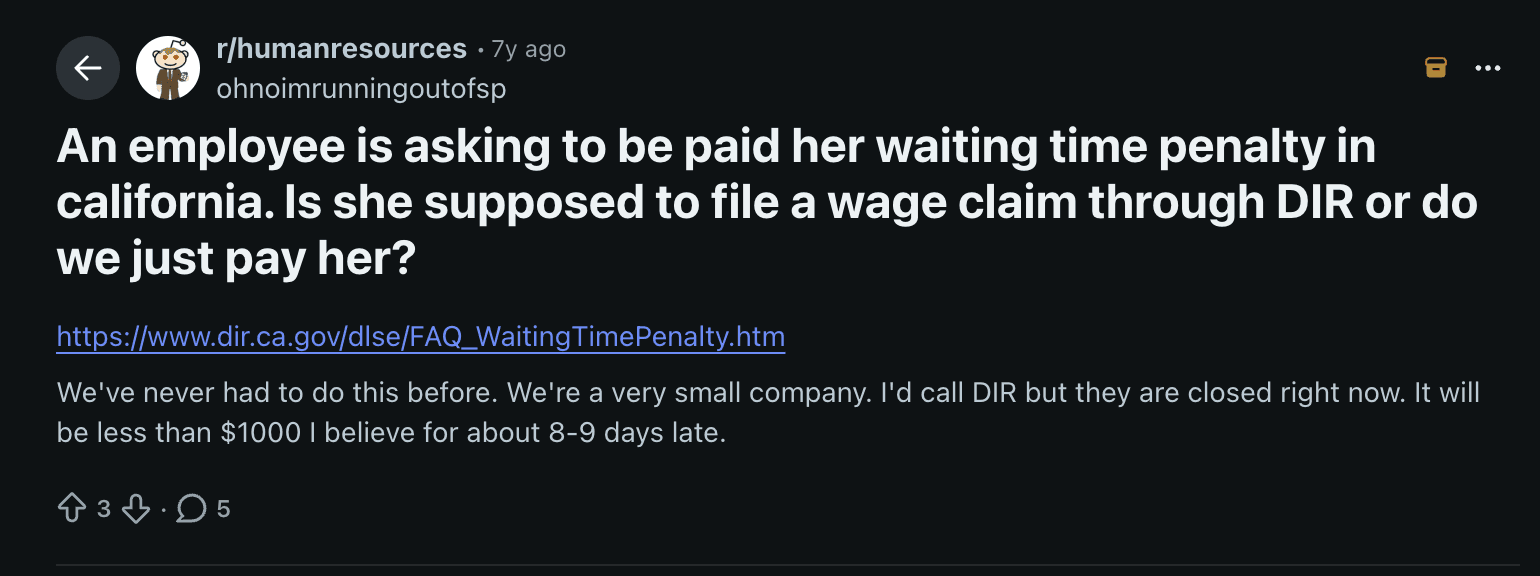
When final wages are late, employers should not improvise. They should calculate potential waiting time exposure, review whether a good-faith dispute exists, and consider early correction before the matter becomes a DLSE claim.
2) California HR teams are worried that relaxed meal-break enforcement can create PAGA or wage-claim exposure.
In one HR thread, a California HR manager described a PAGA-related claim involving employees who took late lunches or returned early from breaks. The post shows how informal break practices can later become evidence in wage, DLSE, or representative claims.
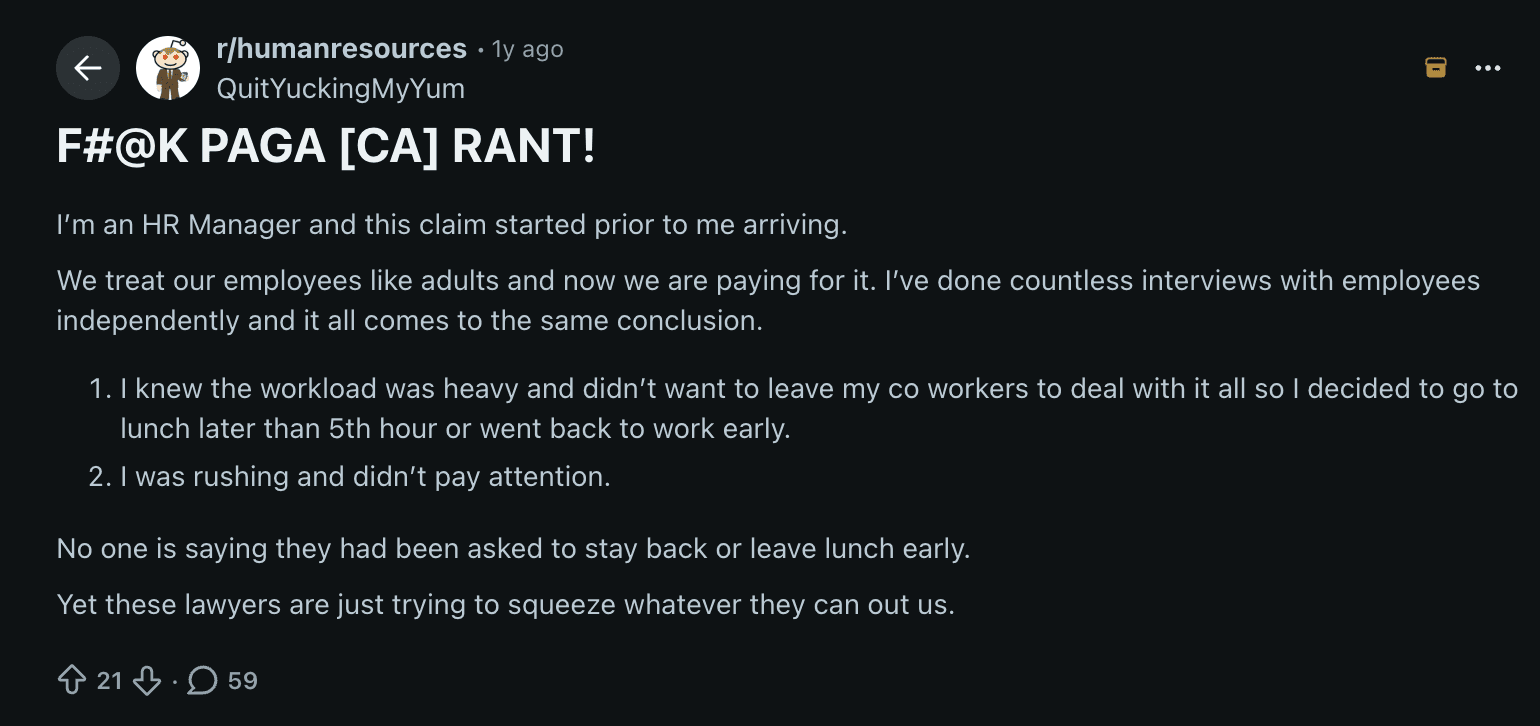
Employers should not rely on an informal break culture. Meal and rest break policies, scheduling, premium-pay rules, manager training, and timekeeping records should all be reviewed before a pattern becomes a DLSE or PAGA issue.
The larger lesson for employers: if a final-pay, waiting-time, break-record, payroll, or personnel-file issue is unclear enough to ask Reddit, it is serious enough to document and review before a DLSE notice arrives. DLSE claims are often decided by records, timing, and whether the employer can prove what happened.
FAQs
How should an employer respond to a DLSE wage claim?
What happens after an employer responds to a California wage claim?
What is a Berman hearing in California?
Can an employer settle a DLSE claim before the Berman hearing?
Should an employer appeal a Berman hearing decision?
Conclusion
Knowing how to respond to a DLSE claim means understanding where you actually have leverage and where you don't. The settlement conference is the highest-leverage, lowest-cost moment in the California DLSE wage claim process. The Berman hearing requires complete, consistent documentation to win. The appeal carries bond requirements and attorney fee exposure that make it a last resort for most claims.
Working through the settle-or-fight decision with a clear framework and employer-side counsel who knows the process is what separates businesses that resolve these cases efficiently from those that absorb the full cost of the process.
DefendMyBiz represents California employers only. If a DLSE notice has arrived, book your complimentary 15-minute consultation or call (818) 418-6625.
Disclaimer: The above content is for informational purposes only. This is not legal or tax advice. Laws, IRS guidance, and withholding requirements can change, and outcomes depend on specific facts. You are advised to contact a qualified attorney for any legal advice.