What Is the U.S. Department of Labor, and When Does It Investigate California Employers?
U.S. DOL (Federal) Defense

A federal investigator calls your office. Or a notice arrives stating that the U.S. Department of Labor's Wage and Hour Division has opened an investigation into your business. You have days to respond, and you're not sure what you're actually facing.
A Department of Labor investigation is a federal enforcement action that can require you to produce years of payroll records, submit to employee interviews, and potentially pay back wages, civil penalties, and, if the matter goes to litigation, liquidated damages on top of that. In FY2025, the DOL's Wage and Hour Division recovered $259 million in back wages for nearly 177,000 workers. This was the highest total in five years.
California employers face this alongside the DLSE and state labor enforcement. Understanding how a DOL investigation works, what triggers one, and what the Department of Labor's investigation procedure looks like, step by step, is what separates employers who respond effectively from those who don't.
What the DOL Actually Investigates and Which Division May Contact You
The U.S. Department of Labor oversees federal labor laws through several enforcement divisions. California employers most commonly encounter two:
Division | What It Enforces | Common Targets |
|---|---|---|
Wage and Hour Division (WHD) | FLSA: overtime, minimum wage, recordkeeping, FMLA, child labor | Businesses engaged in interstate commerce or with employees individually covered by the Act. |
OSHA | Workplace safety and health standards | Manufacturing, construction, healthcare, and agriculture |
For most California employers, the WHD is the primary federal enforcement risk.
The WHD enforces the Fair Labor Standards Act (FLSA), which runs parallel to but does not replace California's state labor laws. Both can pursue the same employer for the same pay period. A DLSE wage claim and a WHD investigation can run simultaneously.
The WHD's top enforcement targets in California include construction, hospitality, healthcare, agriculture, and residential care facilities. These are industries with historically high rates of overtime violations, misclassification, and off-the-clock work.
A DOL investigation can run alongside a DLSE wage claim, but the procedures, deadlines, and defense strategies differ. For a deeper look at the state-side process, read our guide to DLSE litigation strategy and Labor Commissioner proceedings.
What Triggers a DOL Investigation
DOL investigations usually follow identifiable triggers. They follow identifiable patterns:
Employee complaint:
This is the most common trigger. A complaint can cause WHD to open an investigation, and the employer may first learn about the issue from a federal investigator.
Industry sweep:
The WHD conducts targeted audits in high-violation industries. If you're in construction, hospitality, or healthcare in California, your industry is on the list regardless of whether anyone complained.
Follow-up investigation:
Prior violations increase the risk of follow-up investigations and can make later violations more likely to be treated as willful or repeated.
Referral from another agency:
Other agencies, including OSHA, the EEOC, or California labor agencies, may refer wage-related concerns to WHD or trigger overlapping enforcement attention.
Retaliation complaint:
If an employee reports that you acted against them for raising wage concerns, the WHD investigates both the retaliation and the underlying pay practices.
How the Department of Labor Investigation Procedure Works: Step by Step
Understanding the Department of Labor investigation procedure helps employers control risk, manage deadlines, and avoid avoidable mistakes.
Step 1: Notice or unannounced visit
Investigators may notify you in advance or arrive at a worksite without warning. Employers should remain professional, identify the investigator, ask about the scope of the investigation, and contact employer-defense counsel before producing records or allowing access beyond what is legally required.
Step 2: Opening conference
The investigator explains the scope of the investigation and requests records. Scope matters. A complaint about one employee's overtime can expand into a full-workforce audit if your records are inconsistent or incomplete.
Step 3: Records review
The WHD may request payroll records, timekeeping data, employee rosters, job classifications, work schedules, compensation policies, and related wage-and-hour records. Gaps, manual edits, or inconsistencies signal broader problems and invite expanded scrutiny.
Step 4: Employee interviews
Investigators speak with your employees privately. You have limited control over what is said. This is why your practices need to be defensible before day one of an investigation, not after.
Step 5: Closing conference
The investigator presents findings. If violations are identified, the discussion moves to back wages owed, civil penalties, and a compliance agreement. This is the negotiation stage, and having employer-side counsel involved can help the employer challenge assumptions, evaluate calculations, and negotiate the scope of any resolution.
Step 6: Resolution or litigation
Most investigations are resolved administratively. If the matter does not resolve administratively, the Department of Labor may pursue enforcement litigation, in which back wages, civil penalties, and liquidated damages may be included.
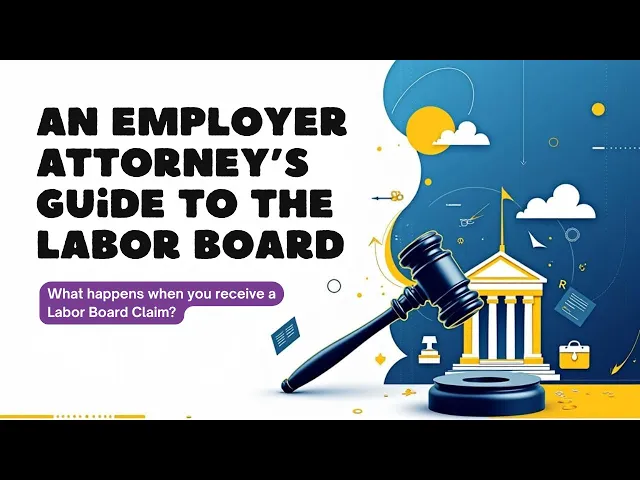
Watch: John Fagerholm explains exactly what happens when a Labor Board claim arrives, the notice, the conference, and what employers need to do immediately. 🎬 An Employer Lawyer's Guide to the Labor Board: What Happens When You Get a Claim
How Long Does a Department of Labor Investigation Take?
DOL investigations can range from a few months to more than a year, depending on the number of employees, the scope of the work site, record quality, industry focus, and whether the matter is resolved administratively. A single-employee complaint with clean records may move faster; a multi-worksite investigation or industry sweep usually takes longer.
What extends timelines most: missing records, inconsistent documentation, uncooperative responses, and scope expansion after initial review. Employers with organized payroll data, accurate timekeeping, and counsel engaged early are usually better positioned to respond efficiently.
The Real Financial Exposure of a DOL Violation
The wages allegedly owed are often only the starting point.
In administrative investigations (as of June 27, 2025):
Back wages for the investigation period
Civil money penalties for willful or repeated violations
Compliance agreement with ongoing reporting obligations
If the matter proceeds to litigation:
Back wages + liquidated damages equal to 100% of the unpaid wages
Attorney fees paid to the prevailing employee
Civil money penalties may apply for willful or repeated minimum wage and overtime violations, and separate, higher penalties may apply for child labor violations.
Prior violations can increase penalty and settlement risk.
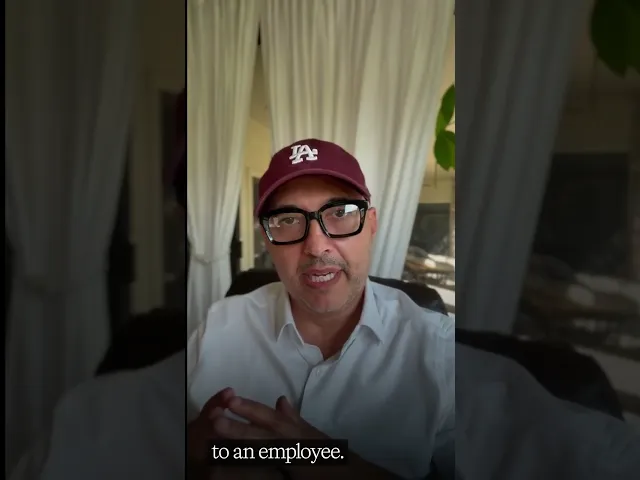
Watch: John Fagerholm explains how waiting time penalties work and how quickly they compound for California employers facing wage claims. 🎬 Labor Board Claims & Waiting Time Penalties Explained
Proactive Steps That Reduce Your DOL Investigation Risk
The strongest position in a DOL investigation is built before the investigator calls.
Run an annual wage and hour audit.
Pull a cross-section of employee records, including hours worked, overtime calculations, classifications, and deductions. Verify them against FLSA and California Labor Code requirements. Do not assume payroll software will catch wage-and-hour violations automatically.
Audit independent contractor classifications.
Misclassification remains a top enforcement priority. If contractors perform core business functions under your direction, the risk is real regardless of contract language.
Fix your timekeeping.
Systems that allow manual edits, automatic rounding, or manager overrides without employee sign-off create documented exposure. Investigators look specifically for these patterns.
Train supervisors.
Most FLSA violations trace back to a manager who didn't understand that off-the-clock work, auto-deducted meal breaks, or rounded time must be compensated.
Keep required posters current.
Federal and state law require specific notices to be posted. Missing or outdated posters are a visible, immediate violation that investigators note on arrival.
For misclassification risk specifically, one of the DOL's primary California enforcement priorities, read Employee Misclassification in California: Independent Contractor vs. Employee
What to Do the Moment a DOL Notice Arrives
The first few days can shape the trajectory of the investigation.
Contact employer-defense counsel before responding substantively. Scope management starts with your first communication.
Do not volunteer beyond what is requested. An investigator focused on one department should not receive company-wide records unless legally compelled.
Designate one point of contact. All investigator communications go through one person, ideally your legal counsel. Inconsistent statements from multiple staff members expand the scope and create credibility problems.
Issue a litigation hold immediately. Preserve all payroll records, timekeeping data, personnel files, and communications. Altering or deleting records after an investigation begins can turn a compliance issue into a separate record-preservation or obstruction concern.
Respond to all deadlines. Missed deadlines signal disorganization or bad faith, both of which invite broader scrutiny.
Received a U.S. Department of Labor notice or records request? DefendMyBiz represents employers only, helping California businesses respond strategically, manage the scope of investigations, and defend against federal wage-and-hour enforcement.
Learn how our U.S. DOL Defense team can help.
What Employers Are Asking Online About DOL and Wage-Hour Risk
DOL investigation risk often starts with practical employer questions such as "What happens during a payroll audit?" "Do we owe overtime for early clock-ins?" "Can we auto-deduct meal breaks?" "How should we track time for exempt or nonexempt employees?" These questions may seem operational, but they are exactly the kinds of issues WHD investigators review.
Reddit discussions from small business owners, HR teams, and payroll professionals show that many employers recognize the risk only after a payroll practice is already in place.
1) Employers are asking whether early clock-ins create overtime exposure.
In a small business Reddit thread, an employer asked whether overtime was owed when an employee arrived early, sat at the computer, and was not scheduled to begin work yet. That is a practical FLSA and California wage-hour issue because employers may still need to pay for work they knew or should have known was being performed.
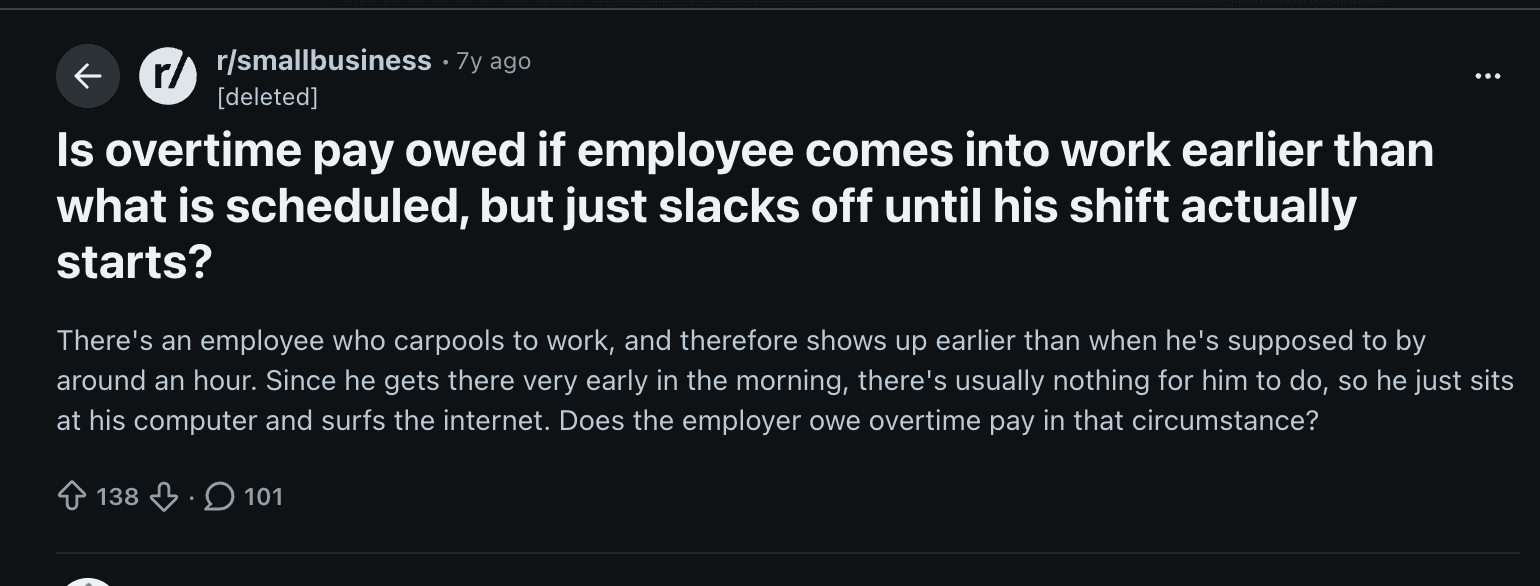
Employers need a written policy for early clock-ins, unauthorized work, manager approval, and accurate timekeeping. If an employee performs work before or after a scheduled shift, the business may still owe wages even if the work was not approved.
2) Employers are asking how to manage employees who stay clocked in after being relieved from duty.
In a small-business Reddit thread, an employer asked what to do when an employee refused to clock out and was concerned about overtime. This is a common employer pain point, but withholding wages for recorded time without a defensible process is not the answer.
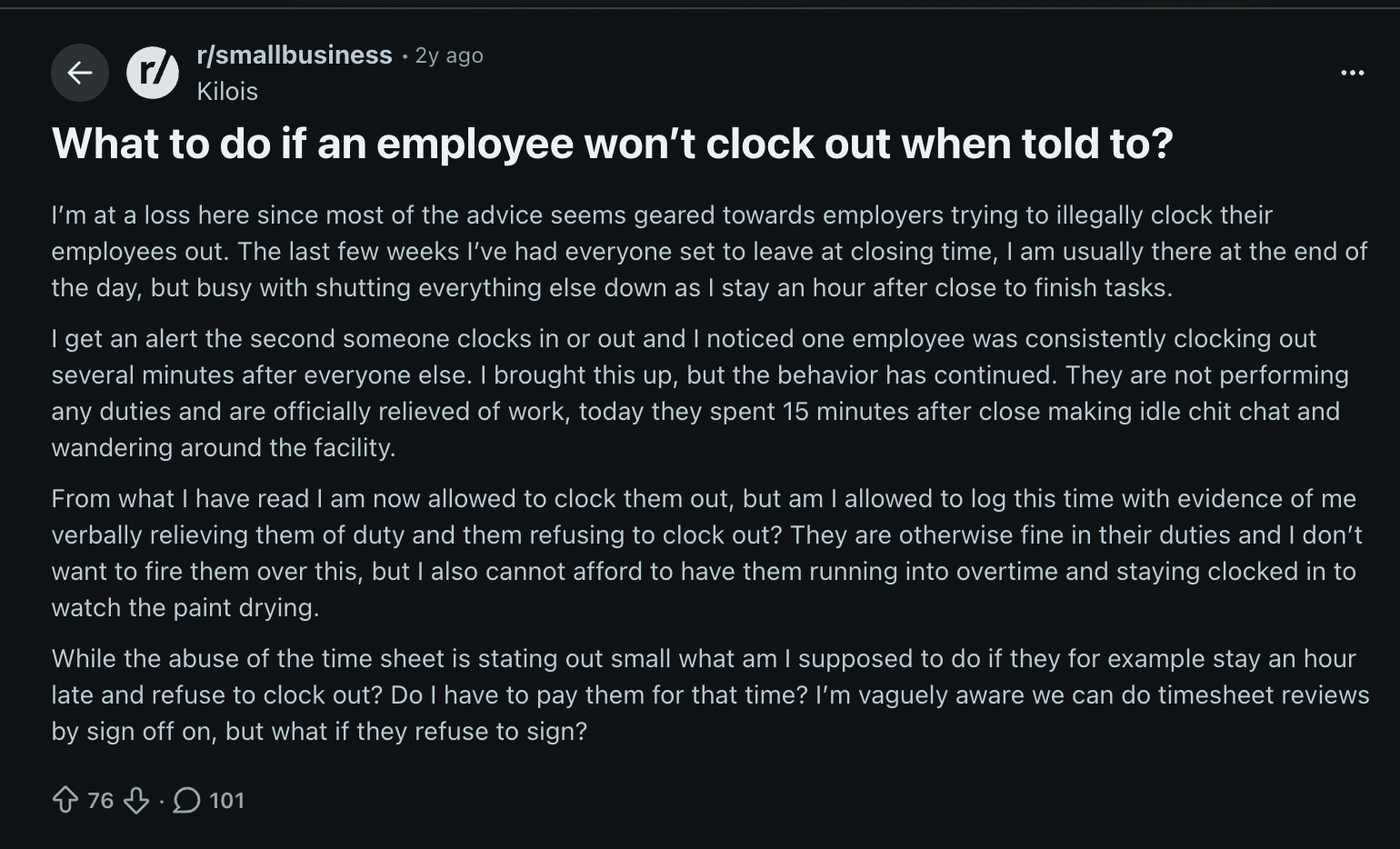
Employers can discipline employees for violating overtime or clock-out policies, but they must still pay for time worked. Timekeeping disputes should be documented through manager notes, schedules, camera records where lawful, written warnings, and payroll corrections.
The larger lesson for employers: if a wage, overtime, meal-break, timekeeping, or classification question is unclear enough to ask Reddit, it is important enough to document and review before a DOL investigator calls. WHD investigations often turn on records, manager practices, payroll settings, and whether the employer can prove the system worked as written.
FAQs
What triggers a U.S. Department of Labor investigation?
How long does a Department of Labor investigation take?
What is the difference between a DOL investigation and a California DLSE wage claim?
Can the DOL still seek liquidated damages in a wage-hour investigation?
Should an employer respond to a DOL records request without counsel?
Final Thoughts
A Department of Labor investigation is a federal enforcement action with real financial exposure, such as back wages, civil penalties, and potentially litigation-stage liquidated damages, all running on a timeline the employer doesn't control. The June 2025 policy change on liquidated damages creates a genuine opportunity to resolve administrative investigations on better terms, but only for employers who respond strategically and quickly.
Understanding the Department of Labor investigation procedure before you need it, and knowing how long a DOL investigation takes and what drives that timeline, is what separates businesses that absorb these cases cleanly from those that don't.
DefendMyBiz represents California employers only. If a DOL notice has arrived or you want to know where your business stands, book your complimentary 15-minute consultation or call (818) 418-6625.
Disclaimer: The above content is for informational purposes only. This is not legal or tax advice. Laws, IRS guidance, and withholding requirements can change, and outcomes depend on specific facts. You are advised to contact a qualified attorney for any legal advice.