What are Non-FEHA & Hybrid Claims and Why They Matter in California
Hybrid / Non-FEHA Claims

FEHA is often the first law employers think about when they hear "employment claim" in California. But not every employment lawsuit is an FEHA case.
California employers can also face non-FEHA claims involving wrongful termination in violation of public policy, whistleblower retaliation, workers' compensation retaliation, wage-and-hour retaliation, defamation, and certain leave-related claims. These claims may involve different statutes, filing procedures, agencies, and defense strategies.
Hybrid claims combine FEHA and non-FEHA theories in the same lawsuit. For employers, that means one termination, leave decision, complaint response, or performance action can create multiple legal tracks at once.
Here's what every California employer needs to understand about both.
FEHA vs. Non-FEHA: Where the Line Is
FEHA governs workplace discrimination, harassment, and retaliation based on protected characteristics such as race, sex, disability, age, religion, and other protected traits. It is enforced by the California Civil Rights Department (CRD). Some non-FEHA claims fall outside the CRD process entirely, while others overlap with CRD-enforced rights.
That distinction matters because the filing deadline, agency process, available remedies, and defense strategy can change depending on the claim.
Claim Type | Common Legal Basis | Usual Forum / Process |
|---|---|---|
FEHA discrimination, harassment, retaliation | FEHA / Gov. Code §12900 et seq. | CRD process, right-to-sue, civil court |
Wrongful termination in violation of public policy | Common law / Tameny claim | Civil court |
Whistleblower retaliation | Labor Code §1102.5 | Civil court; may involve LWDA-related procedures |
Workers' compensation retaliation | Labor Code §132a | WCAB, with possible overlapping civil claims |
Wage-and-hour retaliation or PAGA | Labor Code and PAGA statutes | DLSE, LWDA notice, civil court, depending on the claim |
Leave interference/retaliation | CFRA, PDL, FMLA, FEHA overlap | CRD, federal process, or civil court, depending on the claim |
Defamation tied to termination | Civil Code §§44–46 | Civil court |
Each of these runs on its own procedural track. When one incident triggers claims under multiple statutes, that's a hybrid claim, and employer exposure compounds quickly.
For specific obligations related to pregnancy and protected leave, here's a quick guide titled "Your Employee Just Announced a Pregnancy. Here's What California Law Requires"
The Most Common Non-FEHA Claims California Employers Face
1. Wrongful Termination in Violation of Public Policy (Tameny Claims)
A Tameny claim arises when an employee is fired in a way that violates a fundamental California or federal public policy, even if the termination doesn't involve a protected FEHA characteristic.
Common triggers:
Firing an employee for refusing to commit a crime
Terminating an employee who filed a workers' comp claim
Dismissing an employee who reported a safety violation
Terminating an employee who served on jury duty
The exposure: Tameny claims may allow compensatory damages and, in appropriate cases, punitive damages. Unlike some federal employment claims, there is no simple statutory damages cap. However, punitive damages still require proof of legally sufficient misconduct and are subject to judicial and constitutional limits.
2. Whistleblower Retaliation: Labor Code §1102.5
Labor Code §1102.5 protects employees who disclose information about suspected legal violations to a government agency, law enforcement, a supervisor, or another employee with authority to investigate or correct the issue. The employee does not need to prove the violation actually occurred; a reasonable belief can be enough to trigger protection.
Why employers are seeing more of these claims:
§1102.5 claims are increasingly filed as primary claims, not just add-ons to FEHA suits. §1102.5 has a different, employer-unfavorable burden-shifting framework. Once the employee shows that protected whistleblowing activity was a contributing factor in the adverse action, the employer must prove by clear and convincing evidence that it would have made the same decision for legitimate, independent reasons. This makes contemporaneous documentation critical.
2025 employer-favorable development: In Lampkin, the court held that employers who successfully prove the same-decision affirmative defense can avoid paying the employee's attorney fees under §1102.5, a meaningful distinction from FEHA, where that defense doesn't block fees.
The exposure: Civil penalty up to $10,000 per violation, reinstatement, lost wages, and attorney fees if the employer loses.
For how retaliation claims layer on top of other actions, read Retaliation Claims in California: How Employers Defend Business Decisions
3. Workers' Compensation Retaliation: Labor Code §132a
Terminating or taking adverse action against an employee for filing a workers' comp claim is a §132a violation. It runs through the Workers' Compensation Appeals Board, a completely separate track from the CRD or civil court.
The exposure: A Labor Code §132a violation can result in a 50% increase in workers' compensation benefits, up to $10,000, along with reinstatement and reimbursement for lost wages and work benefits.
Hybrid Claims: When One Incident Triggers Multiple Legal Tracks
A hybrid claim arises when a single workplace event gives rise to both FEHA and non-FEHA causes of action in the same lawsuit. This is where employer exposure becomes most complex and most expensive.
Common hybrid scenarios include:
Pregnancy + termination: An employer fires a pregnant employee during her PDL or shortly after returning. This triggers both an FEHA pregnancy discrimination claim and a Tameny wrongful termination claim. Two legal theories, different damages models, one lawsuit.
Workplace complaint and termination: An employee reports a wage violation internally and is fired two weeks later. This triggers §1102.5 whistleblower retaliation and, if the employee also has a protected characteristic, a potential FEHA retaliation claim.
Protected leave interference + adverse action: An employer denies a leave request or terminates an employee mid-leave. This can generate a CFRA/PDL interference claim and an FEHA discrimination claim, especially if the leave is pregnancy-related.
In a hybrid case, the employer must defend each cause of action under its own standard.
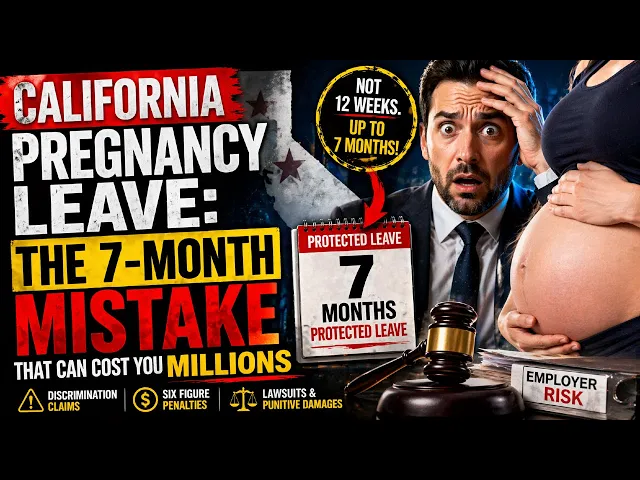
Watch: John Fagerholm explains the 7-month protected leave rule that catches California employers off guard. Know how PDL and CFRA stack, and why mishandling them leads to claims on multiple fronts. 🎬 California Pregnancy Leave: The 7-Month Rule That Can Cost You Millions
Why Non-FEHA Claims Are Often Harder to Defend Than FEHA Claims
Most employers focus their compliance efforts on FEHA, like anti-harassment training, accommodation processes, and CRD procedures. Non-FEHA claims often catch businesses unprepared because:
Issue | FEHA Claims | Non-FEHA Claims |
|---|---|---|
Administrative exhaustion required | Yes, must file with CRD first | No, §1102.5 can go directly to court |
Burden of proof on the employer | Intermediate: articulate a legitimate reason | Higher: clear and convincing evidence for the same-decision defense under §1102.5. |
Damages cap | None (uncapped under FEHA) | None (uncapped, punitive damages available in Tameny) |
Agency involved | CRD | DLSE, WCAB, LWDA, or direct to court |
Attorney fees | Yes, if the plaintiff prevails | Yes, under §1102.5, but Lampkin (2025) creates an employer defense |
Statute of limitations | 3 years (to file with CRD) | 3 years (§1102.5); 1 year (§132a WCAB filing) |
The lack of CRD exhaustion for §1102.5 claims is particularly significant. Under FEHA, an employee must file with the CRD and obtain a right-to-sue notice before filing a lawsuit, giving the employer a window to respond administratively.
Unlike FEHA claims, Labor Code §1102.5 claims do not require administrative exhaustion with the CRD before filing in court. Employers, therefore, may first see the claim in a civil complaint rather than through a CRD intake or right-to-sue process.
Red Flags That a Non-FEHA or Hybrid Claim Is Coming
Most non-FEHA claims are foreseeable. These patterns signal risk:
Termination within weeks of a protected activity: filing a workers' comp claim, reporting a safety concern, requesting leave, or complaining about pay. Close timing is often one of the plaintiff's strongest facts.
No documented performance history before termination: without a paper trail, a "performance-based" termination looks retaliatory.
Leave requests that were denied or interrupted: CFRA and PDL interference claims are among the most common hybrid triggers.
Manager comments made during or after a protected complaint: comments about an employee's pregnancy, their workers' comp claim, or their safety report become exhibits.
Policy decisions that selectively affect employees who complained: schedule changes, reassignments, or reduced hours after protected activity are potential adverse actions.
For wrongful termination defense strategy, see Wrongful Termination in California: What Employers Need to Know
What to Do When a Non-FEHA or Hybrid Claim Is Filed
1.
Identify all causes of action immediately.
A complaint that appears to be a simple wrongful termination case may simultaneously include §1102.5, Tameny, and CFRA claims. Each requires a separate defense analysis.
2.
Preserve everything.
Performance records, leave documentation, timekeeping records, manager communications, and the entire file. Hybrid claims pull evidence from every part of the employment relationship.
3.
Assess the same-decision defense early.
Under §1102.5, the employer's strongest defense is proving that it would have made the same decision regardless of the protected activity. This analysis needs to happen immediately, before any response is drafted.
4.
Evaluate arbitration agreement applicability.
Some non-FEHA claims can be compelled to individual arbitration. Whether an existing agreement covers the specific claim and whether it was properly executed requires immediate legal review.
5.
Engage employer-side counsel with hybrid claim experience.
Counsel experienced in FEHA defense may still need specific experience with whistleblower, WCAB, leave, and public-policy claims. Non-FEHA and hybrid claims require counsel who understands all the tracks simultaneously.
DefendMyBiz handles the full spectrum of non-FEHA and hybrid claims California employers face. We represent employers only, never employees. Our Hybrid & Non-FEHA Claims defense team manages all causes of action under one roof, so your defense is coordinated rather than fragmented.
If a claim has arrived or you're seeing the early warning signs, book your complimentary 15-minute consultation or call (818) 418-6625.
What Employers Are Asking Online About Non-FEHA and Hybrid Claim Risk
Non-FEHA and hybrid claim risk often starts with practical employer questions: "Can we terminate someone after a workers' comp injury?" "What if an employee keeps filing internal complaints?” "Can a policy-based termination look retaliatory?" "Should HR document a termination differently if the employee recently complained?"
Reddit discussions from HR professionals and small business owners show that these issues often appear before a formal complaint is filed.
1) Employers are asking whether they can terminate an injured employee without creating workers' compensation retaliation risk.
In one California AskHR thread, an employer asked whether they could legally terminate an injured employee. The discussion focused on whether the reason for termination was independent of the workers' compensation issue. That is directly relevant to Labor Code §132a and hybrid retaliation risk.
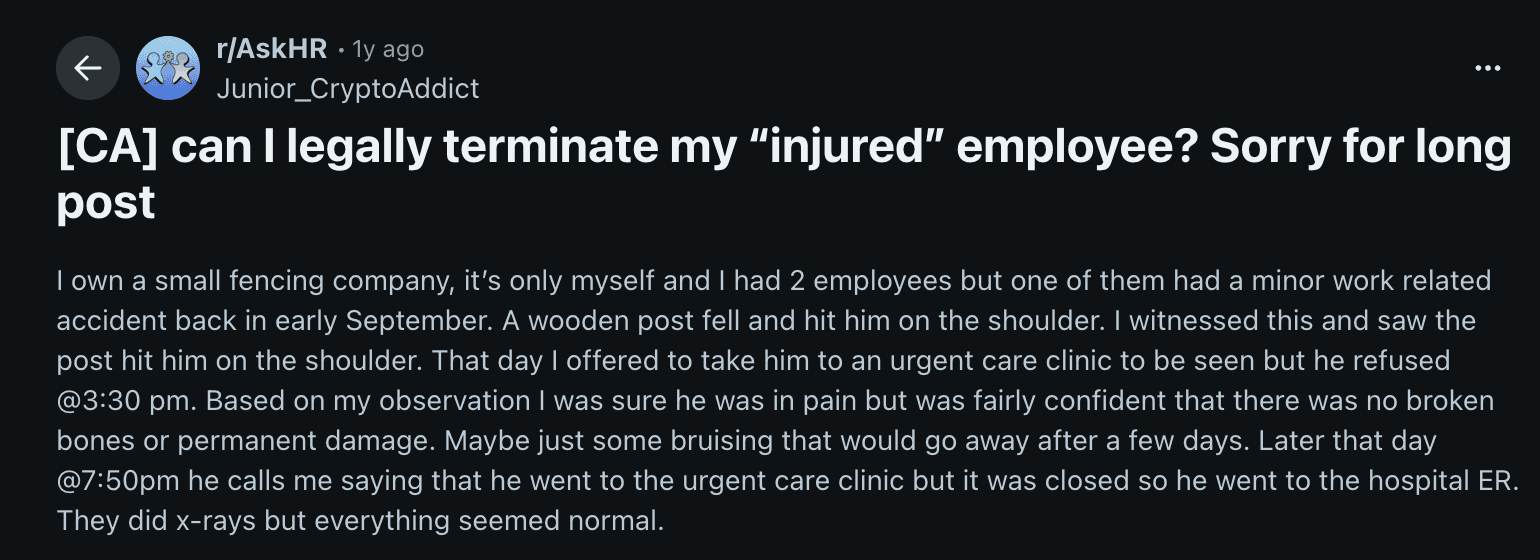
Employers should not make termination decisions in isolation when a workers' compensation claim, injury, medical restriction, or leave issue is active. The file should clearly show a legitimate, documented reason unrelated to the protected activity.
2) Employers are asking how to manage employees who repeatedly file internal complaints.
In an HR thread, a manager described an employee who filed frequent official complaints, some of which were valid. This is a common non-FEHA and hybrid-risk scenario because complaints about safety, wages, legal violations, harassment, or discrimination may trigger different retaliation protections.
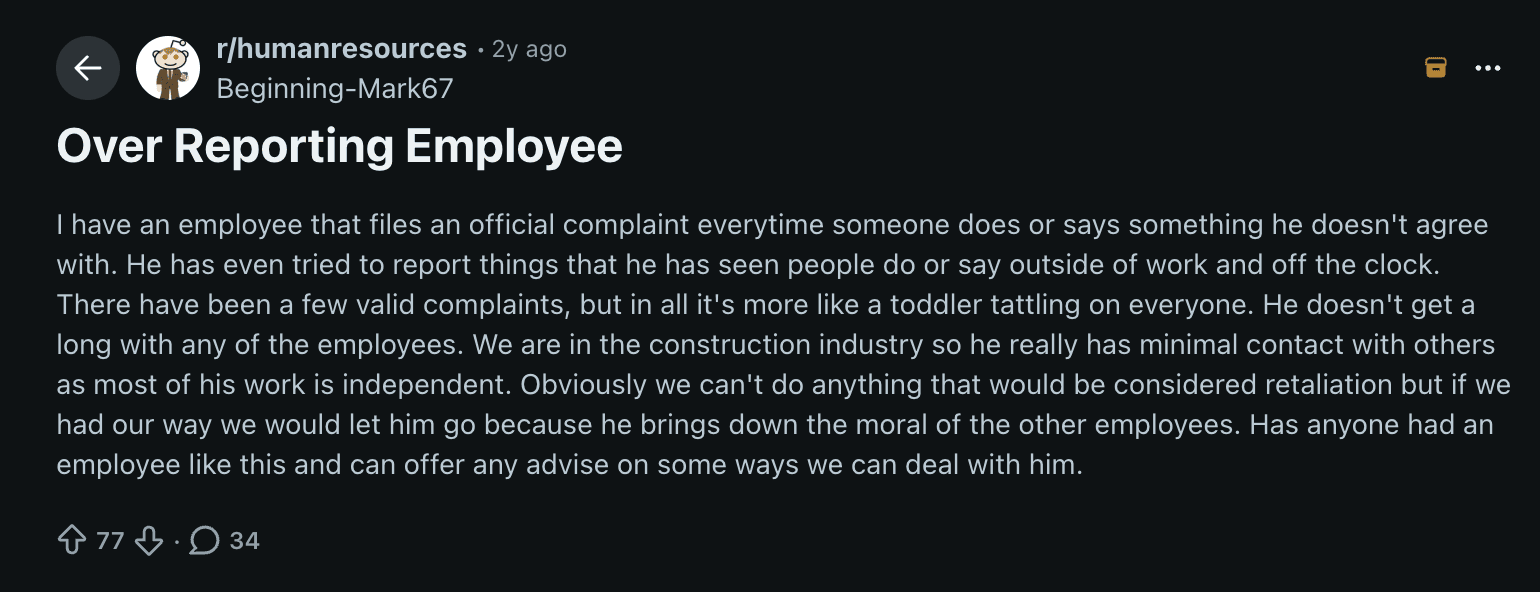
Employers should not treat frequent complaints as an annoyance. Each complaint should be categorized, investigated where appropriate, documented, and kept separate from any subsequent performance or disciplinary decision.
The larger lesson for employers: if a termination, complaint, injury, leave request, or post-termination communication is complex enough to ask Reddit, it is complex enough to document and review before action is taken. Non-FEHA and hybrid claims often turn on timing, records, manager comments, and whether the employer can prove the same decision would have been made for legitimate reasons.
FAQs
How long does an employee have to file a FEHA claim in California?
What is the difference between FEHA and the EEOC?
What types of workplace issues does the California Labor Commissioner handle?
Can an employer be sued for wrongful termination outside of FEHA?
Why are hybrid claims harder to defend?
Final Thoughts
Non-FEHA claims in California, such as wrongful termination, whistleblower retaliation, workers' comp retaliation, and protected leave interference, operate under entirely different rules from FEHA, often with higher employer burdens of proof, no damages caps, and faster pathways to litigation. Hybrid claims combine both in a single lawsuit, requiring coordinated defense across multiple legal tracks simultaneously.
Understanding the landscape before a claim arrives is what separates employers who resolve these cases efficiently from those who absorb years of escalating exposure.
DefendMyBiz represents California employers only. If a non-FEHA or hybrid claim has arrived or you want to assess your exposure before one does, book your complimentary 15-minute consultation or call (818) 418-6625.
Disclaimer: The above content is for informational purposes only. This is not legal or tax advice. Laws, IRS guidance, and withholding requirements can change, and outcomes depend on specific facts. You are advised to contact a qualified attorney for any legal advice.