
Cost-Benefit Decisions in California Employment Litigation: When Fighting Beats Settling (and Vice Versa)
General Defense Resources

Here's what most employers don't realize until they're in the middle of a claim: the goal of many plaintiff attorneys in California employment litigation isn't necessarily to win at trial. It's to make defending the case expensive enough that settling feels like the only rational option, regardless of whether the claim has merit.
That pressure is real. But so is the cost of settling every claim that lands on your desk. Businesses that settle reflexively may signal that filing a claim produces a quick payout. Businesses that fight every claim may spend more than necessary on disputes that could have been resolved efficiently.
The question every California employer eventually faces is: why would an employer offer a settlement agreement, and when is fighting the better call?
This guide provides a framework for answering that question from the employer's perspective.
The Real Cost of California Employment Litigation
Before any strategy discussion, employers need to know what they're actually dealing with financially. These are some common employer-side defense cost ranges, depending on claim complexity.
Defense costs alone:
Stage | Employer Defense Cost |
|---|---|
Through discovery + summary judgment ruling | $75,000–$125,000 |
Through a jury trial (if summary judgment is lost) | $175,000–$250,000 total |
If the employer loses at trial | Above costs + the employee’s attorneys' fees |
On top of defense costs:
Some California employment verdicts have reached seven-figure or higher amounts, especially in cases involving retaliation, discrimination, harassment, or punitive damages theories.
FEHA claims do not have the same Title VII-style statutory damages cap, and compensatory, punitive, and attorney fees may be available depending on the claim.
PAGA penalties stack per pay period, per employee
If the employer loses, it pays the plaintiff's attorney fees in addition to any judgment
These explain why settlement conversations happen. Defense costs alone can exceed the settlement value of the claim before any judgment is considered.
Watch: John Fagerholm explains how plaintiff attorneys use litigation costs as deliberate pressure and what employers need to understand about when the real goal isn't a verdict. 🎬 California Employers: Sometimes the Goal Isn't Winning — It's Pressuring You to Settle
Why Employers Offer Settlement Agreements: The Real Reasons
A settlement agreement is a contract that resolves a dispute. The employee releases specified claims. The employer pays an agreed amount or provides other consideration. In return, the business gets cost certainty, finality, and defined terms around what happens next.
For California employers, the agreement must be drafted carefully. The release should clearly identify the claims being resolved, provide valid consideration, avoid prohibited confidentiality or non-disparagement language, and comply with applicable review-period and attorney-consultation notice rules.
Employers usually offer settlement agreements for four strategic reasons:
Converting unknown exposure into a fixed number:
A defined settlement can be better than months of defense costs, discovery, motion practice, and uncertain trial risk.
Avoiding fee-shifting risk:
Some California employment statutes allow a prevailing employee to recover attorneys' fees. That means the employer's downside may include the judgment, its own defense costs, and the employee's fee claim.
Preserving permissible confidentiality and business control:
California restricts confidentiality around unlawful workplace acts, including harassment, discrimination, and retaliation, but properly drafted agreements may still address confidentiality of settlement amounts, return of property, cooperation, reference language, and no-admission terms.
Ending the business distraction:
Employment litigation consumes management time, records, witnesses, and operational attention. Settlement can sometimes buy back focus when the economics justify it.
When Settling Is the Right Call
Not every claim that lands on your desk warrants a fight. These factors push the analysis toward settlement:
Your documentation has gaps.
Missing timekeeping records, undocumented termination decisions, or the absence of a written break compliance policy hand the narrative to the plaintiff. When your documentation can't tell the story, the employee's testimony fills the gap, and juries respond to testimony.
The exposure is mathematically clear.
If you owe unpaid overtime for a discrete period and the records confirm it, the question is how much you'll pay. Settling early and resolving at a number below full penalty exposure is a sound business decision.
The claim involves PAGA or class theories.
PAGA can materially change the settlement analysis because civil penalties may be calculated across employees and pay periods. But post-2024 PAGA rules are more nuanced. Depending on the notice date, alleged violations, standing, cure efforts, reasonable steps, and penalty-reduction rules, the maximum theoretical exposure may not reflect the realistic settlement value.
The plaintiff's attorney is sophisticated, and the case is well-pled.
A well-researched complaint from an experienced plaintiff firm signals investment in the case. Fighting a well-resourced plaintiff through trial on a meritorious claim is expensive and risky.
The settlement number is below your defense cost.
When the plaintiff's demand is materially lower than what it costs to defend through summary judgment, and your documentation is incomplete, the business case for settlement is straightforward.
Payroll records, personnel files, timecards, and policy acknowledgments often decide whether a claim is defensible or settlement-driven. Read our guide on 5 record retention reminders California employers must know.
When Fighting Is the Right Call
This is the part of the analysis that employers often need stated clearly. Settling every claim signals that filing a claim against your business pays off. That signal generates more claims.
These factors push the analysis toward fighting:
The claim is factually weak, and your documentation is strong.
Timecards, break records, a documented rationale for termination, a clean performance history, and a meritorious defense are worth running. Some claims are filed with the expectation that the employer will settle before fully testing the facts.
The plaintiff's demand is unreasonable relative to actual exposure.
Inflated demand letters routinely stack every possible penalty, most of which don't hold up against a complete factual record. When the demand doesn't reflect legal reality, negotiating it down through litigation pressure is often the right strategy.
Settling would set a precedent inside your business.
Word travels. If employees and their counsel learn that filing a claim against your business produces a settlement check, the filing rate increases. Defending credibly, especially on weak claims, is itself a business protection strategy.
You have strong affirmative defenses.
A genuine good-faith dispute over wage calculations rebuts the waiting-time penalty under Labor Code §203. A documented same-decision defense may reduce damages and attorney-fee exposure in some §1102.5 whistleblower cases.
Summary judgment may be realistically available.
Not all employment claims survive summary judgment. A case with clear evidentiary gaps on the plaintiff's side can be won at summary judgment at a fraction of trial cost.
If the claim is weak, the demand is disconnected from actual exposure, and the employer's documentation is strong, a firm defense posture may be the better business decision. The problem with giving in to an unreasonable number is that you are setting yourself up for several more of the same.
The Settlement vs. Litigation Decision Framework
Every California employment dispute involves the same core variables. Work through them before making the call:
Factor | Points Toward Settlement | Points Toward Fighting |
|---|---|---|
Documentation quality | Gaps, inconsistencies, missing records | Complete, timestamped, consistent |
Actual legal exposure | Mathematically clear and significant | Disputed or overstated by the plaintiff |
Plaintiff's demand | Close to realistic exposure | Inflated beyond a defensible range |
Claim type | PAGA, class action, uncapped FEHA | Individual DLSE claim, bounded exposure |
Plaintiff's attorney | Experienced, invested, well-resourced | Demand letter mill, no substance behind it |
Precedent risk | Isolated dispute, no pattern signal | A settlement would invite more claims |
Defense cost vs. demand | Defense cost exceeds settlement value | Defense cost is proportionate to the amount at stake |
Summary judgment viability | Low: factual disputes will reach the jury | High: clear evidentiary gaps on plaintiff's side |
No single factor is determinative. The analysis requires weighing all of them against your specific facts, which is exactly why this decision needs employer-side counsel rather than a general business attorney who handles employment matters occasionally.
DLSE proceedings have their own deadlines, hearing process, appeal risks, and attorney-fee exposure. Read our guide on California Labor Board claims and what employers need to know when a complaint is filed.
How Mediation Fits In
Between full settlement and full litigation lies mediation: a structured negotiation with a neutral mediator that both sides voluntarily enter into. In California employment disputes, mediation is the most common path to resolution for mid-complexity claims.
Why employers use mediation:
Both sides control the outcome; there is no judicial decision
Confidential, unlike trial proceedings
Faster than litigation, one mediation session can sometimes resolve a dispute that would otherwise require months of litigation
Mediators experienced in California employment law can reality-test both sides' positions
When mediation works:
When both sides have a realistic view of their exposure and want a defined resolution without the uncertainty of a trial. Mediation works best when the employer's documentation is solid enough to hold firm on a number, but the claim has enough merit that a full defense-to-verdict carries meaningful risk.
When mediation fails:
When the plaintiff's demand is so disconnected from the facts that no realistic middle ground exists, and when the employer's defense is strong enough to warrant taking that position to summary judgment or trial.
If mediation involves allegations of harassment, discrimination, or retaliation, FEHA exposure changes the settlement range. FEHA claims can involve emotional distress, punitive damages, attorney-fee exposure, and no Title VII-style damages cap. Learn how DefendMyBiz handles employer-side FEHA defense.
How to Negotiate a Settlement Agreement From the Employer's Side
When settlement is the right call, how you negotiate determines the outcome.
1.
Define your number before any conversation.
Know your maximum, know your opening, and know the non-monetary terms you need: confidentiality, non-disparagement, return of company property, and post-termination restrictions. Walking into settlement negotiations without a defined ceiling is how employers overpay.
2.
Anchor with a documented rationale.
A settlement offer grounded in exposure analysis is more credible than a number that feels arbitrary. The employer should be able to explain what the wage calculation shows, what penalties are realistically in dispute, what defenses apply, and what continued defense costs would look like.
3.
Non-monetary terms matter, but they need to be drafted carefully.
Reference language, return of company property, no-admission language, cooperation clauses, and permitted confidentiality terms can help protect the business. But overbroad confidentiality, non-disparagement, or social-media restrictions may create enforceability problems under California law and federal labor law.
4.
Include a no-admission-of-liability clause.
Settlement is a business resolution, not a concession. Make that explicit in the agreement.
5.
Give the employee the required review time.
For Covered California separation agreements, employers must notify the employee of the right to consult an attorney and provide at least five business days to do so. If the release includes federal age-discrimination claims, additional OWBPA timing rules may apply.
DefendMyBiz handles settlement negotiations, mediation, and California employment litigation defense at every level, from initial demand letters through DLSE hearings, civil trials, and PAGA representative actions. We represent California employers only. Every strategy recommendation is built around one goal: protecting your business.
If a claim has arrived and you need to know whether to fight or settle, book your complimentary 15-minute consultation or call (818) 418-6625.
What Employers Are Asking Online About Settlement Pressure
Settlement pressure does not only appear in formal litigation. Employers, HR teams, and small business owners are already asking online whether a demand letter is legitimate, whether they should settle, when to involve counsel, and how to avoid paying inflated demands.
Reddit discussions show the same pattern this article explains: settlement is often a business decision, but it should not be made blindly or emotionally.
1) HR professionals are discussing when a potential lawsuit is really settlement pressure.
In one HR thread, an employer-side discussion described a potential lawsuit, and commenters noted that some claims may be designed to pressure parties into out-of-court settlements. That is exactly the strategic problem this blog addresses: the employer must decide whether the facts support settlement, negotiation, or a firm defense.
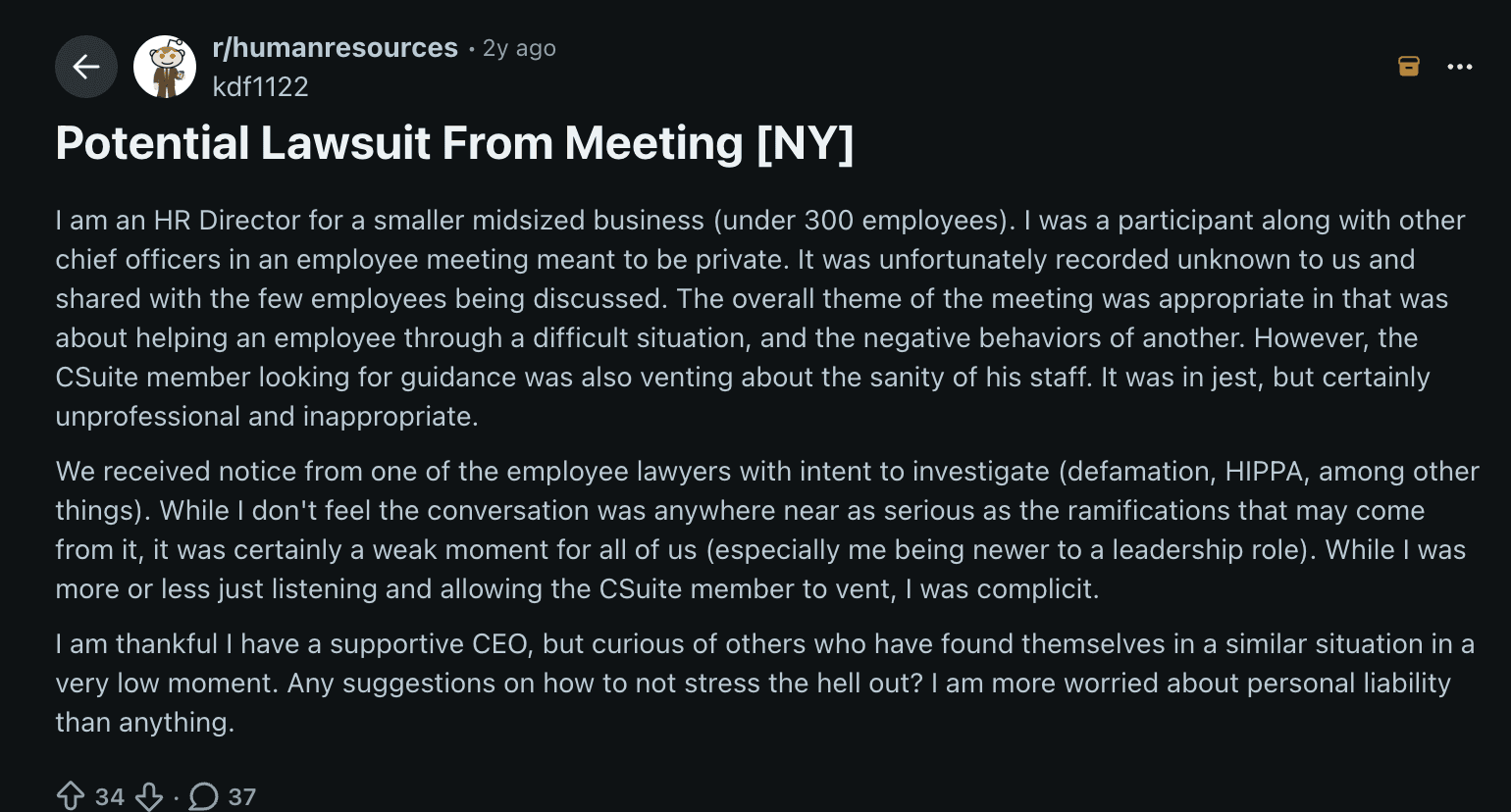
Employers should not assume every threat is worth paying, but they also should not dismiss it casually. The right response depends on documentation, witness risk, legal exposure, and the credibility of the claim.
2) HR teams are asking when to involve legal before a situation turns into litigation.
In another HR discussion, a new HR manager asked how often HR should contact legal and whether legal should only be used when “things hit the fan.” This is highly relevant because settlement decisions are far stronger when counsel is involved before the employee's attorney frames the record.
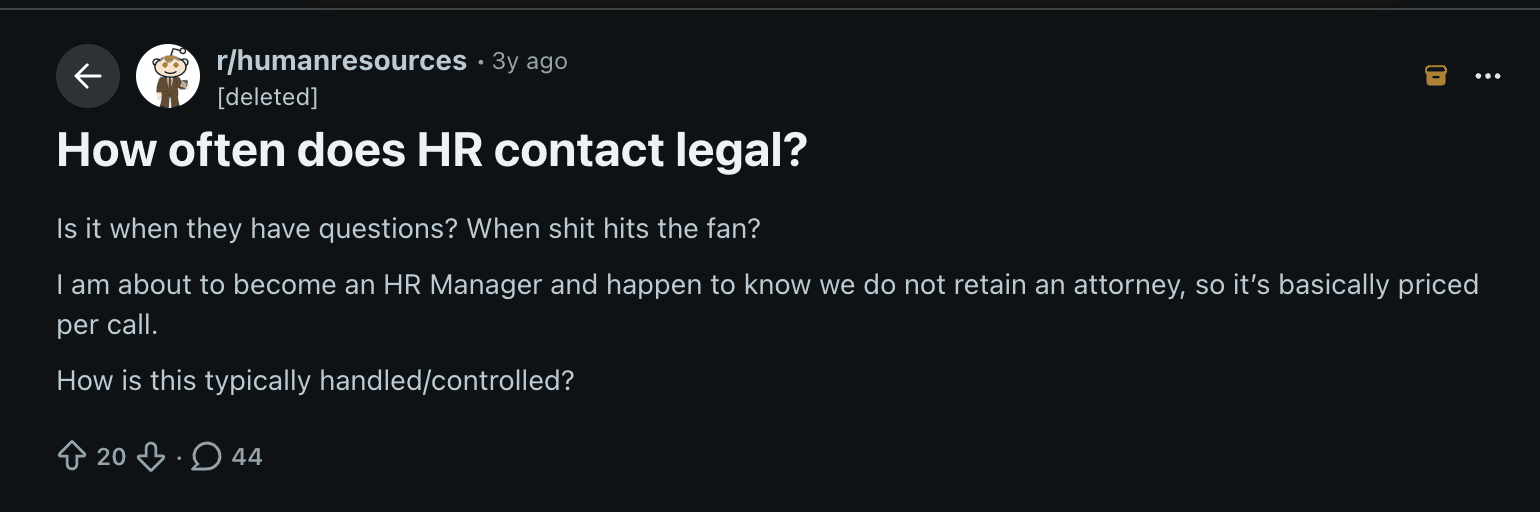
Counsel should be involved before an employer makes high-risk settlement, termination, document-production, or response decisions. Early review often costs less than fixing an avoidable mistake later.
The larger lesson for employers: if a demand letter, termination decision, arbitration issue, or documentation gap is serious enough to ask Reddit, it is serious enough to review before making a settlement decision. California employment litigation is expensive, but settling blindly can be expensive too.
FAQs
Why would an employer offer a settlement agreement even if the claim is disputed?
What makes a California employment settlement agreement enforceable?
Is mediation required before trial in California employment cases?
Can settling an employment claim increase the risk of future claims?
How do PAGA claims change the settle-or-fight analysis?
Conclusion
California employment litigation forces every employer into a cost-benefit decision: settle or fight. Neither answer is always right. Settling on weak claims with strong documentation wastes money and invites more claims. Fighting every dispute regardless of merit wastes more.
The correct answer depends on the quality of the documentation, actual exposure, the plaintiff's demand, the claim type, and whether a credible defense is available. All of this requires analysis by employer-side counsel who knows California employment litigation from the inside.
DefendMyBiz represents California employers only. If a claim has arrived and you need a clear-eyed assessment of whether to settle or fight, book your complimentary 15-minute consultation or call (818) 418-6625.
Disclaimer: The above content is for informational purposes only. This is not legal or tax advice. Laws, IRS guidance, and withholding requirements can change, and outcomes depend on specific facts. You are advised to contact a qualified attorney for any legal advice.