How Plaintiff Lawyers Stack PAGA Penalties: The Math California Employers Don't See Coming
PAGA Defense

A single payroll error, missed meal period, or wage statement defect can become much larger when it is multiplied across employees and pay periods. That is the basic math behind stacking PAGA penalties.
Before California's 2024 PAGA reform, plaintiffs could often model their exposure by layering several Labor Code penalty theories onto the same underlying pay issue. That penalty model is what turned relatively small wage disputes into high-value representative actions.
The 2024 reform reduced some of that exposure, but it did not eliminate PAGA stacking entirely. So, can you stack PAGA penalties today? In certain circumstances, yes.
The answer depends on the LWDA notice date, the violations alleged, whether the penalties are derivative or independent, whether the employer took reasonable compliance steps, and how the claim is framed.
How PAGA Penalty Stacking Worked: The Old Framework
Before AB 2288 and SB 92 took effect, the stacking mechanism was straightforward and financially severe:
Base PAGA penalties under the old law:
$100 per aggrieved employee, per pay period — initial violations
$200 per aggrieved employee, per pay period — subsequent violations
One unpaid overtime theory could trigger a cascading set of related penalty theories:
Violation Type | Labor Code Section | Penalty Per Employee Per Pay Period |
|---|---|---|
Unpaid overtime (base) | §510 | $100–$200 |
Failure to pay wages when due | §204 | $100–$200 (stacked separately) |
Wage statement defect | §226 | $100–$200 (stacked separately) |
Failure to pay final wages | §203 | $100–$200 (stacked separately) |
Meal period premium not paid | §226.7 | $100–$200 (stacked separately) |
The math on a mid-size employer:
50 employees on biweekly payroll
2-year lookback period = 52 pay periods
3 stacked violations per pay period
At $200 per violation: 50 × 52 × 3 × $200 = $1,560,000
That number is before attorney fees (typically 33–40% of settlement), before interest, before individual wage claims running alongside the PAGA action.
This is why employers often face settlement pressure that is disconnected from the actual unpaid wages. The theoretical maximum exposure became the settlement leverage.
Watch: John Fagerholm explains why PAGA went 20 years without meaningful rules and what California finally did about it. 🎬 PAGA just got rules… after 20 YEARS.
What the 2024 Reform Actually Changed (AB 2288/SB 92)
California's 2024 PAGA reform, AB 2288 and SB 92, applies to PAGA notices and cases governed by the amended law. LWDA's FAQ explains that different rules apply depending on whether the PAGA notice was filed before or on/after June 19, 2024.
For employers, the most important changes include:
Derivative penalty limits:
Plaintiffs generally cannot recover separate civil penalties for certain derivative violations under Labor Code §§201–204 and §226 when they arise from the same underlying unpaid wage violation, unless a statutory exception applies.
Penalty reductions for reasonable steps.
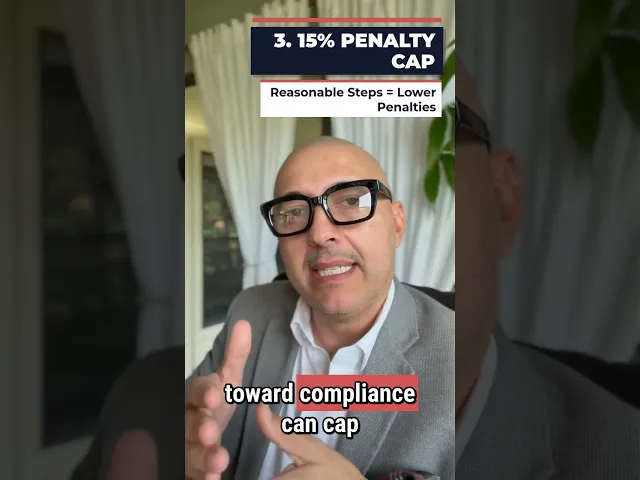
Employers that took "all reasonable steps" before receiving a PAGA notice may reduce recoverable penalties to 15% of the default amount. Employers that take those steps within the statutory post-notice window may reduce penalties to 30%, subject to exceptions.
Reduced penalties for some technical wage-statement issues:
Certain wage-statement violations may receive reduced penalties when the missing information is readily determinable, or the issue is technical rather than harmful.
Limits on the higher $200 penalty:
The amended law makes it harder for plaintiffs to reach the higher subsequent-violation penalty tier.
Changed penalty distribution:
For notices governed by the amended rules, recovered penalties are generally split 65% to the LWDA and 35% to aggrieved employees, instead of the prior 75%/25% split.
Before vs. After: What the Reform Did
Issue | Pre-June 19, 2024 | Post-June 19, 2024 |
|---|---|---|
Derivative stacking (§§201-204, §226) | Permitted, each section is independent | Eliminated (unless willful/intentional) |
$200 subsequent penalty | Triggered by any repeat violation | Requires malicious/fraudulent conduct or prior finding |
Reasonable steps defense | Not available | Up to 85% penalty reduction |
Wage statement technical errors | $100–$200/period | $25/period if determinable |
Weekly payroll penalty | Same as biweekly | 50% reduction |
Employee share of penalties | 25% | 35% |
Where Plaintiff Attorneys May Still Push the Boundaries
The no-derivative-stacking rule eliminates one specific type of stacking penalty for §§201-204 and §226 that flows from the same underlying unpaid wage violation. It does not eliminate:
Independent stacking across unrelated violations.
A meal break violation and an overtime violation, arising from different facts, policies, or time periods, can still generate independent PAGA penalties. Plaintiff attorneys now structure complaints to frame violations as arising from separate underlying conduct wherever possible.
Willful and intentional exceptions.
Plaintiff attorneys may argue that repeated or known non-compliance supports a willfulness theory, especially when prior complaints, manager messages, or audit records suggest the employer knew about the issue.
Independent §226.7 meal/rest break penalties.
The treatment of certain non-derivative violations, including meal and rest break premium theories, may remain a contested issue depending on the facts, pleadings, and how plaintiffs frame the underlying conduct.
Pre-June 19, 2024, notices.
Any LWDA notice filed before June 19, 2024, is subject to the old framework. Full stacking applies. Cases with pre-reform notices are still actively in litigation.
Employer takeaway:
The reform reduced stacking exposure meaningfully but did not eliminate it. Employers who assume the reform has solved the stacking problem and don't audit their practices are misreading the law
For the standing challenges employers can raise against PAGA actions, here's a quick read on PAGA Standing Challenges: How Employers Can Attack Who Filed and Why
The Penalty Reduction Math: Why "All Reasonable Steps" Is Worth Understanding
The 2024 reform introduced a compliance-based penalty reduction, the most financially significant tool available to California employers facing PAGA exposure.
Scenario: 50-employee company, biweekly payroll, 1-year lookback, one violation category
Timing of Compliance | Penalty Cap | Calculation | Employer Cost |
|---|---|---|---|
No compliance steps taken | 100% of default | 50 × 26 × $100 | $130,000 |
Reasonable steps before the LWDA notice | 15% of default | $130,000 × 15% | $19,500 |
Reasonable steps within 60 days of the LWDA notice | 30% of default | $130,000 × 30% | $39,000 |
In this simplified example, documented pre-notice compliance steps reduce modeled exposure by $110,500. Scale that across multiple violation types or a larger workforce, and the savings become the most important number in your PAGA defense strategy.
What counts as "all reasonable steps" under AB 2288:
Documented periodic payroll audits
Written wage and hour policies were distributed to all employees
Supervisor training on meal periods, rest periods, and overtime rules
Active correction of identified violations before they compound
Accurate, complete wage statements with every required field populated
The critical point is that these steps must be documented and implemented, not just planned or verbally described. In litigation, written, timestamped, and distributed records usually carry more weight than verbal descriptions of compliance.
For the meal and rest break violations that most commonly trigger PAGA claims, read California Meal and Rest Break Violations: What the Premium Pay Penalty Actually Costs Employers
Red Flags That Signal Your PAGA Exposure Is Active
Most PAGA notices don't surprise experienced employers. They follow predictable patterns and policies that generate violations across the entire workforce:
Automatic meal break deductions without documentation:
if your timekeeping system deducts 30 minutes regardless of whether a break was actually taken, every affected employee on every pay period is a potential PAGA violation
Time rounding that consistently rounds down:
any rounding system that statistically shortchanges employees creates a systematic wage violation across your workforce
Wage statements missing any of the 9 required items under §226:
a payroll system printing the same defective pay stub for every employee creates per-employee, per-period exposure immediately
Independent contractors doing core business functions:
AB5 misclassification creates back wage exposure that flows directly into PAGA territory
Prior LWDA notice or court finding:
if your business had a PAGA action or wage finding within the last 5 years, the $200 per-period penalty tier is accessible to plaintiffs from day one
For misclassification risk specifically, see Employee Misclassification in California: Independent Contractor vs. Employee
What to Do When a PAGA Notice Arrives
The LWDA notice triggers deadlines and opens the penalty reduction window. What you do in the first 60 days matters more than anything else.
1.
Identify which framework applies.
If the LWDA notice was filed before June 19, 2024, the old stacking rules apply. Full analysis under the prior framework is needed immediately.
2.
Assess whether cure rights apply.
The 2024 reforms expanded cure opportunities for certain violations, but the process depends on the violation, employer size, notice timing, and whether employees must be made whole. Employers should not assume every violation is curable or that the same 33-day process applies in every case.
3.
Begin "all reasonable steps" immediately.
The 60-day window for a 30% penalty cap starts from the date of the LWDA notice. Documented payroll audits, policy distribution, and supervisor training initiated immediately can materially reduce maximum exposure.
4.
Assess the scope of the representative action.
For PAGA notices governed by the amended law, the plaintiff generally must have personally experienced each alleged Labor Code violation they seek to pursue on a representative basis.
5.
Retain PAGA-specific employer defense counsel before responding to anything.
PAGA actions may involve LWDA procedures, civil litigation, and related class or wage-and-hour claims, often simultaneously. General employment counsel may not be familiar with the new early evaluation conference (EEC) process or the specific cure procedures introduced by the reform.
DefendMyBiz handles PAGA defense from the LWDA notice stage through trial. We represent California employers only. Our PAGA Defense team has defended employers against representative actions at every complexity level, from single-employee notices to multi-violation, company-wide representative actions.
If a PAGA notice has arrived or you want to understand your exposure before one does, book your complimentary 15-minute consultation or call (818) 418-6625.
What Employers Are Asking Online About PAGA Penalty Risk
PAGA penalty risk often starts with employer-side operational questions: "Can meal-break issues become a PAGA claim?" "How bad is a PAGA notice?" "Can overtime controls backfire?" "What records do we need to defend this?" These are the questions HR teams and business owners ask before the penalty model is fully understood.
Reddit discussions by HR professionals and employers show how quickly payroll, break, and wage-statement issues can expose representatives.
1) Employers are asking how late payroll or regular pay-day errors should be handled.
In a California HR thread, an HR professional asked whether an owner could delay payroll to review a discrepancy, even though the company had established regular paydays. This type of pay-timing issue can connect directly to Labor Code §204 and broader PAGA theories.
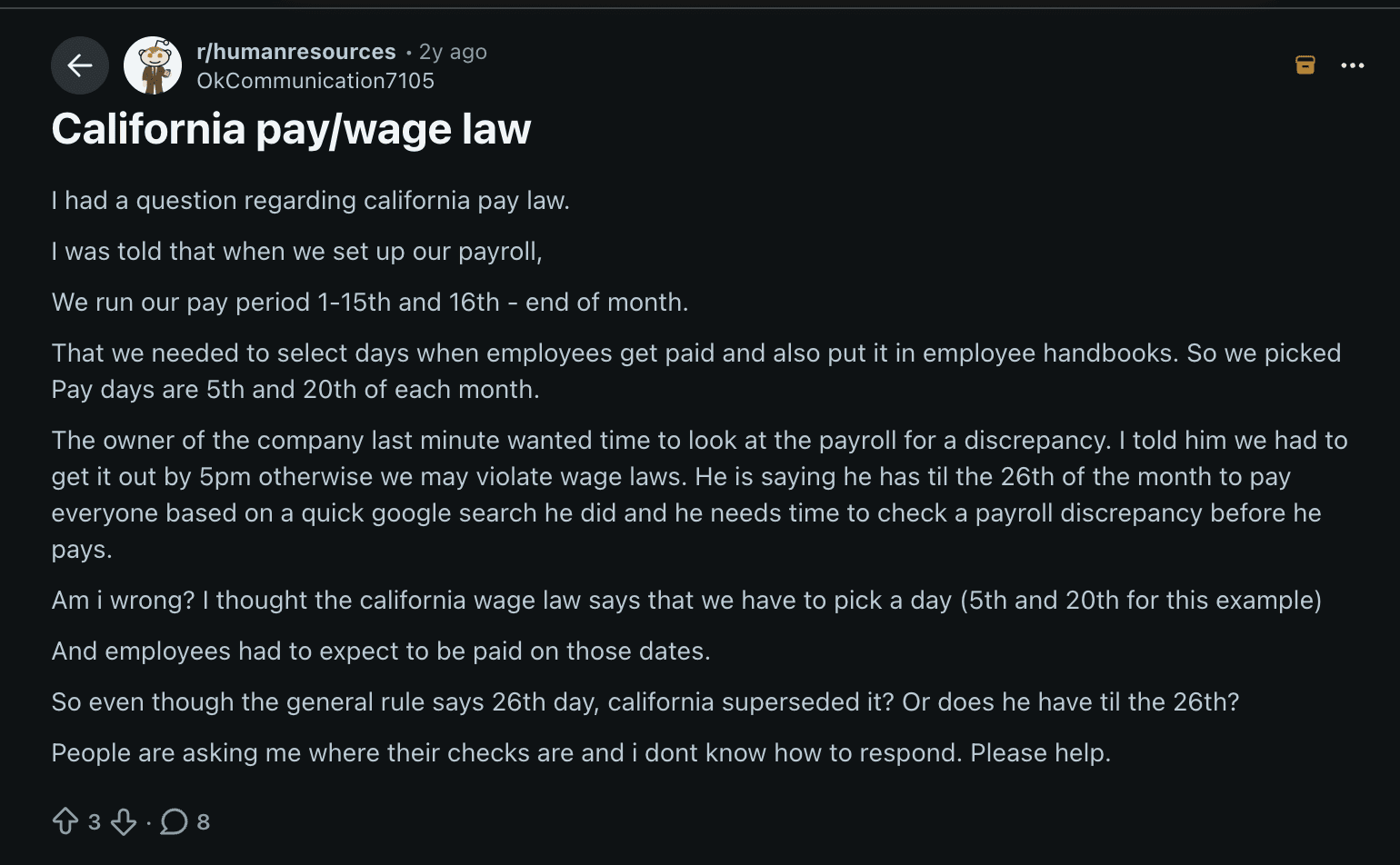
Pay-timing decisions should not be improvised. Employers should follow established paydays, document payroll corrections, and involve counsel before a late-pay issue becomes a representative wage claim.
The larger lesson for employers: if a payroll, meal-break, overtime, wage-statement, or pay-timing issue is broad enough to affect multiple employees, it is broad enough to become PAGA exposure. Stacking PAGA penalties often starts with one repeated payroll practice, not one dramatic mistake.
FAQs
Can you stack PAGA penalties after the 2024 reform?
What does stacking PAGA penalties mean?
What changed under the 2024 PAGA reform?
What steps reduce PAGA penalty exposure for employers?
Are all PAGA violations curable after the 2024 reform?
Conclusion
Stacking PAGA penalties was one of the most powerful tools plaintiff attorneys had against California employers for 20 years. The 2024 reform eliminated derivative stacking on specific sections but left independent stacking intact, preserved a willfulness carve-out that plaintiff counsel are actively exploiting, and left pre-reform notices entirely untouched.
Can you stack PAGA penalties today? Yes, in certain circumstances, and plaintiff attorneys know exactly which ones. The penalty reduction pathways are real and meaningful, but only for employers who take documented compliance steps before the notice arrives.
DefendMyBiz represents California employers only. If a PAGA notice has arrived or you want to understand your exposure before one does, book your complimentary 15-minute consultation or call (818) 418-6625.
Disclaimer: The above content is for informational purposes only. This is not legal or tax advice. Laws, IRS guidance, and withholding requirements can change, and outcomes depend on specific facts. You are advised to contact a qualified attorney for any legal advice.