Arbitration or Court: Which Is Better for California Employers Facing an Employment Claim?
Class Action Defense

You have an arbitration agreement, or you're considering one. You've probably heard it protects you from runaway jury verdicts and keeps disputes out of the public record. Both of those things can be true.
What many California employers don't know is that the arbitration landscape shifted significantly in 2025. A series of court rulings changed what your agreement must say, what claims it can cover, and what happens if you miss a payment deadline by even one day. The agreement that protected you two years ago may not provide the protection you think it does today.
This guide provides California employers with a current answer to the arbitration vs court question. Learn what each forum actually delivers, where arbitration still wins, where it's been undermined, and what your agreement needs to say to hold up in 2026.
Key Takeaways
For many California employers, arbitration remains the preferred dispute resolution forum because it often provides confidentiality, avoids jury trials, and limits discovery.
The EFAA (effective March 2022, applied aggressively by California courts in 2025) removes sexual harassment and sexual assault claims from mandatory arbitration.
Casey v. Superior Court (2025): choice-of-law clauses cannot route EFAA-covered claims into arbitration; Liu v. Miniso (2024/final 2025): the entire case is exempt once any sexual harassment claim is pled.
Hohenshelt (California Supreme Court, Aug 2025): missing the 30-day arbitration fee payment deadline forfeits your right to arbitrate. The FAA does not preempt this rule.
California courts void arbitration agreements for both procedural unconscionability (how the agreement was presented) and substantive unconscionability (systematically biased terms).
A compliant 2026 California arbitration agreement must include: mutual obligation, explicit EFAA carve-out, class/PAGA waiver, named provider, CCP §1281.98-compliant fee provisions, and signed individually at onboarding.
Arbitration vs Court: The Core Differences for Employers
Both forums resolve employment disputes. They operate on fundamentally different terms, and the difference that matters most to California employers is not cost. It's exposure control.
Factor | Arbitration | Court Litigation |
|---|---|---|
Decision-maker | Neutral arbitrator (attorney or retired judge) | Judge and/or jury |
Jury exposure | Eliminated | Full jury trial available |
Class action risk | Can be waived; powerful protection | Significantly higher exposure |
Confidentiality | Private proceedings and records | Public court record |
Speed | Typically 6–12 months | Often 2–5 years |
Discovery | Limited by agreement | Full discovery process |
Appeal rights | Extremely narrow | Full appellate review |
Arbitrator fee obligation | Employer typically pays, strict deadlines | Standard court filing fees |
EFAA exceptions | Sexual harassment/assault claims are now exempt | Employee's choice for covered claims |
The arbitration argument has always rested on three pillars: no jury, limited discovery, and confidentiality. All three still hold for most employment claims. The argument has weakened specifically around sexual harassment, where federal law now hands the forum choice to the employee, regardless of what your agreement says.
Where Arbitration Still Strongly Protects California Employers
For the majority of employment claims wage-and-hour disputes, wrongful termination, discrimination, retaliation, FEHA claims without sexual harassment allegations a properly drafted arbitration agreement remains one of the most effective employer-defense tools available.
The class action waiver is the most valuable single clause. Under the Federal Arbitration Act (FAA), class action waivers in arbitration agreements are enforceable. A well-drafted waiver prevents employees from banding together in large-scale wage class actions or PAGA mass claims through arbitration.
The arbitrator replaces the jury. California jury verdicts in employment cases have become increasingly unpredictable. A San Diego jury in late 2024 awarded an individual plaintiff over $11 million in an employment discrimination case involving a 74-year-old medical screener. Arbitrators are experienced legal professionals who assess facts and law, not emotional testimony from a sympathetic plaintiff. For California employers, removing the jury is often worth the entire cost of building a compliant arbitration program.
Discovery limitation reduces cost and exposure. Wage-and-hour class actions in California generate massive discovery demands, such as tens of thousands of timekeeping records, payroll reports, and management communications. An arbitration agreement that limits the scope of discovery reduces both the cost and the breadth of discovery. That matters in cases where your documentation practices are not perfect.
For context on how wage and hour class action exposure stacks up, see Defeating Wage and Hour Class Actions in California: An Employer's Defense Guide.
The EFAA: The Single Biggest Change to California Arbitration Law
The Ending Forced Arbitration of Sexual Assault and Sexual Harassment Act (EFAA), effective March 3, 2022, removed one category of claims from employer arbitration programs entirely. California courts have applied it aggressively, and the 2025 rulings foreclosed every workaround employers had been testing.
What the EFAA does: Any employee alleging sexual harassment or sexual assault can void their pre-dispute arbitration agreement unilaterally and proceed in court. This is not a litigation outcome that your attorneys can argue around. The election belongs solely to the employee.
What California Courts Decided in 2025?
The California Court of Appeal held that the EFAA preempts attempts under State law to compel arbitration of sexual harassment disputes. In Casey v. Superior Court (2025), the employer sought to invoke a California choice-of-law clause in the arbitration agreement to argue that state law, rather than the federal EFAA, governed. The court rejected this directly: relying on the choice-of-law provision would "directly contravene Congress's purpose and objectives in enacting the EFAA."
The "Entire Case" Rule
Under Liu v. Miniso Depot CA, Inc. (2024, California Court of Appeal), once a viable sexual harassment claim is alleged, the entire case, including wage-and-hour, discrimination, and retaliation claims, is exempt from arbitration. The California Supreme Court declined to review Liu in December 2024. The US Supreme Court declined to take up the issue in October 2025. The rule is now firmly in place.
The "Poison Pill" Problem
Since its enactment, the federal Ending Forced Arbitration of Sexual Assault and Sexual Harassment Act has resulted in plaintiffs' lawyers tacking on increasingly implausible sexual harassment claims to unrelated garden-variety employment claims in an increasingly common attempt to defeat otherwise enforceable arbitration agreements. A wage claim that would clearly belong in arbitration now goes to court if plaintiff's counsel adds a harassment allegation, and California courts have broadly permitted this.
What this means for your agreement: Carve out sexual harassment and sexual assault claims explicitly. Do not try to force these claims into arbitration through choice-of-law clauses or delegation provisions. California courts will not enforce that approach, and the attempt signals bad faith.
For a related look at how sexual harassment claims develop and how employers defend them, see Sexual Harassment Claims Against California Employers: What the Defense Looks Like.
The 30-Day Fee Trap That Loses You the Right to Arbitrate
This is the California-specific rule that surprises employers most and is not widely discussed.
California Code of Civil Procedure §1281.98 requires employers to pay arbitration fees within 30 days of the due date or forfeit the right to arbitrate entirely. The case then proceeds to court, and the employee can also recover attorney's fees and sanctions for the employer's failure.
In Hohenshelt v. Superior Court (California Supreme Court, August 2025), the court confirmed that the FAA does NOT preempt the 30-day payment rule. California employers who miss the deadline lose arbitration, regardless of federal policy favoring arbitration.
Practical implication: The moment an arbitration demand is served, your legal team and accounts payable team must coordinate immediately. A payment delayed by even a few days beyond the deadline, whether due to administrative oversight, a holiday, or a processing lag, can destroy your arbitration agreement's value in that specific case.
How California Courts Are Striking Down Arbitration Agreements
The unconscionability doctrine, a California court's tool for invalidating arbitration agreements it considers unfair, is being applied aggressively. Understanding how agreements get struck down gives you the blueprint for drafting one that survives.
Procurement matters as much as content. In Velarde v. Monroe Operations, LLC (2025), the California Court of Appeal struck down an agreement presented in a high-pressure group meeting, with misrepresentations about its effect, to workers with limited English proficiency. The Court affirmed the denial of a motion to compel arbitration based primarily on extreme procedural unconscionability: the employer presented the agreement in a high-pressure group meeting, made express misrepresentations about its effect, and failed to ensure that workers with limited English proficiency understood it.
Multiple unconscionable terms signal a rigged forum. When an agreement contains several provisions that systematically favor the employer, courts refuse to sever the bad terms and enforce the rest. The pattern of bias voids the entire agreement.
What survives scrutiny. In Vo v. Tech Credit Union (2025), a California court compelled arbitration, with the agreement incorporating JAMS Rule 17, which authorizes the arbitrator to expand discovery as needed for a fair proceeding. Courts upheld the agreement because it built in a neutral discovery-expansion mechanism, signaling fairness rather than strategic constraint.
A Forum Question: Does an Old Arbitration Agreement Still Apply If Employees Never Sign the Updated Version?
A recurring question on Reddit asks whether an arbitration agreement signed during onboarding remains enforceable after California law changes if the employer later distributes an updated agreement that the employee never signs.
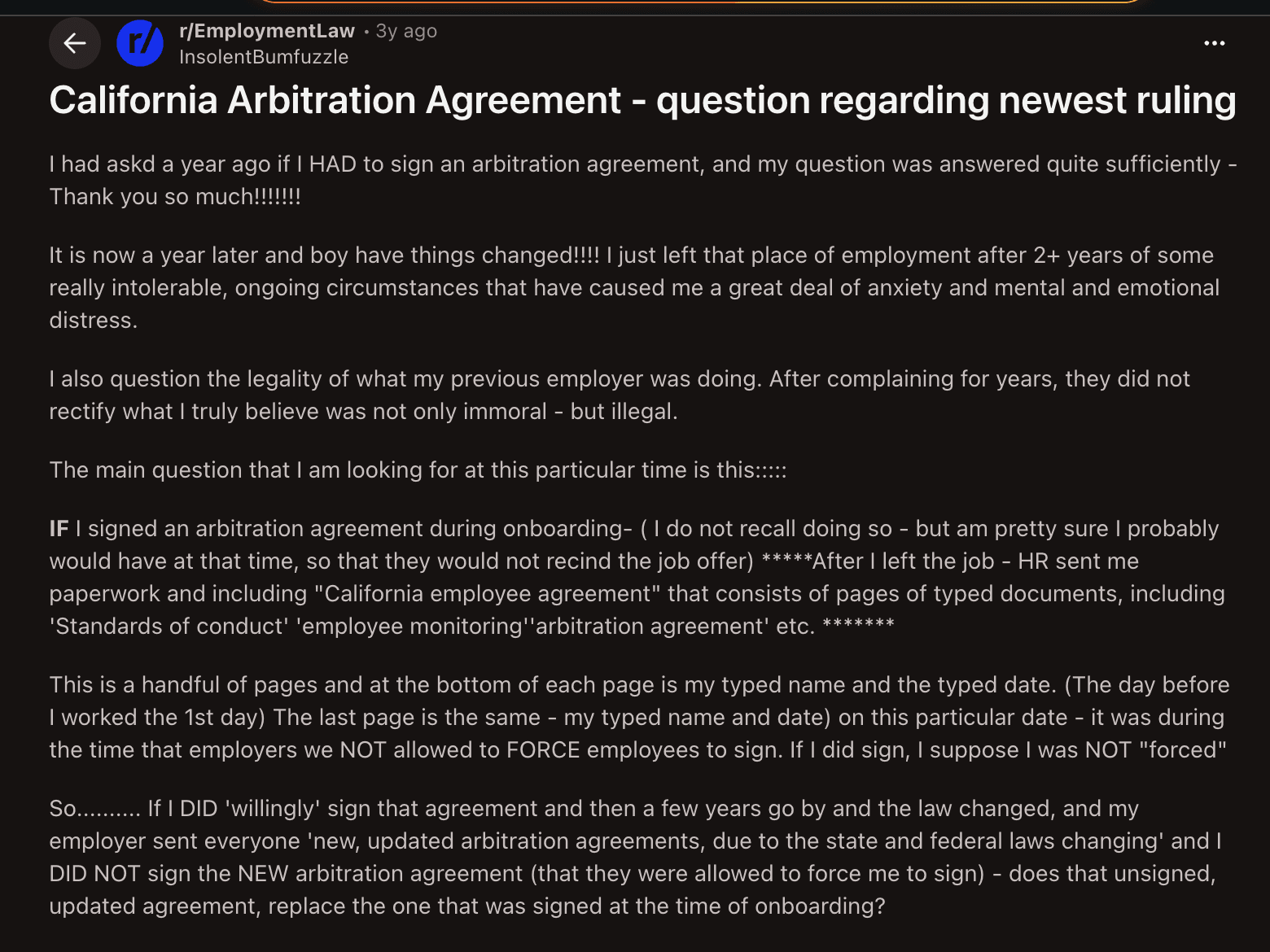
The answer depends on the language of the original agreement, the purpose of the updated agreement, and whether the employer intended to replace or merely supplement the existing contract.
For employers, the practical takeaway is that simply emailing a revised arbitration agreement does not automatically invalidate or replace an earlier signed agreement. Whether the original agreement remains enforceable depends on traditional contract principles and California arbitration law.
Before relying on an older arbitration agreement, employers should confirm:
The original agreement was properly executed and retained in the employee's personnel file.
The agreement still complies with current California and federal law, including the Ending Forced Arbitration of Sexual Assault and Sexual Harassment Act (EFAA) where applicable.
Any updated arbitration agreement clearly states whether it supersedes prior agreements or simply amends specific provisions.
Employees were given adequate notice of any revisions and, where required, provided valid consideration for new contractual obligations.
The agreement remains free from procedural or substantive unconscionability under current California case law.
Many employers assume that circulating an updated arbitration agreement automatically replaces every previous version. In reality, courts typically analyze which agreement governs, whether a valid contract was formed, and whether the employer can prove the applicable version was accepted. Maintaining signed copies, version control, and clear onboarding records can become critical if arbitration is later challenged.
What Your California Arbitration Agreement Must Include in 2026
A checklist for the core provisions that both enforce and survive challenge:
Mutual obligation.
The agreement must bind both employer and employee. One-sided agreements that restrict only the employee are regularly voided.
Explicit EFAA carve-out.
State clearly that sexual harassment and sexual assault claims are excluded from the arbitration obligation, consistent with federal law. Do not try to route these claims into arbitration through choice-of-law or delegation clauses.
Class action waivers
remain broadly enforceable under the FAA. PAGA provisions, however, require careful drafting. While arbitration agreements may require arbitration of an employee's individual PAGA claim in certain circumstances, California law continues to limit the enforceability of broad representative PAGA waivers. Employers should have PAGA provisions reviewed regularly as this area continues to evolve.
Named arbitration provider.
Specify JAMS, AAA, or CPR Dispute Resolution Services and ensure you incorporate their employment arbitration rules by reference, including any discovery expansion provisions.
Fee allocation in compliance with CCP §1281.98.
Spell out who pays fees and when, and ensure your internal processes guarantee those payments are made within 30 days of the due date, every time.
Reasonable discovery scope.
Avoid overly restrictive discovery provisions that courts deem to deprive employees of a meaningful opportunity to present their claims. Build in flexibility (JAMS Rule 17 is the model) rather than rigid limitations.
Signed individually at onboarding, not in a group setting.
Present the agreement one-on-one, in the employee's primary language, with genuine time and opportunity to review. Document the signing process. A high-pressure group presentation is grounds for voiding the agreement under Velarde.
Update for existing employees.
An arbitration agreement signed four years ago may not reflect current EFAA requirements, discovery provisions, or fee allocation rules. Existing employees who are offered new consideration, such as a promotion, a raise, or a new role, may be asked to sign updated agreements. Have employment defense counsel review before re-rolling.
For related guidance on how arbitration interacts with PAGA claims specifically, here are a few quick reads: Your Arbitration Agreement May Not Stop a PAGA Claim: Here's What California Courts Are Enforcing and PAGA vs. Class Action: What's the Difference.
When Court Is the Better Choice for a California Employer
Arbitration is not always the right forum. There are situations where going to court serves employers better.
1.
When the claim is legally weak and likely to be dismissed early.
A motion to dismiss or for summary judgment can end a meritless case before arbitration costs accumulate. Arbitrators rarely grant dispositive motions at the same rate courts do. If the employee's claim has a clear legal defect, the court may resolve it more quickly and more cheaply than through arbitration.
2.
When you need broad discovery.
Proving your defense with extensive documentation, third-party depositions, or subpoenas for records outside your control requires the broader discovery tools that court provides. An arbitration agreement that limits you to two depositions may work against you in a complex case.
3.
When the claim involves sexual harassment, you can build a strong defense.
Since the employee chooses the forum under the EFAA, you have no choice. But if you have strong documentation, clear investigation records, and solid training documentation, a court defense is not a losing proposition.
DefendMyBiz has compelled arbitration in sexual harassment-adjacent discrimination cases where the harassment claims did not qualify under the EFAA, and successfully defended in court where they did.
How DefendMyBiz Approaches the Arbitration Decision
At DefendMyBiz, we represent California employers exclusively. Every arbitration strategy, every agreement review, and every defense plan is built from the employer's side of the table because that is the only side we have ever been on.
When a claim arrives, our employer defense attorneys assess the specific facts: What does your agreement say? What claims are alleged? Does the EFAA apply? Are you in the 30-day fee window? What's the realistic jury exposure in this jurisdiction? That analysis drives the forum decision rather than a general preference for arbitration or court.
The DefendMyBiz Class Action Defense team handles arbitration motions, class certification defense, and PAGA representative actions as part of comprehensive employer defense.
Book a free 15-minute consultation if you have an active claim, an arbitration agreement you haven't reviewed since 2022, or a pending harassment allegation.
FAQ
Is it better to go through arbitration or court as a California employer?
Why do California employers prefer arbitration?
Can a California employer require employees to sign an arbitration agreement?
What happens if I miss an arbitration fee payment deadline in California?
Does the EFAA apply to wage and hour claims joined with a sexual harassment allegation?
Disclaimer: The above content is for informational purposes only. This is not legal or tax advice. Laws, IRS guidance, and withholding requirements can change, and outcomes depend on specific facts. You are advised to contact a qualified attorney for any legal advice.


