Defending a FEHA Harassment Claim: Why the EFAA Carveout Changes Your Strategy
FEHA / EEO Defense

When a lawsuit against your business includes a sexual-harassment claim covered by the EFAA, the plaintiff may elect to take the case out of arbitration. In California, that election can affect the entire lawsuit, not just the harassment claim.
This changes what evidence is built, how a wage claim that rides alongside the harassment allegation is litigated, and when settlement actually makes sense. Here's what changes in your defense once arbitration is no longer available, not just legally, but strategically.
Key Takeaways
Under Liu v. Miniso Depot CA, Inc. (2024), a California court will not compel arbitration of the entire case when the plaintiff's lawsuit includes at least one sexual harassment claim covered by the EFAA and the plaintiff elects the statutory protection.
The California Supreme Court denied review on December 31, 2024. The U.S. Supreme Court later denied certiorari on October 6, 2025, leaving the California Court of Appeal's decision intact.
Casey v. Superior Court (2025) held that a California-law choice-of-law provision could not be used to circumvent the EFAA where the Act otherwise applied.
Losing arbitration widens discovery, makes the case public, puts a jury in charge, and pulls unrelated claims, like wage-and-hour disputes, into the same public proceeding.
Documented complaint procedures and training records become the primary evidence in defense, replacing the role an arbitration agreement previously played.
Delegation clauses don't help either. California courts, not arbitrators, decide whether the EFAA applies.
The Rule That Controls Your Case Now
The Ending Forced Arbitration of Sexual Assault and Sexual Harassment Act, effective March 3, 2022, voids pre-dispute arbitration agreements for claims involving sexual assault or sexual harassment. California courts have gone further than the statute's bare text requires, holding that if a lawsuit includes even one viable sexual harassment claim, the entire case is exempt from arbitration.
That rule comes from Liu v. Miniso Depot CA, Inc. (2024) 105 Cal.App.5th 791, where the plaintiff's lawsuit included sexual harassment allegations alongside unrelated wage and hour claims. The Court of Appeal held that because Congress used the word "case" rather than "claim" in drafting the EFAA, the entire lawsuit (harassment, wage claims, retaliation, everything) proceeds together in court.
The California Supreme Court denied review on December 31, 2024, and the U.S. Supreme Court denied certiorari on October 6, 2025, leaving California's broad reading in place with no further appellate check.
Why This Changes More Than Where the Case Is Heard
Losing arbitration isn't just a procedural inconvenience. It restructures the entire defense:
What Changes | Why It Matters |
|---|---|
Discovery scope widens | Discovery may become broader and more formalized, depending on the applicable procedural rules and the scope of the claims. |
The proceeding becomes public | Court filings and proceedings generally carry greater public-access and reputational considerations than confidential arbitration, although specific filings or proceedings may be subject to confidentiality or sealing rules. |
Potential jury trial | If the claims proceed to trial, the employer may face a jury rather than an arbitrator, which would change the presentation and risk profile of the case. |
Unrelated claims travel together | A wage and hour claim that might have settled quietly in arbitration now proceeds alongside the harassment allegation, in the same public proceeding |
Settlement timing shifts | Because the "entire case" rule removes an early procedural off-ramp, employers often face pressure to resolve earlier, before discovery exposes more than they'd like publicly |
What Strengthens the Defense in Open Court
With arbitration off the table, your defense has to be built for public court scrutiny from the outset, not adapted to it after the fact.
1.
Your documented complaint procedure becomes the centerpiece of your defense.
Courts and juries weigh whether you had a clear, functioning process for employees to report concerns, and whether you responded promptly and appropriately when concerns were raised.
2.
Training records should be maintained and readily available if the employer later needs to demonstrate compliance.
California requires covered employers with five or more employees to provide sexual harassment prevention training every two years: two hours for supervisors and one hour for nonsupervisory employees.
3.
Prior complaint history gets scrutinized closely.
Prior complaints involving the same supervisor or department can become important evidence, particularly if they concern similar conduct and the employer's response is disputed.
4.
The wage-and-hour claims arising alongside the harassment allegation need their own defense,
not an afterthought. Both Liu and Casey applied the EFAA's "case" language to prevent the non-harassment claims in those lawsuits from being compelled to arbitration separately.
5.
A delegation clause does not eliminate the court's role
in determining whether the EFAA itself bars arbitration. Courts must first determine whether the statutory carveout applies before compelling arbitration.
Watch: Sexual Harassment Claims Covered Under EFAA - a direct look at how far California's interpretation of covered harassment claims has expanded, and what that means for the policies you have in place today.
What HR Professionals Are Asking About Sexual Harassment Investigations
The practical questions employers ask online are often less about the abstract definition of harassment and more about what the company should do after receiving a complaint, whether it must investigate after the employee withdraws the complaint, and how much documentation is necessary.
For example, an HR professional in California asked: "An employee wants to walk back her sexual harassment complaint. Is this unwise to allow?"
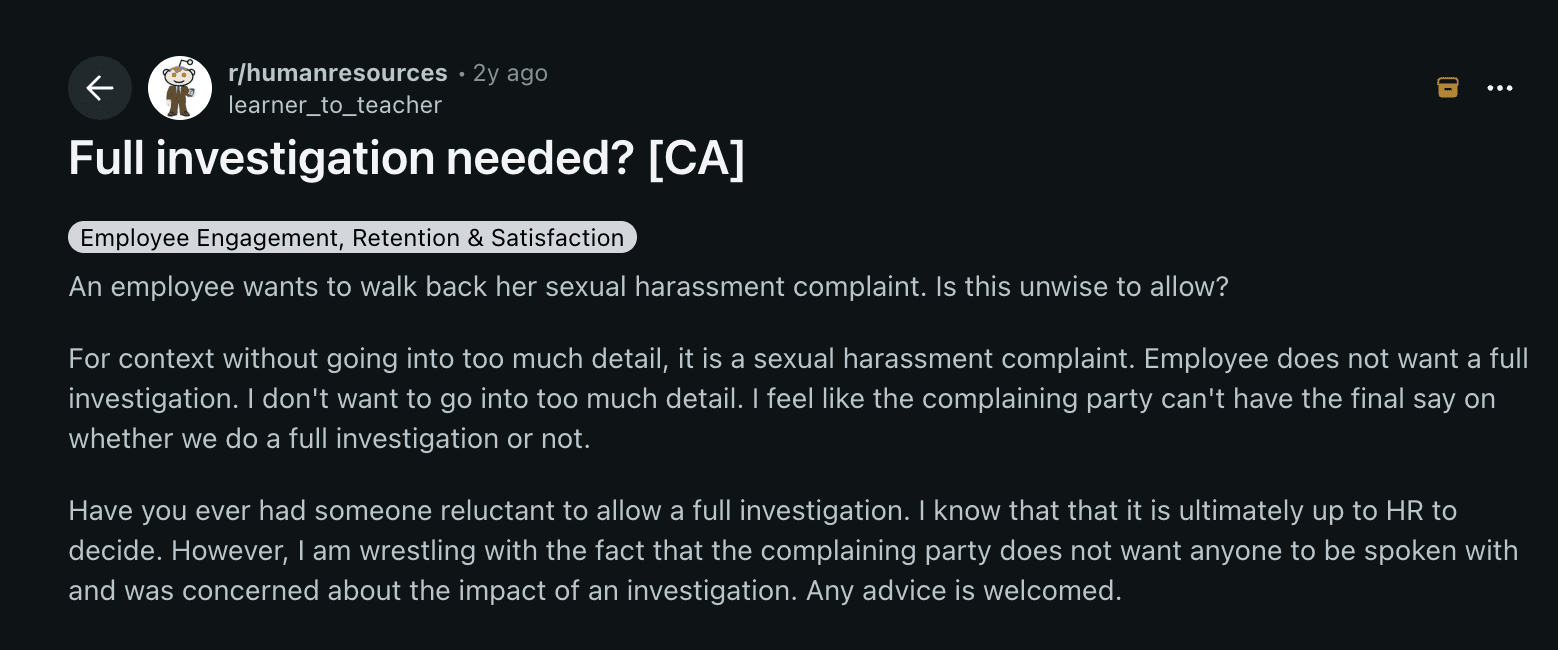
The post explains that the employee did not want a full investigation and asks whether HR should proceed anyway. The discussion focused overwhelmingly on completing and documenting the investigation despite the employee's reluctance.
Another HR professional asked: "Withdrawn Sexual Harassment Complaint?"
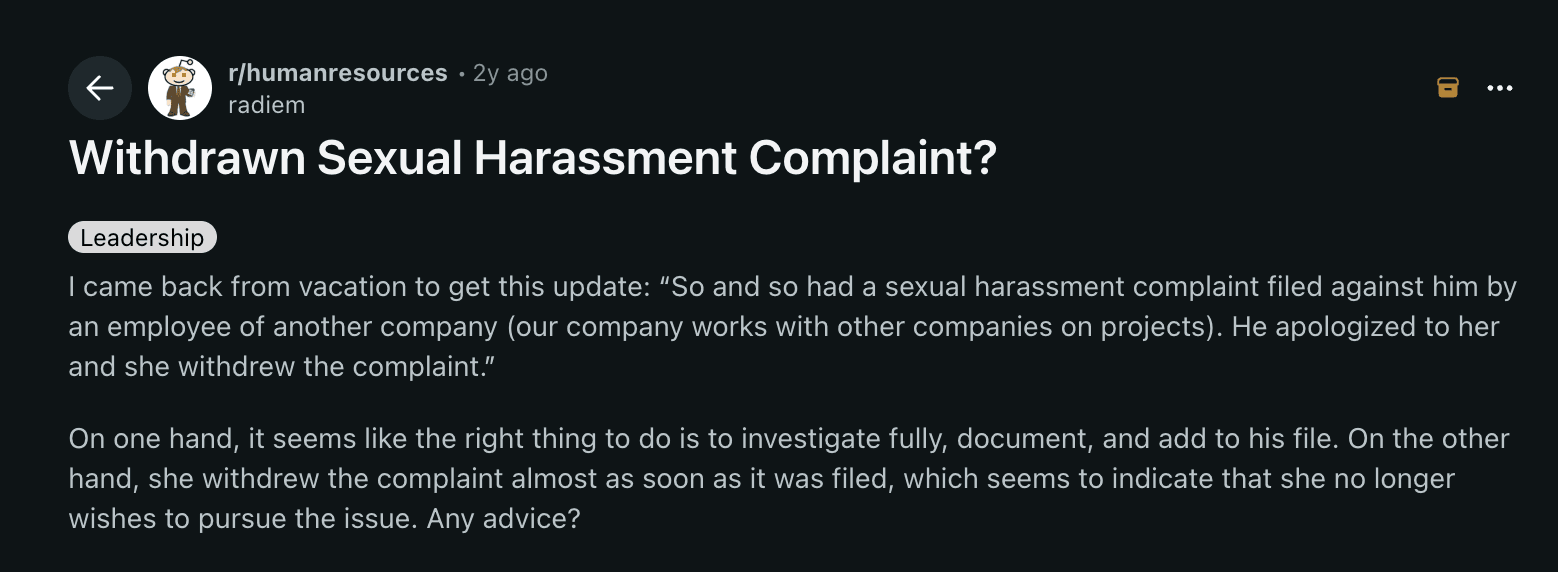
The employer-side question involved an employee from another company who filed a sexual harassment complaint, apologized, and then withdrew it. The HR professional specifically asked whether the company should still investigate and document the matter.
A broader HR discussion asked: "If someone is being treated unfairly or discriminated against, what is the general process for handling the complaint? Would you as an HR representative go directly to the source of the complaint?"
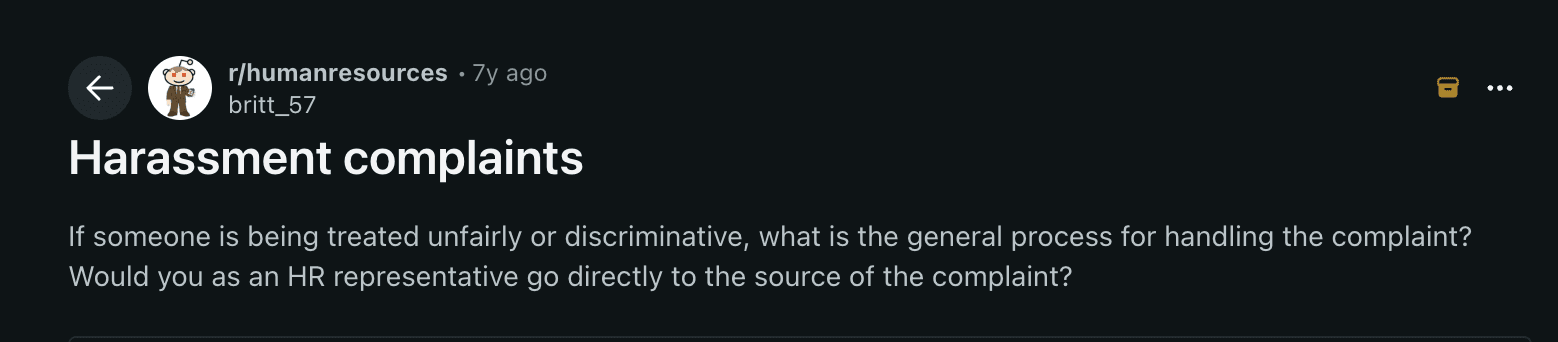
The discussion focused on investigation procedures, interviewing the complainant, protecting employees during the process, and documentation.
Looking at these actual queries, the recurring employer-side concern is not simply "Can I arbitrate this?" It is:
Do we have to investigate if the employee withdraws the complaint?
Who should conduct the investigation?
What should HR document?
What happens if there were earlier complaints?
How do we protect the company while keeping the investigation fair?
What evidence will matter if the dispute later becomes litigation?
That dovetails extremely well with the central argument: once arbitration may be unavailable, the employer's investigation and documentation process becomes even more important.
How to Build the Right Defense Posture Before a Claim Arrives
Audit your current harassment complaint and investigation procedures now. If a claim is filed, this process, not your arbitration agreement, becomes your primary evidence.
Confirm your supervisor and general employee training is current and documented, with dated records, not just a policy stating training occurs.
Review any prior complaints against the same manager or department before they resurface as part of a pattern argument in litigation.
Stop relying on an arbitration agreement as your primary risk-management tool for harassment exposure. It no longer functions that way once a viable harassment claim is present, and building your risk posture around it invites a false sense of security.
Get employer defense counsel involved the moment a harassment complaint surfaces, not after a lawsuit is filed. The response you build in real time is what a court will later evaluate.
For a fuller picture of how FEHA harassment and discrimination claims are actually built and litigated in California, our guide to what FEHA covers is worth reading alongside this piece. The EFAA changes the forum, but the underlying FEHA harassment standard is what the case is ultimately decided on.
Our FEHA / EEO Defense team builds exactly this kind of court-ready defense, since arbitration-based strategy no longer applies once a harassment claim is in the mix.
Conclusion
California courts have interpreted the EFAA to exempt an employer's entire case from arbitration whenever a lawsuit includes at least one viable sexual harassment allegation, a rule confirmed in Liu v. Miniso Depot and left undisturbed by both the California and U.S. Supreme Courts.
Casey v. Superior Court further confirmed that choice-of-law provisions don't provide a workaround. The practical consequence is that your entire defense posture needs to be built for open court, not adapted from an arbitration strategy that no longer applies.
The standard now is that your documented complaint procedure and training records are your primary defense, not your arbitration agreement. That shift needs to happen in how you prepare, not just in where the case eventually gets heard.
If a harassment complaint has already been filed against your business, DefendMyBiz offers a free 15-minute consultation. Book a call with our employer defense team today.
Frequently Asked Questions
Can an employee still sue after signing an arbitration agreement in California?
Does the EFAA carve-out apply to my whole case, or just the harassment claim?
Can a choice-of-law clause help route a case back to arbitration?
What matters most in defending a FEHA harassment claim without arbitration?
Is this issue likely to be resolved differently outside California?
Disclaimer: The above content is for informational purposes only. This is not legal or tax advice. Laws, IRS guidance, and withholding requirements can change, and outcomes depend on specific facts. You are advised to contact a qualified attorney for any legal advice.


