What Is FEHA? The California Fair Employment and Housing Act, Explained for Employers
FEHA / EEO Defense

An employee files a complaint with the California Civil Rights Department. A discrimination lawsuit lands on your desk. If you are only now asking what FEHA is, the response window may already be narrowing.
The California Fair Employment and Housing Act is the state's primary civil rights law governing workplace discrimination, harassment, and retaliation. It may apply to smaller employers than federal law, cover more protected categories, use broader disability standards, and allow uncapped damages in civil litigation. Understanding FEHA is the starting point for assessing employment-law exposure.
Here's what it covers, who it applies to, what it requires from you, and where employers most commonly get it wrong.
What Is FEHA in California and How Does It Compare to Federal Law?
FEHA (California Government Code §12900 et seq.) prohibits discrimination, harassment, and retaliation in employment based on protected characteristics. It is enforced by the California Civil Rights Department (CRD), formerly the DFEH.
Where FEHA goes further than federal law:
Issue | Federal Law (Title VII / ADA) | California FEHA |
|---|---|---|
Employer size threshold | 15+ employees | 5+ employees for most discrimination and retaliation claims; all employers for harassment claims. |
Damages cap | Yes, capped by company size | No Title VII-style statutory damages cap; compensatory damages, punitive damages, and attorneys' fees may be available depending on the claim. |
Disability definition | Narrow ADA standard | Broader than the ADA: physical or mental disabilities that limit a major life activity, with California generally applying a lower threshold than federal law. |
Protected categories | Fewer | Broader list, including sexual orientation, gender identity, marital status, military/veteran status, genetic information, and other protected traits. |
Statute of limitations | 180–300 days to file with EEOC | 3 years from the date of the alleged act (California Civil Rights Department) |
That gap matters. An employer who is fully compliant with federal law is not necessarily compliant with FEHA.
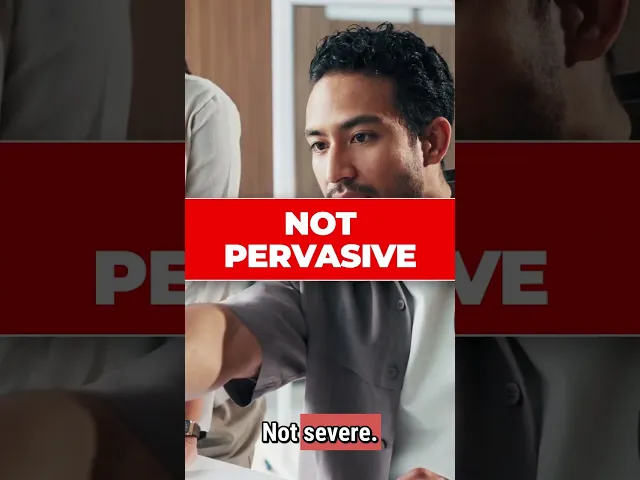
Watch: John breaks down exactly how a single FEHA complaint can cost California employers $100K or more, and what that exposure looks like in practice. Watch here →
Who FEHA Covers
FEHA's discrimination and retaliation protections apply to employers with five or more employees. The harassment protections apply to every California employer, regardless of size, even a single-employee operation.
FEHA also covers:
Current employees (full-time, part-time, temporary)
Job applicants: a discrimination claim can arise before anyone is hired
Unpaid interns and volunteers (in certain circumstances)
Independent contractors (for harassment protections)
Applicant-related exposure catches many employers off guard. A hiring decision, rejection, screening question, or interview process can serve as the basis for an FEHA discrimination claim.
What FEHA Requires From You: The Non-Negotiable Employer Obligations
Knowing FEHA exists is not the same as compliance. The law places specific, affirmative obligations on California employers.
1.
Post required workplace notices.
The CRD mandates specific posters about employee rights. Failure to post required notices can create separate compliance exposure.
2.
Adopt and distribute a written anti-harassment policy.
Must address sexual harassment specifically, outline a complaint procedure, and distribute it to every employee in writing. A verbal policy is difficult to prove and usually offers little practical defense value.
3.
Provide mandatory harassment prevention training.
Employers with five or more employees must provide harassment-prevention training every two years: two hours for supervisors and one hour for nonsupervisory employees.
4.
Engage in the interactive process for disability accommodations.
When an employer becomes aware of a potential disability-related work limitation, FEHA may require a good-faith interactive process to evaluate reasonable accommodations. Failing to initiate or continue that process is itself a FEHA violation, even if no accommodation was ultimately possible.
5.
Manage pregnancy disability leave correctly.
Employees disabled by pregnancy, childbirth, or related medical conditions may be entitled to up to four months of Pregnancy Disability Leave under FEHA. PDL is separate from CFRA bonding leave, and confusing the timelines can create avoidable exposure.
For a detailed breakdown of PDL obligations, see: Your Employee Just Announced a Pregnancy. Here's What California Law Requires You to Do
Where Employers Get Exposed: Common FEHA Violations
Most FEHA claims don't come from malicious intent. They come from policies that were never written, training that was skipped, or complaints that were mishandled.
Employer Risk Area | Why It Happens | Why It Matters |
|---|---|---|
No written harassment policy | The business relies on informal practices | Weak documentation makes the defense harder |
Missed harassment training | Training deadlines are not tracked | Training gaps can increase FEHA litigation risk |
Mishandled accommodation requests | Managers do not recognize disability-related triggers | Can lead to failure-to-accommodate and failure-to-engage claims |
Changed treatment after a complaint | Frustration, poor communication, or weak documentation | Retaliation exposure can become more serious than the original complaint |
Risky screening or interview practices | Hiring criteria are not reviewed for protected-category impact | Applicant claims can arise before employment begins |
The 2024 Ruling Every Employer Must Know:
In Bailey v. San Francisco District Attorney's Office, the California Supreme Court held that a single severe incident, including a coworker's use of an unambiguous racial epithet, may be enough to support a hostile work environment claim under FEHA.
Previously, courts weighed the totality of conduct over time. Now, one incident is enough. The practical consequence is that every harassment report must be taken seriously and responded to immediately, regardless of whether it was "just once."
Employers can face strict liability for actionable harassment by supervisors, even when senior leadership was unaware of the conduct. In cases of coworker harassment, employer liability often turns on whether the employer knew or should have known of the harassment and failed to take prompt corrective action.
For how retaliation claims layer on top of an FEHA complaint, see: Retaliation Claims in California: How Employers Defend Business Decisions
What Happens When a FEHA Complaint Is Filed Against You
Understanding the process is as important as understanding the law.
Step 1: CRD complaint filed
The employee files with the California Civil Rights Department. You will receive notice and should respond carefully, with supporting documentation and a clear factual record. Failing to respond can seriously damage the employer's position and may lead to adverse administrative consequences.
Step 2: CRD investigation
The CRD investigates, requests documents, and may conduct interviews. The employer's documentation, or its absence, shapes the outcome at this stage.
Step 3: Right to sue issued
After the CRD process, or sometimes immediately upon request, the employee may receive a right-to-sue notice and proceed to civil court. If an immediate right-to-sue notice is issued, the CRD generally does not investigate the complaint.
Step 4: Civil litigation
FEHA claims in court can recover lost wages, reinstatement, emotional distress damages, punitive damages, and attorney's fees, with no cap on damages. That last point meaningfully separates FEHA from federal employment claims.
What you do in steps 1 and 2, your documents, your response, and your demonstrated compliance, determines how much of step 4 you face.
DefendMyBiz handles FEHA defense at every stage: CRD investigations, civil litigation, mediation, and settlement. Our FEHA / EEO Defense team represents employers only. Every strategy is built from the employer's perspective.
What Employers Are Asking Online About FEHA Risk
FEHA issues do not always begin as lawsuits. They often begin as practical HR questions: “Do we need training?” “What do we do after a harassment complaint?” "When does a disability comment trigger the interactive process?” “How do we document that employees received the required policies?”
Reddit discussions show the same pattern. Employers often recognize that an issue may carry legal risk, but they are unsure what California law requires before the problem escalates.
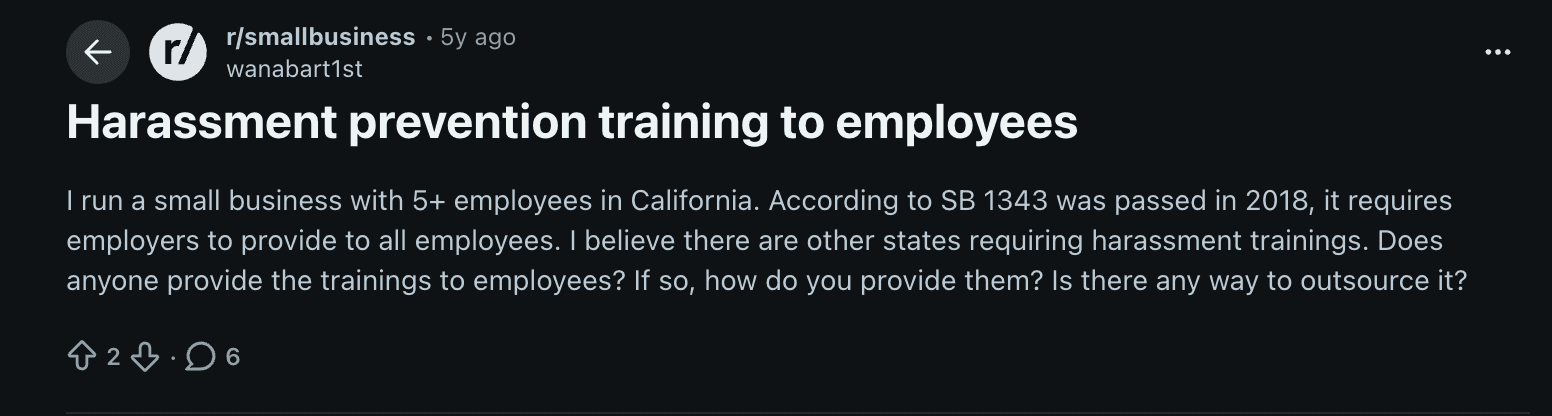
1. Employers are asking how to handle mandatory harassment-prevention training.
In a small-business Reddit discussion, California employers discussed harassment-prevention training requirements, including the state's one-hour employee training and two-hour manager training options. This directly connects to FEHA compliance because California employers with five or more employees must provide harassment-prevention training every two years.
Training is not just an HR checkbox. Employers should track completion dates, retain certificates, train new supervisors on time, and ensure policies align with the training employees receive.
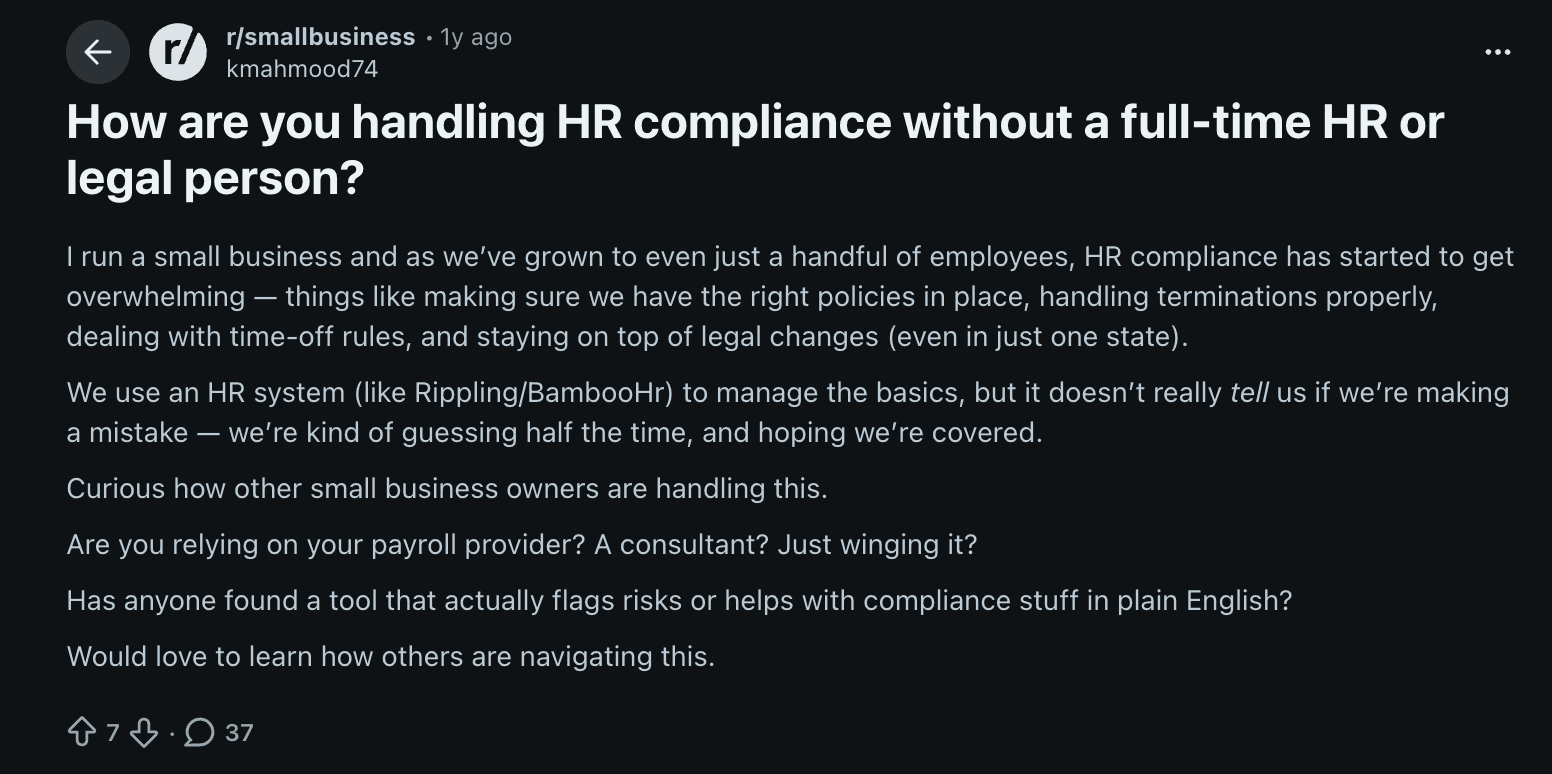
2. Small businesses are worried about HR compliance without a dedicated HR or legal team.
In another small-business discussion, a business owner said HR compliance had become overwhelming as the company grew, including policies, terminations, time-off rules, and evolving legal requirements. That concern is especially relevant in California, where FEHA obligations apply once a business reaches 5 employees, while harassment protections apply even below that threshold.
Growing employers should not wait until a complaint arrives to build policies. Written anti-harassment policies, complaint procedures, training records, accommodation workflows, and termination documentation should be in place before the first CRD complaint.
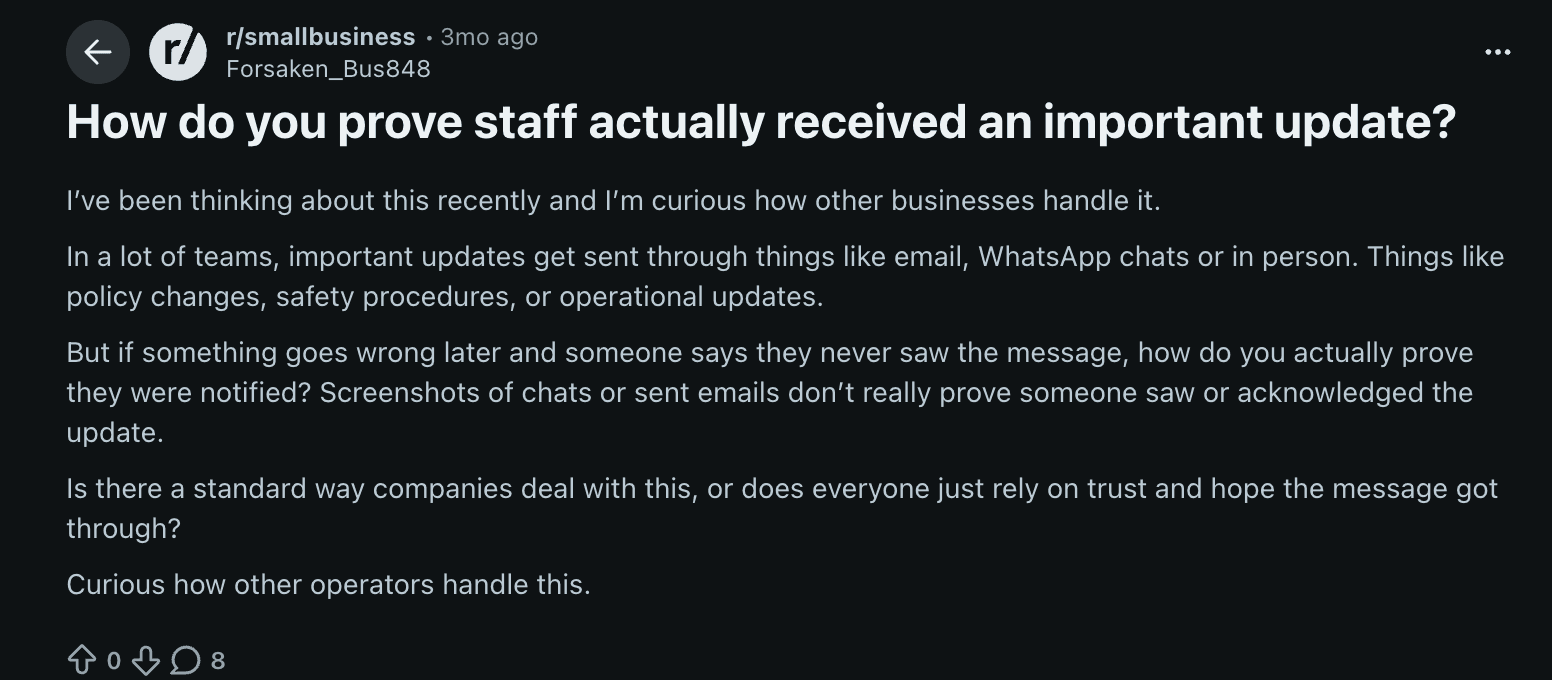
3. Employers are asking how to prove employees received important policies and training.
In a small-business Reddit thread, users discussed how to prove that employees actually received important workplace notices, training materials, or legally significant documents. This matters for FEHA because written policies, training records, acknowledgments, and complaint procedures can become critical evidence in a harassment, discrimination, or retaliation defense.
Employers should use signed acknowledgments, digital completion logs, policy receipts, training certificates, and centralized HR records. In FEHA litigation, the issue is often not just whether the employer had a policy, but whether the employer can prove it was distributed and enforced.
The larger lesson for employers: if a FEHA-related question is unclear enough to ask Reddit, it is important enough to document properly and review with counsel. California FEHA claims often turn on what the employer did before the complaint, how quickly it responded, and whether it can prove compliance through records.
FAQs
What is FEHA in California?
Does FEHA apply to small businesses?
How is FEHA different from federal law?
What is the interactive process under FEHA?
What should an employer do after receiving a CRD complaint?
Final Thoughts
FEHA is California's most significant employment protection law, broader than federal law, with uncapped damages and a three-year lookback window. It's a legal framework that demands written policies, documented training, proper accommodation processes, and a response protocol for every complaint. The 2024 Bailey ruling raised the stakes further: one incident can now be enough.
If a FEHA complaint has arrived, or you want to know where your business is exposed before one does, DefendMyBiz is ready. We represent California employers only.
Book your complimentary 15-minute consultation or call (818) 418-6625.
Disclaimer: The above content is for informational purposes only. This is not legal or tax advice. Laws, IRS guidance, and withholding requirements can change, and outcomes depend on specific facts. You are advised to contact a qualified attorney for any legal advice.


