California Extended the Equal Pay Deadline. Here's What Changed for Your Business
Wage & Hour Defense

If you run a business in California, the California Equal Pay Act statute of limitations changed on January 1, 2026, and it now works against employers in ways the old law didn't. Senate Bill 642 replaced a two-tier filing deadline with a flat three-year window that applies to every claim, plus a six-year reach into your payroll history once a claim is filed.
Read what changed, how the new timeline actually works, and what to check in your pay practices before it becomes a problem.
Key Takeaways
SB 642 replaced the old 2-year/3-year willful distinction with a flat 3-year filing deadline for all Equal Pay Act claims, effective January 1, 2026.
Employees may recover up to six years of lost wages if a timely Equal Pay Act claim is established under SB 642.
Each paycheck that reflects a pay disparity counts as a new violation under the continuing violation framework, thereby extending the period during which a disparity remains actionable.
"Wages" now includes bonuses, stock, profit-sharing, and benefits, not just salary or hourly pay.
"Sex" now means "another sex," explicitly extending equal pay comparisons to nonbinary employees.
Conducting a pay equity audit through legal counsel is generally the best way to maximize attorney-client privilege while evaluating potential Equal Pay Act exposure.
What SB 642 Actually Changed
Before SB 642, the California Equal Pay Act, codified at Labor Code §1197.5, gave employees two years to file a claim for a non-willful violation, or three years if the violation was willful. SB 642 eliminated that distinction.
Element | Before Jan 1, 2026 | After Jan 1, 2026 (SB 642) |
|---|---|---|
Filing deadline | 2 years (non-willful) / 3 years (willful) | 3 years for every claim, willful or not |
Back-pay recovery window | Generally tied to the filing period | Up to 6 years, once a claim is timely filed |
"Wages" definition | Base salary and hourly pay | Salary, bonuses, stock/stock options, profit-sharing, benefits, travel reimbursement, and more |
"Sex" definition | "Opposite sex" | "Another sex" — expressly covers nonbinary employees |
Pay scale requirement | Estimated range "for the position" | "Good faith estimate" of what's paid upon hire |
The statute now runs "three years after the last date the cause of action occurs," and the law spells out what counts as a new occurrence. A cause of action arises each time:
an unlawful pay practice is adopted
an employee becomes subject to it, or
an employee is affected by it, including every paycheck that reflects the disparity.
That third trigger is what makes the three-year clock functionally longer than it looks.
How the Three-Year Window and Six-Year Lookback Work Together
These are two different numbers doing two different jobs, and conflating them is the most common mistake we see:
The three-year window governs whether an employee can bring a claim at all. Because each paycheck reflecting a pay disparity counts as a new violation, an employee is rarely "too late" as long as the disparity is ongoing.
The six-year lookback governs how far back damages can be calculated once that claim is filed. Depending on the facts and the continuing nature of the alleged disparity, damages may reach back as far as six years once a timely claim is established.
In practical terms: a pay decision made today doesn't age out of exposure after two or three years anymore. As long as the disparity continues, the clock effectively resets with every pay period, and the damages window trails six years behind whenever a claim lands.
"Wages" and "Sex" Now Mean More Than You'd Assume
Two definitional changes expand who's covered and what's on the table in a claim, and both apply specifically to §1197.5, not the rest of the Labor Code.
Wages now include: salary, overtime pay, bonuses, stock and stock options, profit-sharing and bonus plans, life insurance, vacation and holiday pay, cleaning or gas allowances, hotel accommodations, and travel expense reimbursement. If your comp structure leans on equity grants, signing bonuses, or perks to close a gap in base pay, that gap is no longer invisible to a claim. Total compensation is now what gets compared.
Sex now means "another sex," replacing the old "opposite sex" language. This explicitly extends equal pay protections to nonbinary employees, meaning pay comparisons can now be made across any combination of genders, not just male-to-female.
Separately, SB 642 also tightened the pay transparency side of the law: job postings now require a "good faith estimate" of what you'd actually pay a new hire on day one. If your postings still show a broad catch-all range, that's worth revisiting during this review. It's enforced under the same statute.
Why This Raises Your Exposure
Run an illustrated calculation on a single employee:
A $20,000 annual pay gap, once six years of back pay are factored in, amounts to $120,000 in potential exposure before liquidated damages, attorneys' fees, or civil penalties are added. For a role with more than one affected employee, that number scales fast, and equal pay claims frequently arrive bundled with a parallel FEHA discrimination claim, since both often stem from the same underlying facts.
That overlap matters for how you defend the case.
If you're unfamiliar with how FEHA claims work alongside a wage claim like this, our guide on what FEHA is and what it covers is worth reading in tandem. The two statutes are often litigated together, so treating them as separate problems can leave gaps in your defense.
The records that decide these cases are the same records a plaintiff's attorney will request first. Incomplete or inconsistent versions of any of them make it much harder to prove a defensible pay gap after the fact.
What HR Professionals Are Discussing on Public Forums
Pay equity issues rarely begin with a lawsuit. More often, they begin when HR teams realize they cannot easily explain why employees performing substantially similar work are paid differently.
1) In one discussion on Reddit's HR community, an HR/payroll professional raised concerns after discovering internal compensation differences.
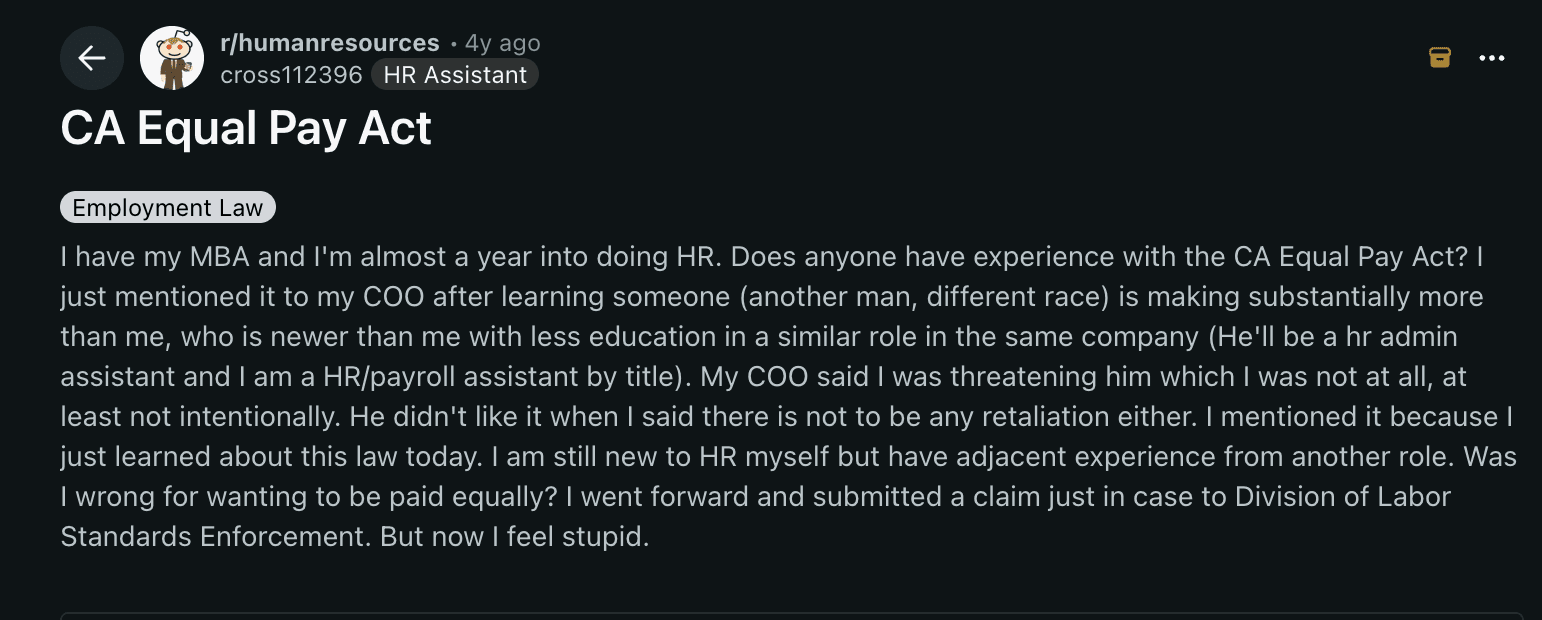
Rather than assuming an Equal Pay Act violation, experienced HR practitioners emphasized the importance of documenting legitimate compensation factors, including experience, job responsibilities, seniority, merit systems, and objective business reasons, before any challenge arises. Employers should have clear compensation structures instead of relying solely on individual salary negotiations.
2) Another recent California discussion centered on an employer refusing to provide an employee with the pay scale for their position.
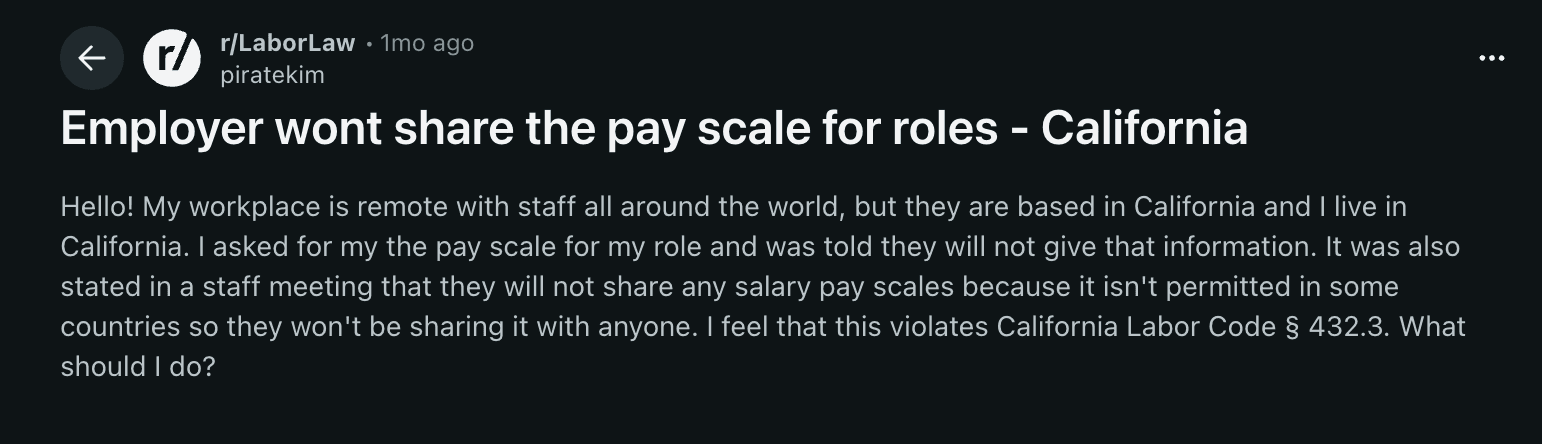
While an employee wrote the post, the discussion serves as a reminder for California employers that pay transparency obligations and compensation documentation are increasingly becoming part of Equal Pay Act disputes. Employers that cannot readily produce compensation policies, pay ranges, and objective reasons for wage differences may find themselves defending multiple Labor Code claims simultaneously.
Your Compliance Checklist Before the Next Pay Cycle
1.
Run a privileged pay equity audit.
Do this through counsel, not internally, so the findings stay protected by attorney-client privilege rather than becoming discoverable evidence against you.
2.
Compare total compensation, not just base pay.
Bonuses, equity, and benefits are all in scope now.
3.
Document your legitimate pay factors in writing.
Seniority, merit, and production-based systems, as well as bona fide factors such as education or experience, remain valid, but only if they're applied consistently and account for the entire wage difference.
4.
Extend your compensation records retention.
California's general payroll retention requirement is three years, but given the six-year damages window, retaining pay records, job descriptions, and performance documentation for at least seven years is now the practical floor.
5.
Review job postings for "good faith estimate" language
tied to what you'd actually pay upon hire, not a broad positional range.
6.
Brief your managers.
Pay decisions are made or influenced at the manager level far more often than HR realizes, and a manager who doesn't know what justifies a pay difference is your biggest unmanaged risk.
If a pay equity question has already surfaced in your business, that's the time to involve wage-and-hour defense counsel before conducting any further audit work outside of privilege.
Or, if you have questions about your compensation practices or are facing an equal pay claim, DefendMyBiz offers a free 15-minute consultation. Book a call with our employer defense team today.
Frequently Asked Questions
How far back can you claim equal pay under the new California law?
What was the statute of limitations for California Equal Pay Act claims before January 1, 2026?
What does the "continuing violation" doctrine mean for equal pay claims?
How long should employers keep pay records because of the new equal pay law?
Does SB 642 change anything besides the statute of limitations?
Can employers still justify pay differences?
Disclaimer: The above content is for informational purposes only. This is not legal or tax advice. Laws, IRS guidance, and withholding requirements can change, and outcomes depend on specific facts. You are advised to contact a qualified attorney for any legal advice.


