The PAGA Cure Procedure: Which Violations Qualify and Which Don't
PAGA Defense

Before assuming you can cure your way out of a PAGA notice, first determine whether the alleged Labor Code violation falls within California's expanded cure framework.
The 2024 PAGA reforms significantly expanded the types of violations you can cure before a lawsuit proceeds. For PAGA notices filed on or after June 19, 2024, the expanded framework covers 12 specified Labor Code sections, including wage statements, meal and rest period premiums, overtime, minimum wage, vacation pay, and expense reimbursement.
But "curable" does not mean automatically resolved. The procedure depends on the violation involved, the employer's size, and whether the employer is using the small-employer administrative cure process, the separate wage-statement cure process, or a court-supervised Early Evaluation Conference after litigation has begun.
Here's exactly what qualifies, what the cure actually requires, and how to avoid wasting the deadline on a cure process that doesn't apply to your situation.
Key Takeaways
For PAGA notices filed on or after June 19, 2024, the reforms expanded the cure framework to 12 specified Labor Code sections.
Employers with fewer than 100 total employees during the year before the PAGA notice may use the small-employer administrative cure process for qualifying violations.
An eligible small employer generally has 33 days from receipt of the PAGA notice to submit a cure proposal to the LWDA. If the LWDA issues a cure plan following a conference, the employer generally has 45 days after the conference to complete the required cure actions.
A cure proposal is not an admission of liability. The LWDA treats cure proposals as confidential settlement proposals that generally cannot be used to prove the validity of the underlying claim.
The cure process is not available indefinitely or automatically for every Labor Code violation. Employers must identify the exact statutory provisions alleged before deciding which resolution path to pursue.
What Actually Qualifies for Cure Right Now
The 2024 PAGA reforms expanded the cure framework for notices filed on or after June 19, 2024. The expanded framework covers 12 specified Labor Code sections:
Labor Code section | General violation covered | Cure framework |
|---|---|---|
§226 | Itemized wage statement requirements | Curable |
§226.7 | Meal/rest period premium payments | Curable |
§227 | Wage-payment requirements | Curable |
§227.3 | Vacation pay | Curable |
§510 | Overtime | Curable |
§512 | Meal-period requirements | Curable |
§513 | Makeup time | Curable |
§1194 | Recovery of minimum wages | Curable |
§1197 | Minimum wage | Curable |
§1197.1 | Minimum-wage penalties | Curable |
§2800 | Employer indemnification | Curable |
§2802 | Necessary business expenses | Curable |
The important point is that the 2024 reforms did not limit cure to four wage-and-hour violations. They deliberately expanded the framework to cover a broader group of Labor Code provisions. Minimum wage and unpaid vacation are violations that often surface alongside the late-final-pay issues we cover in our guide on minimizing waiting-time penalty exposure.
The first question should always be: What Labor Code sections does the notice allege, and when was it filed?
What About Violations That Aren't on the Cure List?
The expanded cure framework is not a blanket mechanism for every Labor Code violation.
For PAGA notices filed on or after June 19, 2024, the 2024 reforms specifically identify the Labor Code sections eligible for the expanded cure procedures. If a notice alleges provisions outside that framework, an employer should not assume that correcting the underlying practice will eliminate PAGA exposure.
That does not mean the employer cannot correct the underlying violation. It means the employer may not have access to the statutory PAGA cure mechanism that prevents a PAGA action from proceeding based on that violation.
For those allegations, the defense strategy may instead involve:
documenting reasonable steps taken to comply;
assessing whether statutory penalty reductions are available;
negotiating an early resolution;
challenging the sufficiency or scope of the PAGA notice;
or defending the claim through litigation.
For PAGA notices filed before June 19, 2024, the pre-reform framework may apply, so confirm the filing date before applying the current cure rules.
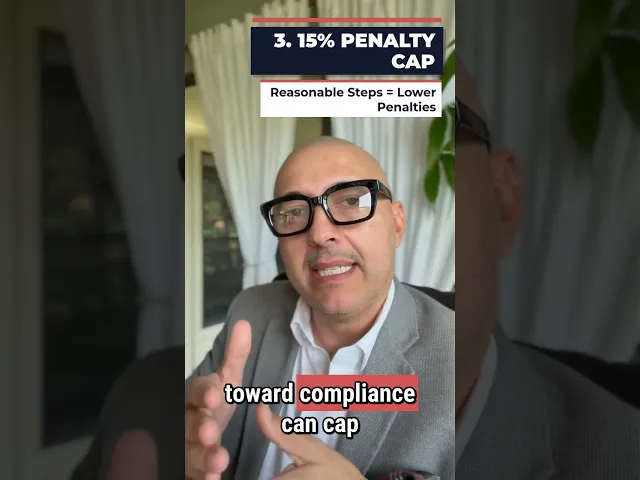
Watch: PAGA just got rules… after 20 YEARS. - a direct rundown of what changed in PAGA's first major overhaul in two decades, and why the rules around this process are still evolving, not settled.
How the Cure Process Works for Qualifying Violations
Assuming the alleged violation falls within the expanded cure framework, the procedure depends on the employer's size and the type of violation.
If you have fewer than 100 employees
The relevant test is more specific than simply looking at your current California headcount.
To qualify for the LWDA's small-employer administrative cure process, the employer must have employed fewer than 100 employees in total during the one year preceding the filing of the PAGA notice.
That count includes:
exempt and nonexempt employees;
current and former employees;
temporary, seasonal, and intermittent employees;
employees inside and outside California.
For staffing agencies, the calculation also isn't limited to employees placed with the particular client where the PAGA claimant worked.
If the employer qualifies:
1.
Submit the cure proposal within 33 days.
The employer must submit its proposal to the LWDA within 33 days after receiving the PAGA notice. There is a $75 filing fee for a cure proposal.
2.
LWDA reviews the proposal.
The LWDA has 14 days to determine whether the proposal is facially sufficient or whether a conference is necessary to evaluate whether the alleged violations can be cured.
3.
Attend the cure conference if scheduled.
The employer and employee, along with their respective counsel if represented, participate in the conference. The LWDA can seek information about the alleged violations, payroll practices, and workplace practices.
4.
Complete the cure plan.
If the LWDA determines that a sufficient cure is possible, it issues a cure plan describing the required corrective actions. Those actions must generally be completed within 45 days after the conference.
5.
Document completion.
After completing the cure, the employer submits a sworn notice describing the corrective actions and any additional records required by the cure plan. The LWDA then reviews the submission.
If you have 100 or more employees
The small-employer administrative cure process is not available to you.
However, for a PAGA lawsuit filed on or after June 19, 2024, an employer with 100 or more employees during the preceding one-year period may request a court-supervised Early Evaluation Conference after filing the lawsuit. Smaller employers may also request the process.
The EEC is a separate, post-litigation mechanism. Do not confuse it with the LWDA's pre-litigation administrative cure process.
That distinction matters:
Administrative cure: before the PAGA lawsuit, through the LWDA.
Early Evaluation Conference: after the PAGA lawsuit has been filed, through the court.
For an employer already facing litigation, the EEC can provide another opportunity to evaluate and potentially cure qualifying violations before the case moves deeper into discovery.
Wage-statement violations have their own cure process
Labor Code §226 provides a separate expedited process when wage-statement violations are the only violations the employer is attempting to cure.
Unlike the small-employer process, this option is available to employers of any size.
The employer must submit a notice to the LWDA and send it to the employee by certified mail within 33 days of the postmark date of the employee's PAGA notice. Unlike the small-employer process, the employer must complete the required cure actions within those 33 days.
This distinction is important because there is no single universal "33-day PAGA cure clock." The starting point and procedural requirements depend on the cure mechanism being used.
What "Making the Employee Whole" Requires
Curing isn't simply correcting the policy going forward.
For wage-related violations, the LWDA generally requires the employer to make each affected employee whole for the applicable violation. That means paying:
all amounts owed under the applicable Labor Code provisions for the three years preceding the PAGA notice;
7% interest on those payments;
any liquidated damages required by law; and
reasonable attorney's fees and costs as determined by the LWDA.
For wage-statement violations, the cure may also require corrected wage statements for each affected pay period for the past 3 years, depending on the type of defect. A failure to provide the employer's correct name and address is treated differently and can be cured through written notice identifying the correct information and affected pay periods.
The practical lesson is important: "cure" can be substantially more expensive than simply fixing the practice going forward.
If, for example, a meal-period issue affected employees for years, the employer needs to determine the historical amount owed, not just confirm that the policy is correct today.
Should You Pursue a Cure If the Violation Qualifies?
Qualifying for cure doesn't automatically mean cure is your best move. It's worth weighing the cure against other resolution paths:
Factor | Pursuing Cure | Other Resolution Paths |
|---|---|---|
Timeline | Statutory deadlines can be very short | Mediation or litigation may take longer |
Cost certainty | Historical payments and required corrective action can be calculated | Settlement amount may be negotiated |
Best fit | Clear, well-documented violations | Disputed facts or scope |
Evidence | Requires detailed payroll/workplace analysis | Discovery may provide more information |
Strategic value | Can prevent the cured violation from proceeding as a PAGA claim | May preserve more room to contest liability |
Cure can be particularly attractive when the underlying violation is clear, the affected population can be identified, and the employer can calculate the cost with reasonable confidence.
It can be less attractive when the alleged violation is factually disputed or when making employees whole costs significantly more than a negotiated resolution.
That's why you should make the decision after an immediate exposure analysis, not simply because the statute offers a cure mechanism.
Getting This Right Before the Clock Runs Out
1.
Confirm which Labor Code sections the notice actually cites.
Don't assume that every allegation qualifies simply because it involves wages, breaks, or payroll.
2.
Confirm when the PAGA notice was filed.
The 2024 reforms apply to notices filed on or after June 19, 2024. The pre-reform framework can govern older notices.
3.
Determine which cure procedure applies.
A small-employer administrative cure, wage-statement-only cure, and post-lawsuit Early Evaluation Conference have different requirements and deadlines.
4.
Document the date the notice was received and, for a wage-statement-only cure, the notice's postmark date.
The applicable 33-day deadline depends on the procedure you're using.
5.
Audit the full scope of the alleged violation before submitting a cure proposal.
An incomplete cure that misses affected employees, pay periods, or statutory requirements can leave the underlying exposure unresolved.
6.
Calculate the actual cost of making employees whole before committing to cure.
Include unpaid wages or expenses, interest, liquidated damages where applicable, corrected wage statements, and any other required components.
7.
Get counsel involved immediately if the notice alleges violations outside the cure framework.
Your strategy may need to shift toward reasonable-steps documentation, early resolution, or litigation defense.
If you're unsure whether your current compliance posture would even support a cure proposal, or want your documented "reasonable steps" strengthened for violations that don't qualify for cure at all, our guide on running a wage and hour audit before a claim does covers exactly the kind of proactive review that supports both paths.
Our PAGA Defense team can assess which violations in your specific notice qualify and which resolution mechanism makes sense before the deadline closes.
What Employers and HR Professionals Say About PAGA
The practical employer concern around PAGA is often less about the terminology and more about how quickly an apparently minor compliance issue can become a company-wide exposure.
In a 2026 r/humanresources discussion, an HR professional asked: "Has anyone gone through a PAGA?"
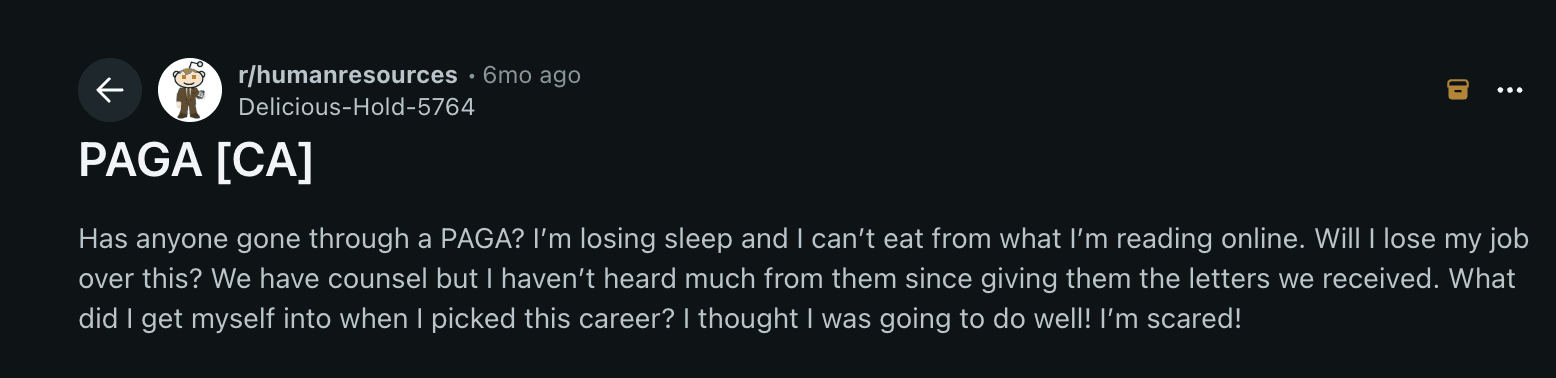
The poster described receiving PAGA-related letters, involving counsel, and feeling uncertain about what would happen next. Other HR professionals discussed involving counsel, reviewing the allegations, and examining wage-and-hour practices.
Another discussion centered on meal-period allegations and the employer's use of timekeeping attestations and automatic meal-premium calculations to identify and address missed or late meal periods.
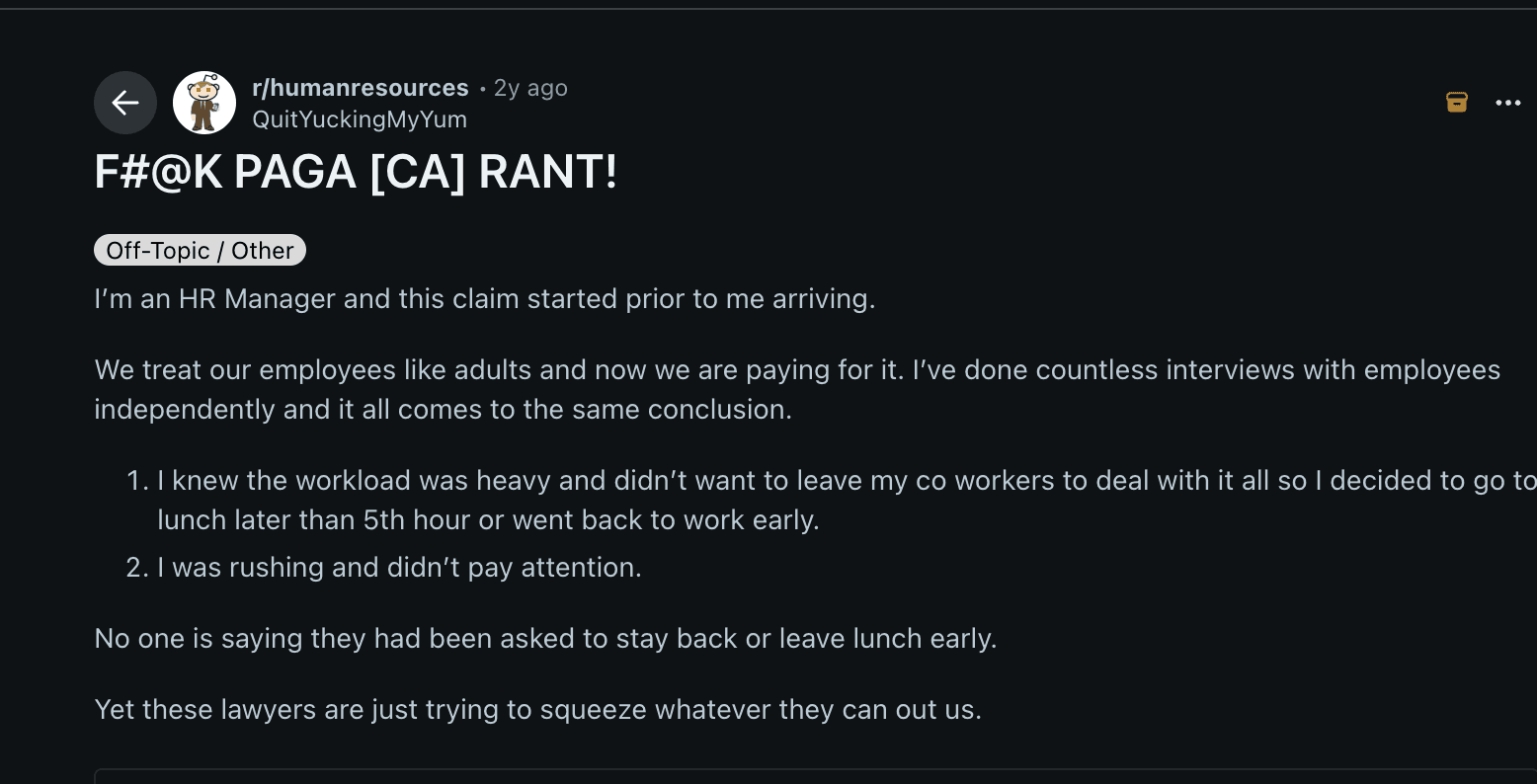
The employer-side lesson is important: the cure question only becomes useful if the employer can quickly identify the underlying violation, quantify the affected employees and pay periods, and document what has actually been corrected.
That's why the first response to a PAGA notice should be an immediate review of the specific Labor Code sections alleged, rather than assuming that every violation can or cannot be cured
Conclusion
California's 2024 PAGA reforms significantly expanded the cure framework. For PAGA notices filed on or after June 19, 2024, 12 specified Labor Code sections, including wage statements, meal and rest period premiums, overtime, minimum wage, vacation pay, and expense reimbursement, can fall within the expanded cure framework. The applicable procedure depends on the violation and the employer's circumstances.
For eligible small employers, the critical deadline is 33 days to submit a cure proposal after receiving the PAGA notice. If the LWDA issues a cure plan following a conference, the employer generally has 45 days after the conference to complete the required cure actions. Wage-statement-only cures have their own expedited process, including a separate 33-day deadline measured from the PAGA notice postmark date.
If you've received a PAGA notice and need to determine which cure process applies, DefendMyBiz offers a free 15-minute consultation. Book a call with our employer defense team today.
Frequently Asked Questions
What violations can be cured under California's PAGA cure procedure?
Can I cure a minimum wage violation under PAGA?
How long do I have to submit a PAGA cure proposal?
Is unpaid final vacation pay curable under PAGA?
What does "making an employee whole" require during a PAGA cure?
Disclaimer: The above content is for informational purposes only. This is not legal or tax advice. Laws, IRS guidance, and withholding requirements can change, and outcomes depend on specific facts. You are advised to contact a qualified attorney for any legal advice.