Headless PAGA Claims: What Leeper v. Shipt Will Decide (and How to Position Now)
PAGA Defense

A "headless" PAGA claim generally refers to a PAGA action in which the plaintiff seeks civil penalties only for violations allegedly suffered by other employees, while declining to seek an individual PAGA remedy for violations personally suffered. The strategy can matter when the employer has an arbitration agreement that would otherwise apply to the plaintiff's individual PAGA component.
As of this writing, the Court still hasn't ruled. Here's what's being decided, why three appellate districts disagree, and what protects you while the uncertainty continues.
Key Takeaways
A "headless" PAGA claim drops the plaintiff's individual claim entirely, pleading only a representative claim to avoid an arbitration agreement that would otherwise compel the individual piece.
Two appellate decisions directly support opposite approaches to headless PAGA actions, while a third appellate decision rejected Leeper's reasoning but expressly declined to decide the broader headless-PAGA pleading question.
The California Supreme Court granted review on its own motion in April 2025 to resolve the split, with briefing completed in January 2026 and a decision still pending as of this writing.
Neither possible outcome eliminates the underlying wage-and-hour violations that give rise to these claims. It only changes where and how they're litigated.
A documented compliance audit reduces your exposure, regardless of how this case is ultimately decided.
What Does "Headless" Mean Here?
A standard PAGA lawsuit has two parts:
An individual claim (violations the plaintiff personally experienced)
A representative claim (violations suffered by other employees, brought on the state's behalf).
The plaintiff's status as an "aggrieved employee" establishes PAGA standing. The individual PAGA component matters because arbitration agreements may apply to penalties for violations the plaintiff personally suffered.
A "headless" claim drops the individual piece entirely. The plaintiff pleads only the representative claim, then argues there's nothing left for your arbitration agreement to compel. No individual PAGA claim remains to compel arbitration, leaving the representative portion in court. Whether that strategy is legally available is precisely what Leeper will resolve.
Is This Legal? Three Courts, Three Different Answers
This is the precise question the California Supreme Court took up for review. Three appellate districts have reached three different conclusions:
District | Case | What the court actually decided |
|---|---|---|
Second District | Held that every PAGA action necessarily includes an individual PAGA component and ordered arbitration of that component. | |
Fourth District | Held that the complaint before it did not assert an individual PAGA claim; rejected Leeper's reasoning but expressly declined to decide whether headless PAGA actions are permissible. | |
Fifth District | Held that headless PAGA actions were permissible under the pre-June 19, 2024 version of PAGA. |
That's a genuine three-way split. The outcome in a given case can currently depend on which appellate district you're litigating in, a level of inconsistency the Supreme Court's review is meant to eliminate statewide.
What Is the Supreme Court Deciding?
On April 16, 2025, the Court granted review on its own motion. Neither party had requested review, and the Court directed the parties to brief two specific questions:
Does every PAGA action necessarily include both an individual and a non-individual claim, regardless of how the complaint is worded?
Can a plaintiff choose to bring only a non-individual (representative) PAGA action, dropping the individual piece entirely?
As of August 18, 2026, the California Supreme Court has not issued its decision. The case is fully briefed, and the Court has taken steps toward scheduling oral argument.
What Happens to Your Business Either Way?
Neither outcome eliminates the underlying compliance risk. It only changes where and how a claim gets litigated:
If the Court rules for employers
(adopting Leeper's reasoning), headless claims will no longer work as a statewide arbitration workaround. Plaintiffs with valid arbitration agreements will have their individual claims compelled to arbitration regardless of how they plead the complaint.
If the Court rules against employers
(adopting Galarsa's reasoning), the headless strategy would receive significant statewide support, subject to the current statutory framework and any subsequent legislative or judicial developments.
Either way, the wage-and-hour violations that give rise to these claims remain just as actionable as they were before this case. The arbitration question changes your procedural posture. It doesn't change whether the underlying claim has merit.
What California HR Professionals Worry About When PAGA Hits
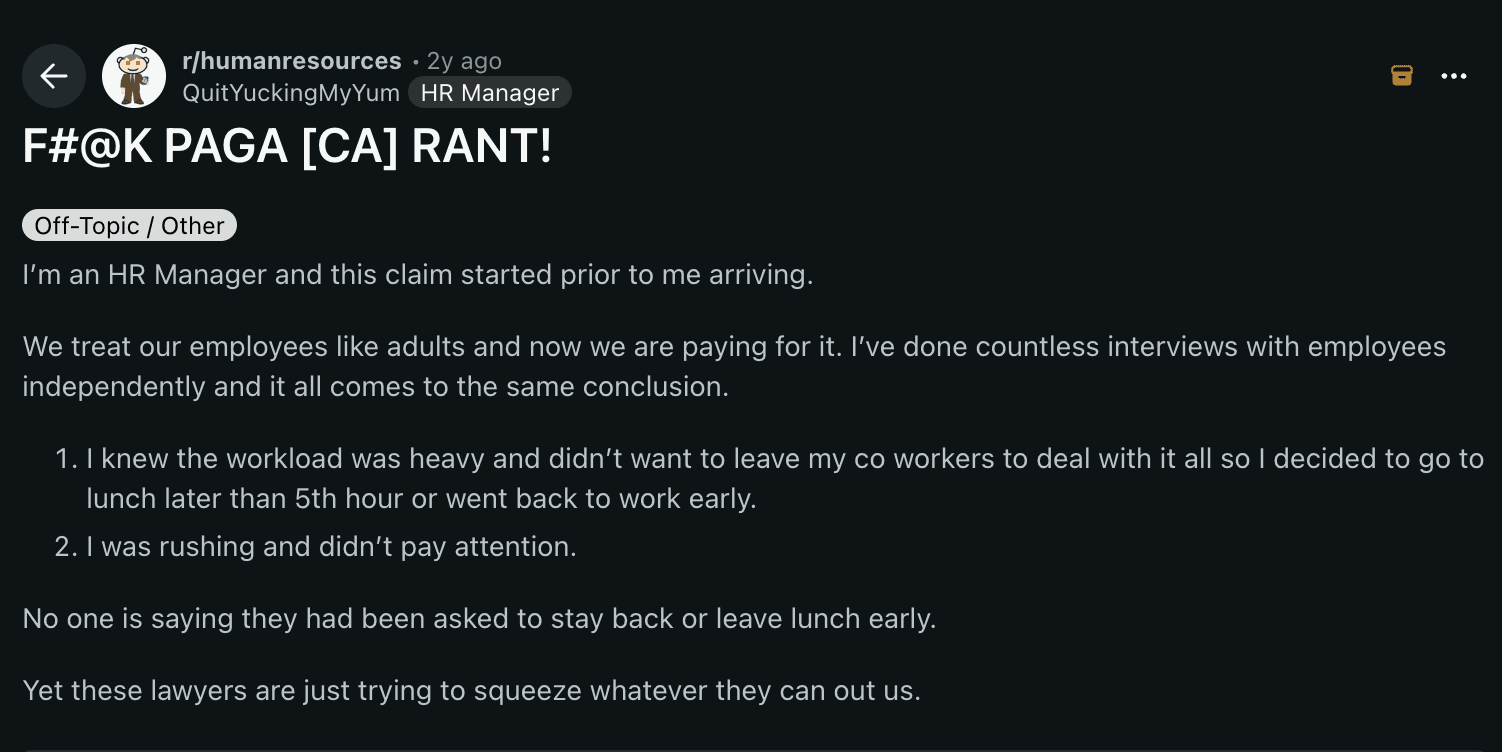
Employer-side Reddit discussions around PAGA focus far less on appellate doctrine than on the underlying operational problem: what wage-and-hour system failure created the claim in the first place?
An HR manager handling a PAGA claim described the frustration with meal-period allegations and the company's use of timekeeping attestations and automated meal-premium calculations.
In another February 2026 discussion, an HR professional facing a PAGA matter described the stress of receiving PAGA-related letters and trying to understand what the allegations meant for the business.

The employer lesson is straightforward: Leeper may determine how an arbitration agreement interacts with a headless PAGA pleading, but it doesn't fix a broken timekeeping system, incorrect wage statements, missed meal periods, or unreimbursed expenses.
How Should You Position Your Business While This Is Still Pending?
Waiting for the ruling isn't a strategy in itself, since PAGA notices are being filed against California employers right now, regardless of how this case resolves.
Don't assume your arbitration agreement is currently a reliable shield against a representative-only claim. Given the active split, whether it functions that way today depends on which district your dispute lands in.
Treat compliance as the real lever you control. Neither outcome in Leeper affects whether your meal breaks, wage statements, and expense reimbursement practices are actually compliant. That exposure exists independent of this ruling.
Run a documented compliance audit now, not after a notice arrives. Our guide on running a wage-and-hour audit before a claim covers exactly the kind of proactive review that reduces your exposure, regardless of how this case comes out.
If you're already facing a PAGA notice with a headless-style complaint, get counsel involved immediately to assess how your specific appellate district's current precedent applies. This is not a wait-and-see moment for an active claim.
Review your arbitration agreement's scope language independent of this issue. A separate line of cases has been narrowing the conditions under which arbitration agreements are enforceable in the first place. Our broader PAGA claims guide covers how these different pressure points on PAGA defense fit together.
Our PAGA Defense team tracks this case specifically. It can assess how the current split applies to your situation if a claim is already in motion, and our Class Action Defense team handles the arbitration-agreement side of this same strategic picture.
Conclusion
The California Supreme Court's decision in Leeper v. Shipt will resolve a three-way appellate split over whether a PAGA plaintiff can drop their individual claim entirely and pursue only a representative action to avoid arbitration.
But as of this writing, that decision hasn't been issued, and a ruling isn't expected until later in the 2026 court term. Until then, whether a headless claim can defeat your arbitration agreement depends on which appellate district the case is filed in.
If you're facing a PAGA notice, DefendMyBiz offers a free 15-minute consultation. Book a call with our employer defense team today. If you want to assess your compliance posture before one arrives, that's a paid 1-hour consultation instead.
Frequently Asked Questions
What is a "headless" PAGA claim?
What did the Leeper v. Shipt Court of Appeal ruling decide?
Has the California Supreme Court ruled on Leeper v. Shipt yet?
Does the outcome of Leeper v. Shipt eliminate my PAGA exposure?
What should I do if I'm facing a headless PAGA claim right now?
Disclaimer: The above content is for informational purposes only. This is not legal or tax advice. Laws, IRS guidance, and withholding requirements can change, and outcomes depend on specific facts. You are advised to contact a qualified attorney for any legal advice.


