AB 406 Expanded Leave for Crime Victims: New Employer Obligations
Hybrid / Non-FEHA Claims

If you're trying to figure out what AB 406 crime victim leave actually changed, one important change took effect on a specific date. AB 406 didn't create California's crime victim leave protections from scratch. That was AB 2499 in 2024.
AB 406 is a follow-up bill, signed on October 1, 2025, that expands paid sick leave use and adds one genuinely new anti-retaliation protection starting January 1, 2026. Here's exactly what AB 406 changed, what already existed under AB 2499, and what California employers should be doing now.
Key Takeaways
AB 2499 (2024) created the core framework: the "qualifying act of violence" definition, CRD enforcement, and the 25-employee threshold. AB 406 (2025) builds on it.
AB 406 took effect October 1, 2025. It clarified and expanded California's paid sick leave rules for jury duty, subpoenaed witness appearances, and certain crime-victim purposes.
The separate new judicial-proceeding protection under Government Code §12945.8(a)(4), and the corresponding paid-sick-leave use for that purpose, began January 1, 2026.
A "qualifying act of violence" applies even if no one was arrested, prosecuted, or convicted.
Adverse action after a leave request doesn't need to be a termination to trigger a retaliation claim. Schedule changes and negative reviews can qualify.
Certification documentation must be stored separately from the general personnel file, with confidentiality obligations that carry their own liability if mishandled.
Is It AB 406 or AB 2499? (They're Not the Same Bill)
This confusion shows up constantly, so it's worth settling first.
AB 2499, signed in 2024 and effective January 1, 2025, built the entire framework. It created the "qualifying act of violence" (QAV) definition, moved enforcement from the Labor Commissioner to the Civil Rights Department (CRD), set the 25-or-more-employee threshold, defined who counts as a "victim," extended protection to family members, and required annual written notice to employees.
AB 406, signed October 1, 2025, builds on top of that. It doesn't replace it. AB 406 has three practical effects for employers:
It expands the purposes for which paid sick leave may be used
Restores certain repealed Labor Code provisions solely for older claims arising on or before December 31, 2024
Adds a new January 1, 2026 protection for qualifying judicial proceedings under Government Code §12945.8(a)(4).
If your compliance checklist only references "AB 406," you may be missing the broader AB 2499 framework it sits atop. If it only references "AB 2499," you're likely missing the new January 2026 judicial-proceedings protection this article covers.
Does This Apply to Your Business?
Not every AB 406 protection has the same employee-count threshold. The broader qualifying-act-of-violence leave and family-member protections in Government Code §12945.8(b) apply to employers with 25 or more employees. But AB 406's new January 1, 2026 protection for attending qualifying judicial proceedings appears in §12945.8(a)(4), which does not contain that 25-employee threshold.
That distinction matters. An employer should not assume that having fewer than 25 employees automatically removes the new judicial-proceeding protection.
What Counts as a "Qualifying Act of Violence"?
This term determines whether a leave request is covered. It includes domestic violence, sexual assault, stalking, and a range of specified felonies, and it applies regardless of whether anyone was ever arrested, prosecuted, or convicted. An employee doesn't need a criminal conviction, or even an active case, for the underlying incident to trigger protected leave.
Specifically, for AB 406's new January 2026 judicial-proceedings provision, the definition of "victim" is narrower and more specific: it covers people affected by one of 14 different crimes, including violent and serious felonies.
What If the Employee's Family Member Is the Victim?
Coverage extends to employees whose immediate family members are victims, not just employees who are personally affected. The definition of "family member" is broader than that of spouse or child and includes specified relatives, a domestic partner, and a designated person who meets the statutory definition.
Do You Have to Pay for This Leave?
Not automatically. AB 406 and AB 2499 together don't mandate a new category of paid leave. Employees can use accrued vacation, personal leave, compensatory time, or paid sick leave where applicable.
What AB 406 specifically changed is that paid sick leave can now be used for jury duty, witness duty, and attendance at judicial proceedings tied to a qualifying act of violence, effective October 1, 2025. Previously, paid sick leave didn't clearly cover those specific purposes.
For the broader family-member protections under §12945.8(b), employers may limit total leave to 12 weeks, with additional limits in certain family-member-only circumstances. Those limits should not be described as a blanket cap on every form of leave.
Can You Request Proof Before Granting Leave?
Yes, but within limits. For covered unscheduled absences, an employer may request certification within a reasonable time after the absence. Acceptable documentation can include a police report, qualifying court documentation, documentation from a medical or support provider, or another document reasonably verifying that the qualifying act of violence occurred.
You must store that certification separately from the employee's general personnel file, and confidentiality obligations are real. Mishandling this documentation may compound your liability rather than protecting you from it.
What Happens If You Take Adverse Action After a Leave Request?
This is where most litigation risk lies.
It doesn't have to be a termination to create exposure. A negative performance review, a schedule change, or a shift to less desirable duties following a leave request can all support a retaliation claim. And because enforcement now sits with the CRD rather than the Labor Commissioner, these claims are investigated and remedied using the same tools the agency applies to harassment and discrimination complaints.
If a pattern exists, such as leave consistently denied or granted for one employee and refused for another in similar circumstances, that inconsistency becomes evidence a CRD investigation looks for. For a fuller picture of how CRD-enforced claims are built and defended, our guide to what FEHA actually covers is worth reading alongside this piece, since AB 406 and AB 2499 claims now run through the same civil rights enforcement structure.
What HR Teams Are Asking About Domestic-Violence Leave
The employer-side questions are revealing because they tend to focus less on the abstract right to leave and more on what HR should do when it learns of violence, how involved the employer should be, and how to balance confidentiality with workplace safety.
In one r/humanresources discussion, an HR professional described learning second-hand that an employee might be experiencing domestic violence and asked how HR should respond without overstepping the employee's privacy.
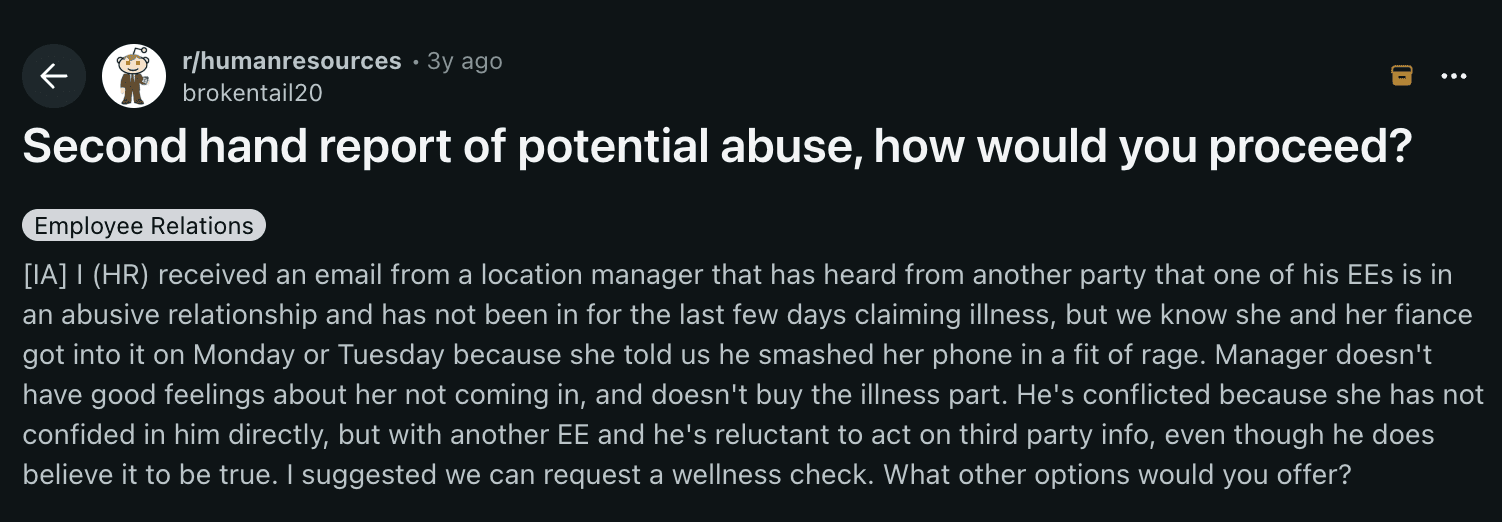
The discussion centered on whether HR should reach out, document the concern, provide resources, or remain out of the employee's personal situation unless the employee explicitly requests help.
A separate California HR discussion involved an employee experiencing apparent domestic violence and an employer's decision to remove an attendance bonus and threaten further write-ups.

The discussion raised the employer-side question of where ordinary attendance management ends and protected leave, safety, or retaliation concerns begin. The post came from a California workplace with about 35 employees, making the employer-size question particularly relevant to California's statutory framework.
What These HR Questions Reveal
The recurring employer questions are:
When does HR's knowledge of domestic violence create an obligation to act?
How much documentation can HR request?
When does an attendance issue become a protected-leave issue?
How should HR protect confidentiality while also addressing workplace safety?
Can a manager continue enforcing attendance or performance rules after a protected leave request?
What should an employer's written policy actually say?
Those are precisely the operational gaps AB 406 makes more important.
What California Employers Should Do Now
Update your leave policy to reflect both bills together: the AB 2499 framework and AB 406's PSL expansion and judicial-proceedings addition, not just whichever one you found first.
Confirm your paid sick leave policy explicitly allows use for jury duty, witness duty, and judicial proceedings tied to a qualifying act of violence.
Provide the required written notice to new employees upon hire, to all employees annually, upon request, and whenever an employee informs the employer that they or their family member is a victim.
Create a restricted-access process for storing certification and leave documentation. Maintain the records confidentially and disclose them only as permitted by law or when necessary to protect workplace safety.
Train managers specifically on retaliation risk. A manager who schedules a performance review right after a leave request, even without bad intent, can create liability regardless of intent.
Document every leave decision in writing when you make it, including the specific reason for any denial, tied to your business's actual capacity and operational needs.
Because these claims now run through the CRD alongside discrimination and retaliation matters, our Hybrid / Non-FEHA Claims team reviews leave policies and documentation for this kind of overlapping exposure before a denied request becomes a filed complaint.
Conclusion
AB 406, signed October 1, 2025, builds on the framework established by AB 2499 in 2024 rather than replacing it. It expands paid sick leave for jury duty, witness duty, and judicial proceedings (effective immediately). It adds a new anti-retaliation protection for attending judicial proceedings related to a qualifying act of violence, effective January 1, 2026.
Your policy needs to reflect both bills together. Your paid sick leave language must explicitly cover the newly added purposes, and any adverse action taken after a leave request must be supported by a documented, non-retaliatory business reason recorded at the time of the request.
If your leave policies haven't been updated to reflect AB 406's January 2026 changes, DefendMyBiz offers a paid 1-hour consultation to review them. Book a call with our employer defense team today.
Frequently Asked Questions
What is the difference between AB 406 and AB 2499?
What are the rights of crime victims to take time off work in California?
What is considered a qualifying act of violence?
Can I deny a crime victim leave request?
What changed for paid sick leave under AB 406?
Disclaimer: The above content is for informational purposes only. This is not legal or tax advice. Laws, IRS guidance, and withholding requirements can change, and outcomes depend on specific facts. You are advised to contact a qualified attorney for any legal advice.


