
Retaliation Claims After a Wage Complaint: How California Employers Defend the Documented Firing
Wage & Hour Defense

Let's assume a situation. An employee complains that they are owed unpaid wages. Sixty days later, you terminate them for a documented performance problem that predates the complaint entirely. Under California Labor Code §98.6, that timing can trigger a rebuttable presumption of retaliation.
A sound retaliation defense strategy for a California employer has to be built before this sequence occurs, not after. Here's how SB 497's presumption works, what evidence can help rebut it, and how employers can strengthen the record before a termination decision is made.
Key Takeaways
SB 497, effective January 1, 2024, created a rebuttable presumption of retaliation when an employer takes prohibited action within 90 days of specified protected activity under Labor Code §98.6 and §1197.5.
The presumption should not be described as a blanket 90-day presumption under §1102.5. Whistleblower retaliation under §1102.5 remains governed by its separate statutory framework.
Documentation created before the protected activity is what rebuts the presumption. Documentation assembled afterward, even if accurate, invites a pretext argument.
Civil penalties reach $10,000 per employee per violation, payable directly to the employee, in addition to back pay, reinstatement, and attorneys' fees.
Consistent discipline across similarly situated employees is one of the strongest available defenses against a pretext argument.
The 90-Day Presumption You're Actually Up Against
Senate Bill 497 (the Equal Pay and Anti-Retaliation Protection Act), effective January 1, 2024, amended Labor Code §98.6 and §1197.5 to insert a specific rule: if an employer disciplines or discharges an employee within 90 days of that employee filing a wage complaint or exercising Equal Pay Act rights, the law presumes the action was retaliatory. The burden shifts immediately to you to prove otherwise.
This is a meaningfully different posture from the one retaliation law used to have. Before SB 497, the employee carried the burden of establishing a prima facie case, including some evidence of causation. Now, qualifying timing can trigger the statutory presumption without requiring the employee first to establish the same preliminary showing that would otherwise be required.
The employer must then be prepared to rebut the statutory presumption with evidence supporting a legitimate, non-retaliatory reason for the action.
How the Rebuttal Actually Works
The 90-day presumption does not make termination unlawful. It changes the evidentiary posture. Once the statutory conditions are met, the employer should be prepared to:
Identify the legitimate, non-retaliatory reason for the employment action.
Produce contemporaneous records supporting that reason.
Show that the same standards were applied consistently to similarly situated employees.
Address any evidence suggesting that the stated reason was pretextual.
The practical consequence: the burden of production shifts to you first, and it shifts immediately. You don't get to wait until trial to explain the real reason for the termination. You need that explanation and the documentation behind it already in place by the time a claim is filed.
What Actually Survives This Standard
One of the strongest pieces of evidence is when the documentation was created. Contemporaneous records showing that the performance or conduct issue existed before the protected activity can significantly strengthen the employer's defense.
Documentation Type | Rebuttal Strength |
|---|---|
Performance issues documented before the wage complaint was filed | Strong: shows the reason predates the protected activity |
Issues documented for the first time after the complaint, describing pre-complaint conduct | Weak: looks reconstructed, invites a pretext argument |
Consistent discipline applied to similarly situated employees for the same conduct | Strong: undercuts a pretext argument directly |
A pattern of escalating discipline that stalled, then suddenly resumed right after the complaint | Weak: timing itself becomes evidence of pretext |
Vague, undated, or verbally-relayed performance concerns | Very weak: courts and the Labor Commissioner give this little weight |
Watch: Avoiding Retaliation Lawsuits - a direct walkthrough of exactly this pattern: a complaint, then a termination within 90 days, and why the presumption now applies even when the underlying reason was completely legitimate.
What Counts as Protected Activity?
Not every workplace disagreement about compensation triggers the same statutory protection. California Labor Code §98.6 expressly protects employees who make written or oral complaints that they are owed unpaid wages, file qualifying complaints or claims with the Labor Commissioner, or exercise other protected Labor Code rights.
Section 1197.5 separately protects activity related to the enforcement of equal-pay rights. Different retaliation statutes can apply to whistleblower disclosures, safety complaints, discrimination complaints, and other protected conduct.
The Financial Exposure Behind This
Labor Code §98.6 allows a civil penalty of up to $10,000 per employee for each violation, awarded to the affected employee. That's in addition to potential reinstatement, lost wages, interest, and other available remedies, depending on the forum and claims asserted.
Even a claim that ultimately fails carries real defense costs before it gets there, and the 90-day presumption makes early dismissal harder to secure than it used to be.
The practical result is greater defense pressure at the outset: employers may need to address the presumption and supporting documentation before they can meaningfully assess whether an early resolution is appropriate.
What California Employers Are Asking About Retaliation
Real-world HR discussions show that employers and HR professionals often struggle with two questions: when an employee's complaint becomes legally protected activity, and how to distinguish a legitimate employment decision from one that could look retaliatory after the fact.
For example, HR professionals discussing California retaliation issues have raised questions about employees alleging retaliation after complaints to management, as well as concerns about employees characterizing ordinary adverse employment decisions as retaliation.
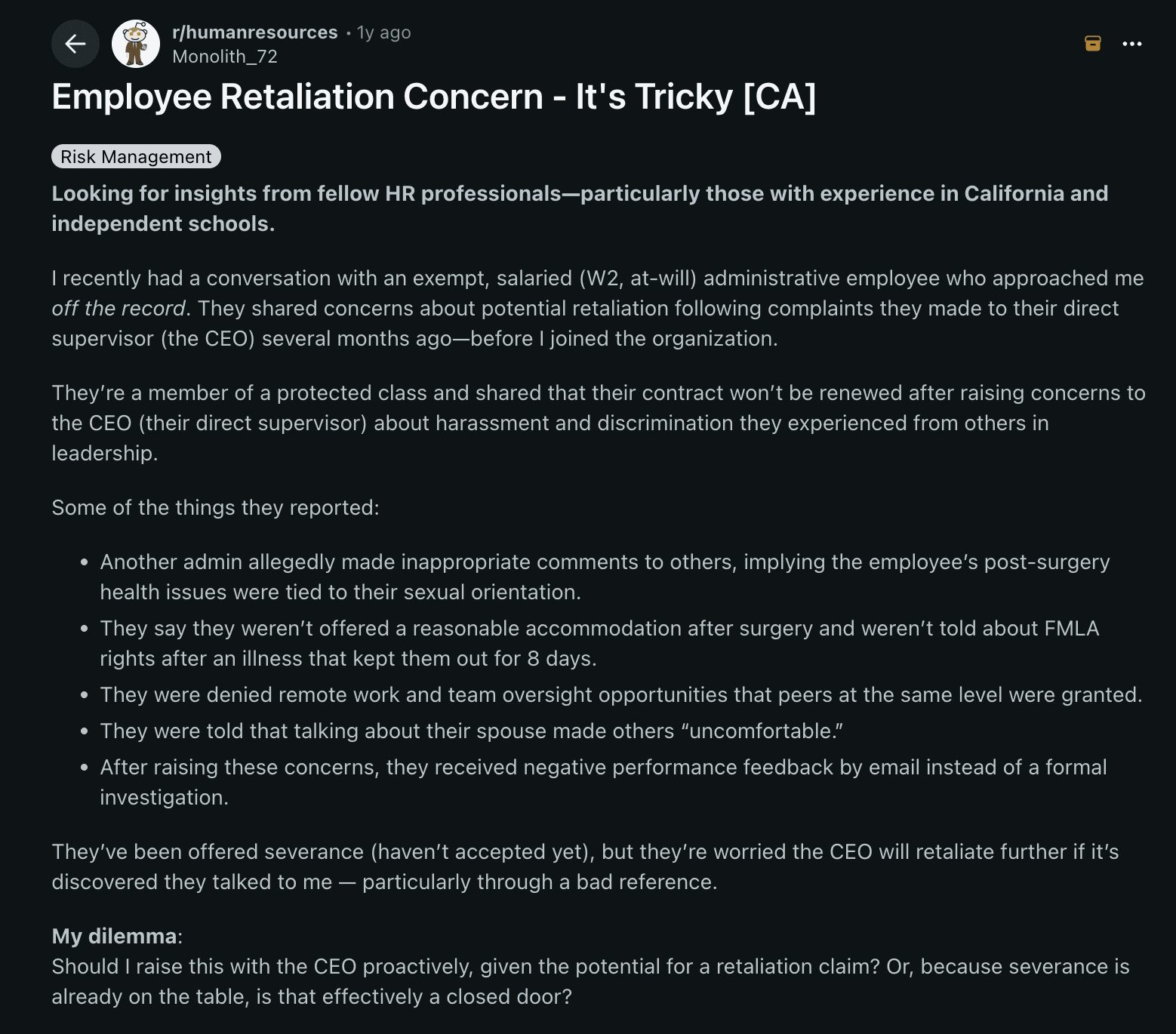
Questions employers and HR teams are actually asking:
"What should HR do when an employee claims retaliation after making a complaint months earlier?"
"When does an employee's retaliation allegation actually create legal exposure?"
"How should HR handle termination decisions when managers haven't documented performance problems consistently?"
The safest approach isn't to assume that every retaliation allegation is valid or that every termination is prohibited. It is to identify the protected activity, determine whether a statutory presumption applies, and evaluate the employer's contemporaneous evidence supporting the employment decision.
Building the Defense Before the Complaint Ever Arrives
1.
Document performance issues in real time, as they happen,
not retroactively once a complaint or termination is being considered. A contemporaneous record is what separates a legitimate business reason from something that appears to have been assembled after the fact.
2.
Apply discipline consistently across similarly situated employees.
If two employees violate the same policy and only one, the employee who recently complained, gets terminated, that disparity can become the centerpiece of a pretext argument.
3.
Train managers to recognize protected activity.
A supervisor who doesn't realize a wage question or informal complaint counts as protected activity can unknowingly create the exact causal link a plaintiff needs.
4.
Flag any pending termination decision that falls within 90 days of a known complaint,
and route it through legal review before it's finalized, not after the paperwork is already signed.
5.
Contact employer defense counsel the same day
a retaliation-adjacent complaint arrives, particularly if a termination decision is already in motion for that employee.
If a wage complaint has already surfaced and you're evaluating next steps for that specific employee, our guide on what qualifies as a wage-and-hour claim in California is worth reviewing alongside this piece. Understanding the strength of the underlying wage claim often shapes how a parallel retaliation risk should be handled.
Our Wage & Hour Defense team regularly reviews exactly this fact pattern: a pending termination that overlaps with a recent wage complaint, before the decision is finalized rather than after.
Conclusion
SB 497 created a rebuttable presumption of retaliation under Labor Code § § 98.6 and 1197.5. Whenever an employer disciplines or discharges an employee within 90 days of a wage complaint or Equal Pay Act activity, the burden shifts to the employer. The presumption doesn't require any showing of intent from the employee. The calendar alone triggers it.
Documentation created before the protected activity and applied consistently to similarly situated employees actually rebuts this presumption. Documentation assembled afterward, even if accurate, can read as reconstructed and give a plaintiff's attorney exactly the pretext argument the 90-day window was designed to support.
If a wage complaint has already been filed with the Labor Commissioner or another agency and you have a termination decision pending on that employee, DefendMyBiz offers a free 15-minute consultation. Book a call with our employer defense team today.
Frequently Asked Questions
What is the 90-day presumption under SB 497?
Can an employer still fire someone within 90 days of a wage complaint?
What penalties apply under SB 497?
Does SB 497's 90-day presumption apply to whistleblower claims under §1102.5?
What's the strongest defense against a retaliation presumption?
What counts as a protected wage complaint in California?
Disclaimer: The above content is for informational purposes only. This is not legal or tax advice. Laws, IRS guidance, and withholding requirements can change, and outcomes depend on specific facts. You are advised to contact a qualified attorney for any legal advice.


