Missed an Arbitration Fee Deadline? What Hohenshelt Means for Employer Defense
Class Action Defense

Before Hohenshelt, California courts generally treated a missed §1281.98 payment deadline as triggering automatic forfeiture of the employer's arbitration rights, even when the delay resulted from an inadvertent mistake.
The Hohenshelt arbitration fee deadline rule changed that on August 11, 2025, when the California Supreme Court replaced an automatic-forfeiture standard with a fault-based one.
But this ruling gives employers real protection only if they understand exactly what it covers and where a separate set of rules can still undo that protection entirely. Here's what actually changed and the practical risk most coverage of the decision leaves out.
Key Takeaways
Hohenshelt v. Superior Court (Aug. 11, 2025) rejected the rigid automatic-forfeiture interpretation of California Code of Civil Procedure §1281.98.
The 30-day payment deadline still exists. Hohenshelt allows relief from forfeiture when the late payment resulted from circumstances such as good-faith mistake, inadvertence, or excusable neglect rather than willful, grossly negligent, or fraudulent conduct.
Relief is not necessarily cost-free. The employer may still have to compensate the other side for losses resulting from the late payment, including qualifying attorneys' fees and costs.
The parties can establish a different payment period or agree to an extension, subject to the terms of the statute and arbitration agreement.
AAA's current Employment/Workplace Rules create separate consequences for nonpayment, including possible suspension or termination of an arbitration and potential consequences for future AAA cases involving the business.
Payment tracking, prompt correction, and contemporaneous documentation can be critical evidence when an employer seeks relief from forfeiture.
What Did Hohenshelt v. Superior Court Change?
Under California Code of Civil Procedure §1281.98, when the drafting party is responsible for arbitration fees or costs during the proceeding, it generally has 30 days after the payment due date to pay before the statutory forfeiture provisions are triggered, subject to the agreement's terms and the relief-from-forfeiture principles recognized in Hohenshelt.
In Hohenshelt v. Superior Court (S284498, decided August 11, 2025, by a 5-2 vote), the California Supreme Court held that §1281.98 is not preempted by the Federal Arbitration Act. But it rejected the rigid, no-exceptions reading lower courts had applied.
Instead, the Court held that the statute must be read alongside longstanding California contract principles, specifically Civil Code §3275, which allows relief from forfeiture when a breach isn't willful, grossly negligent, or fraudulent.
Before Hohenshelt | After Hohenshelt |
|---|---|
Any late payment = automatic forfeiture of arbitration rights | Forfeiture requires the delay to be willful, grossly negligent, or fraudulent |
Late payment was generally treated as a forfeiture of arbitration rights, regardless of the reason for the delay. | Courts must consider whether the delay was excusable under applicable relief-from-forfeiture principles. |
Employer bears no path to cure | Employer must establish facts supporting relief from forfeiture, including that the delay was not willful, fraudulent, or grossly negligent |
The Separate Risk: Your Arbitration Provider's Own Rules
Hohenshelt governs how California courts interpret §1281.98. It does not override the internal rules of the arbitration provider administering your case.
AAA's Employment/Workplace Rule R-56, effective May 1, 2025, adopted just months before Hohenshelt was decided, states that failure to pay arbitration fees "shall result in a waiver of the right to arbitrate," with no stated regard to intent or prejudice.
That's a stricter standard than what the California Supreme Court just softened. If your arbitration is administered through AAA, it remains uncertain whether a court will allow AAA's automatic-waiver rule to override the fault-based relief that Hohenshelt otherwise provides.
In practical terms: knowing your rights under Hohenshelt isn't enough if your arbitration agreement routes disputes through a provider whose own rules are more punitive than California law currently requires. This is worth checking specifically.
What Hohenshelt Did Not Decide
Two open questions are worth tracking, since either could change your practical exposure:
Can parties contract around §1281.98 entirely by expressly stating the agreement is governed solely by the FAA, not the California Arbitration Act? The Court noted parties are free to negotiate a different due date, but deliberately avoided deciding whether an express FAA-only election displaces §1281.98's deadline altogether.
Will this decision face further challenge? The dissent argued that the statute, even as construed by the majority, remains inconsistent with the FAA's equal-treatment principle. That disagreement signals that this area of law isn't fully settled, and further litigation, potentially reaching federal courts, remains plausible.
Don't Confuse §1281.97 With §1281.98
California's arbitration fee statutes contain separate deadlines. Section 1281.97 addresses fees and costs required to initiate an employment or consumer arbitration, while §1281.98 addresses fees and costs required during the pendency of an arbitration. Hohenshelt directly addressed §1281.98, although courts have subsequently considered its reasoning in cases involving §1281.97 as well.
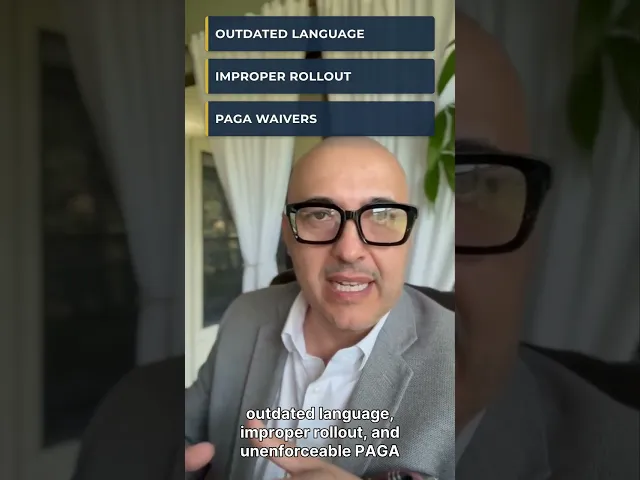
Watch: Arbitration Agreements Under Attack - useful context for how this fee-deadline fight fits into the broader pressure arbitration agreements are facing on multiple fronts right now.
What California Employers Are Asking About Arbitration
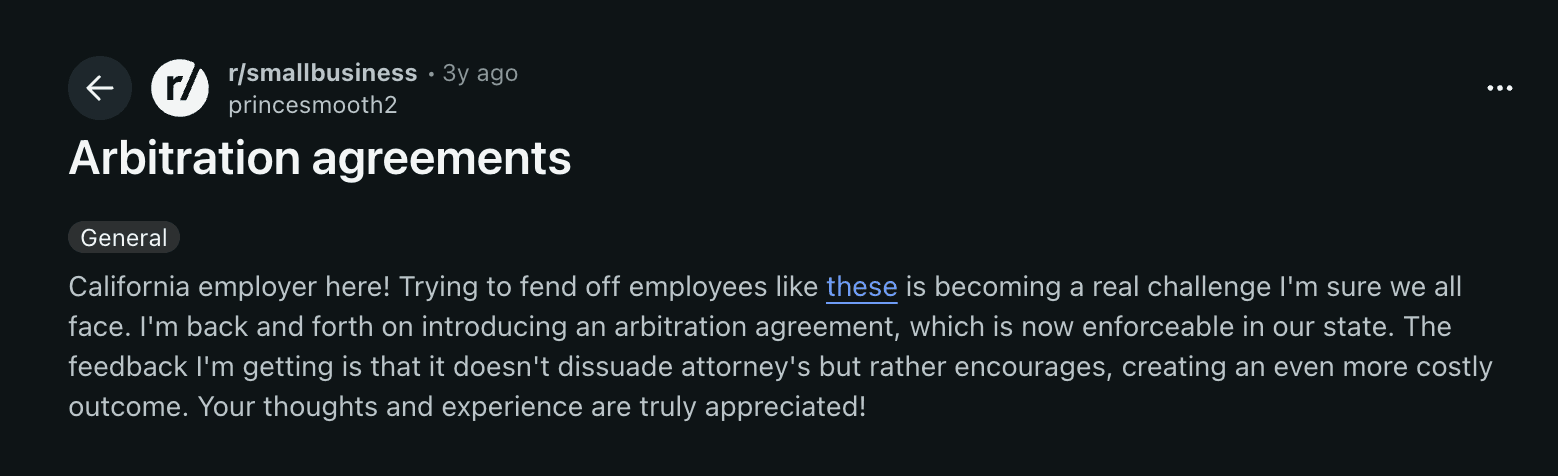
Employer discussions on Reddit show a recurring concern: whether arbitration actually reduces litigation exposure or instead creates another layer of cost and administrative risk.
One California business owner considering an arbitration program specifically questioned whether arbitration agreements discourage claims or simply make them more expensive to defend.
Hohenshelt adds another operational issue to that discussion: arbitration is only useful as a litigation-control mechanism if the employer has a reliable process for paying arbitration fees and documenting compliance with applicable deadlines.
How Employers Should Prevent Arbitration Fee Defaults
1.
Negotiate an extended payment window into your arbitration agreement.
The Court confirmed that parties can contract for a different payment period or agree to extend the statutory default deadline.
2.
Check which provider your agreement routes disputes to,
and specifically whether that provider's own rules (like AAA's Rule R-56) impose a stricter standard than California law currently requires.
3.
Centralize arbitration invoice tracking
with a single point of contact and deadline alerts. A centralized process reduces the risk that an invoice is lost or delayed between departments.
4.
Document everything if a payment does slip.
Date stamps, confirmation numbers, payment records, and a contemporaneous explanation can help establish that the delay resulted from inadvertence or excusable neglect rather than willful, fraudulent, or grossly negligent conduct.
5.
Contact the arbitration provider in writing the moment you discover a delay.
Proactive, documented outreach is exactly the kind of evidence courts look for when deciding whether a delay was genuinely inadvertent.
If a fee-deadline dispute has already escalated to a motion to withdraw from arbitration, the exposure isn't just the loss of your arbitration forum. It's the underlying claim that proceeds in court instead, often as the broader dispute covered in our guide on how employment class actions actually build in California.
Employer Arbitration Fee Deadline Checklist
Before a fee deadline arrives, confirm:
Who receives arbitration invoices?
Who is responsible for approving payment?
Who has authority to release payment?
What date is the invoice actually due?
What 30-day statutory deadline applies under §1281.98?
Does the agreement specify a different payment period?
Which arbitration provider's rules apply?
Does the provider have separate nonpayment procedures?
Who confirms that payment was actually received?
Where are payment confirmations stored?
Our Class Action Defense team reviews arbitration agreements and payment protocols together, since a fee-deadline slip often determines whether a dispute remains confined to arbitration or expands into litigation.
Conclusion
The California Supreme Court's decision in Hohenshelt v. Superior Court replaced an automatic-forfeiture rule for late arbitration fee payments with a fault-based standard. Forfeiture now requires that the delay be willful, grossly negligent, or fraudulent, with relief available for good-faith mistakes under Civil Code §3275.
But this protection operates only within California courts' control; if your arbitration is administered under rules like AAA's Rule R-56, which imposes an automatic waiver regardless of intent, that stricter standard may still apply and hasn't been tested against Hohenshelt in court.
Negotiate a longer payment window now, confirm which provider's rules actually govern your disputes, and build a documented payment process. Because the difference between a forgivable mistake and a forfeited right to arbitrate comes down entirely to what you can prove happened.
If you're facing a fee-deadline dispute, DefendMyBiz offers a free 15-minute consultation. Book a call with our employer defense team today.
Frequently Asked Questions
Does Hohenshelt eliminate the 30-day arbitration fee deadline?
What counts as excusable neglect after Hohenshelt?
Does Hohenshelt protect me if my arbitration is through AAA?
Can I contract around the 30-day deadline?
Should I still prioritize paying arbitration fees on time?
Disclaimer: The above content is for informational purposes only. This is not legal or tax advice. Laws, IRS guidance, and withholding requirements can change, and outcomes depend on specific facts. You are advised to contact a qualified attorney for any legal advice.


