
What Is an Employment Class Action in California? How These Cases Work, Step by Step
Class Action Defense

A single employee complaint can lead to a coordinated lawsuit affecting your entire workforce. That is how an employment class action works. By the time many California employers understand what is happening, the case is already in motion.
In 2025, plaintiffs filed 26,635 employment law cases in federal courts, the highest total since at least 2016. California-specific PAGA filings also remained elevated, with 9,343 filings in 2025, even after the 2024 PAGA reforms.
Class action lawsuits in California are not a rare legal theory. They're a business reality.
This guide explains what an employment class action is, how it forms step by step, what most commonly triggers one, the early warning signs to catch before a claim is filed, and what employers can do about it.
What Is an Employment Class Action Lawsuit?
An employment class action is a single lawsuit brought by one or a few employees on behalf of a larger group, alleging the same or substantially similar violations against the same employer.
Instead of filing dozens of individual cases, plaintiffs consolidate into one action. The employer faces one lawsuit, but the exposure represents the entire class.
California employers commonly face two related forms of representative employment litigation:
Type | Legal Basis | Who Brings It |
|---|---|---|
Traditional class action | California Code of Civil Procedure §382 / FRCP Rule 23 | Named plaintiff(s) on behalf of a certified class |
PAGA representative action | California Labor Code §2698 et seq. | One employee on behalf of all "aggrieved employees." |
PAGA claims are not traditional class actions. They allow an aggrieved employee to seek civil penalties for alleged Labor Code violations on behalf of the State of California and other allegedly aggrieved employees.
That said, PAGA is not limitless. For notices filed on or after June 19, 2024, California's PAGA reforms added important standing, cure, penalty, and early-evaluation rules. The scope of representative exposure depends on the violations alleged, the employee's standing, the affected workforce, and whether the employer took reasonable steps to comply
For how to challenge PAGA standing specifically, here's a quick read on PAGA Standing Challenges: How Employers Can Attack Who Filed and Why
How an Employment Class Action Forms: Step by Step
Understanding the timeline is critical. The employer's window to shape the outcome is widest in the early stages before certification.
Step 1: Attorney identifies a pattern
Plaintiffs' attorneys do not always wait for multiple employees to contact them. They actively investigate industries and companies for systemic violations of policies that apply uniformly to large groups of workers.
Step 2: Named plaintiff files the complaint
One or a few employees file a lawsuit alleging the violation on behalf of themselves and "all others similarly situated." The complaint describes the alleged class, who it includes, and what they're all owed.
Step 3: Discovery begins
Both sides exchange documents. The employer's payroll records, timekeeping data, policy manuals, job descriptions, and personnel files are all subject to discovery. What you have and what you're missing shape the litigation from here.
Step 4: Class certification motion
This is the critical battlefield for employers. In federal court, the plaintiff must satisfy Rule 23 requirements, including numerosity, commonality, typicality, and adequacy. In California state courts, certification is generally analyzed in terms of an ascertainable class and a well-defined community of interest, including common questions, typicality, and adequacy.
Step 5: Settlement, trial, or dismissal
Many employment class actions resolve through settlement before trial, often after key motions, discovery, or certification rulings. Class-action settlements generally require court approval. Cases that are not certified, or where certification is defeated, typically reduce to individual claims with substantially lower exposure.
Watch: John Fagerholm breaks down what employers actually need to know about class actions, how they form, how they end, and where the real leverage is. 🎬 The Truth About Class Actions: What Employers Need to Know
What Most Commonly Triggers Class Action Lawsuits in California
Class actions follow patterns. These are the violations plaintiff attorneys target first because they affect large numbers of employees in identical ways, making it easier for plaintiffs to argue certification.
Trigger | Why It Creates Class Exposure |
|---|---|
Unpaid overtime / misclassified exempt employees | A single exempt classification policy applied to a job category covers every employee in that role |
Missed meal and rest breaks | A uniform scheduling policy that routinely cuts into break time affects every employee on that schedule |
Off-the-clock work | Policies requiring pre-shift or post-shift work without pay apply the same way across a location or company |
Independent contractor misclassification | Every contractor in the same role faces the same classification decision. One incorrect classification decision can create broader exposure. |
Wage statement defects | A single payroll system error producing defective pay stubs generates a violation for every employee on every pay period |
Expense reimbursement failures | A written policy denying reimbursable expenses under Labor Code §2802 applies uniformly across the workforce |
The common thread is that a company-wide policy or practice, rather than an individual manager's decision, makes a class viable. Class exposure usually grows when the alleged violation comes from a common policy, recurring practice, or shared payroll system rather than a one-off personnel decision.
For a deep dive on defending these cases once certified, see: Defeating Wage and Hour Class Actions in California: An Employer's Defense Guide
Early Warning Signs Your Business May Already Be at Risk
The period before a complaint is filed is where employers have the most room to act. These signals indicate a class action may be forming:
Multiple employees raising the same pay or scheduling complaint independently: when the issue is systemic, workers start talking to each other before they talk to an attorney
High turnover concentrated in one role or location: often reflects a policy-level problem that plaintiff firms will frame as class-wide
An EEOC charge or DOL inquiry referencing company-wide practices: not just one incident
Individual lawsuits with identical legal theories: plaintiff firms sometimes test arguments through individual cases before consolidating
Outside attorneys contacting your employees directly: requests for records or informal interviews from counsel you don't recognize signal an active investigation
If any of these are present, the window to act proactively is now.
For misclassification specifically, which is one of the most common class action triggers, read Employee Misclassification in California: Independent Contractor vs. Employee
What to Do When a Class Action Notice Arrives
What happens in the first days determines the entire defense trajectory.
1.
Retain employer-side class action counsel immediately.
General business counsel may not be equipped for employment class action defense. The procedural complexity, certification strategy, discovery management, and PAGA coordination require specialized experience.
2.
Issue a litigation hold.
Preserve everything: payroll records, timekeeping data, personnel files, policy documents, communications. Destroying or altering relevant records after notice of a claim can create separate sanctions, adverse inferences, or additional litigation risk.
3.
Conduct an internal exposure audit.
Work with counsel to calculate actual exposure, not the inflated number in the complaint. Knowing your real risk drives every strategic decision that follows.
4.
Review your arbitration agreements.
A properly drafted arbitration agreement with a class-action waiver may require some claims to proceed individually rather than on a class basis. However, enforceability depends on the agreement, timing, notice, opt-out terms, applicable state and federal law, and whether PAGA claims are involved.
5.
Control internal communications.
Do not discuss the lawsuit with employees outside of counsel-approved communications and formal legal processes. Anything that appears to be retaliation or interference significantly escalates the case.
DefendMyBiz handles class action defense at every stage, from analyzing the complaint and attacking certification to negotiating a resolution or preparing for trial. We represent employers only. Our Class Action Defense team is built to defend employers in high-stakes representative litigation.
If a class action notice has arrived or you're seeing early warning signs, book your complimentary 15-minute consultation or call (818) 418-6625.
What Employers Are Asking Online About Class Action Risk
Employment class action risk often starts with the same questions employers ask online: "Can this payroll issue affect everyone?" "Can relaxed break enforcement create a PAGA claim?" "Will an overtime-control policy backfire?" "Do exempt employees need to track time?"
Reddit discussions from HR managers, small business owners, and California employers show that many class-action problems begin as everyday operational decisions.
1. HR managers are asking what happens after a PAGA notice arrives.
In one HR Reddit thread, a California HR professional said they were losing sleep after receiving PAGA letters and were unsure what would happen next. This reflects a real employer-side issue: PAGA and representative claims can create panic when the employer does not yet understand the scope, deadlines, or defense strategy.

A PAGA notice should trigger immediate document preservation, payroll review, counsel involvement, and deadline tracking. Waiting for the lawsuit to develop before reviewing exposure can make the defense harder.
2. Employers expanding into California are being warned about wage-and-hour litigation risk.
In an HR thread about an employer expanding to California, commenters specifically warned that wage-and-hour, meal-break, and rest-break compliance is where lawsuits often arise. That is a useful reminder for businesses entering California: policies that work elsewhere may not survive California's daily overtime, break, wage statement, and PAGA environment.
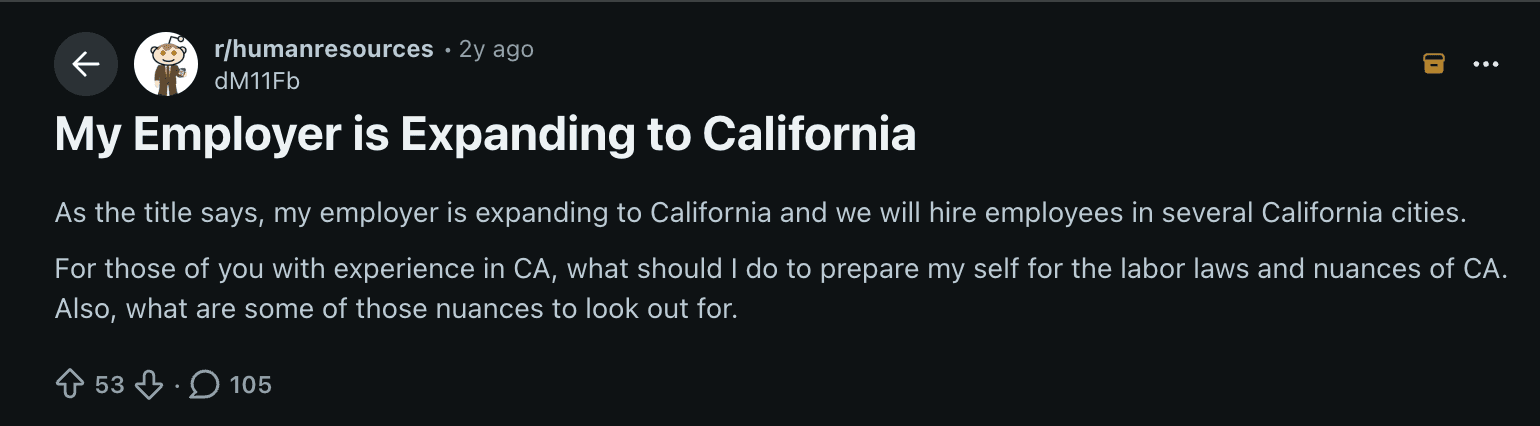
Employers entering California should not copy and paste national HR policies. California-specific audits should cover overtime, meal and rest breaks, wage statements, final pay, sick leave, reimbursements, arbitration agreements, and classification decisions.
The larger lesson for employers: if a pay, break, classification, or payroll-system question is broad enough to affect multiple employees, it is broad enough to become class-action or PAGA exposure. California employers should treat these questions as early warning signs rather than routine HR confusion.
FAQs
What is an employment class action in California?
What is the difference between a class action and a PAGA action?
How many employees are needed for a class action?
Can an arbitration agreement stop an employment class action?
Why does class certification matter so much?
Final Thoughts
An employment class action lawsuit in California can form quickly, expand to cover your entire workforce, and carry exposure most employers never anticipated. Understanding how these cases form, what policy-level violations trigger them, and what the employer's real defense options are at each stage is what separates businesses that absorb these cases cleanly from those that don't.
If a complaint has arrived or the warning signs are there, the time to act is now. DefendMyBiz represents California employers only. Book your complimentary 15-minute consultation or call (818) 418-6625.
Disclaimer: The above content is for informational purposes only. This is not legal or tax advice. Laws, IRS guidance, and withholding requirements can change, and outcomes depend on specific facts. You are advised to contact a qualified attorney for any legal advice.