Revoked Job Offer Leads to $93K Settlement: What California Employers Should Know
FEHA / EEO Defense

In June 2026, a California city agreed to pay $93,000 after allegedly rescinding a conditional job offer without following the process required by the California Fair Chance Act. The California Fair Chance Act (FCA) governs exactly how you're allowed to do that. Missing required steps can turn a routine background-check decision into a CRD complaint, a settlement, and mandatory changes to your hiring process.
Here's what happened in Signal Hill, what California law requires, and where employer hiring processes most often create avoidable risk.
Key Takeaways
A California city paid $93,000 after skipping the individualized assessment required before revoking a job offer based on criminal history.
The Fair Chance Act applies to any employer, public or private, with five or more employees, with only narrow, specific exemptions.
The two failures that drive these cases are treating a background check as an automatic disqualifier and failing to document consideration of the applicant's response.
Employers in the City of LA or unincorporated LA County face additional local ordinance requirements in addition to the state FCA.
Fair Chance Act claims can expose employers to CRD investigations and civil litigation involving lost pay, emotional distress damages, punitive damages, and much more.
What Happened: The Signal Hill Settlement
On June 17, 2026, the California Civil Rights Department (CRD) announced a $93,000 settlement with the City of Signal Hill in Los Angeles County over allegations that the city violated the California Fair Chance Act.
The dispute arose from a complaint CRD received in 2025 involving an applicant for a water systems operator position in the city's Public Works Department. The role included hydrant and pipeline repairs, meter reading, groundwater treatment, and customer service. After multiple rounds of interviews, the city extended a conditional job offer and then conducted a background check.
According to the complaint, the city allegedly:
Failed to conduct the required individualized assessment before denying employment based on conviction history;
Disregarded information the applicant submitted challenging the accuracy of the background check; and
Relied on criminal history information more than 7 years old and allegedly unrelated to the job.
Following a CRD investigation, the city settled, without admitting wrongdoing, for $93,000, plus a set of mandatory process changes: updated hiring policies, revised applicant notices, staff training on individualized assessments, and one year of CRD reporting on every hiring decision tied to criminal history.
A revoked job offer is just one of many ways a hiring or employment decision can lead to litigation. Here are some of the most common types of employment lawsuits California employers face.
What Is the California Fair Chance Act?
The California Fair Chance Act ("Ban the Box") took effect January 1, 2018, and applies to any employer, public or private, with five or more employees.
The core rule: you cannot ask about conviction history on a job application, and you cannot run a background check until after a conditional job offer is extended. If that background check turns something up, you can't simply rescind the offer. The law requires a documented, individualized assessment first. Although California's statewide FCA does not require the assessment itself to be written, documenting the analysis can be critical if the decision is later challenged.
Two Fair Chance Act Process Failures Employers Should Watch
From an employer-defense perspective, the allegations highlight two recurring process failures:
Mistake 1: Treating the background check as the decision rather than an input.
A conviction appearing in a background report should not automatically determine the hiring decision. For a covered position, the FCA requires the employer to assess whether the conviction history has a direct and adverse relationship with the specific duties of the job. A blanket "we don't hire anyone with a felony" policy is exactly the kind of shortcut that creates cases like this one.
Mistake 2: Ignoring the applicant's response.
Once you send a preliminary notice of intent to rescind, the applicant has the right to respond with evidence disputing the report's accuracy, or documentation of rehabilitation. Failing to consider the applicant's response can violate the Fair Chance Act process requirements. And even where the employer did consider the response, failing to preserve a record of that review can make the decision much harder to defend.
Both issues show why substance and process matter. An employer may believe it has a job-related reason for concern, but that does not eliminate the FCA's assessment and notice requirements.
California Fair Chance Act Exemptions: The Exceptions Are Position-Specific
The Fair Chance Act generally applies to California employers with five or more employees. But Government Code § 12952 identifies several position-specific exceptions. Employers should be careful not to treat an entire industry as exempt simply because some roles are subject to mandatory criminal-history screening.
Exemption Category | When It May Apply |
|---|---|
Employer size | The statewide FCA generally applies to employers with five or more employees |
State or local agency background checks | A state or local agency is otherwise required by law to conduct a conviction-history background check for the position |
Criminal justice agency positions | The position is with a criminal justice agency as defined by California law |
Farm Labor Contractor positions | The position falls within the statutory Farm Labor Contractor exception |
Legally required criminal-history screening | State, federal, or local law requires the employer or its agent to conduct a criminal background check or restrict employment based on criminal history |
The important distinction is that the exception is often tied to the specific position and the legal authority that requires the check.
For example, an employer should not assume that every healthcare, childcare, financial services, or public-sector position falls outside the FCA. The employer should identify the specific law that requires a background check or a criminal-history restriction before treating a position as exempt.
The Layer Most Multi-City Employers Miss
If you operate in more than one California city and especially anywhere in Los Angeles County, the state FCA is often not the only rulebook. The City of Los Angeles and unincorporated Los Angeles County both have their own fair chance ordinances layered on top of the state law, with stricter notice and assessment requirements.
The allegations against Signal Hill were a pure state-law issue since it's an incorporated city outside both of those local ordinances. But if your hiring footprint touches the City of LA or unincorporated county areas, you're managing multiple overlapping rulebooks, not just one.
Watch: Employer Law: Requirements for the Los Angeles Fair Chance Ordinance. This video is worth a look if any of your hiring occurs within LA city limits or unincorporated LA County, where local ordinances impose requirements beyond what Signal Hill's case even involved.
The Real Penalty Exposure
A procedural failure in this process can trigger a CRD complaint or become part of a civil claim under the Fair Chance Act. Because violations fall under FEHA, the exposure isn't limited to the CRD's investigation itself; it extends to civil litigation, statutory penalties, and reputational fallout that outlasts the case.
Here's the full range of what's actually on the table:
Risk Category | Potential Consequence |
|---|---|
CRD complaint | Investigation, mediation, and potential corrective measures |
Civil litigation | Back pay, front pay, emotional distress damages, and other available relief |
Punitive damages | Potentially available where the applicable legal standard is met |
Attorney's fees and costs | Potential exposure in FEHA litigation |
Policy and training obligations | Revised hiring procedures, notices, and staff training |
Ongoing reporting obligations | As seen in Signal Hill, periodic reporting to CRD |
Once a complaint is filed, you may be facing the same decision every employer in litigation eventually faces: settle early, as Signal Hill did, or fight it. That call depends more on the strength of your documentation than anything else.
Our recent breakdown of when fighting beats settling in California employment litigation walks through how that decision is actually made.
What Employers Are Asking About Background Checks on Reddit
The uncertainty around background checks is showing up in real HR discussions. In one Reddit thread, an HR professional asked whether an employer could allow a new hire to start before the background check was complete, citing an offer letter that made employment contingent on clearing the check.
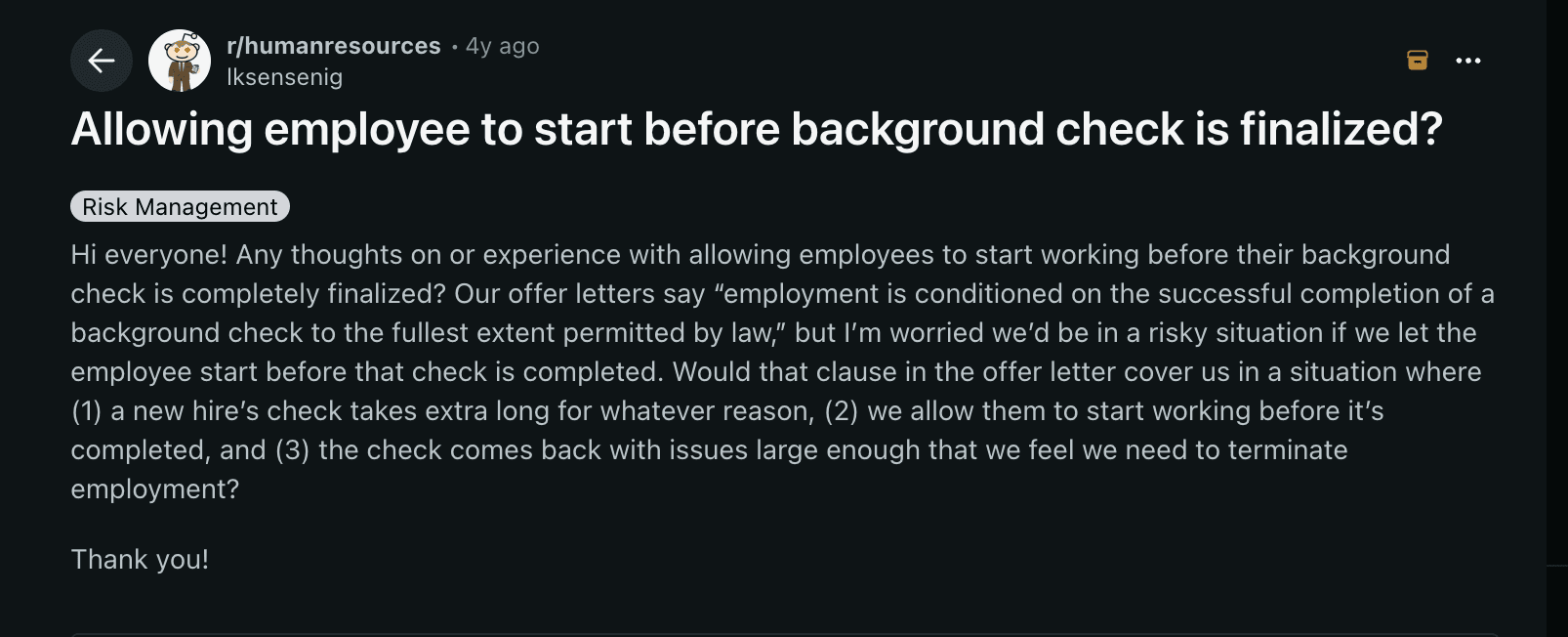
That concern matters in California. Starting work does not necessarily allow an employer to sidestep the Fair Chance Act process if criminal history later appears. The safer question is not simply whether the offer letter says "conditional," but whether the employer followed the required assessment, notice, and response process before taking adverse action based on conviction history.
For California employers, background-check timing should be part of the hiring workflow, not an issue resolved after the employee has already started.
The California Fair Chance Act Process: 7 Steps Before You Revoke an Offer
For most covered California employers, the safest way to think about the Fair Chance Act is as a series of steps. The order matters.
1.
Make a conditional job offer.
Do not ask about or consider conviction history before the conditional offer unless a statutory exception applies.
2.
Conduct the permitted criminal-history check.
Confirm that your background-screening process also complies with applicable federal and California consumer reporting laws.
3.
Review only the criminal history information the employer is legally permitted to consider.
California law restricts consideration of certain arrests, diverted matters, sealed records, and other categories of criminal-history information.
4.
Conduct an individualized assessment.
Determine whether the specific conviction history has a direct and adverse relationship with the specific duties of the position. Consider the nature and gravity of the offense, the time that has passed, and the nature of the job.
5.
Send a written preliminary notice if you intend to rescind.
Identify the conviction that forms the basis of the preliminary decision and provide the required information and documents.
6.
Give the applicant time to respond and reassess the decision.
The applicant generally must receive at least five business days to dispute the report's accuracy or submit evidence of rehabilitation or mitigating circumstances. The employer must consider information submitted before making a final decision.
7.
Send a written final notice if the offer is revoked.
If the employer proceeds with the decision, the final notice must include required information about any reconsideration process and the applicant's right to file a complaint with CRD.
The Signal Hill settlement is a reminder that a defensible hiring decision is not only about the final answer. The employer needs to follow the required process used to reach it.
If your hiring process has never been audited against the FCA's exact sequence, that's a gap worth closing before a complaint forces the conversation. Our FEHA / EEO Defense team reviews hiring workflows for exactly this kind of exposure.
If your current process doesn't automatically generate that paper trail, DefendMyBiz can review your hiring workflow and close the gap before it becomes your next CRD complaint. Book a free 15-minute consultation with our employer defense team.
Frequently Asked Questions
What are the exemptions to the California Fair Chance Act?
What is the 7-year rule for background checks in California?
Can an employer automatically disqualify an applicant with any criminal record?
How long must a California employer give an applicant to respond before rescinding a conditional job offer?
What happens if an applicant disputes their background check results?
Does the California Fair Chance Act require an individualized assessment to be in writing?
Can California employers ask about criminal history during an interview?
Disclaimer: The above content is for informational purposes only. This is not legal or tax advice. Laws, IRS guidance, and withholding requirements can change, and outcomes depend on specific facts. You are advised to contact a qualified attorney for any legal advice.


