
Most Common Types of Employment Lawsuits California Employers Face
General Defense Resources

California employers do not need to make an extreme mistake to face litigation. A missed meal break premium, a documentation gap, or a termination following a protected leave request can trigger a lawsuit costing six figures before it's resolved.
This guide explains what is actually being filed against California employers and which mistakes generate each claim.
Why California Is a Different Lawsuit Environment
California employment lawsuits usually start with small gaps that repeat: a late meal break, a vague termination record, an ignored complaint, or a payroll setup error.
The most common claims employers face are retaliation, wage-and-hour/PAGA, discrimination, wrongful termination, harassment, leave interference, and class or representative actions.
Documentation is the difference between a defensible business decision and a plaintiff's timeline.
If the reason for discipline, termination, pay treatment, or leave denial was not documented before the complaint, the defense gets harder.
Most exposure is preventable. Employers who document discipline, investigate complaints, and review decisions before taking adverse action are in a much stronger defense position.
Watch: John explains why California employers are being caught off guard by employment claims and what being unprepared actually costs. Watch here →
7 Common Types of Employment Lawsuits and What Triggers Each One
Lawsuit Type | Key Law | Primary Trigger | Employer Exposure |
|---|---|---|---|
Retaliation | FEHA, Labor Code, SB 497 | Adverse action after protected activity | Burden-shifting, emotional distress, and attorney's fees |
Wage & Hour / PAGA | Labor Code, IWC Wage Orders, PAGA | Pay stub, overtime, meal/rest, or final pay errors | Workforce-wide penalties and representative claims |
Discrimination | FEHA, Title VII | Adverse action tied to a protected characteristic | Uncapped FEHA damages and attorney's fees |
Wrongful Termination | FEHA, public policy, common law | Termination without clean documentation | Civil damages, punitive exposure, and fee leverage |
Harassment | FEHA, Title VII | Hostile work environment or supervisor misconduct | Investigation, retaliation, and failure-to-prevent exposure |
FMLA/CFRA Violations | FMLA, CFRA, PDL | Leave interference or post-leave discipline | Reinstatement, back pay, benefits, and retaliation claims |
Class / Representative Actions | Labor Code, FEHA, PAGA | Systemic policy or payroll failures | Multi-employee exposure without traditional class certification in PAGA |
The Six Claims Most Likely to Hit You Specifically
1.
Retaliation
Retaliation remains the most common EEOC charge category. In FY2024, retaliation appeared in 42,301 charges, representing 47.8% of all EEOC filings. Under SB 497, certain adverse actions taken within 90 days of covered protected activity may create a rebuttable presumption of retaliation. Even absent that presumption, an adverse action occurring close in time to a complaint, wage claim, leave request, or protected disclosure can create a serious retaliation fact pattern.
For how retaliation claims develop and how to defend them, read Retaliation Claims in California: How Employers Defend Business Decisions.
2.
Wage & Hour/PAGA
Labor and employment class actions rose about 10% in the 2024 Carlton Fields Class Action Survey. One systematic payroll error can create PAGA exposure across affected employees and pay periods, subject to standing, notice, cure, and penalty rules under the 2024 PAGA reforms. $100 per employee per pay period, across 50 employees for 12 months, totals $130,000 in PAGA penalties before litigation costs.
To understand how California wage-and-hour class actions are structured and how to defeat them, read Defeating Wage and Hour Class Actions in California: An Employer's Defense Guide.
3.
Discrimination
Employer-side litigation surveys continue to identify employment disputes, discrimination, harassment, and class actions as major areas of litigation exposure. California's FEHA covers more protected categories than federal law, with no cap on damages and a 3-year filing window.
4.
Wrongful Termination
Wrongful termination claims are common because they often attach to other allegations, including retaliation, discrimination, whistleblower activity, protected leave, and public policy violations. Public policy violations, implied contract claims, and terminations following protected activity all defeat at-will status. The absence of prior written documentation is one of the biggest weaknesses in the defense in these cases.
For the full wrongful termination defense framework: Wrongful Termination Defense in California: What Employers Need to Know.
5.
Harassment
This is the most emotionally charged claim type and the one where employer liability is hardest to cap. Harassment claims are difficult to defend when the employer delays the investigation, uses a biased investigator, fails to separate the parties when appropriate, or allows retaliation after the complaint is filed.
To know what liability actually looks like, depending on who committed the conduct, and what a defense that holds up requires, here's a quick guide: Sexual Harassment Claims Against California Employers.
6.
FMLA/CFRA Violations
Interfering with a protected leave or taking adverse action after an employee returns from leave are the two most common triggers. FMLA/CFRA violations can result in reinstatement, back pay, benefits, attorney fees, interference, retaliation, and exposure to civil litigation. In California, CFRA applies to employers with just 5 employees, and PDL, CFRA, and FMLA can stack to produce up to 7 months of consecutive protected leave that many employers don't anticipate.
For how PDL, CFRA, and FMLA interact and where employers get sued, read Pregnancy Disability Leave: Coordinating PDL, FMLA, and CFRA.
How to Avoid an Employment Lawsuit in California
Most employment lawsuits don't stem from ill intent. They come from five specific, preventable failures:
Acting too close to a protected event. Terminating, disciplining, or demoting an employee within weeks of a complaint, leave request, or protected disclosure creates a causation story the plaintiff doesn't have to prove. Under certain retaliation statutes, SB 497 may shift the burden earlier than many employers expect.
No documentation before termination. Courts expect PIPs, written warnings, and performance reviews. A termination without a paper trail looks retaliatory, regardless of the actual reason.
Inconsistent policy enforcement. Applying rules inconsistently across employees, even unintentionally, can create the basis for a discrimination claim. Documented consistency is the defense.
Ignoring an internal complaint. Receiving a harassment or discrimination complaint and failing to investigate promptly is a separate, independently actionable failure-to-prevent claim under FEHA § 12940(k).
Systematic payroll errors. RROP miscalculations, missing pay stub fields, and overtime errors are often systemic. They can affect every employee in the same pay structure and directly feed PAGA claims. One payroll configuration error, running for 26 pay periods across 50 employees, is already worth six figures in exposure before litigation starts.
For defense services across all claim types: Wage & Hour Defense → | FEHA / EEO Defense → | PAGA Defense →
What Employers Are Asking Online and What It Signals
Across Reddit's r/humanresources, r/managers, and r/smallbusiness, employers and HR professionals are not asking abstract legal questions. They are asking what happens when routine HR decisions start turning into retaliation, wage-and-hour, discrimination, harassment, and class-action risk.
1) "Can we terminate without a clean PIP or documentation?"
In one r/humanresources thread, an HR professional described a manager who wanted to terminate an employee but had little documentation in the employee's performance record. The discussion focused on whether the company had enough support for the decision.
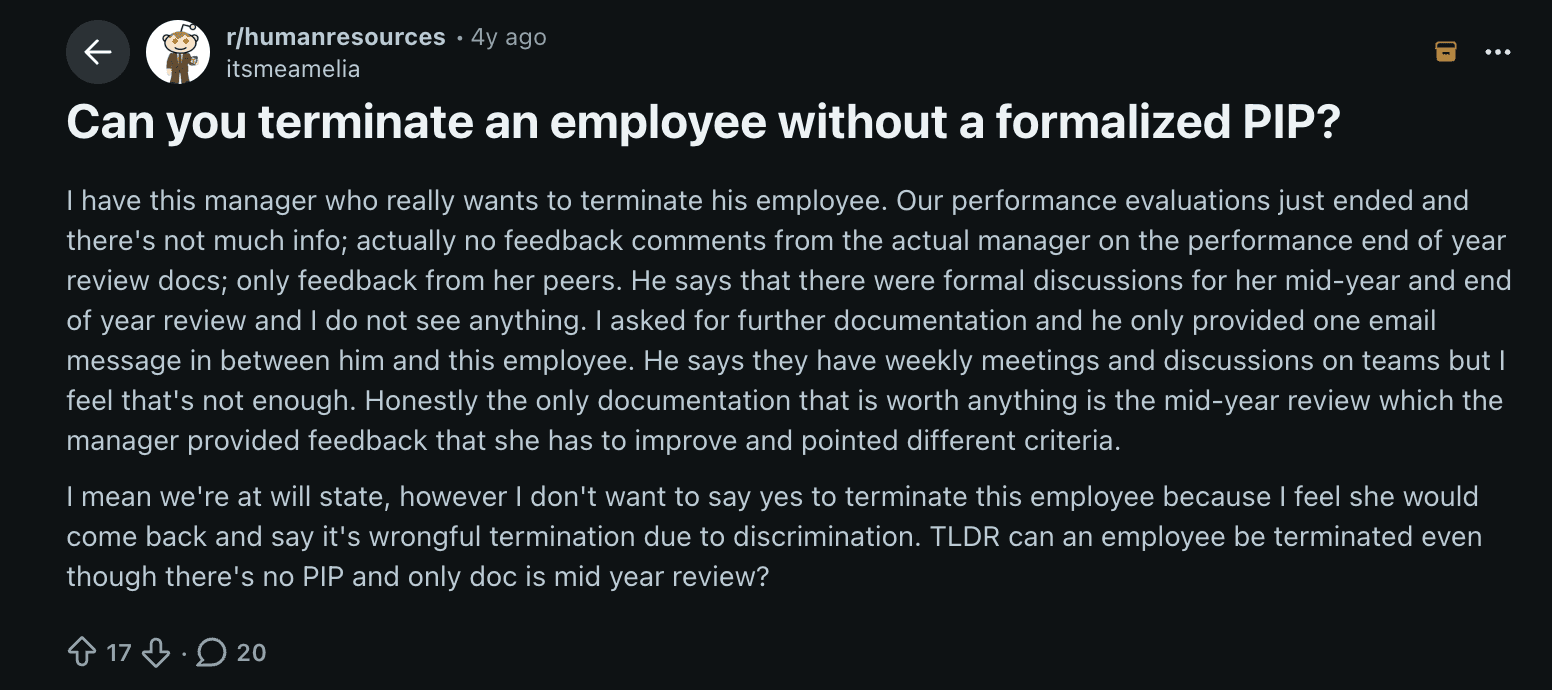
For employers, this is where wrongful termination and discrimination defenses start to fail. If the business reason is legitimate but not documented before the termination, the employee has room to argue that it was a pretext.
2) "Why does every employee issue turn into a retaliation concern?"
In a California r/humanresources thread, an HR professional asked why retaliation claims arise so often when employees challenge disciplinary actions, complaints, or workplace decisions.
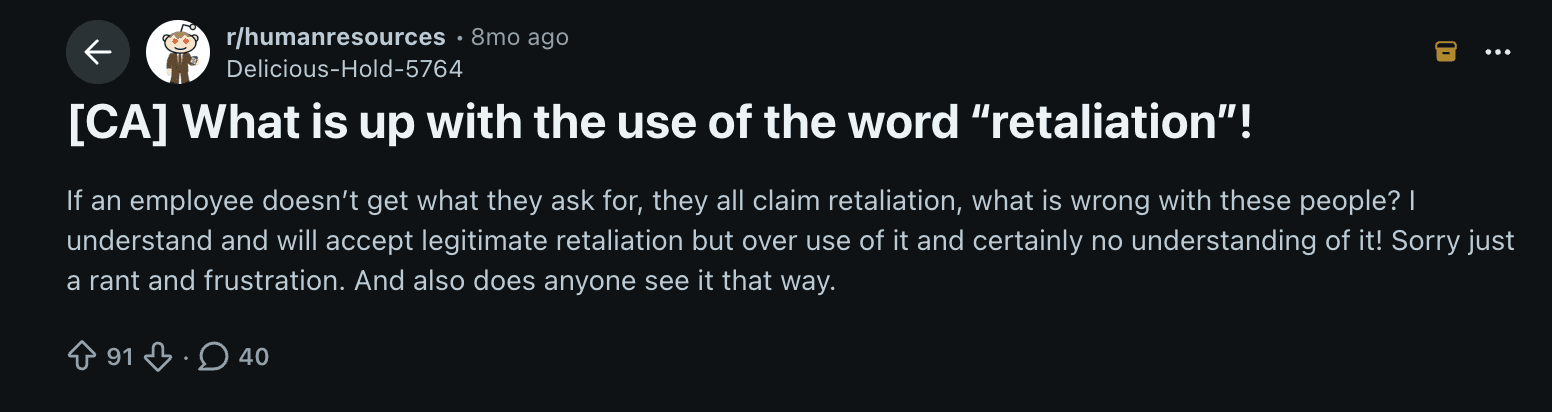
For employers, this is the timing problem. Discipline, write-ups, schedule changes, or termination after protected activity can constitute a retaliation claim, even when the underlying decision has a legitimate basis.
The employer takeaway: The most common employment lawsuits do not stem from a single category of mistake. They stem from recurring business-process gaps: undocumented discipline, inconsistent enforcement, payroll errors, weak investigations, and adverse actions too close to protected activity.
DefendMyBiz helps California employers defend against retaliation, wage-and-hour, PAGA, discrimination, harassment, wrongful termination, and leave-related claims before routine HR decisions are used as leverage in litigation.
Conclusion
The types of employment lawsuits hitting California employers in 2026 follow predictable patterns. Retaliation, wage-and-hour PAGA claims, discrimination, wrongful termination, harassment, and leave interference: all of them stem from specific, documentable mistakes that most employers make without realizing the exposure they're creating.
Know which claims are most common, know what triggers each one, and get defense counsel involved before a notice forces the conversation.
Contact DefendMyBiz for a free 15-minute consultation → | (818) 418-6625
FAQs
What is the most common employment lawsuit filed against California employers?
Can a small California employer be sued
What is the difference between a retaliation claim and a wrongful termination claim?
How quickly must an employer respond to an EEOC charge or CRD complaint?
What's the fastest way to reduce employment lawsuit exposure right now?
Disclaimer: The above content is for informational purposes only. This is not legal or tax advice. Laws, IRS guidance, and withholding requirements can change, and outcomes depend on specific facts. You are advised to contact a qualified attorney for any legal advice.


