Adding a Service Charge? California Law Says You May Already Owe Employees That Money
Wage & Hour Defense

If your restaurant added a mandatory service charge to cover rising labor costs, California law may limit how that money can be retained or distributed. The answer can depend on how the fee is described, what customers reasonably understand it to mean, how the restaurant actually uses the money, and whether a local ordinance applies.
A 2019 court decision, two newer state laws, and a growing list of city ordinances all weigh in on this, and a mismatch between the fee's label, disclosure, and actual treatment can create a gratuity or wage dispute. Know what actually controls the answer, and where most restaurants may get exposed without realizing it.
Key Takeaways
A service charge is a mandatory, business-controlled fee; a tip is voluntary and belongs entirely to employees under Labor Code §351.
Under O'Grady v. Merchant Exchange Productions, a service charge can be treated as a tip if a reasonable customer would believe it's intended for the staff, regardless of the employer's intent.
SB 478 (2024) generally bans hidden fees; SB 1524 exempts restaurants only if the fee is clearly disclosed, with a technical display standard taking effect on July 1, 2025.
A retained fee survives challenge only if it's tied to a specific non-labor cost, kept separate from payroll, disclosed before ordering, and explicitly not framed as compensation for service.
Santa Monica, West Hollywood, Berkeley, and Oakland each have independent local ordinances requiring distribution to non-managerial staff.
Service charge practices can create separate wage-and-hour exposure when amounts paid to nonexempt employees are not properly accounted for in regular-rate calculations.
What Is a Service Charge in California?
A service charge is a mandatory fee added to a customer's bill, set and controlled by the business, different from a tip, which a customer leaves voluntarily.
Under Labor Code § 351, gratuities are the sole property of the employee or employees for whom they are left or given. Employers and their agents may not keep any portion, although lawful tip-pooling arrangements may distribute gratuities among eligible employees.
A mandatory service charge is generally distinguished from a voluntary tip because the customer is required to pay it. But in California, the word "mandatory" does not end the analysis. Under O'Grady, a service charge may potentially be treated as a gratuity for purposes of Labor Code § 351 depending on the facts.
The Court Ruling That Changes Everything: O'Grady
In O'Grady v. Merchant Exchange Productions, Inc. (2019), a California Court of Appeal rejected the argument that a mandatory service charge can never qualify as a gratuity under Labor Code § 351.
The case involved a 21% service charge imposed on banquet food-and-beverage bills. A banquet server alleged that customers reasonably understood the charge to be a gratuity for service staff, even though the employer retained part of the charge and distributed other portions to managers and non-service employees.
The Court of Appeal did not ultimately decide that the service charge was a gratuity. The case arose at the pleading stage. Instead, the court held that the employee's allegations were sufficient to proceed and that a mandatory charge may potentially fall within § 351 depending on the facts, including what a reasonable customer would understand the payment to be for.
For restaurant employers, the risk is that calling a fee a "service charge" does not automatically keep it outside California's gratuity rules.
For the fuller picture of how a single mislabeled fee can become a wage claim, and what that claim actually looks like once filed, see our guide to what qualifies as a wage-and-hour claim in California.
How SB 478 and SB 1524 Changed the Disclosure Rules
Two more recent laws layered additional requirements onto the O'Grady analysis.
SB 478 (effective July 1, 2024) amended the Consumers Legal Remedies Act to prohibit advertising a price that doesn't include all mandatory fees the "no hidden fees" rule. It applies broadly to virtually any California business, not just restaurants.
SB 1524 (signed days before SB 478 took effect) created a food-and-beverage exception covering qualifying restaurants, bars, food concessions, grocery stores and grocery delivery services, and specified banquet or catering contracts, subject to disclosure requirements.
As of July 1, 2025, the disclosure must satisfy Civil Code § 1791(u)'s "clear and conspicuous" standard. The language must appear in larger type, in contrasting type, font, or color, or be set off by symbols or other marks in a manner that clearly calls attention to it.
Law | What It Requires | Who It Applies To |
|---|---|---|
SB 478 (Jul 2024) | All mandatory fees included in advertised price | Nearly all California businesses |
SB 1524 (Jun 2024) | Restaurant exemption from SB 478, if fee is clearly disclosed | Restaurants, bars, food vendors |
Civil Code §1791(u) (Jul 2025) | Technical "clear and conspicuous" display standard | Applies to SB 1524's disclosure requirement |
A disclosure violation can create consumer-protection exposure under the CLRA, including claims for actual damages, restitution, injunctive relief, punitive damages where available, and attorney's fees. California law also provides that the total damages award in a CLRA class action may not be less than $1,000.
What Makes a Service Charge Riskier Under California Law?
California law does not provide restaurants with a simple four-part safe harbor for retaining a mandatory service charge. Instead, employers need to evaluate the fee's wording, purpose, customer-facing disclosures, actual use, and any applicable local ordinance together.
From an employer-defense perspective, several facts can increase the risk of a Labor Code § 351 dispute:
The fee sounds like compensation for service. Terms such as "service charge," "auto-gratuity," or other staff-focused descriptions may affect how a reasonable customer understands the payment.
The restaurant tells customers the fee supports employees. Descriptions that tie the charge to wages, healthcare, benefits, or staff compensation may be relevant to the gratuity analysis.
The restaurant's practices do not match its disclosure. A fee described one way on the menu but handled differently in accounting or payroll creates a factual inconsistency that can be difficult to defend.
Managers or the business retain money customers may understand as intended for service employees. That was central to the allegations in O'Grady.
A local service charge ordinance applies. Some California cities impose separate distribution requirements on hospitality employers.
The practical lesson is not that one disclaimer makes a service charge safe. Restaurants should review the fee's label, stated purpose, customer disclosures, accounting treatment, payroll treatment, and local law requirements as a single connected policy.
Why Service Charge Payments Can Create Overtime Exposure
The service charge issue can create a separate payroll problem when mandatory charge proceeds are distributed to employees.
Voluntary tips generally are not included in an employee's regular rate of pay for overtime calculations. Mandatory service charges are different. Under federal wage-and-hour guidance, amounts distributed to employees from compulsory service charges are not treated as tips and may need to be included in the regular rate.
That means a restaurant can distribute service charge proceeds to hourly employees and still create an overtime underpayment if payroll calculates overtime using only the employee's base hourly wage. For employers, the audit question is straightforward: If service charge proceeds were paid to nonexempt employees, did payroll include the required compensation in the regular-rate calculation?
If the answer is no across multiple employees and pay periods, the resulting overtime claim can expand beyond the original service charge dispute.
If you're unclear on how that process actually plays out, our guide on what happens when a DLSE claim arrives walks through it step by step. And if one already has, Should You Settle or Fight This DLSE Claim? is the framework worth reading before you respond.
What Restaurant Teams Are Discussing About Service Charges
The confusion over labels is already showing up in real restaurant discussions. In one Reddit post, a restaurant worker described management changing the wording on customer bills from "gratuity" to "service charge" and then using part of the charge to offset a manager's salary.
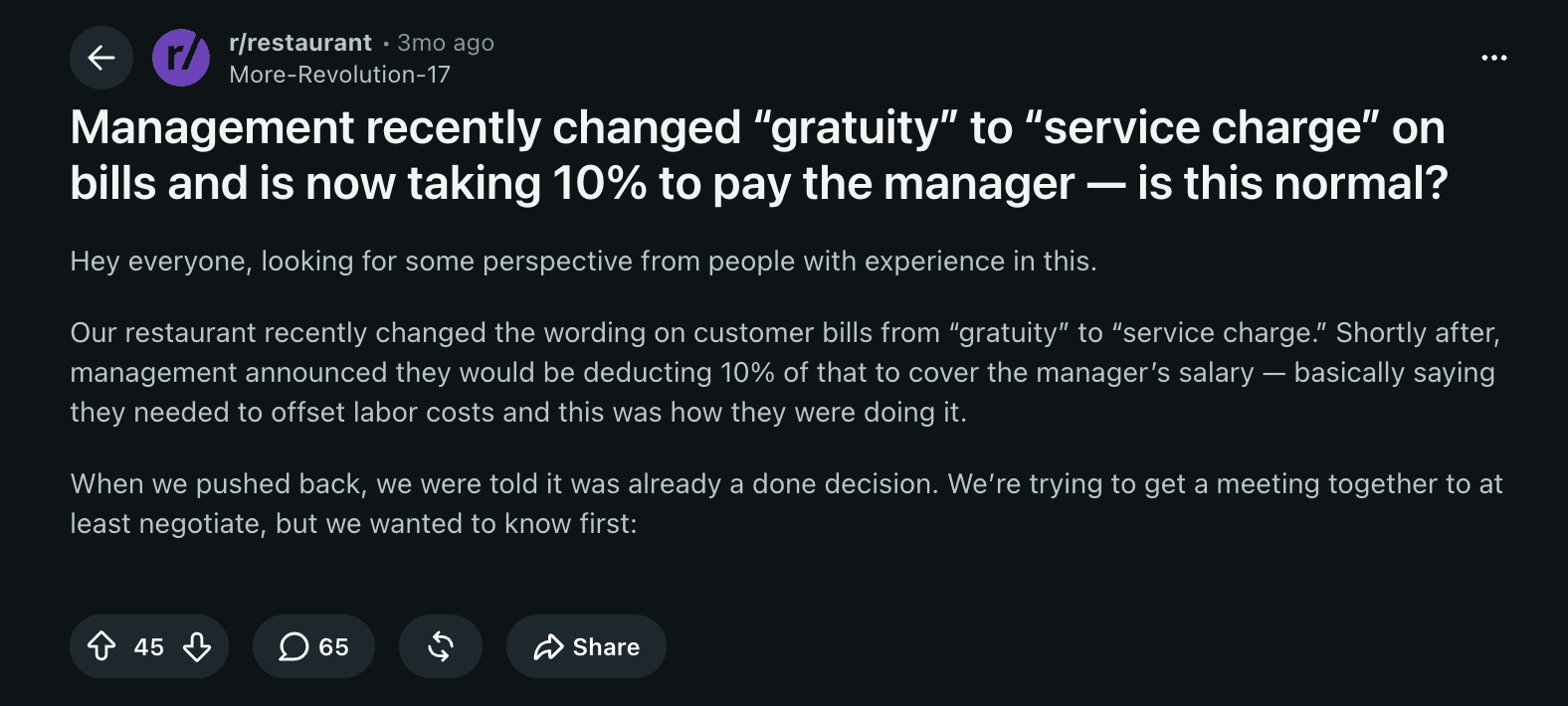
For California restaurant employers, changing the label is not the end of the analysis. O'Grady is a warning that a court may look beyond the words printed on the check and consider what a reasonable customer understood the charge to be for.
If your fee changed from "gratuity" to "service charge," but the customer experience and purpose of the charge otherwise stayed the same, the new label alone may not resolve the Labor Code § 351 risk.
Your Service Charge Compliance Checklist
1.
Audit the fee's name and description.
Review terms such as "service charge," "auto-gratuity," "hospitality fee," "kitchen appreciation fee," and "benefits surcharge." Ask what a reasonable customer would understand the charge to be for.
2.
Compare the disclosure with the actual use of the money.
Menu language, website explanations, accounting treatment, and payroll practices should tell a consistent story.
3.
Review every price display covered by SB 1524.
Check physical menus, digital menus, advertisements, online ordering pages, and other displays containing food or beverage prices.
4.
Confirm the disclosure meets the current formatting standard.
Since July 1, 2025, the mandatory fee and explanation must satisfy Civil Code § 1791(u)'s "clear and conspicuous" requirements.
5.
Check the local ordinance for every restaurant location.
Santa Monica, West Hollywood, Berkeley, and Oakland impose additional service charge rules, and their requirements differ.
6.
Audit regular-rate calculations.
If mandatory service charge proceeds are paid to nonexempt employees, confirm payroll has evaluated whether those payments must be included in overtime calculations.
7.
Review who receives the proceeds.
Payments to owners, managers, supervisors, front-of-house employees, and back-of-house employees can raise different issues depending on whether § 351 or a local ordinance applies.
8.
Consider whether all-in pricing is operationally cleaner.
Increasing menu prices may reduce issues related to separate-fee disclosure, but restaurants should still review the wage and payroll treatment of any compensation paid to employees.
If your current policy hasn't been reviewed against all four of these layers: Labor Code §351, SB 478/1524, the local ordinance, and overtime recalculation, that's a real gap. Our Wage & Hour Defense team reviews service charge structures for this kind of stacked exposure before they become claims.
Conclusion
California restaurants should not assume that calling a mandatory fee a "service charge" resolves who may keep it or how it should be treated.
A mandatory charge may potentially fall within Labor Code § 351 when the facts support a reasonable understanding that the money was intended as a gratuity for service employees. If proceeds are paid to employees, regular-rate and overtime treatment may create an additional payroll issue. The risk usually appears when these systems are reviewed separately. The menu says one thing, accounting treats the fee another way, and payroll applies a third rule.
A defensible service charge policy should be reviewed as a single, interconnected system: the fee's label, customer disclosure, stated purpose, actual use, employee distribution, local ordinance, and payroll treatment.
If you're unsure whether your current service charge structure would hold up under that review, DefendMyBiz can assess your menu language, fee disclosures, distribution policy, and payroll treatment together. Book a free 15-minute consultation with our employer defense team.
Frequently Asked Questions
Is a service charge the same as a tip in California?
What is the O'Grady decision regarding service charges in California?
How does SB 478 affect service charges in California restaurants?
Do mandatory service charges have to go to employees in California?
Are service charge payments included in the regular rate for overtime?
Disclaimer: The above content is for informational purposes only. This is not legal or tax advice. Laws, IRS guidance, and withholding requirements can change, and outcomes depend on specific facts. You are advised to contact a qualified attorney for any legal advice.