What Is the DLSE? California's Labor Commissioner Explained for Employers
California DLSE / Labor Commissioner Defense

A notice arrives. A former employee has filed a wage claim with the California Labor Commissioner's Office. You have a deadline to respond and no clear picture of what happens next.
The Division of Labor Standards Enforcement (DLSE) is the California state agency that handles wage-and-hour complaints against employers. It operates through the Labor Commissioner's Office, and it has broad authority. It can investigate wage claims, request payroll and employment records, hold administrative hearings, and issue an Order, Decision, or Award that may become enforceable as a court judgment.
Every California employer needs to understand how a DLSE wage claim works from their side of the table before one lands.
What the DLSE Actually Does
The DLSE enforces California's wage-and-hour laws under Labor Code §§ 96 and 98. When an employee files a claim, the DLSE investigates and adjudicates disputes over:
Claim Type | Common Examples |
|---|---|
Unpaid wages | Overtime, minimum wage, and off-the-clock work |
Break violations | Missed meal or rest periods, premium pay owed under §226.7 |
Final paycheck | Late or incomplete payment at termination (waiting time penalties, §203) |
Wage statement defects | Missing required items under §226 |
Unreimbursed work expenses under §2802 | |
Misclassification | Independent contractor disputes |
The DLSE generally handles claims by employees, not true independent contractors. However, if a worker classified as an independent contractor claims they were misclassified, the Labor Commissioner may evaluate whether the worker was actually an employee for purposes of California wage laws.
A California DLSE wage claim is not a civil lawsuit. It is an administrative process, but one that can quickly escalate into civil litigation, especially when PAGA is involved.
Read our California Employer Wage & Hour FAQ to understand the payroll, break, final pay, and classification issues that most often lead to DLSE claims.
How the DLSE Wage Claim Process Works: Step by Step
The DLSE process follows a predictable sequence. Understanding each stage and what happens if you miss it is what gives employers a real advantage.
Step 1: Claim filed
Employee files DLSE Form 1 with the Labor Commissioner's Office for the jurisdiction where the work was performed. No filing fee. No attorney required. The filing barrier is low.
Step 2: Notice of Claim issued
You receive formal notice with the allegations and required response deadlines. Do not ignore this. Failure to respond can result in the matter being set for hearing without your input.
Watch: John Fagerholm explains exactly what the Notice of Claim means for employers and what happens at the conference stage. 🎬 Notice of Claim & Conference Explained | California Labor Board
Step 3: Settlement conference
A DLSE deputy holds an informal conference with both parties. This is not a formal hearing, but it sets the trajectory for everything that follows. Many claims resolve here. Employers who come prepared with documentation are in a significantly stronger position. Employers who appear without counsel or records are often at a disadvantage.
Step 4: Berman hearing (§98)
If the claim does not resolve at the conference, the matter may proceed to a Berman hearing before a hearing officer. Both sides may present testimony, records, and other evidence. After the hearing, the Labor Commissioner issues an Order, Decision, or Award.
Step 5: Appeal (§98.2)
Either party may appeal the ODA to the Superior Court within 10 days after service. The appeal is heard de novo, meaning the court reviews the case fresh rather than simply reviewing the Labor Commissioner's decision. The scope of the appeal and any additional issues should be reviewed carefully with counsel.
The appeal trap employers need to understand:
If an employer appeals and is unsuccessful, Labor Code §98.2 can require the employer to pay the employee's attorney fees and costs. An employer appealing an ODA generally must also post a bond or cash deposit in the amount of the award. Because the appeal can add attorney-fee exposure, employers should evaluate the appeal strategy carefully before filing.
Watch: John Fagerholm breaks down the full wage claim investigation process and what California employers face at each stage. 🎬 Navigating the Complexities of Wage Claim Investigations in California
What Employers May Be Exposed To
The base wage amount in a DLSE wage claim is rarely what the employer ultimately pays. California's penalty structure significantly compounds the exposure.
Exposure Type | How It Accrues |
|---|---|
Back wages | All unpaid wages within the statute of limitations |
Waiting time penalties | Up to 30 days of daily wages for late final pay (Lab. Code §203) |
Wage statement penalties | Can reach up to $4,000 per employee, where Labor Code §226 penalty requirements are met |
Break premiums | 1 hour of pay per missed meal or rest break (Lab. Code §226.7) |
Interest | May accrue on unpaid amounts |
PAGA penalties | May create representative exposure for Labor Code violations, but post-2024 PAGA rules include standing, cure, penalty-reduction, and early-evaluation considerations |
Attorney fees | If the employer appeals and loses in the Superior Court |
Statute of limitations
California DIR lists different filing deadlines depending on the claim:
One year for certain penalties
Two years for an oral promise to pay more than minimum wage
Three years for minimum wage, overtime, unpaid meal/rest breaks, sick leave, illegal deductions, and unpaid reimbursements
Four years for written contract claims.
A single DLSE claim can therefore pull years of payroll records into dispute.
Timeline: DLSE wage claims can move faster than civil litigation, but timing varies by district office, claim complexity, conference scheduling, and whether the matter proceeds to a Berman hearing or appeal.
For a breakdown of how meal and rest break penalties specifically compound, read California Meal and Rest Break Violations: What the Premium Pay Penalty Actually Costs Employers
Employer Defenses That Hold Up
Receiving a DLSE wage claim is not the same as owing the amount claimed. Valid defenses exist, and which ones apply depends entirely on your documentation.
Defense | When It Applies |
|---|---|
Accurate timekeeping records | Employee-verified time records show hours and wages were compliant |
Proper exemption classification | Employee's actual duties, not job title, meet California's executive, administrative, or professional exemption standards |
Documented break compliance | Written policy existed, and employees had the opportunity to take breaks; timestamped records support it |
Payment was made | Records show the alleged wages were paid or corrected before the claim |
Statute of limitations | The claim was filed outside the applicable window |
Good-faith dispute | A genuine disagreement existed about the amount owed — this rebuts waiting time penalties under §203 |
The documentation reality: Missing, inconsistent, or incomplete records often work against employers at both the settlement conference and the Berman hearing. The DLSE deputy weighs what exists, not what the employer believes happened.
Red Flags That Signal a DLSE Claim Is Coming
Most DLSE wage claims don't surprise experienced employers. They follow predictable patterns:
Terminations where final pay wasn't issued on the last day: potential waiting time penalty exposure
Employees classified as exempt who were doing mostly non-exempt work: misclassification is one of the most audited issues
Break compliance tracked informally or not at all: employee testimony fills the evidentiary gap when records are absent
Commission or bonus structures that weren't documented in writing: verbal agreements are difficult to defend
Wage statements missing any of the 9 required items under §226: each defective wage statement can create separate penalty exposure where statutory requirements are met
If any of these exist in your business, the risk of a California DLSE wage claim is active, not hypothetical.
For how the Labor Board claims process unfolds more broadly: California Labor Board Claims: What Employers Need to Know When a Complaint Is Filed
What to Do the Day a DLSE Notice Arrives
The first few days matter more than many employers realize.
Do not ignore it. The DLSE process may proceed without the employer's input, and an adverse ODA can create a risk of an enforceable judgment.
Preserve everything immediately. Payroll records, timekeeping logs, break records, personnel files, offer letters, and any relevant communications. A litigation hold should be implemented immediately.
Identify the claim period. Pull all payroll and time records for every period covered by the statute of limitations, not just the dates in the notice.
Retain employer-defense counsel before the settlement conference. The conference is informal, but decisions made there set the direction for the entire case. Employers who prepare with counsel are usually better positioned to evaluate exposure, organize evidence, and avoid avoidable mistakes.
Assess your real exposure. Not the number in the claim. Your actual payroll data, break records, and classification documents tell you what's defensible and what isn't. That assessment drives the strategy.
DefendMyBiz handles DLSE wage claim defense at every stage, from the initial notice through the settlement conference, Berman hearing, and appeal. We represent California employers only. Our DLSE Defense team has defended employers across LA, Orange County, and Southern California against wage claims of all complexities.
If a DLSE notice has arrived, or you want to assess your exposure before one does, book your complimentary 15-minute consultation or call (818) 418-6625.
What Employers Are Discussing Online About DLSE and Wage Claim Risk
DLSE wage claim risk often begins before a formal notice arrives. Employers, HR teams, payroll managers, and small business owners are already asking online about the same issues that often lead to Labor Commissioner claims: final pay, overtime, meal breaks, wage deductions, and payroll records.
Reddit discussions show that many California employers understand there may be risk, but they are unsure how quickly a payroll mistake can turn into a wage claim.
1. Employers are asking whether early clock-ins create overtime exposure.
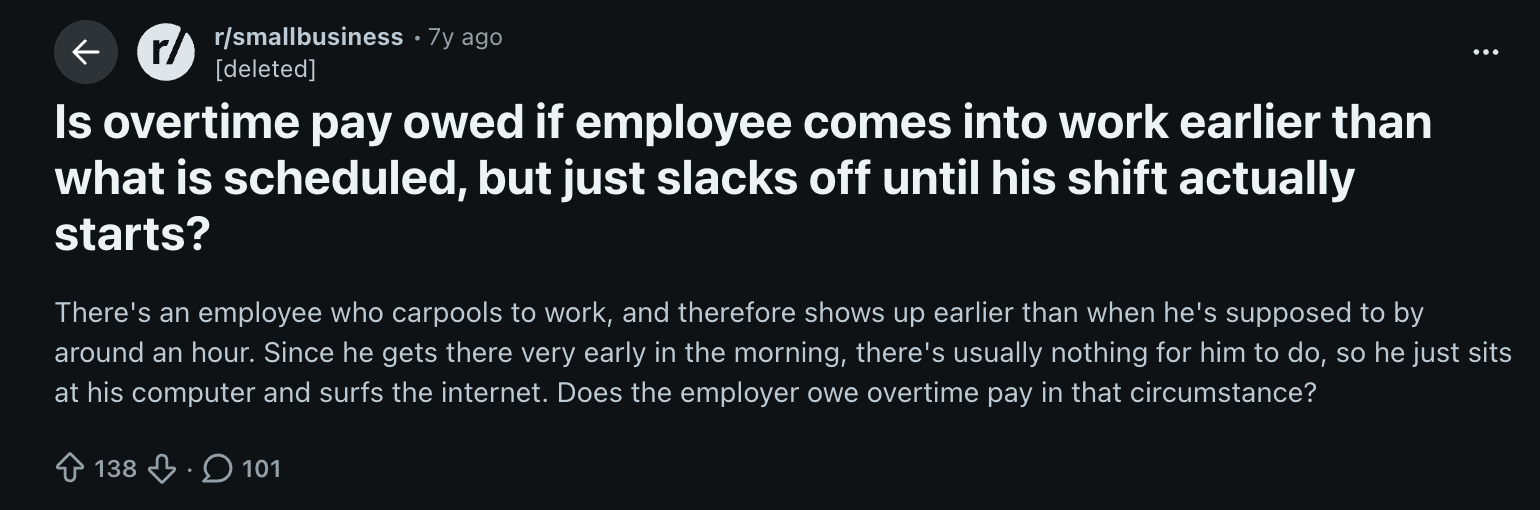
In a small-business Reddit thread, an employer asked whether overtime was owed when an employee arrived early, sat at the computer, and was not scheduled to begin work yet. This is a practical DLSE risk issue because off-the-clock work often turns on what the employer knew, allowed, or failed to control.
Employers should have a written policy on early clock-ins, unauthorized work, and timekeeping accuracy. If employees are working before or after scheduled hours, the business may still need to pay for that time.
2. Employers are asking whether employees can voluntarily work extra days without overtime.
In another small-business thread, a California employer asked whether employees could voluntarily work a sixth day for regular wages rather than overtime. That kind of question directly relates to DLSE wage-claim risk because an employee agreement does not waive California overtime requirements.
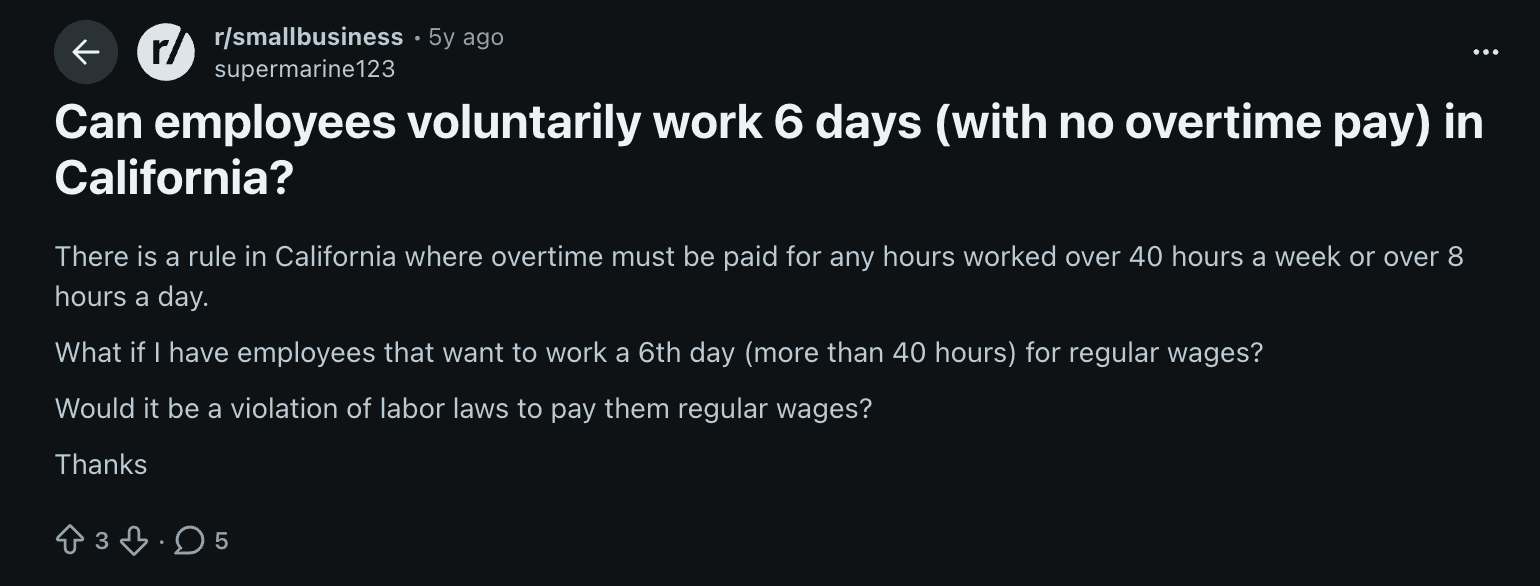
Employers should not rely on "the employee agreed" as a defense to unpaid overtime. California overtime rules still apply even when employees want extra hours.
The larger lesson for employers: if a pay, final-check, overtime, break, or wage-deduction question is unclear enough to ask Reddit, it is serious enough to document and review before a DLSE notice arrives. California wage claims often turn on records, timing, and the employer's ability to prove what actually happened.
FAQs
What is the DLSE in California?
Is a DLSE wage claim the same as a lawsuit?
What happens if an employer ignores a DLSE notice?
Can an employer appeal a DLSE decision?
How far back can a DLSE wage claim go?
Final Thoughts
A California DLSE wage claim is a serious administrative matter with a compressed timeline, stacking penalties, and an appeal process that creates practical and financial risks for employer appeals. The employers who come through these cases best positioned are those who understood the process before it started, had documentation to support their policies, and had employer-side counsel involved before the settlement conference.
DefendMyBiz represents California employers only. If a DLSE notice has arrived or you want to understand your exposure before one does, book your complimentary 15-minute consultation or call (818) 418-6625.
Disclaimer: The above content is for informational purposes only. This is not legal or tax advice. Laws, IRS guidance, and withholding requirements can change, and outcomes depend on specific facts. You are advised to contact a qualified attorney for any legal advice.