What Is a Wage and Hour Claim in California? A Plain-English Guide for Employers
Wage & Hour Defense

You may not have done anything intentionally wrong. But a former employee filed a claim, a demand letter arrived, or a DLSE notice showed up, and now you need to understand what you're actually facing.
A wage and hour claim is a formal allegation that your business violated California law governing pay, hours, or working conditions. It can come from a single employee, a government agency, or an attorney filing under PAGA on behalf of your entire workforce. California has some of the strictest wage-and-hour rules in the country, and the penalties often stack in ways employers do not expect.
Here's what every California employer needs to know.
What Counts as a Wage and Hour Violation
California's wage and hour laws go well beyond the federal FLSA. A claim can be triggered by any of the following:
Violation | California Law |
|---|---|
Unpaid overtime | Labor Code §510: overtime kicks in after 8 hrs/day, not just 40 hrs/week |
Missed meal or rest breaks | Labor Code §226.7: 1 hr of premium pay for each missed, late, short, or noncompliant meal or rest period, where legally required. |
Off-the-clock work | Work the employer knew or should have known about generally must be compensated, even if it was not formally approved. |
Wage statement deficiencies | Labor Code §226: requires specific information on wage statements, and statutory penalties can reach up to $4,000 per employee |
Late final paycheck | Labor Code §203: up to 30 days of daily wages as waiting time penalties |
Employee misclassification | Exempt status is based on duties, not job title |
Most claims don't allege one violation. They stack several, because California's penalty structure rewards it.
Why California Claims Hit Harder Than Employers Expect
This is where businesses get blindsided. A claim that starts as a relatively small unpaid wage dispute can become much larger once premium pay, wage statement penalties, waiting time penalties, attorney fees, and potential PAGA exposure are evaluated.
Here's why:
Penalties stack. Missed breaks generate premium pay, wage statement penalties, and waiting time penalties
PAGA can multiply exposure. One employee's violation can result in a company-wide penalty. For notices filed on or after June 19, 2024, the split is generally 65% to the LWDA and 35% to aggrieved employees. Because PAGA penalties are calculated across pay periods and affected employees, it can escalate quickly.
The lookback window is long. California's statute of limitations runs 3 years for most Labor Code violations, and up to 4 years. It is far longer than the federal 2-year FLSA standard.
EPLI usually doesn't cover it. Most Employment Practices Liability Insurance policies explicitly exclude wage-and-hour claims. The full cost of defense and settlement comes out of your business.
Watch: John Fagerholm explains exactly how California's wage and hour laws can destroy a business if you get them wrong and what employers can do about it. 🎬 California Employers: Wage & Hour Laws Can Destroy Your Business If You Get Them Wrong
The Two Paths a Claim Takes Against You
Understanding the procedural landscape matters from day one.
Path 1:
DLSE / Labor Commissioner (Berman Hearing)
Employee files a wage claim with the California Labor Commissioner's Office
DLSE schedules a settlement conference; if unresolved, proceeds to a Berman hearing before an administrative officer
The employer can appeal to the Superior Court, but may increase the risk. If the employee obtains a recovery in court, the employer may face attorney-fee exposure in addition to the underlying award
Timeline: DLSE claims can move faster than civil litigation, although timing varies by office, claim complexity, and hearing schedule
Path 2:
Civil Lawsuit
Employee retains an attorney and files directly in state or federal court
Commonly, when back wages are significant, PAGA penalties are involved, or a class of employees is affected
Discovery, depositions, potential trial: timeline stretches substantially
Both can run simultaneously. In some cases, an employer may face both an individual wage claim and a separate PAGA notice involving similar alleged violations.
If you've already received a DLSE complaint, see our guide: California Labor Board Claims: What Employers Need to Know When a Complaint Is Filed
Risk Flags: Are You Already Exposed?
Most wage-and-hour claims stem from outdated policies, informal practices, and misapplied exemptions, not intentional violations. Check your exposure against these common triggers:
Managers editing, approving, or rounding time records without clear documentation can create off-the-clock exposure.
"Exempt" employees doing mostly non-exempt work: job titles don't control; actual duties do
Independent contractors doing core business functions: California's ABC test under AB5 is strict
No timestamped break records: When records are incomplete, employee testimony about missed or interrupted breaks becomes harder to rebut.
Final paychecks issued on the next pay cycle: automatic waiting time penalty exposure under Labor Code §203
For a deeper look at misclassification risk specifically, read Employee Misclassification in California: Independent Contractor vs. Employee
What Wage and Hour Claims Defense Actually Looks Like
Receiving a claim is not the same as owing money. Experienced wage and hour claims defense starts with three things:
Real exposure analysis. Not accepting the employee's number. Independently calculating actual exposure from your payroll data, timekeeping records, and job descriptions. Inflated demand letters routinely stack every possible penalty. Most don't reflect what's legally supportable.
Documentation assembly. Timecards, payroll registers, break logs, meal period waivers, classification records, and offer letters. What exists, what's missing, and what gaps mean for your defense strategy.
A clear path forward. Some claims resolve quickly through early settlement when exposure is bounded. Others have legitimate, defensible positions: a good-faith classification dispute, documented compliance with the challenged policy, or a statute-of-limitations argument. The right answer depends on the facts, not on what's most comfortable.
DefendMyBiz represents employers only, never employees. Every analysis, recommendation, and defense strategy is built around one goal: protecting your business. Our Wage & Hour Defense team has defended California employers at every level: DLSE hearings, civil litigation, PAGA representative actions, and class action proceedings.
If a wage and hour claim has landed, or you want to assess your exposure before one does, start with a complimentary 15-minute consultation. Call (818) 418-6625 or visit defendmybiz.com/contact-us.
What California Employers Are Asking Online About Wage-and-Hour Risk
Wage-and-hour issues usually do not start as lawsuits. They often start as everyday payroll and scheduling. Wage-and-hour risk does not always begin with an employee complaint.
Reddit threads from small business owners, payroll teams, and HR managers show the same pattern: employers often ask the right question only after the practice is already in place. For California employers, that delay can turn a small compliance issue into a wage claim, a DLSE proceeding, a PAGA notice, or a class-action threat.
1. "Do I owe overtime if an employee shows up early?”
In a small-business Reddit thread, an employer asked whether overtime was owed when an employee arrived early, sat at the computer, and was not scheduled to begin work yet. That kind of situation poses a real risk to California employers because off-the-clock work depends heavily on what the employer knew, allowed, or should have controlled.
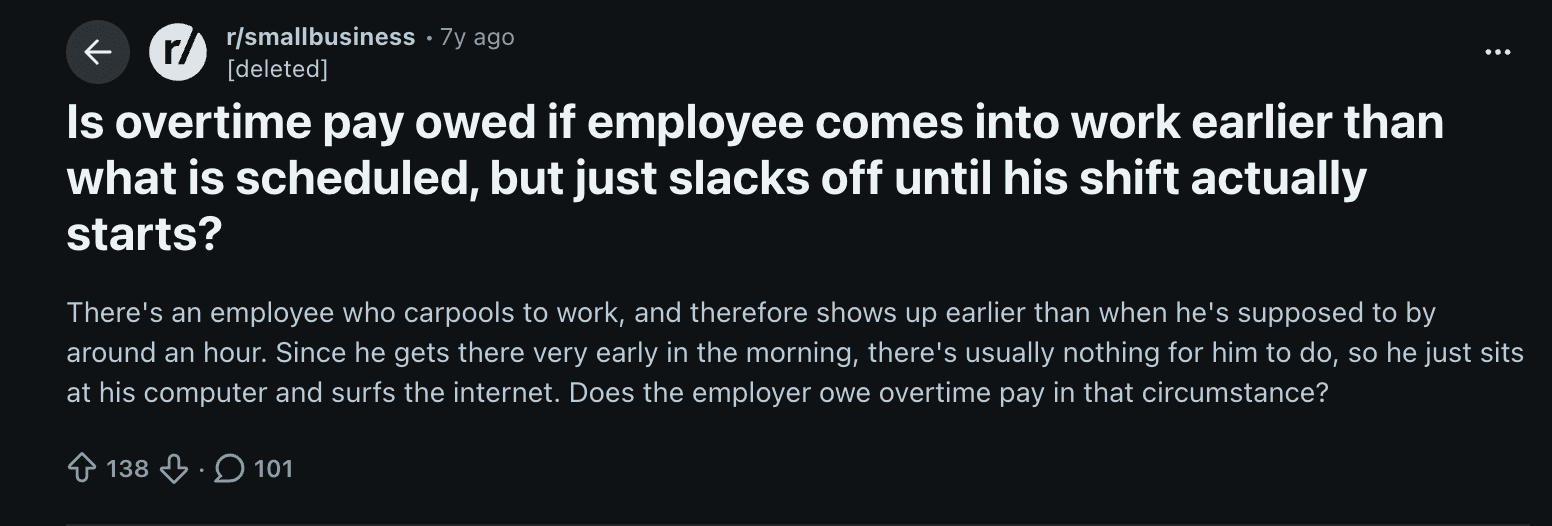
Employers need a clear written policy on early clock-ins, unauthorized work, time approval, and manager response. If employees are present and performing work before or after scheduled hours, the business may still face wage exposure.
2. "Can employees voluntarily work six days without overtime?”
In another thread, an employer asked whether employees could voluntarily work a sixth day for regular wages instead of overtime. This is exactly the kind of misunderstanding that creates wage-and-hour liability because an employee agreement does not automatically waive California overtime protections.
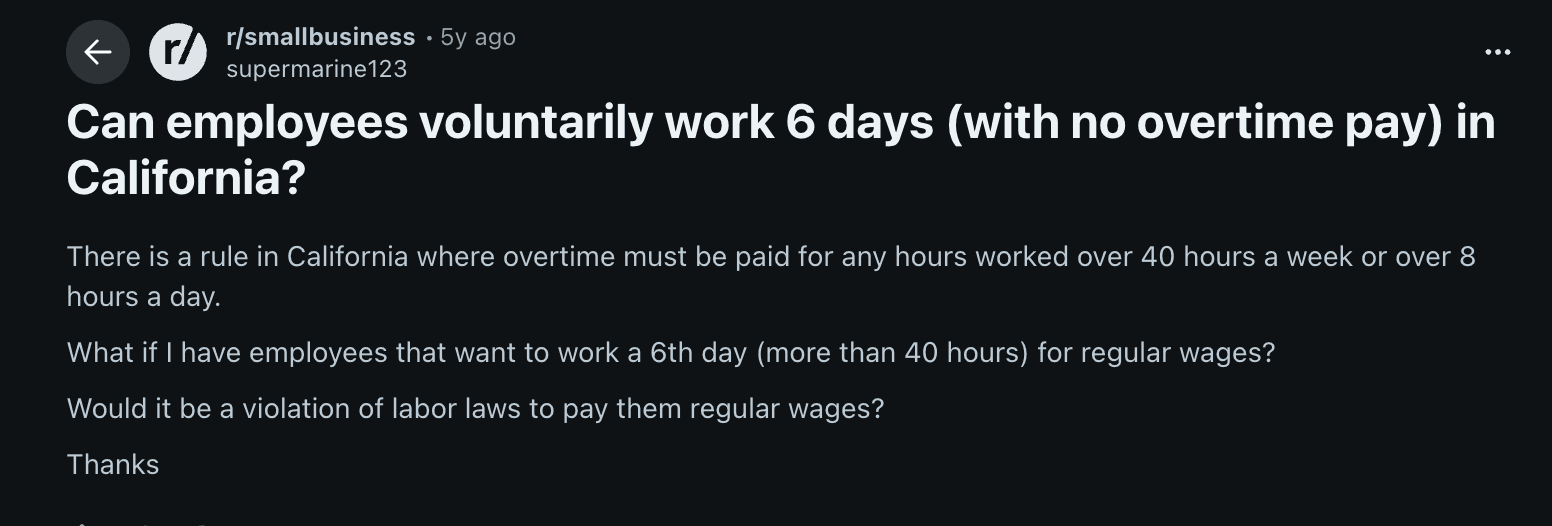
Employers cannot rely on "the employee agreed" as a defense if the pay practice violates California wage-and-hour law. Voluntary extra work still needs to be reviewed under California overtime rules.
3. "Is this salaried California employee entitled to overtime?”
A Reddit user asked whether a California employee earning around $96,000, performing managerial duties, and working long daily hours, was entitled to overtime. This is an employer-side classification issue because salary alone does not decide exempt status; duties matter too.
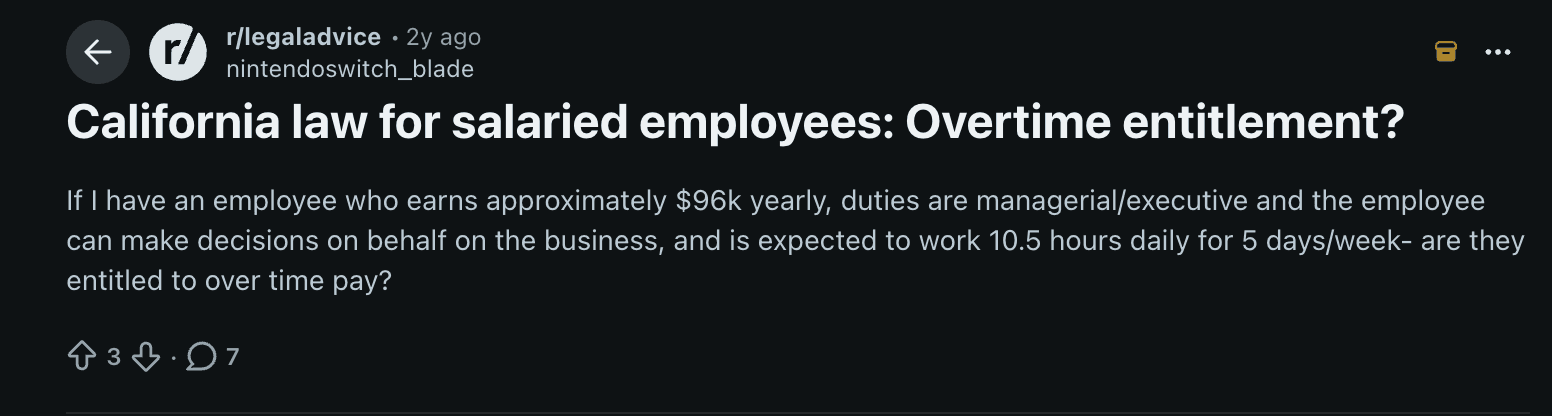
California employers should not classify employees as exempt based only on title, salary, or managerial language in a job description. Actual duties, salary threshold, discretion, independent judgment, and exemption category all matter.
The larger lesson for employers: if a wage-and-hour question is unclear enough to ask Reddit, it is risky enough to warrant counsel review. California wage-and-hour law is technical, penalty-heavy, and unforgiving when payroll practices are repeated across multiple employees or pay periods.
FAQs
What is a wage-and-hour claim in California?
Can one employee's wage claim become a larger case?
How far back can a California wage-and-hour claim go?
Does EPLI cover wage-and-hour claims?
What should an employer do after receiving a wage claim?
Final Thoughts
A wage-and-hour claim in California carries penalty exposure that most employers don't anticipate until they're already facing it. The stacking rules, the long lookback window, and PAGA's company-wide reach make early, experienced defense the difference between a contained resolution and a prolonged legal fight.
If a claim has arrived or you want to know where your business stands before one does, DefendMyBiz is ready. Book your complimentary 15-minute consultation or call (818) 418-6625.
Disclaimer: The above content is for informational purposes only. This is not legal or tax advice. Laws, IRS guidance, and withholding requirements can change, and outcomes depend on specific facts. You are advised to contact a qualified attorney for any legal advice.


