Is Your Arbitration Agreement Still Enforceable? Lessons from Fuentes v. Empire Nissan
Class Action Defense

A California employment arbitration agreement that is enforceable in 2026 has to survive a level of scrutiny that has evolved significantly in recent years, and the California Supreme Court just added a fresh data point in February 2026. In Fuentes v. Empire Nissan, Inc., the Court drew a precise line between formatting problems and substantive fairness.
This distinction changes how you should think about both what your agreement says and how it's presented. Here's what the Court actually held, how it interacts with 2024's Ramirez decision on severability, and what to check in your own agreement.
Key Takeaways
Fuentes holds that illegibility itself supports procedural, not substantive, unconscionability. But a substantively unfair term that is hidden or buried in fine print can still be relevant to the substantive analysis.
High procedural unconscionability still matters: it triggers scrutiny of the substance, construes ambiguity against the employer, and removes any presumption favoring arbitration.
Ramirez v. Charter Communications (2024) rejected a bright-line rule that multiple unconscionable provisions automatically void an entire agreement. Courts must conduct a genuine, case-specific severability analysis.
The core substantive risks flagged across both cases: lack of mutuality, shortened filing deadlines, and unfair attorney's fee-shifting provisions.
A severability clause can strengthen an employer's argument for preserving the remainder of an agreement, but it does not guarantee severance. Courts must still conduct the case-specific analysis required by Ramirez.
What Fuentes v. Empire Nissan Decided
Evangelina Fuentes signed an arbitration agreement at Empire Nissan under real-time pressure. Five minutes to review a dense onboarding packet before a scheduled drug test, with the arbitration clause printed in tiny, blurry text: 900 words in three vertical inches, including one 214-word sentence. After she was terminated following a request for extended medical leave, she sued, and Empire Nissan moved to compel arbitration.
The California Supreme Court, deciding the case on February 2, 2026, drew a specific line: illegible or hard-to-read formatting can support a finding of procedural unconscionability in how the agreement was presented. But it does not, on its own, make the agreement's terms substantively unconscionable. As the Court put it, "font size does not affect the substance of an agreement's terms," so poor formatting alone can't render a term unfair just because it's hard to read.
That might sound like a win for employers, but the Court didn't stop there. Because Fuentes established a high degree of procedural unconscionability, the Court held that courts reviewing the agreement must:
Closely scrutinize the actual terms for one-sidedness, rather than applying a light-touch review.
Construe any ambiguous provisions against the employer as the drafting party.
Apply no presumption favoring arbitration when procedural unconscionability is high.
In other words: illegible formatting won't invalidate a genuinely fair agreement, but it strips away every benefit of the doubt an employer might otherwise get when a court reviews the substance of what was signed.
What Fuentes Did Not Change
Fuentes did not establish that:
small font automatically invalidates an arbitration agreement;
a poorly formatted agreement is automatically unconscionable;
procedural unconscionability alone makes an agreement unenforceable;
every ambiguity is automatically resolved against the employer;
severability is unavailable.
Instead, the decision reinforces a more nuanced rule. High procedural unconscionability increases the level of scrutiny applied to the agreement's substantive terms.
How This Connects to Ramirez v. Charter Communications
Fuentes builds directly on a 2024 decision worth understanding alongside it.
The lower courts identified four potentially unconscionable provisions. The California Supreme Court ultimately agreed that three were substantively unconscionable: lack of mutuality, shortened filing deadlines, and the attorney's-fee provision, while holding that the discovery limits were not unconscionable because the arbitrator could expand discovery when necessary.
Having multiple unconscionable provisions does not automatically invalidate the entire agreement. Ramirez requires a qualitative analysis of whether the defects can be severed or restricted without rewriting the agreement and whether doing so would further the interests of justice. A severability clause can support enforcement of the remainder, but it does not control the court's decision.
What This Means for Your Agreement
Question | Why It Matters After Fuentes and Ramirez |
|---|---|
Is the arbitration clause readable, in a reasonable font size, not buried in dense unrelated text? | Poor formatting won't kill a fair agreement on its own. It triggers closer scrutiny of the agreement's substantive terms, and ambiguities may be construed against the employer as the drafting party. |
Does the agreement require arbitration of the same claim types for both parties? | Lack of mutuality was one of the four defects in Ramirez. This remains a core substantive unconscionability risk |
Does it shorten the employee's filing deadline below what court would allow? | Also flagged in Ramirez as substantively unconscionable on its own |
Does it impose attorney's fee-shifting the employee wouldn't face in court? | Same, an independent basis for substantive unconscionability |
Does the agreement contain a standalone severability clause? | This is what gives you a Ramirez-style argument that individual flaws don't have to void the whole agreement |
Was the employee given real time to review, or rushed through onboarding? | Procedural unconscionability factor: the more rushed the signing, the harder the substantive terms will be scrutinized |
Where This Sits Alongside Federal Preemption
None of this changes whether you can require arbitration as a condition of employment in the first place. A federal district court's permanent injunction against AB 51 (California's attempted ban on mandatory arbitration agreements) remains in place, so employers can still require arbitration where the Federal Arbitration Act governs the relationship.
What Fuentes and Ramirez control is a separate question: once you require arbitration, whether the specific agreement you drafted actually holds up.
That distinction matters for prioritizing your review. If you're confident the FAA applies to your workforce, the more urgent audit is formatting, mutuality, filing deadlines, fee-shifting, and severability, not whether you can mandate arbitration at all.
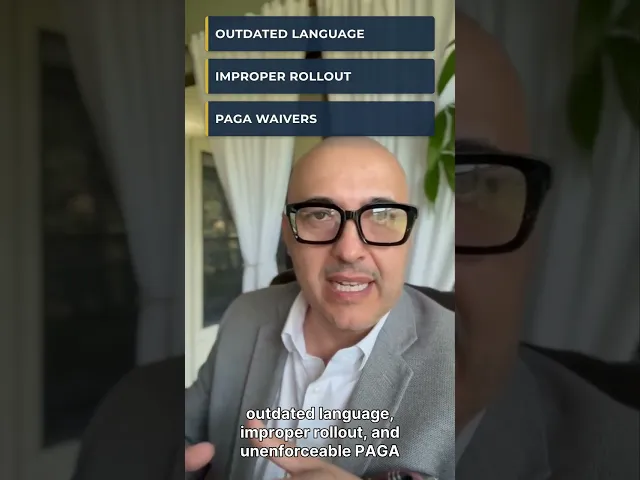
Watch: Arbitration Agreements Under Attack - a broader look at the pressure arbitration agreements are facing across multiple fronts, useful context for why courts are scrutinizing these agreements more closely than they used to.
What California Employers Are Discussing About Arbitration Agreements
The practical questions employers face around arbitration agreements show up on Reddit even when the discussion isn't framed around Fuentes or Ramirez by name.
In one California discussion, an employer had sent arbitration agreements to only some employees.
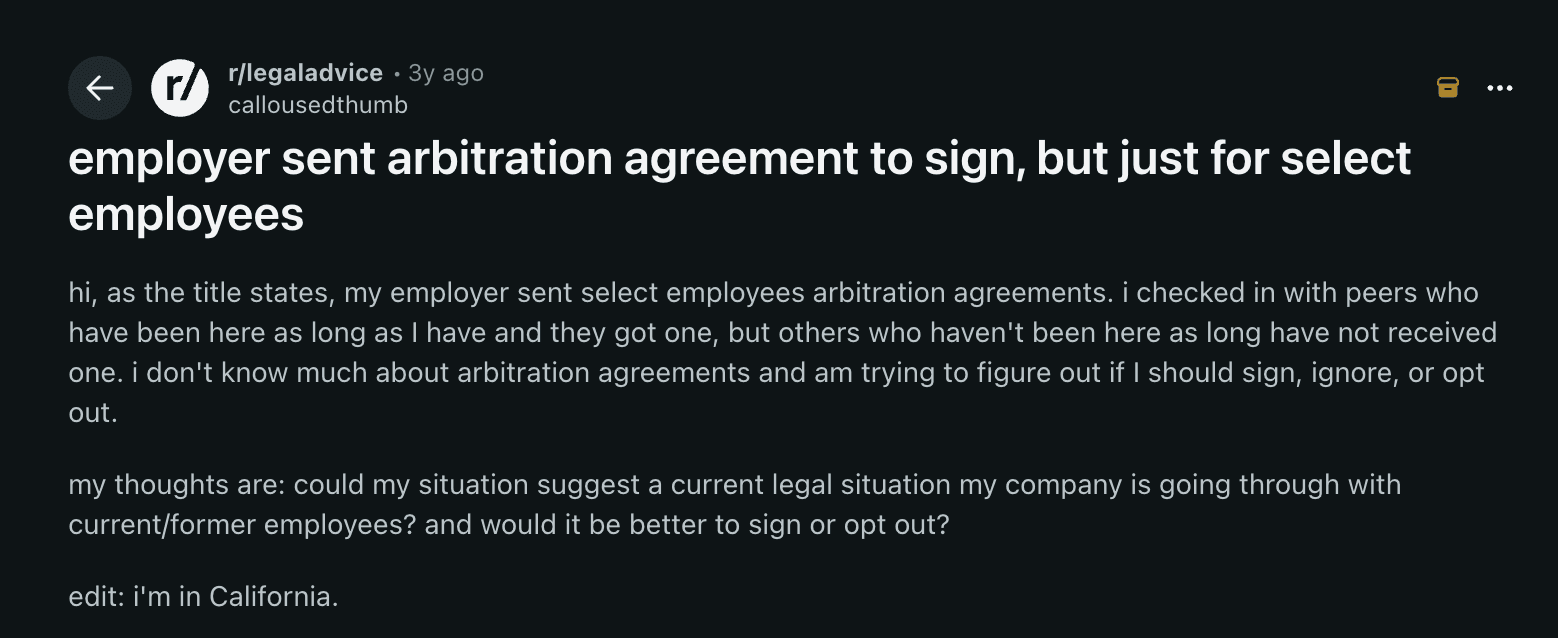
The employer-side question was whether selectively rolling out a new arbitration agreement could indicate an underlying legal issue and whether employees should sign or opt out. The discussion illustrates a practical problem for employers: when an arbitration agreement is introduced, the rollout itself can become part of the enforceability story.
A separate 2026 California discussion described an employer that had never used arbitration agreements during onboarding and then unexpectedly sent one to existing employees years later.

The employer-side question was essentially why a business would introduce an arbitration agreement after employment had already begun. That is exactly the kind of implementation issue that deserves counsel review before a company rolls out a new or revised agreement.
The common thread is important for California employers: the enforceability question isn't only "Did the employee sign?" It's also "What agreement did they receive, when did they receive it, what did the agreement actually say, and how was it presented?" That is precisely where Fuentes becomes operationally relevant.
How to Audit Your Agreement Now
Pull your current template and read it the way a rushed new hire would. If it's genuinely hard to read, that's a procedural unconscionability risk even if the substance is fine.
Check for mutuality. If your agreement routes certain claim types to court for the company while requiring arbitration for everything an employee might bring, that's a Ramirez-style defect.
Compare any contractual filing deadline with the applicable statutory limitations period. A materially shortened period can create substantive unconscionability concerns, particularly where it significantly restricts the employee's ability to pursue statutory claims.
Review any fee-shifting language. If a losing challenge to the agreement itself triggers attorney's fees the employee wouldn't face in court, that's flagged territory.
Confirm that your agreement contains a carefully drafted severability clause and that its operation is consistent with the agreement's structure. Do not assume the clause will automatically save the agreement if multiple provisions are challenged.
Give new hires real review time, documented, separate from a rushed first-day signing stack.
If a specific arbitration clause is already being challenged, or if your agreement includes a class-action waiver you want reviewed alongside these unconscionability standards, our Class Action Defense team handles exactly this intersection.
Our guide on how employment class actions actually build in California is worth reading alongside this piece, since a defeated arbitration agreement is often what allows an individual claim to expand into one in the first place.
Conclusion
The California Supreme Court's decision in Fuentes v. Empire Nissan (February 2026) holds that illegible or poorly formatted arbitration provisions affect procedural unconscionability only, not the substantive fairness of the terms themselves. But a finding of high procedural unconscionability requires courts to scrutinize the substance closely, construe ambiguity against the employer, and apply no presumption favoring arbitration.
Paired with Ramirez v. Charter Communications (2024), which rejected a bright-line rule voiding agreements simply because multiple provisions are flawed, the combined lesson is that severability remains genuinely available but only for agreements with real severability clauses and provisions that are actually collateral to the agreement's core purpose.
If an employee is already challenging the enforceability of your agreement, a free 15-minute consultation is available to assess your current situation. Book a call with our employer defense team today.
Frequently Asked Questions
What are the essential requirements for an employment arbitration agreement to be enforceable in California?
Does illegible or small-print formatting automatically void an arbitration agreement?
If part of my arbitration agreement is found unconscionable, does the whole agreement become void?
Can California employers still require arbitration as a condition of employment?
What should I check first if I haven't reviewed my arbitration agreement recently?
Disclaimer: The above content is for informational purposes only. This is not legal or tax advice. Laws, IRS guidance, and withholding requirements can change, and outcomes depend on specific facts. You are advised to contact a qualified attorney for any legal advice.