AB 450: What California Employers Legally Can and Cannot Do When ICE Shows Up
General Defense Resources

California's Immigrant Worker Protection Act (AB 450) set out three separate obligations when it took effect in 2018. Today, only the employee-notice provisions under Labor Code §90.2 remain enforceable through California's civil penalty framework. The civil penalties tied to the voluntary-consent provisions have remained enjoined since 2018 following federal litigation.
Understanding this distinction is the difference between confident compliance and confusion at the worst possible moment. This article breaks down which AB 450 provisions still carry a live penalty, and how to build a workplace response protocol before you ever need it.
Key Takeaways
AB 450 created three obligations (notice, entry-consent, and records-access) all sharing an identical civil penalty structure of $2,000–$5,000 (first violation) to $5,000–$10,000 (subsequent) in the statutory text.
Only the 72-hour notice requirement under Labor Code §90.2 remains enforceable; the entry-consent and records-access penalties have been enjoined since 2018, affirmed by the Ninth Circuit in 2019.
Even without California's penalty provisions, employers generally retain the ability to withhold voluntary consent to entry into non-public areas unless agents present a judicial warrant or another legal basis requiring access.
A judicial warrant compels access; an administrative warrant (Form I-200/I-205) does not.
A Notice of Inspection starts the 72-hour notification clock the moment it's received, regardless of delivery method.
Personnel decisions made after an inspection carry separate exposure under California's anti-retaliation statutes, independent of compliance with AB 450.
The Three Original Requirements, and Which One Still Carries a Penalty
AB 450 created three obligations, each codified separately, and, notably, each written with the same civil penalty language: $2,000 to $5,000 for a first violation, $5,000 to $10,000 for each subsequent violation, enforced exclusively by the Labor Commissioner or the Attorney General.
Requirement | Statute | Current Enforcement Status |
|---|---|---|
Notify employees within 72 hours of an I-9 Notice of Inspection, and again within 72 hours of the results | Fully enforceable; penalty applies | |
Decline voluntary consent to ICE entering non-public work areas without a judicial warrant | Penalty enjoined since 2018: right to decline still exists, but no state fine for consenting | |
Decline voluntary consent to ICE accessing employee records without a subpoena or judicial warrant | Penalty enjoined since 2018, same status |
The reason for the split: in 2018, a federal district court found the U.S. government likely to succeed on its claim that the entry-consent and records-access provisions were preempted. The federal courts concluded that California was unlikely to be permitted to impose state penalties on employers for voluntarily cooperating with federal immigration enforcement in the manner contemplated by those provisions.
What This Means in Practice
This isn't an invitation to consent freely. It changes the stakes, not the recommendation. Declining consent and requiring a judicial warrant for non-public areas remains the prudent approach for reasons independent of AB 450. It's grounded in ordinary Fourth Amendment protection, and it preserves your ability to control what agents see without a court-authorized basis to see it. What's changed is that you won't face a California-specific civil fine for consenting.
The notice requirement is where the real, current financial exposure sits. Miss either the 72-hour window for the initial notice of inspection, or the post-inspection results notice, and the penalty is fully enforceable today, independent of anything happening in the ongoing federal litigation over the other two provisions.
Distinguishing the Documents at Your Door
Everything about your response depends on which document an agent presents, and getting this wrong under pressure is the single most common mistake:
Judicial warrant:
Signed by a federal judge. Authorizes entry to the specific non-public areas it describes. Compliance is required.
Administrative warrant (Form I-200 or I-205):
Issued by an immigration agency, not a court. Does not compel access to non-public areas. You may decline and contact counsel.
Notice of Inspection (NOI):
Written notice that ICE intends to inspect I-9 forms, typically giving three business days to produce records. Receipt of an NOI starts your §90.2 72-hour notification clock, regardless of whether an agent physically visits or the notice arrives by mail.
This distinction matters even more if the workers involved aren't directly on your payroll.
If any of the affected employees came through a staffing agency or PEO, our guide on when your business becomes a joint employer under California law is worth reading. Joint employer status affects who actually bears the I-9 and AB 450 compliance obligation for that worker, and it's not always the business where they're physically working.
What California Employers Are Actually Asking About I-9 Compliance
One California small-business owner explained that after nearly ten years in business, they discovered their company had never completed Form I-9s because they mistakenly believed their payroll provider handled the process.
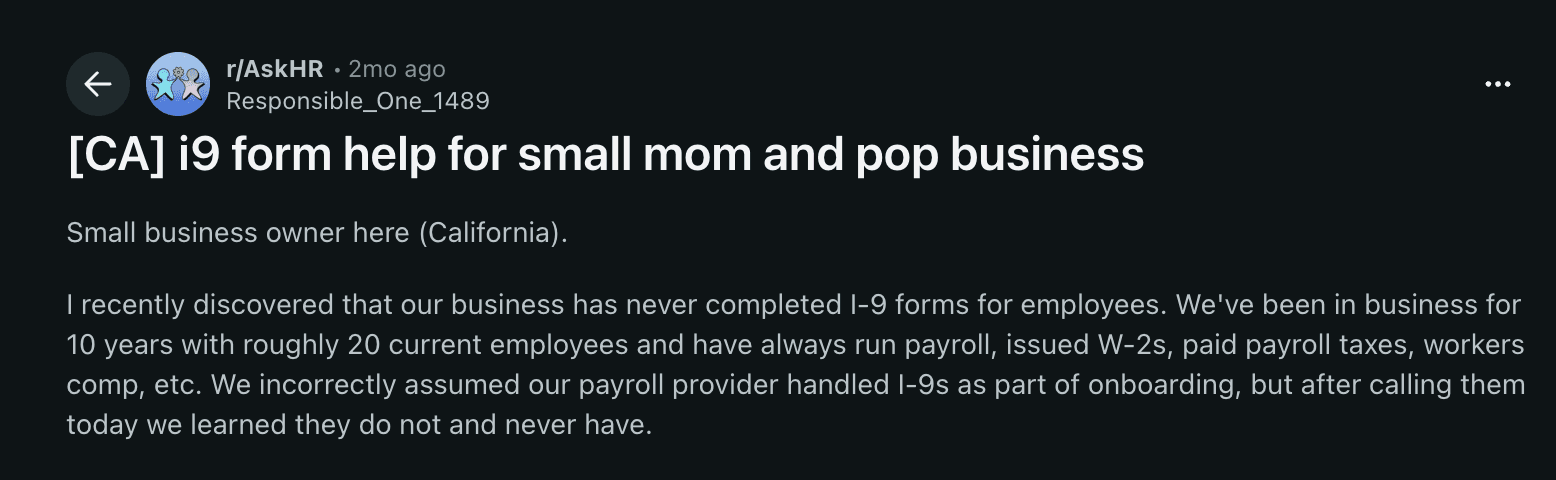
Their questions centered on how to correct the issue, whether proactive remediation would reduce enforcement risk, and what an internal cleanup should look like.
Similarly, HR professionals responsible for compliance frequently ask about conducting internal I-9 audits, correcting missing documentation for former employees, and ensuring records are inspection-ready before a government audit occurs.
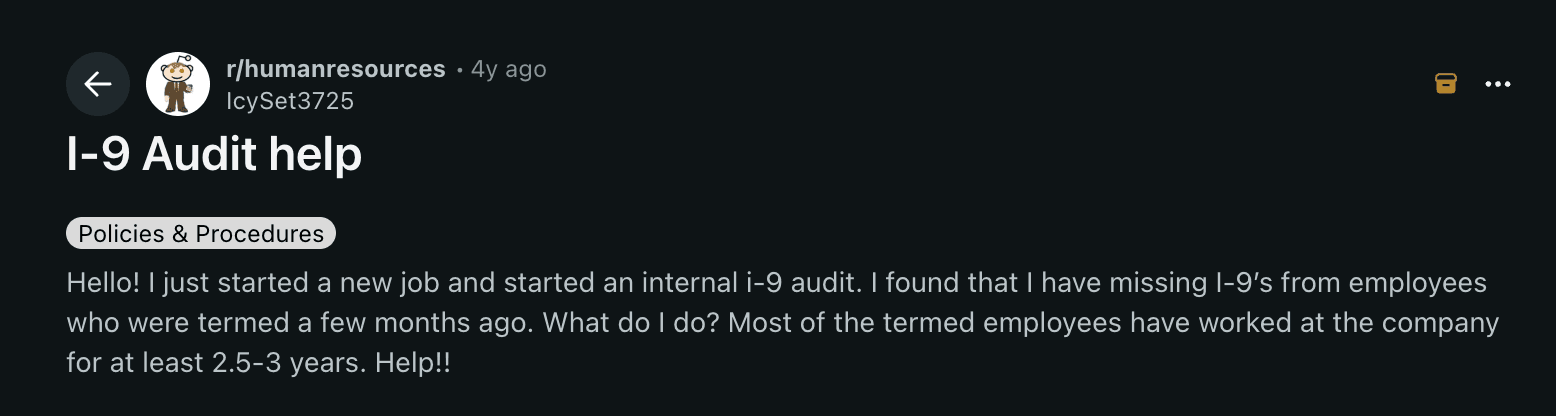
The common thread across these employer discussions is that businesses are far more concerned with being prepared before an inspection than reacting after one begins. That aligns closely with the practical purpose of AB 450.
The law is less about preventing ICE from entering a workplace and more about ensuring employers have clear internal procedures, understand what legal documents actually require compliance, and can respond consistently without making decisions under pressure.
Building Your Internal AB 450 Response Protocol
A written plan turns a high-pressure moment into a rehearsed sequence:
Designate a primary and a backup point of contact, typically HR leadership, authorized to handle all enforcement interactions.
Document the response sequence explicitly: verify credentials, request the warrant or NOI, decline entry to non-public areas absent a judicial warrant, and contact counsel immediately.
Prepare your §90.2 notice template now. The California Labor Commissioner's Office provides a bilingual template. Download and customize it before you need it, not after an NOI arrives.
Train all employees who may interact with government agents. Their role is to receive and report, not to make a legal judgment call about warrant validity in the moment.
Run an internal I-9 audit before any inspection notice arrives. A good-faith correction found proactively is treated very differently than the same error discovered during a federal inspection. Given how aggressively worksite enforcement has intensified this year, this is worth doing now rather than waiting.
Know what you owe workers sent home mid-shift. If an enforcement visit disrupts a shift and you send remaining employees home early, that may trigger California's reporting-time pay requirement independent of anything AB 450 requires. Our guide on when California reporting-time pay applies covers these scenarios.
Why This Extends Beyond the Visit Itself
AB 450 governs the moment of the visit, but the personnel decisions that follow carry their own separate legal exposure under California's anti-retaliation statutes. If a post-inspection decision affects someone who had previously raised a wage or safety concern, that timing alone can shift the burden onto you under California's immigration-retaliation framework.
If you're building or reviewing your workplace response protocol, or want your current I-9 records assessed before an inspection notice arrives, our Hybrid / Non-FEHA Claims team handles exactly this intersection of immigration enforcement exposure and the broader employment claims it tends to generate.
Conclusion
AB 450 created three obligations with identical civil penalty structures, but only the 72-hour employee notification requirement under Labor Code §90.2 remains enforceable today. The entry-consent and records-access penalty provisions have been under federal injunction since 2018, with the Ninth Circuit affirming the injunction in 2019. Employers still retain the underlying right to decline consent and require a judicial warrant, grounded in ordinary constitutional protection independent of AB 450's current enforcement status.
Treat the 72-hour notice deadlines as your live compliance obligation with real financial teeth, and treat the warrant-verification protocol as best practice worth following regardless of whether a state penalty currently attaches to skipping it.
If your business is facing an active ICE enforcement matter or AB 450 compliance issue, DefendMyBiz offers a free 15-minute consultation. Book a call with our employer defense team today.
Frequently Asked Questions
What are the key employer responsibilities under California's AB 450?
What are the penalties for non-compliance with AB 450 in California?
Which AB 450 provisions were upheld or invalidated by federal courts?
Does AB 450 apply to federal immigration enforcement actions at California workplaces?
Where can employers find official resources for AB 450 compliance?
Disclaimer: The above content is for informational purposes only. This is not legal or tax advice. Laws, IRS guidance, and withholding requirements can change, and outcomes depend on specific facts. You are advised to contact a qualified attorney for any legal advice.