
Post-ICE-Raid Employment Claims: Retaliation, Wage, and Wrongful Termination Exposure After a Workplace Visit
Hybrid / Non-FEHA Claims

The workplace visit may end within hours in a raid. But the post-ICE-raid employment claims that follow can take years, and in California specifically, they carry a legal framework most employers underestimate.
California Labor Code §1171.5 provides that all protections, rights, and remedies available under state law are available regardless of immigration status, except where federal law expressly requires otherwise. That means a workplace enforcement action does not, by itself, eliminate an employee's ability to pursue wage, retaliation, discrimination, or workers' compensation claims.
Here's exactly what claims arise after a workplace visit, the California-specific rules that control them, and how to keep one incident from becoming four separate lawsuits.
Key Takeaways
California Labor Code §1171.5 extends full wage, workers' compensation, and FEHA protections to workers regardless of immigration status.
Labor Code §1019 prohibits unfair immigration-related practices used as retaliation, with a rebuttable presumption of retaliation for any such action taken within 90 days of protected activity.
Penalties under §1019.1 reach up to $10,000 per violation, and courts can order business license suspension for a first violation.
A single post-raid termination can trigger FEHA discrimination, wrongful termination, whistleblower, and workers' comp retaliation claims simultaneously.
A raid can expose underlying violations that create criminal, not just civil, exposure for business owners separate from any employment claims covered.
The Foundational Rule: Immigration Status Doesn't Limit These Claims
California Labor Code §1171.5 states plainly that all Labor Code protections, like wage claims, workers' compensation, FEHA discrimination, and harassment claims, apply to every worker regardless of immigration status.
This is the starting point for understanding your exposure: an employee's status doesn't narrow what they can claim against you after a raid. It's often the opposite. A raid frequently surfaces wage and classification issues that had gone unreported for years, because the disruption accelerates claims workers might otherwise have delayed.
The Four Claim Categories That Typically Follow a Raid
Wrongful termination: If workers were let go because they were detained, questioned, or flagged during the visit, termination may still be challenged under California employment laws, regardless of the employee's immigration status, depending on the facts surrounding the decision.
Discrimination and harassment (FEHA): Rushed personnel decisions made during or after enforcement activity often disproportionately affect workers of a particular national origin or ethnicity. California regulations interpret national origin broadly to include characteristics associated with national origin, including accent, language, and certain cultural characteristics. This is a state-law claim, separate from and often filed alongside federal Title VII charges.
Wage and hour disputes: Overtime, missed breaks, and misclassification issues that existed before the raid become formal claims the moment employment ends. The disruption tends to surface disputes that were previously informal.
Immigration-related retaliation: This is the category most out-of-state guidance misses entirely, and it's the one with the sharpest teeth under California law specifically. This deserves closer attention.
Let's discuss it further in a bit more detail.
Why Immigration Retaliation Is the Claim to Watch Closely
California Labor Code §1019 (added by AB 263 in 2013) makes it unlawful for an employer to engage in an "unfair immigration-related practice." This includes threatening to report someone's immigration status, requesting more or different documents than federal law requires, misusing E-Verify, or threatening a false report for the purpose of retaliating against someone who exercised a Labor Code right: filing a complaint, seeking compliance information, or informing others of their rights.
The provision employers most often overlook: §1019(c) creates a rebuttable presumption of retaliation when an unfair immigration-related practice occurs within 90 days of protected activity. In litigation, that presumption can significantly increase an employer's burden of defending the decision, making contemporaneous documentation especially important.
Statute | What It Covers | Penalty |
|---|---|---|
Unfair immigration-related practices as retaliation | Up to $10,000 per violation under §1019.1; court can order business license suspension (up to 14 days for a first violation) | |
Reporting or threatening to report immigration status (of employee, former employee, or relative) as retaliation | Treated as an adverse action independent of §1019 | |
Retaliation for filing a Labor Commissioner complaint | Reinstatement, back pay, civil penalties | |
General whistleblower retaliation for reporting legal violations | Civil penalty up to $10,000 per violation, plus reinstatement and back pay | |
Retaliation tied to a workers' compensation claim | Separate penalty structure; often stacks with the above |
A single termination decision made in the aftermath of a raid can implicate several of these simultaneously, which is exactly the "one complaint, multiple lawsuits" pattern that makes these cases so much more expensive than employers initially expect.
Watch: California Employers: One Complaint. Multiple Lawsuits. - a direct breakdown of how a single adverse employment decision can generate FEHA, whistleblower, wrongful termination, and workers' comp retaliation claims all at once, which is precisely the dynamic that plays out after a raid-driven termination.
What a Raid Can Expose Beyond Employment Claims
When a 2018 workplace raid at a Tennessee meatpacking plant led to a federal civil rights lawsuit, the $1.175 million settlement was paid by the federal government to resolve claims against the ICE agents involved, not by the employer. But the plant's owner was separately convicted on federal charges tied to harboring undocumented workers and tax fraud, and received an 18-month federal prison sentence.
The lesson here is that a raid frequently surfaces the underlying violations like labor, tax, or otherwise that create exposure well beyond the employment claims covered here. If your own compliance gaps are what a raid would expose, that's a conversation worth addressing proactively with counsel before an inspection.
What Employers Are Discussing Before Employment Claims Begin
Rather than discussing lawsuits after an ICE raid, HR professionals on Reddit are overwhelmingly focused on the compliance failures that often create those lawsuits.
An HR discussion described an employer that nearly failed an I-9 audit because expiration dates, verification deadlines, and required documentation had not been reviewed for years.
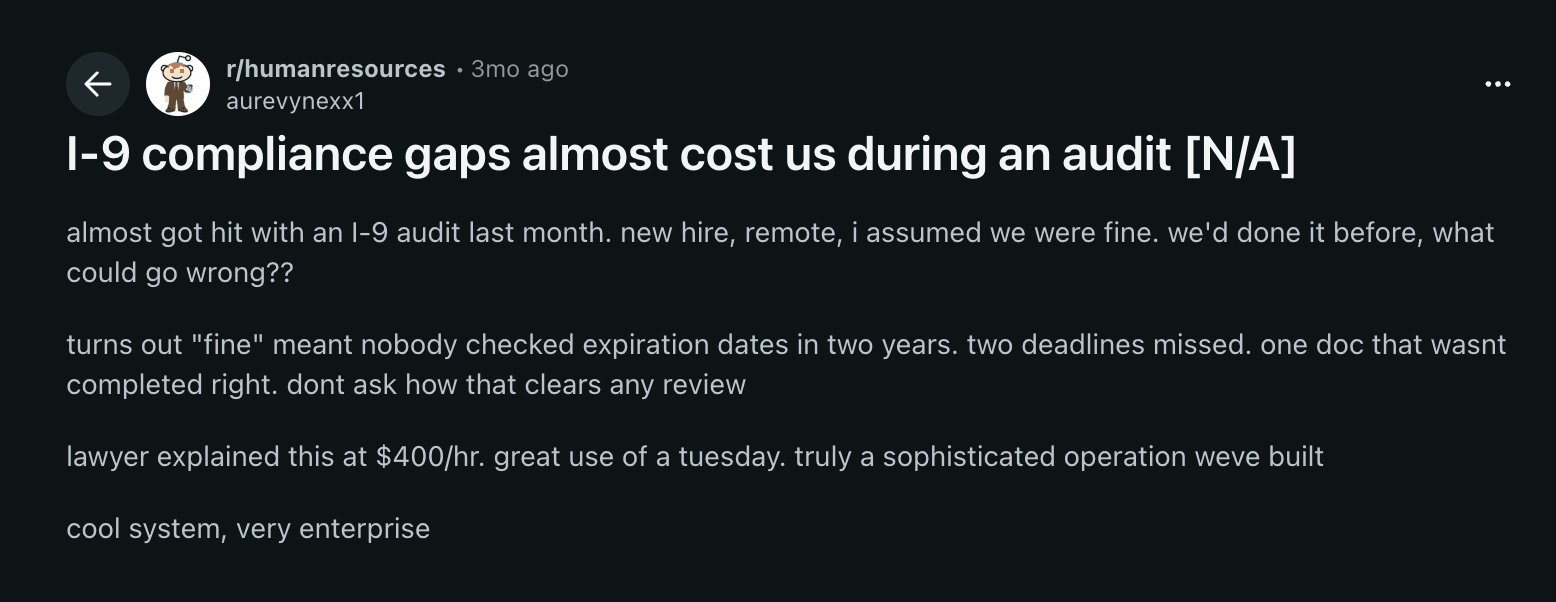
That operational mindset mirrors the central theme of this article: many retaliation and wrongful termination claims become significantly harder to defend when employers are trying to reconstruct decisions after enforcement activity has already begun.
A separate discussion shared guidance from labor and employment attorneys advising employers to designate a single workplace point of contact for ICE interactions, train front-line staff not to grant access to non-public areas without appropriate legal authority, and immediately involve counsel to review warrants or Notices of Inspection.
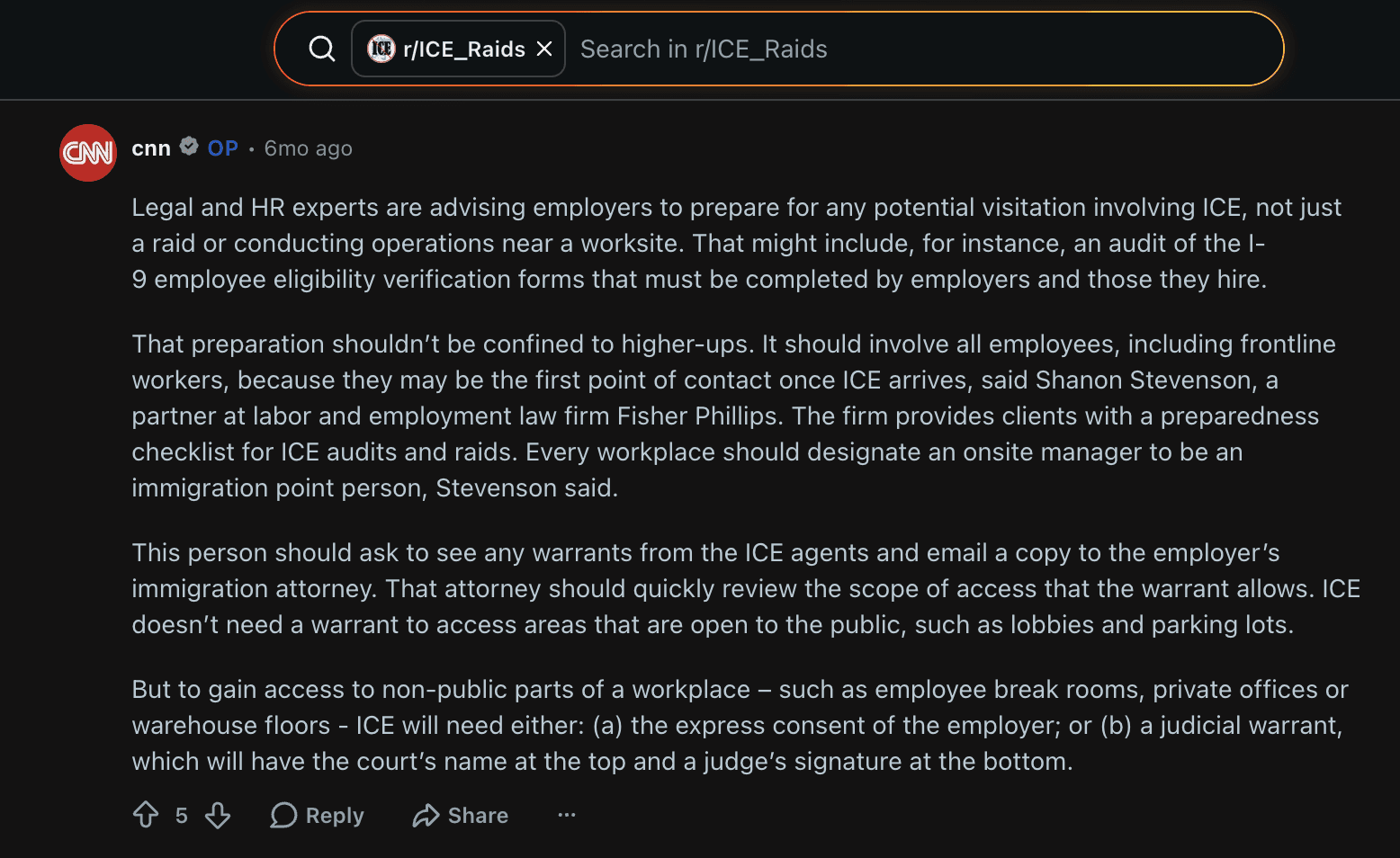
Those recommendations closely align with California employers' need to document post-inspection employment decisions carefully and avoid creating separate retaliation or discrimination exposure after the enforcement action concludes.
Building the Defense: Documentation Before Litigation
The single factor that determines how these claims resolve is whether your personnel decisions were documented before anyone anticipated a lawsuit.
Preserve documentation showing whether the decision was already under consideration before the enforcement action occurred. Never create or alter records after the fact.
Document the stated reason for every post-raid personnel decision. Vague reasons under pressure are exactly what a §1019(c) presumption or a FEHA pretext argument targets.
Preserve the full record of communications during and after the raid: who said what to whom, and when.
Audit remaining I-9 records immediately. A follow-up inspection is likely, and a good-faith correction found before an audit is treated very differently than the same error discovered during one. Our guide on California wage and hour claims covers a related principle: documentation created after the fact carries far less weight than a contemporaneous record.
Retain employer-side counsel immediately, not an immigration attorney who primarily represents workers. The decisions made in the first 48 hours shape every claim that follows.
Because these claims frequently arrive in combination, our Hybrid / Non-FEHA Claims team specifically handles the overlapping, multi-theory litigation this scenario tends to produce, rather than treating each claim as an isolated matter.
Conclusion
California Labor Code §1171.5 guarantees that every worker, regardless of immigration status, retains full wage, workers' compensation, and FEHA rights after a workplace enforcement action. Labor Code §1019 creates a rebuttable presumption of unlawful retaliation for any immigration-related adverse action taken within 90 days of an employee exercising a protected right.
That presumption shifts the burden to the employer, making contemporaneous documentation of any post-raid personnel decision the single most important factor in how these claims resolve.
Wrongful termination, FEHA discrimination, wage disputes, and immigration retaliation frequently arrive together, and the employers who fare best are the ones who documented their reasoning in real time rather than reconstructing it after a complaint arrives.
If your business has been through a workplace enforcement action, DefendMyBiz offers a free 15-minute consultation to assess your exposure across all of these claim categories at once. Book a call with our employer defense team today.
Frequently Asked Questions
What happens to employers after an ICE raid in California?
Can undocumented workers sue their employer in California?
What is the 90-day presumption under Labor Code §1019?
Can an employer be fined for immigration-related retaliation in California?
How should HR handle personnel decisions immediately after an ICE visit?
Disclaimer: The above content is for informational purposes only. This is not legal or tax advice. Laws, IRS guidance, and withholding requirements can change, and outcomes depend on specific facts. You are advised to contact a qualified attorney for any legal advice.