Waiting Time Penalties Under Labor Code §203: When Late Final Pay Becomes 30 Days of Wages
Wage & Hour Defense

A single late final paycheck in California can cost you 30 days of that employee's wages on top of the wages themselves. The California waiting time penalty under Labor Code §203 doesn't require you to have shorted anyone intentionally.
It generally requires that the employer intentionally failed to pay wages when they were due, even without any intent to violate the law, unless a bona fide good-faith dispute exists over whether wages were owed.
This guide explains how the penalty is calculated, what defenses courts recognize, and where employers most often make costly mistakes.
Key Takeaways
Final wages are due immediately upon termination, on the last day worked for a resignation with 72+ hours' notice, or within 72 hours for a resignation without notice.
The penalty equals the employee's daily rate for every calendar day payment is late, capped at 30 days.
"Willful" doesn't require bad intent; it only requires that the employer knew the deadline and missed it, even through negligence.
The only reliable defense is a documented good-faith dispute that meets the mistake-of-law or mistake-of-fact standard; inability to pay and administrative delays don't qualify.
Waiting time penalties are reported as "other income" on Form 1099-MISC, not as wages on Form W-2.
A systemic final-pay gap affecting multiple employees can escalate into PAGA exposure well beyond the original penalty amount.
What Triggers a Waiting Time Penalty
Labor Code §203 penalizes an employer who "willfully" fails to pay all final wages by the deadline the law sets:
Involuntary separation (termination, layoff, discharge): final wages due immediately at the time of separation.
Resignation with 72+ hours' notice: final wages due on the last day worked.
Resignation without notice: final wages due within 72 hours of the resignation.
Courts have repeatedly explained that "willful" does not require fraud or bad faith. If an employer intentionally fails to pay wages that are due even because of an avoidable payroll practice or internal process failure, the standard may be met unless a genuine good-faith dispute exists.
How the Penalty Is Actually Calculated
The penalty equals one day's wages for every calendar day the payment is late, including weekends and holidays, capped at 30 days total. Here's the DLSE's actual formula:
For hourly employees: hourly rate × typical hours worked per day.
For salaried employees: (monthly salary × 12) ÷ 52 weeks ÷ 5 workdays.
For a salaried employee earning $4,500/month, for instance: ($4,500 × 12) ÷ 52 ÷ 5 = $207.69/day.
At the 30-day maximum, that's around $6,230.77 in penalty exposure on top of whatever wages were actually unpaid. Get this formula wrong in your internal exposure estimate, and you'll either underbudget for a settlement or overpay for one, so it's worth using the exact method rather than rounding.
Two details employers consistently underestimate:
The wage base is broader than base pay.
Commissions, nondiscretionary bonuses, piece-rate earnings, and accrued but unused vacation all factor into the daily rate. Vacation pay specifically is treated as earned wages that cannot be forfeited under any circumstances.
Every calendar day counts, not just business days.
A Friday termination that isn't paid until the following Wednesday accrues penalty days for Saturday and Sunday too.
The Only Defense That Works: Good Faith Dispute
If a genuine, documented dispute exists over whether wages were owed at all or how the willfulness element isn't met, the penalty doesn't accrue. But courts apply this defense narrowly, through one of two specific tests:
Defense Type | What It Requires |
|---|---|
Mistake of law | The employer's legal obligation was genuinely unclear or unsettled at the time, not simply that the employer didn't know the law |
Mistake of fact | The employer's belief was reasonable and supported by evidence available at the time, not reconstructed after the fact |
Inability to pay and administrative delays are not valid defenses under California law. A defense has to be about a genuine dispute over the wages themselves, not about the mechanics of paying them.
Even when a good-faith dispute exists, employers should promptly pay any wages that are not genuinely disputed. Withholding undisputed amounts can defeat the good-faith dispute defense altogether under Labor Code § 206.
If you're already facing a claim and need to assess whether your situation actually supports this defense, our guide on what qualifies as a wage and hour claim in California covers how these disputes typically get evaluated once they're formally filed.
Why This Rarely Stays a Single-Employee Problem
A waiting time penalty on one final paycheck is a contained issue. The same payroll gap applied across a broader group of employees is a different problem entirely. If your final-pay process has a systemic flaw, say, routing terminated employees' pay through the standard payroll cycle instead of cutting an immediate check, that pattern likely affects more than one departure. Each instance is its own separately calculable penalty.
This is the kind of per-employee, per-violation exposure that adds up to serious numbers under PAGA. Our breakdown of how plaintiff lawyers stack PAGA penalties shows how a single process gap multiplies once more than one employee is affected.
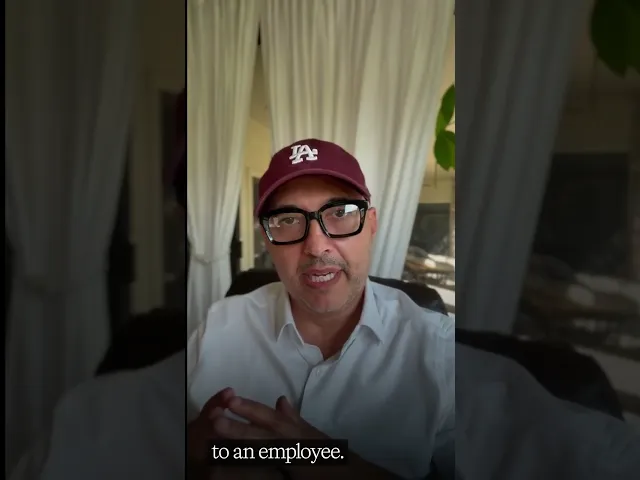
Watch: Labor Board Claims & Waiting Time Penalties Explained - a direct walkthrough of how these claims actually move through the Labor Commissioner's process once one is filed.
The Tax Treatment Most Employers Don't Know
Waiting time penalties are not treated as wages for employment tax purposes. Per an IRS information letter, they're classified as "other income" reportable on Form 1099-MISC, not Form W-2, which means no FICA or unemployment tax withholding applies to the penalty amount itself. The IRS guidance comes from an Information Letter rather than formal Treasury regulations or a Revenue Ruling.
Always confirm current treatment with your tax advisor before relying on guidance for a specific filing decision. But it's worth knowing the distinction exists before assuming the entire settlement amount gets processed through standard payroll.
What California HR Teams Are Discussing About Final Pay Compliance
Employer and HR discussions on Reddit show that waiting-time penalties often stem from process failures rather than intentional underpayment.
Professionals describe situations where final pay was delayed because payroll had already closed, accrued vacation balances had not been updated, commissions were still being calculated, or managers terminated employees without coordinating with payroll in advance.
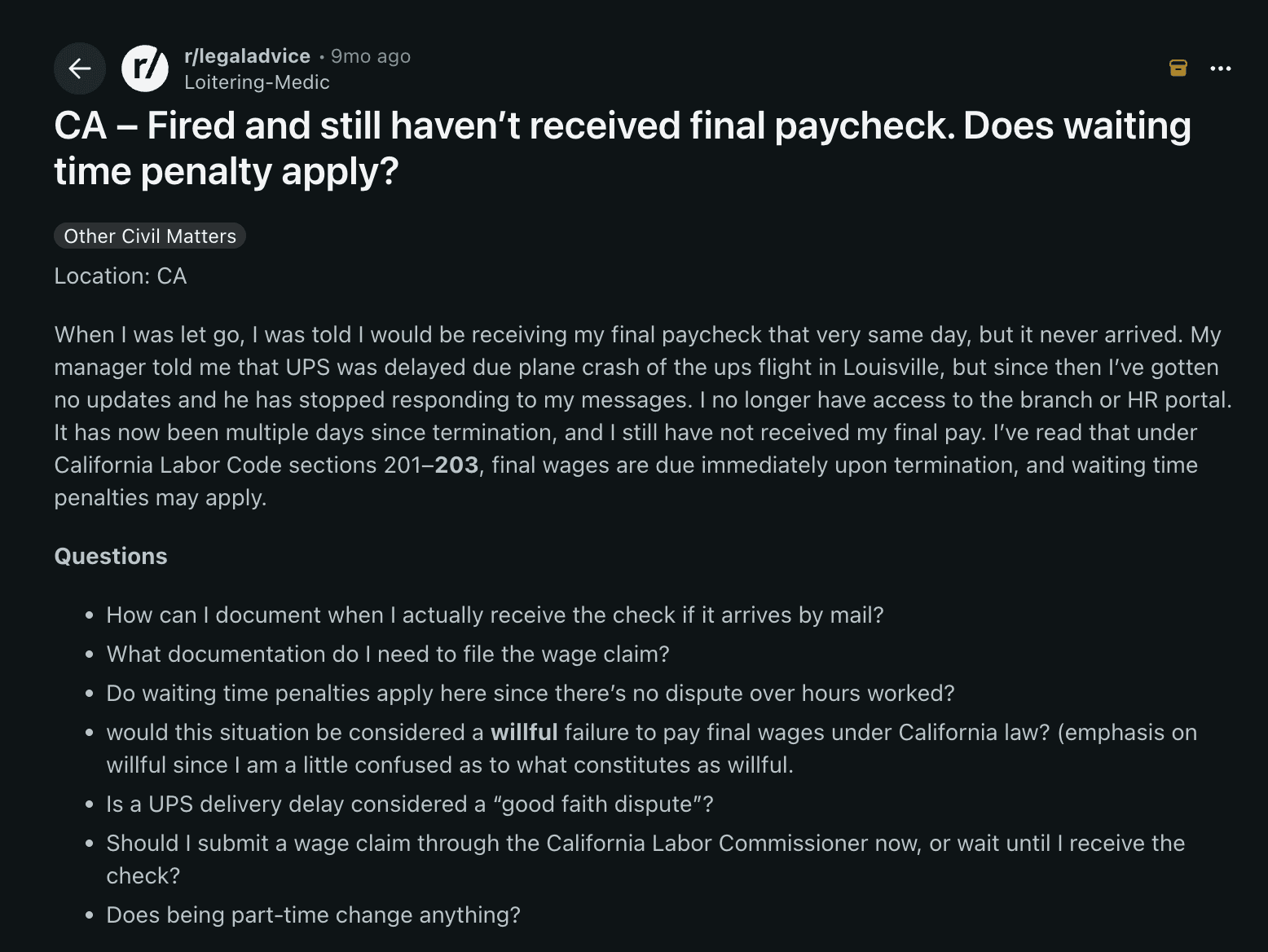
Another recurring theme is the misconception that administrative issues excuse late payment. HR professionals frequently ask whether courier delays, mailing issues, payroll system limitations, or internal approval processes constitute a defense. Administrative difficulties alone generally do not establish a good-faith dispute.
Instead, employers discuss documenting genuine legal or factual disagreements over wages, promptly paying all undisputed amounts, and maintaining contemporaneous records showing why any disputed wages were withheld.
Preventive Measures to Take Before It Costs You
Separate final pay processing entirely from your regular payroll cycle. For terminations, the check needs to be ready at the moment of discharge. Routing it through the next scheduled pay run is exactly how employers accidentally trigger this penalty.
Use a standardized final-pay checklist covering every wage component: base pay, commissions, accrued vacation, bonuses, and reimbursements, used on every separation without exception.
Train the people conducting terminations, not just payroll. A manager who discharges someone at 4 pm without a check in hand starts the penalty clock immediately, regardless of what payroll knows.
Document your position in real time if a genuine dispute exists. A good faith dispute defense built after a claim is filed is far weaker than one supported by contemporaneous records.
Audit independent contractor classifications. Reclassified workers can bring waiting-time claims tied to past separations, making this a retroactive exposure rather than a forward-looking one.
Conduct periodic audits of termination checklists rather than relying solely on payroll software settings.
If a demand letter or DLSE claim referencing this penalty has already landed on your desk, our guide on how to respond to an attorney demand letter covers the first moves that actually matter. Our Wage & Hour Defense team reviews the specific facts to challenge inflated penalty math before it becomes a settlement number you didn't need to accept.
Conclusion
California Labor Code §203 penalizes any willful failure to pay final wages on time with a penalty equal to the employee's daily rate for every calendar day the payment is late, capped at 30 days. "Willful" requires only that the employer knew the deadline and missed it, not any intent to shortchange the employee.
The only defense that reliably works is a documented good-faith dispute, evaluated under the narrow mistake-of-law or mistake-of-fact standards that courts actually apply. Inability to pay or administrative delay does not qualify.
If you're facing a waiting time penalty claim, DefendMyBiz offers a free 15-minute consultation. Book a call with our employer defense team today.
Frequently Asked Questions
What is the 4-hour rule in California?
How do I file a waiting time penalty claim in California?
What are the defenses to waiting time penalties in California?
How late can an employer pay a departing employee in California?
Disclaimer: The above content is for informational purposes only. This is not legal or tax advice. Laws, IRS guidance, and withholding requirements can change, and outcomes depend on specific facts. You are advised to contact a qualified attorney for any legal advice.