
Pay Data Reporting 2026 (SB 464): What Changed, What's Mandatory, What's Coming in 2027
FEHA / EEO Defense

If your business has 100 or more employees, the 2026 California pay data reporting deadline was May 13, 2026. If you missed the May 13 deadline, the risk is active now.
Senate Bill 464 makes the statutory penalty mandatory when the CRD seeks enforcement and asks the court to impose it, but the statute does not create a daily-accruing penalty. CRD can also seek a court order requiring compliance and recover the costs of obtaining that order.
If you did file, SB 464 still changed your ongoing obligations and is about to change them again in 2027. Here's exactly where things stand today, what to do if you're behind, and what the next filing cycle actually requires.
Key Takeaways
The Reporting Year 2025 pay data deadline was May 13, 2026. If you haven't filed, mandatory penalties already apply and increase the longer you wait.
Penalties are $100 per employee for a first violation and $200 per employee for subsequent violations, with no judicial discretion to reduce them under SB 464.
An incomplete or inaccurate report can create enforcement risk, particularly if it does not satisfy the statutory reporting requirement. If you discover an error after filing, use CRD's correction process rather than assuming the original submission closes the issue.
Separate storage of pay-reporting demographic data from personnel records has been required since January 1, 2026, independent of your filing status.
The 2027 filing cycle replaces the 10 EEO-1 job categories with 23 SOC Major Groups, with no direct mapping between old and new categories. Start this reclassification well before the deadline.
The CRD can seek a court order compelling compliance and recover the costs of obtaining it, separate from the per-employee civil penalties.
Where Things Stand Right Now
The California Civil Rights Department's reporting portal for Reporting Year 2025 data opened in February 2026, with a firm May 13, 2026 deadline and no stated grace period. Private employers with 100 or more employees, including employees outside California, and at least one California employee generally must file a payroll employee report.
Separate rules apply to private-client employers with 100 or more labor-contractor employees. SB 464 changed what happens next in two ways that predate this specific deadline and remain true going forward:
SB 464 removed the court's discretion to decline to impose a penalty once CRD requests one under §12999(f). However, the statutory amounts remain capped at $100 per employee for a first failure and $200 per employee for a subsequent failure.
The CRD can seek a court order compelling compliance, and recover the costs of obtaining that order, separate from the per-employee civil penalties described below.
Additionally, if your pay data review involves piece-rate employees, don't overlook the underlying wage-and-hour rules. Our guide to California piece-rate pay and employer defenses explains the compensation rules employers need to get right, as well as the defenses available when disputes arise.
If You Missed the May 13 Deadline
File now. There's no advantage to waiting, and every day of continued non-compliance is a separate basis for the CRD to pursue enforcement. Specifically:
1.
Submit the overdue report through the CRD's Pay Data Portal immediately.
A late filing is materially better than no filing when the CRD is deciding how to respond.
2.
Review your data for completeness before submitting.
An incomplete report is treated the same as an unfiled one. Errors in exemption status, employment type, or weeks-worked calculations can make a report inaccurate and should be corrected promptly rather than assuming a submitted report is sufficient.
3.
Confirm your labor contractor data is included,
if applicable. Contractors can be separately assessed penalties for incomplete submissions, but you remain responsible for their reporting gaps as they affect your overall filing.
4.
Document your remediation steps:
when you discovered the gap, what corrected it, and when you filed. This record matters if the CRD does pursue enforcement despite your late filing.
Potential Statutory Penalty At the Maximum Rate
These figures represent the statutory maximum based on employee count, not an automatic assessment. The statute provides for penalties of up to $100 per employee for a first failure and up to $200 per employee for a subsequent failure.
Employer Size | First Violation | Second Violation |
|---|---|---|
100 employees | $10,000 | $20,000 |
500 employees | $50,000 | $100,000 |
1,000 employees | $100,000 | $200,000 |
An incomplete report carries the same risk as a report never filed at all, which is why remediation quality matters as much as remediation speed.
Watch: CA Pay Reporting Update 2026 - a direct breakdown of the new data fields and stricter demographic handling requirements driving this year's compliance risk.
The Requirement That Applies Whether or Not You Already Filed
Independent of the May 13 deadline, SB 464 imposed a structural change effective January 1, 2026: Demographic information collected for pay data reporting purposes must now be kept separate from personnel records.
If you filed on time but haven't separated this data storage, that's still a live compliance gap. The filing deadline and the storage practice deadline are two separate obligations, and meeting one doesn't satisfy the other.
What Changes for the 2027 Filing Cycle
This is the part worth planning for now, regardless of how the 2026 cycle went.
Starting with the 2027 filing cycle (covering Reporting Year 2026 data), California abandons the 10 EEO-1 job categories entirely in favor of 23 Standard Occupational Classification (SOC) Major Groups. It is a federal Bureau of Labor Statistics framework with no direct one-to-one mapping to the categories you're using today.
That "no direct mapping" detail is the operational problem. You can't simply relabel your existing 10 categories into 23 new ones. Every position in your workforce needs to be reassessed against the SOC framework from scratch.
Employers who wait until early 2027 to start this mapping are setting up exactly the kind of rushed, error-prone reclassification that leads to incomplete reports. And, per the structure above, an incomplete report carries the same mandatory penalty as no report at all.
What HR and Payroll Teams Are Asking About SB 464
The practical challenges of California's pay data reporting changes are already emerging in the HR and payroll communities.
How should employers separate demographic data from personnel records? An r/humanresources discussion focused on how SB 464's new storage requirement interacts with HRIS and personnel file systems.

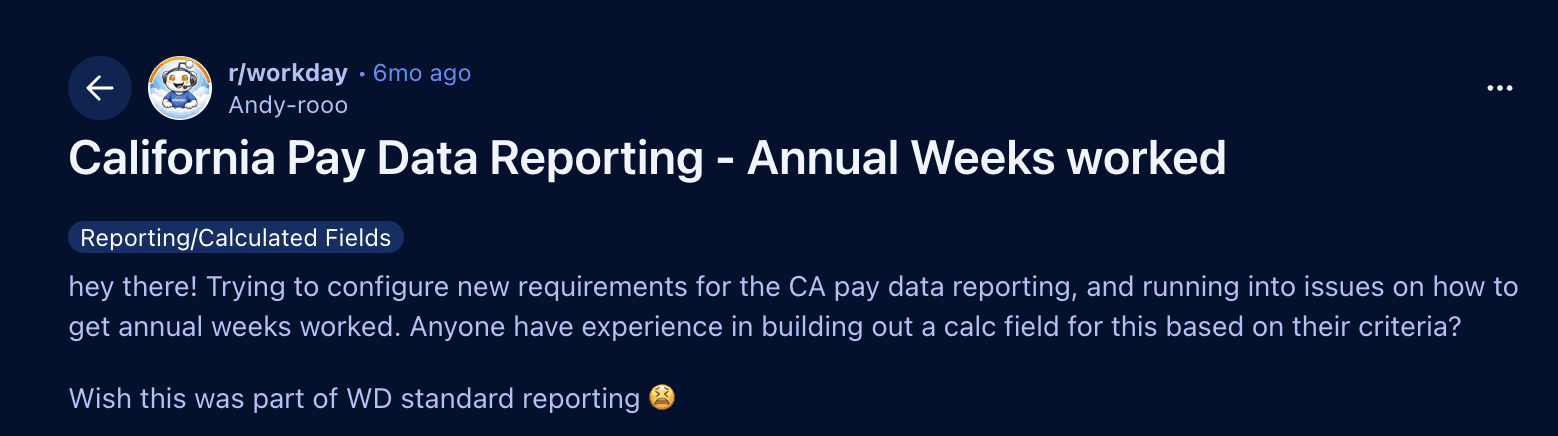
How should employers calculate the new annual-weeks-worked field? A Workday user raised this exact implementation issue while configuring California's new reporting requirements.
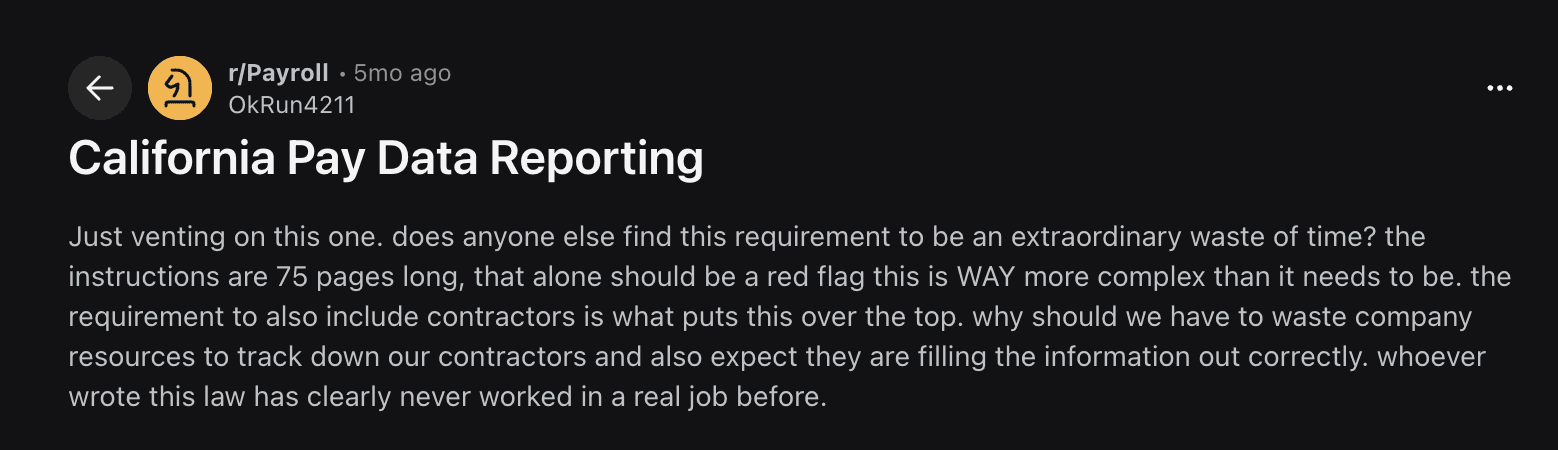
How burdensome is the new reporting process? A March 2026 r/Payroll discussion focused on the workload created by the reporting requirements, particularly collecting and reconciling labor-contractor data.
Employer takeaway: The biggest operational risk isn't simply knowing that SB 464 changed the law. It's ensuring that payroll, HRIS, compensation, and legal teams use the same data definitions before the next filing cycle.
How to Build Your Compliance Process
If you're behind, prioritize completing and submitting an accurate report as promptly as possible. Do not knowingly submit inaccurate information simply to meet a deadline; where an error is discovered after filing, follow CRD's correction procedures.
Separate your demographic data storage immediately if it isn't already, regardless of your filing status.
Run a cross-system audit of your HRIS, payroll, and timekeeping platforms now, since exemption status, employment type, and weeks-worked fields frequently disagree across systems when pulled independently.
Start mapping your current job categories to the 23 SOC groups well before the 2027 deadline. This is a multi-month project for most mid-sized employers, not a form to fill out the week it's due.
Standardize your labor contractor data requests in writing now, since contractor reporting gaps become your exposure regardless of who's technically at fault.
If your exemption classifications haven't been recently reviewed against California-specific standards (which differ from the federal FLSA tests), that's worth doing as part of this process. A misclassification surfaced by your own pay data report is the kind of self-generated evidence that invites further CRD scrutiny.
Our FEHA / EEO Defense team reviews pay data submissions through a legal lens before they go to the state, not after a filing has already created a paper trail you didn't intend.
Conclusion
California's pay data reporting deadline for Reporting Year 2025 was May 13, 2026. SB 464 did not create a daily late-filing penalty. It made the statutory civil penalty mandatory when CRD seeks it through the enforcement mechanism, with a maximum of $100 per employee for a first failure and $200 per employee for a subsequent failure. CRD can also seek a compliance order and recover its enforcement costs.
File immediately if you're behind, separate your demographic data storage now if you haven't, and start your SOC category mapping well ahead of the 2027 cycle rather than during it.
If you need help assessing your current exposure or preparing for the 2027 transition, DefendMyBiz offers a paid 1-hour consultation. If the CRD has already contacted you about a missed or incomplete filing, a free 15-minute consultation is available to assess your active situation.
Frequently Asked Questions
What is the deadline for California pay data reporting for Reporting Year 2025?
What are the penalties for non-compliance with California pay data reporting?
How will the shift from EEO-1 to SOC job categories affect employers in 2027?
Do I need to store pay reporting data separately from personnel files?
What happens if my pay data report has errors instead of being late?
What changes to California pay data reporting in 2027?
Disclaimer: The above content is for informational purposes only. This is not legal or tax advice. Laws, IRS guidance, and withholding requirements can change, and outcomes depend on specific facts. You are advised to contact a qualified attorney for any legal advice.


