California's $70,304 Exempt Salary Threshold in 2026: Reclassification Traps
Wage & Hour Defense

Every January 1, California's exempt salary threshold moves without a separate vote, a new bill, or any announcement beyond a routine DIR bulletin, and employers who don't check the current number can get caught when their payroll system defaults to last year's figure.
As of January 1, 2026, the official California exempt salary threshold for 2026 is $70,304 per year for most white-collar exemptions. But the number is only one part of the exemption test. The employee must also satisfy the applicable salary-basis and duties requirements for the exemption claimed.
Here's the correct threshold by category, why paying above it doesn't automatically protect you, and where reclassification actually creates liability.
Key Takeaways
The official 2026 California exempt salary threshold is $70,304/year, up from $68,640 in 2025, calculated as twice the state minimum wage.
Computer software professionals ($122,573.13/year) and licensed physicians ($107.17/hour) have separate salary and hourly thresholds, as well as a separate duties test.
Paying above the threshold doesn't create an exemption on its own. California's duties test requires that the employee spend more than half of their time on qualifying exempt work.
Fast food and healthcare employees fall under industry-specific wage floors that affect their exemption analysis separately from the general statewide figure.
Misclassification can expose employers to unpaid overtime, related penalties, and other remedies.
A documented audit of both salary and duties is your primary defense if you face a misclassification claim.
What Is the Official 2026 Threshold?
$70,304 per year ($5,858.67 per month) for the standard executive, administrative, and professional exemptions, up from $68,640 in 2025. The calculation is mechanical: California requires exempt employees to earn at least twice the state minimum wage for full-time work, so the number moves automatically whenever the minimum wage does.
$16.90/hour × 2 × 40 hours/week × 52 weeks = $70,304
That mechanical link means this threshold will keep climbing every year the minimum wage does, with zero legislative action required.
Does the $70,304 Number Apply to Every Exempt Employee?
No, and this is where the most expensive mistakes happen. Two categories carry their own, much higher minimums, and applying the standard rate to them is a common, costly error.
Exemption Category | 2026 Minimum |
|---|---|
Standard executive/administrative/professional | $70,304/year |
Covered fast-food employee | $83,200/year |
Qualifying computer software employee | $122,573.13/year |
Licensed physician/surgeon | $107.17/hour |
Covered healthcare employee | Depends on applicable healthcare minimum wage |
If you have salaried tech employees or medical staff being evaluated against the standard $70,304 figure instead of their category-specific threshold, that's an active misclassification.
What About Fast Food and Healthcare Employees?
These industries have their own wage floors that also factor into their exemption analysis. Fast food employees covered under Labor Code §§1474–1476 have a separate $20/hour minimum wage (with room for the Fast Food Council to adjust it annually), and healthcare facility employees have industry-specific minimum wage tiers that took effect in phases starting October 2024.
DIR states that the applicable threshold is 1.5 times the healthcare minimum wage or twice the statewide minimum wage, whichever is greater. The applicable amount depends on the healthcare facility and worker category.
Are You Safe If You Are Paying Above the Threshold?
Not necessarily, and this is the trap most employers fall into. Paying someone $75,000 a year satisfies the salary component, but California also requires each exempt employee to pass a duties test specific to their exemption category, and courts look at what the employee actually does, not their job title or salary alone.
Executive exemption:
requires managing the enterprise or a recognized department, directing the work of at least two full-time employees, and holding genuine hiring/firing authority with more than 50% of working time spent on these managerial duties.
Administrative exemption:
requires exercising discretion and independent judgment on matters of significance. Simply following detailed procedures or carrying out a manager's specific instructions generally will not satisfy the discretion-and-independent-judgment requirement.
Professional exemption:
requires work demanding advanced knowledge in a field of science or learning, generally through prolonged specialized education, not just on-the-job technical proficiency.
California applies a "primarily engaged" standard: exempt employees must spend more than half their actual working hours on qualifying duties. An employee earning well above $70,304 but spending most of their time on non-exempt tasks is still misclassified. That misclassification exposes you to unpaid overtime, civil penalties, and back wages reaching up to four years under California's statute of limitations.
For a fuller picture of how a wage claim like this is actually built and litigated, our guide on what qualifies as a wage-and-hour claim in California is worth reading alongside this one.
What HR Teams Are Doing When They Miss an Exempt Salary Threshold
The problem isn't theoretical. HR professionals are discussing exactly the scenario this article addresses: discovering after an offer or classification decision that an employee doesn't meet the applicable state exemption threshold.
In an April 2026 r/humanresources forum, an HR professional described making a salaried-exempt offer and later realizing the employee's state had a higher exemption salary requirement.
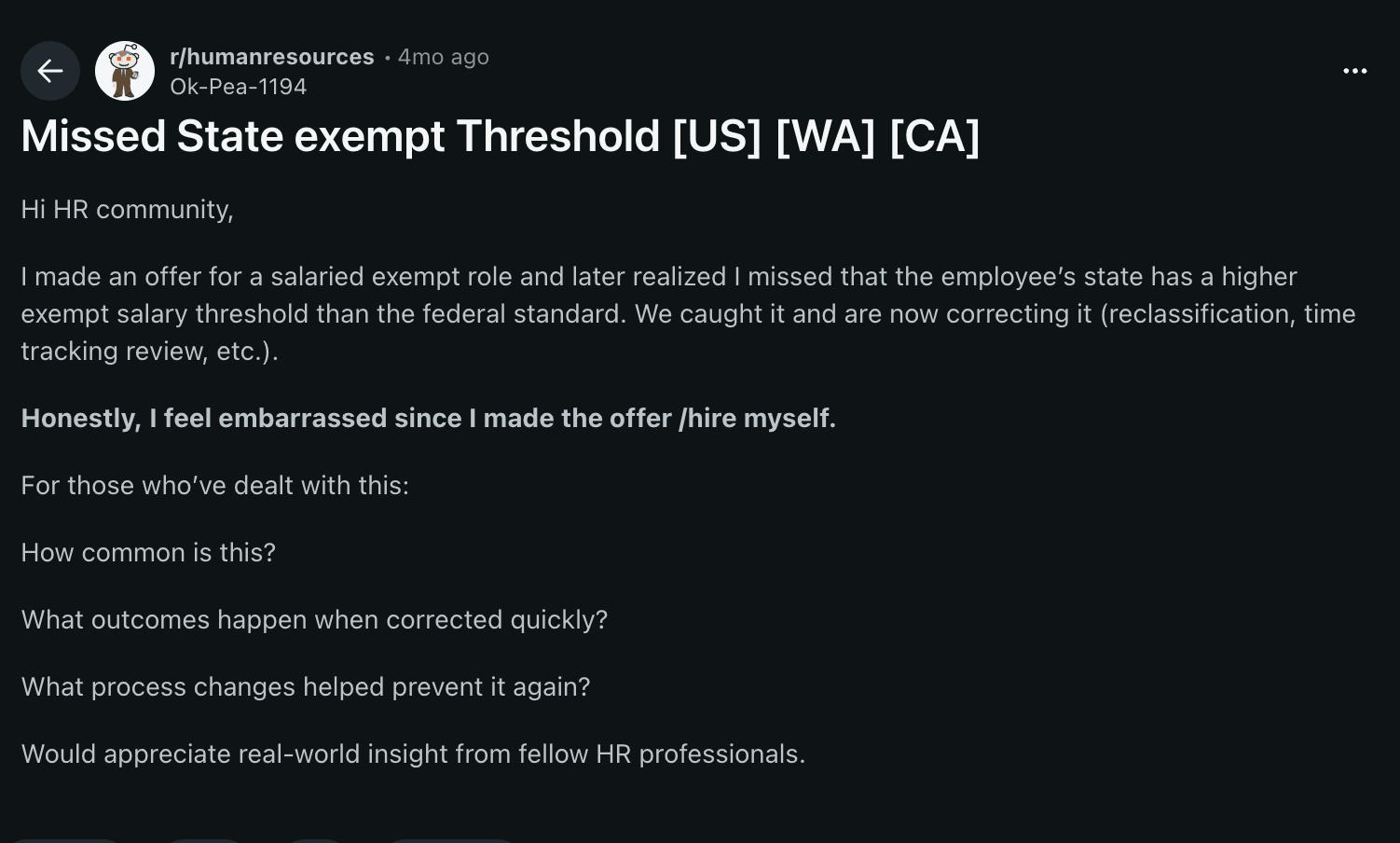
The employer caught the issue and was working through reclassification, time tracking, and corrective action. Other HR professionals described using state-threshold trackers, checking thresholds on a recurring schedule, and retroactively correcting pay where necessary.
Another California HR professional described a worker whose salary fell below the California exempt threshold after a minimum-wage increase.
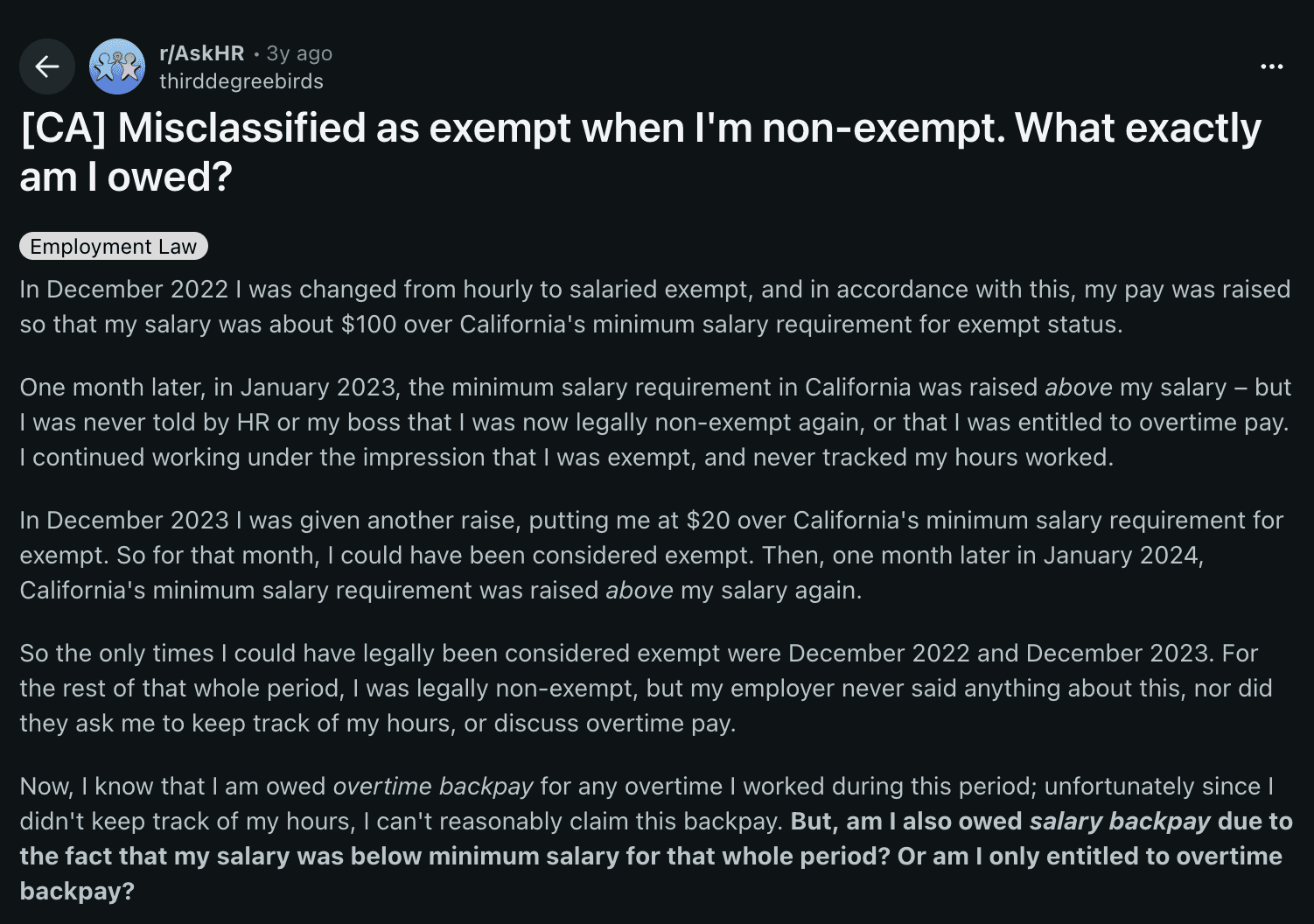
The conversation centered on whether the employee needed to be reclassified and what overtime exposure could result from failing to address the salary gap.
And in another California discussion, an HR professional described a situation where an employee had been paid below the applicable exempt salary threshold and asked about potential back pay and penalties.
For California employers, the annual threshold check should therefore be more than a payroll update. It should trigger a classification review: salary, duties, applicable industry rules, timekeeping, and prior overtime exposure.
How to Audit This Before It Becomes a Claim
Pull a full salary report and flag anyone earning below the correct threshold for their category, rather than the general $70,304 figure applied across the board.
Review actual duties, not job descriptions. Talk to managers, check how time is actually spent, and document what each employee does day to day, not what their offer letter says.
Apply category-specific minimums correctly. Computer software professionals and licensed physicians need their own analysis entirely.
Check local wage ordinances separately. Cities and counties can impose minimum wages above the statewide rate, creating additional wage-and-hour obligations even though the standard §515 exempt salary threshold is tied to the state minimum wage.
Document the audit itself. These records are your first line of defense if a misclassification claim is filed. An audit that was performed but not documented is much harder to use later as evidence of a good-faith compliance process.
If your audit identifies an employee who no longer qualifies for exemption, the employer should determine whether to increase the salary to satisfy the applicable threshold or reclassify the employee as non-exempt. Document either path, communicate it clearly, and coordinate with payroll and timekeeping before the change takes effect.
Our Wage & Hour Defense team reviews exempt classifications against both the salary and duties components, since a threshold audit that only checks the dollar figure misses the very trap most misclassification claims are built around.
What Else Changed for California Employers in 2026?
The exempt threshold doesn't move in isolation. It's one piece of a broader wave of 2026 changes, including stay-or-pay contract restrictions under AB 692, expanded pay data reporting under SB 464, and new workplace notice requirements under SB 294.
If you're auditing payroll for the threshold change, it's a natural moment to check the rest of your 2026 compliance picture as well. Our California employment law compliance checklist covers the full set of laws together.
Conclusion
The official 2026 California exempt salary threshold is $70,304 per year for standard white-collar exemptions, calculated as twice the state's $16.90 minimum wage, but computer software professionals ($122,573.13) and licensed physicians ($107.17/hour) have their own, much higher minimums that don't follow the standard calculation.
Meeting the salary threshold is only half the requirement. California's duties test evaluates what an employee actually does, and a salary above the threshold, combined with non-qualifying duties, still results in a misclassified employee.
If you're not certain your exempt classifications hold up under both tests, DefendMyBiz offers a paid 1-hour consultation. Book a call with our employer defense team today.
Frequently Asked Questions
What is the minimum salary for an exempt employee in California in 2026?
How is the California exempt salary threshold calculated?
Does paying above $70,304 automatically make an employee exempt?
What are the new payroll laws in California starting January 1, 2026?
What happens if I misclassify an employee under the new threshold?
Is the $70,304 California exempt salary threshold gross or net?
Disclaimer: The above content is for informational purposes only. This is not legal or tax advice. Laws, IRS guidance, and withholding requirements can change, and outcomes depend on specific facts. You are advised to contact a qualified attorney for any legal advice.


