
You Can Now Get a Court Order Against an Employee Who Is Harassing You. Here's How California's New TRO Law Works
FEHA / EEO Defense

A former employee is showing up uninvited at your office. A terminated worker is sending threatening emails to your staff. A customer has become obsessed with one of your employees and won't stop calling. Until January 1, 2025, California employers faced a frustrating legal wall: you generally had to wait until the situation escalated to an actual threat of violence before seeking a court order.
That changed. Effective January 1, 2025, SB 428 expanded Code of Civil Procedure §527.8 by allowing employers to seek Workplace Violence Restraining Orders (WVROs) based on qualifying harassment, in addition to unlawful violence and credible threats of violence.
This guide explains what the new law covers, who qualifies to file, what evidence you need, how the process works step by step, and the limits that apply.
Key Takeaways
SB 428, effective January 1, 2025, expanded California CCP §527.8 to allow employers to seek workplace violence restraining orders for harassment, not just violence or credible threats.
Harassment under SB 428 = a knowing and willful course of conduct that seriously alarms or harasses a person, serves no legitimate purpose, and causes substantial emotional distress
Only an employer can file a WVRO. Individual employees cannot file independently; an attorney must represent corporations and LLCs
Before filing, employers must allow the affected employee to decline being named in the petition
WVRO cannot be issued for NLRA-protected activity, constitutionally protected speech, or other legally protected conduct
A TRO generally remains in effect until the scheduled hearing, which is typically held within approximately 21 to 25 days unless continued by the court
SB 553 WVPP incident logs serve as direct evidence in WVRO filings. The two obligations work together
What SB 428 Changed and What You Can Now Do
Before SB 428, California Code of Civil Procedure §527.8 allowed employers to seek a workplace violence restraining order (WVRO) only when an employee had suffered unlawful violence or a credible threat of violence from an identifiable individual. That left a significant gap: systematic harassment that fell short of explicit threats was not covered.
SB 428 also permits employers to seek a temporary restraining order on behalf of employees who have suffered harassment.
Under the amended §527.8, employers can now seek a WVRO for three categories of conduct:
Category | Definition |
|---|---|
Unlawful violence | Any assault, battery, or stalking as defined under California Penal Code |
Credible threat of violence | A knowing and willful statement or course of conduct placing a reasonable person in fear for their safety |
Harassment (NEW - SB 428) | A knowing and willful course of conduct directed at a specific person that seriously alarms, annoys, or harasses the person, serves no legitimate purpose, would cause a reasonable person substantial emotional distress, and actually causes that distress |
The harassment definition is deliberately broad. Supporters of SB 428 pointed out that employers should not have to wait for conduct to escalate to violence before seeking court intervention.
What a WVRO can order the restrained person to do:
Stay away from your workplace, specific employees' homes, schools, and vehicles
Stop all contact with protected employees: in person, by phone, email, text, mail, social media
Do not enter the workplace under any circumstances
Surrender any firearms they possess
Violating a WVRO is a criminal offense. Law enforcement can arrest the restrained person on the spot. That enforceability is what makes this a legally enforceable protective tool.
Who Can File: One Step You Must Take Before Filing
Only an employer can file a workplace violence restraining order in California under CCP §527.8. An individual employee does not have standing to file this type of restraining order independently.
A union representative can file on an employee's behalf, but only if that person serves as the employee's collective bargaining representative at the relevant workplace.
The step most employers miss: Before filing, you must give the employee whose protection is sought the opportunity to decline to be named in the order. SB 428 requires that, before an employer seeks a temporary restraining order, they must provide the employee whose protection is sought the opportunity to decline to be named in the order.
If that employee declines, you are not prohibited from filing on behalf of other affected employees. Document the conversation and the employee's decision in writing before you proceed. California business entities generally must appear through licensed counsel.
The Four Types of Evidence That Win WVRO Cases
The strength of your WVRO (Workplace Violence Restraining Order) petition is entirely dependent on your evidence. At the TRO stage, the standard is "reasonable proof," a lower bar, because it is an ex parte proceeding where only your side is heard.
At the temporary restraining order stage, the court reviews the employer's verified petition and supporting evidence on an ex parte basis to determine whether immediate relief is warranted. At the hearing on a permanent WVRO, the employer must establish the statutory requirements under CCP §527.8, including the applicable burden of proof for harassment-based petitions.
The evidence types courts respond to:
1.
Written communications.
Emails, text messages, social media messages, letters, or any direct communication from the respondent containing threatening, harassing, or alarming language. Print them with timestamps, preserve the digital originals, and organize them chronologically to demonstrate the pattern.
2.
Incident logs.
Contemporaneous notes documenting each incident: date, time, location, what was said or done, who witnessed it, and how the employee responded. These logs are included as Attachment 12 in your WV-100 petition.
3.
Witness declarations
Signed written statements from employees or others who observed the harassing conduct. Declarations must be made under penalty of perjury and should describe specific events, not general impressions.
4.
Surveillance footage and access records.
Video evidence of unauthorized entries or unwanted appearances at your workplace is some of the most compelling evidence available. If you have a key card access log showing the respondent trying to enter, or security footage showing them in the parking lot, include it.
Watch: John Fagerholm explains what California employers can legally do when monitoring workplace email communications, including how lawfully collected email evidence can document harassment patterns. Monitoring Employee Emails — DefendMyBiz YouTube
Step-by-Step: How to File for a Workplace Violence Restraining Order
Step 1: Document everything before you file.
Compile all evidence into chronological order. Your petition will include written attachments describing the specific acts of harassment or violence. Courts respond to specificity, like dates, times, exact words, exact locations, and named witnesses.
Step 2: Notify the affected employee and document their response.
Give the employee whose protection you are seeking a clear opportunity to decline being named. Document the conversation in writing, including whether they consented or declined.
Step 3: Complete the required Judicial Council forms. The forms required under the January 1, 2026 revision are:
WV-100: Petition for Workplace Violence Restraining Orders (the main filing document)
WV-109: Notice of Court Hearing
WV-110: Temporary Restraining Order (the order you ask the judge to sign)
CLETS-001: Confidential CLETS Information (for law enforcement database entry)
Step 4: File with the Superior Court in your county.
The court reviews your petition and issues a decision either the same day or the next business day. California law waives filing fees for many WVRO petitions involving violence, threats of violence, or stalking. Employers should confirm any county-specific filing procedures with the Superior Court.
Step 5: TRO issued (if granted).
If the judge finds your evidence sufficient, a Temporary Restraining Order is issued without the respondent present. The TRO is immediately enforceable and remains in effect for 21 days.
Step 6: Serve the respondent.
The respondent must be personally served with the TRO, the petition, and the notice of hearing at least five days before the hearing. A process server or law enforcement handles service. This step cannot be skipped. If service fails, the hearing cannot proceed.
Step 7: Appear at the court hearing.
Both parties appear before a judge within 21 days of the TRO. The employer presents evidence and witnesses; the respondent can challenge and cross-examine. If the court finds in the employer's favor, a permanent order lasting up to three years can be issued and entered into the California Law Enforcement Telecommunications System (CLETS) so all law enforcement can enforce it. A firearm surrender order is included.
The NLRA Limitation and Why It Matters
The law does not permit courts to issue restraining orders for actions "that are constitutionally protected, protected by the National Labor Relations Act … or otherwise protected by Section 527.3 or any other provision of law."
This limitation is critical. If an employee is engaged in:
Organizing or discussing union activity
Filing complaints with government agencies (OSHA, DLSE, EEOC)
Discussing wages and working conditions with coworkers
Engaging in protected concerted activity under the NLRA
A WVRO cannot be issued for those activities, even if they annoy, alarm, or create conflict with management. Filing a petition that targets protected activity exposes the employer to a malicious prosecution claim and potential NLRB charges.
The line between protected activity and actionable harassment requires an experienced employer defense attorney to evaluate before filing. A petition filed against a union organizer who is also sending personally threatening communications is a case that needs careful factual separation.
The SB 553 Connection: Why Your WVPP Is Part of This
If you have already built a compliant Workplace Violence Prevention Plan (WVPP) under California SB 553 (effective July 1, 2024), that plan is not just a compliance document. It is the foundation of your WVRO case.
Your WVPP must include a violent incident log, a formal record of every workplace violence or threatening incident, including dates, descriptions, and responses. That log becomes direct evidence in your WV-100 petition. It demonstrates that the pattern of conduct you are documenting was formally observed, recorded, and not resolved through internal means exactly what courts look for in a harassment-based WVRO.
Employers who treat SB 553 as a checkbox often miss this connection. For context on how SB 553 compliance intersects with broader harassment liability, see An Employee Just Reported Harassment: What California Law Requires in the Next 72 Hours and An Employee Is Claiming You Discriminated Against Them. Learn How to Defend That Decision.
An Actual Query: Does California's Workplace Violence Prevention Law Apply to Employers With Remote Employees?
A recurring employer compliance question is whether California's workplace violence requirements apply when a company is headquartered outside California or primarily employs remote workers.
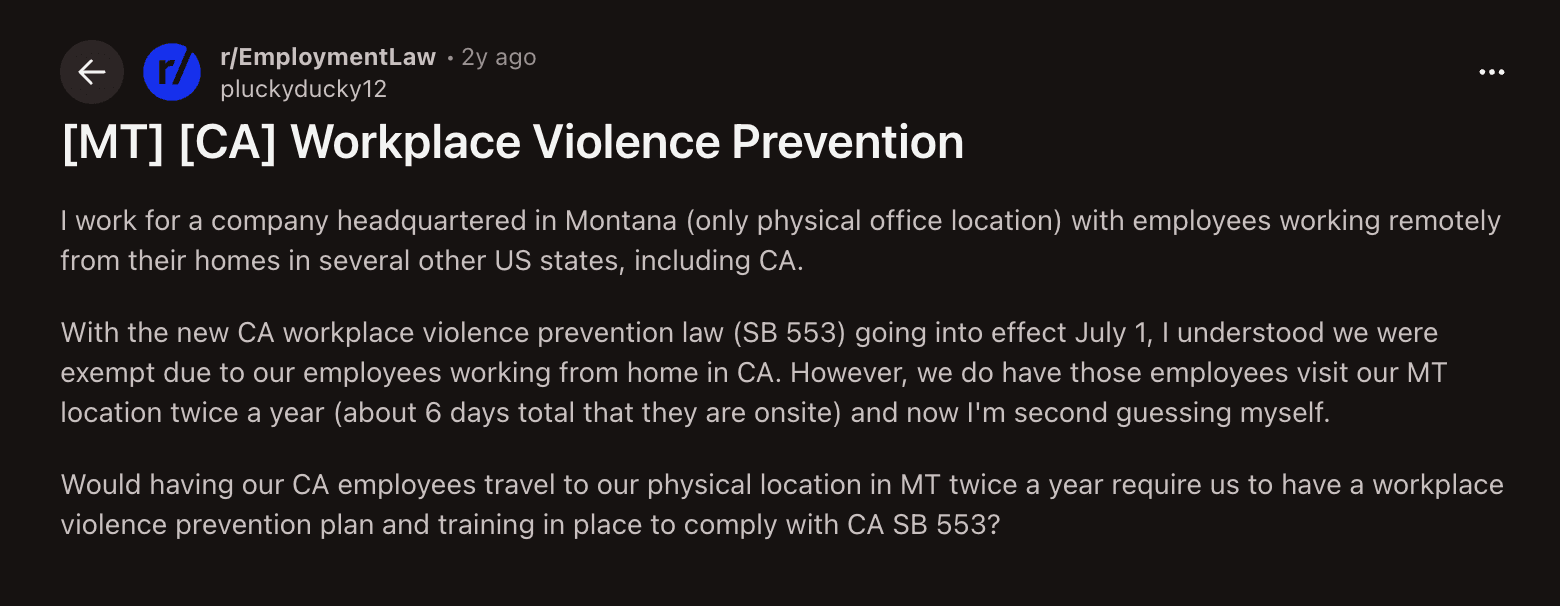
While this discussion centers on SB 553's Workplace Violence Prevention Plan (WVPP) rather than a restraining order, it directly affects an employer's ability to document workplace violence incidents that may later support a Workplace Violence Restraining Order (WVRO) petition.
Employers should evaluate:
Whether California employees are covered under SB 553.
Whether a compliant Workplace Violence Prevention Plan has been implemented.
Whether workplace violence incident logs are being maintained.
Whether managers understand how to document threatening conduct before it escalates.
One of the biggest mistakes employers make is treating the WVPP as a standalone compliance requirement. In many situations, those incident logs become some of the strongest evidence in support of a later California Workplace Violence Restraining Order petition.
When to Consult an Employer Defense Attorney Before Filing
Not every harassment situation warrants a WVRO, and filing without adequate evidence or filing against someone engaged in protected activity creates its own liability. Consult an employer defense attorney before filing when:
The respondent is a current or former employee who may have a pending or anticipated employment claim
The conduct involves group activity that could have NLRA protection
The affected employee has declined to be named, but you want to file on behalf of others
You are unsure whether the conduct meets the legal definition of harassment under SB 428
The respondent is likely to contest the order and hire their own attorney
At DefendMyBiz, we represent California employers exclusively. Our employer defense attorneys assess the strength of your evidence, identify any NLRA or constitutional speech issues that could complicate your filing, guide you through the complete petition process, and represent your business at the permanent order hearing.
The DefendMyBiz FEHA/EEO defense team handles WVRO petitions as part of comprehensive employer defense because a harassment situation that warrants a TRO often runs alongside FEHA claims, retaliation concerns, and workplace investigation obligations.
If you're already dealing with a threatening former employee, harassing customer, or pattern of conduct targeting your staff, contact DefendMyBiz for a free 15-minute consultation.
FAQ
What is the legal definition of harassment under California's workplace violence restraining order law after SB 428?
Can an individual employee file a workplace violence restraining order in California?
What forms does an employer need to file a workplace violence restraining order in California?
What is the difference between a temporary and permanent workplace violence restraining order?
Are there filing fees for a workplace violence restraining order in California?
Can an employer obtain a Workplace Violence Restraining Order against a former employee?
Can an employer obtain a Workplace Violence Restraining Order against a customer or client?
How long does a California Workplace Violence Restraining Order last?
Disclaimer: The above content is for informational purposes only. This is not legal or tax advice. Laws, IRS guidance, and withholding requirements can change, and outcomes depend on specific facts. You are advised to contact a qualified attorney for any legal advice.


