An Employee Just Reported Harassment. Learn What California Law Requires You to Do in the Next 72 Hours
FEHA / EEO Defense

An employee just reported workplace harassment to HR, a manager, or you directly. The first 72 hours are critical, but not a statutory deadline. They are the practical window where employers preserve evidence, separate the parties if needed, and begin a defensible investigation.
How you respond either strengthens or weakens your defense.
California imposes stricter harassment response requirements on employers than federal law. Miss the standard on timing, investigation process, or retaliation prevention, and the complaint you're looking at today becomes a FEHA lawsuit you're defending next year.
What the Law Requires the Moment You Receive a Complaint
Under Gov. Code § 12940(j), once an employer knows or should know about harassment, it must take immediate and appropriate corrective action.
You have an affirmative duty to take all reasonable steps to prevent and correct harassment. This is a separate, standalone cause of action.
If a supervisor engages in actionable harassment, the employer may face strict liability under FEHA, regardless of whether upper management knew about it.
For coworker harassment, liability attaches if you knew or should have known and failed to act promptly.
Certain adverse actions taken within 90 days of a covered protected activity may create a rebuttable presumption of retaliation.
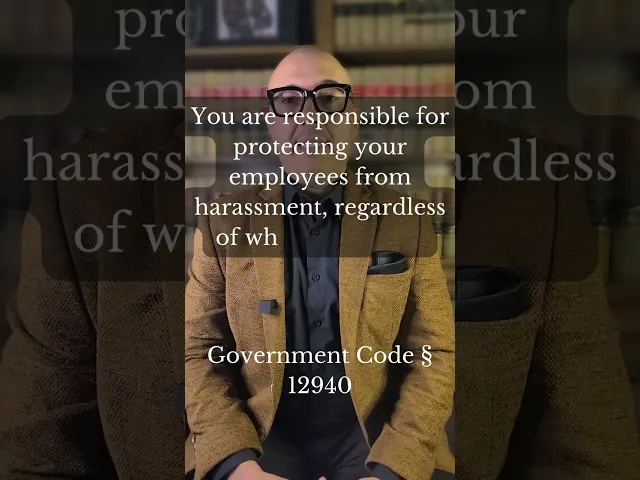
Watch: John explains exactly what California law requires employers to do to protect employees from harassment and what happens when they don't. Watch here →
The First 72 Hours: What You Must Do
Hour 1: Preserve and separate
Document the complaint in writing immediately: date, time, who reported, what was alleged, and who is allegedly involved. If the accused and the complainant share a workspace, supervisor relationship, or regular contact, implement separation now. This means ensuring the alleged harasser is not in a position to retaliate or repeat the alleged harassment while the investigation is underway.
Do not: tell the complainant to "work it out" with the accused. Do not discourage the report. Do not ask the complainant why they waited to report. Any of these responses becomes evidence of bad faith.
Hour 2–24: Notify counsel and start the investigation
Under the CRD's 2025 Harassment Prevention Guide, the investigation must be prompt, impartial, thorough, and conducted by a qualified investigator. That investigator can be internal HR, outside counsel, or a licensed private investigator, but they must have no stake in the outcome.
If you plan to use an attorney-led investigation, note the privilege waiver risk: if you later assert "we investigated and found no wrongdoing" as a defense, you may have waived attorney-client privilege over the investigation file, turning it over to plaintiff's counsel.
Hour 24–72: Conduct witness interviews and document everything
Interview the complainant first, then the accused, then any identified witnesses. Use open-ended questions. Take detailed notes. Investigations must use a preponderance-of-the-evidence standard to determine whether the harassment occurred. Document every step, every interview date, every finding.
Confidentiality: You can request confidentiality during the investigation, but it cannot be guaranteed. The CRD and EEOC consider confidentiality protections best practice, but given evolving NLRB guidance (Stericycle), consult counsel before requiring it as a blanket rule.
For how sexual harassment claims specifically develop against California employers, see: Sexual Harassment Claims Against California Employers: Know How the Defense Works.
What the CRD's 2025 Guide Expects From Your Investigation
In March 2025, California's Civil Rights Department published a substantially revised Harassment Prevention Guide, the agency's practical roadmap for FEHA enforcement. The guide is not a statute, but it is a practical roadmap for how the CRD expects employers to prevent, investigate, and correct harassment.
Here's what it requires:
Investigation Element | CRD 2025 Guide Expectation |
|---|---|
Timing | Begin promptly; unexplained delays can show failure to prevent or correct |
Investigator | Impartial, qualified, and without a stake in the outcome |
Interviews | Complainant, accused, and relevant witnesses |
Evidence standard | Preponderance of the evidence, more likely than not |
Documentation | Written record of steps taken, evidence reviewed, and findings |
Confidentiality | Limit information to those with a need to know; avoid blanket confidentiality rules without legal review |
Remedial action | Corrective or preventive steps where inappropriate conduct is found |
Retaliation monitoring | Monitor for retaliation after the investigation closes |
Remote work | Virtual investigations may be appropriate, but must meet the same standards |
The remedial action point is critical:
Under the updated 2025 Guide, employers must implement effective remedial measures even when the investigation finds conduct that doesn't technically violate FEHA. The CRD expects employers to correct problematic behavior. Failure to document and implement corrective action is independently actionable.
Watch: John breaks down California's mandatory harassment prevention training requirements: what employers must provide, when, and for whom. Watch here →

For FEHA / EEO Defense services: FEHA / EEO Defense →
Where Employers Can Lose These Cases
1) Not acting immediately. Gov. Code § 12940(j) requires "immediate" corrective action. Courts may penalize delays of even one to two weeks. If the investigation doesn't start within days of receiving the complaint, the delay itself becomes evidence.
2) Investigating with a biased investigator. Using the accused's direct supervisor, a close friend of management, or HR personnel with a personal stake in the outcome destroys the investigation's credibility. The 2025 CRD Guide specifically requires impartiality. Investigators with a stake in the outcome are a recognized pitfall.
3) Retaliating after the complaint. This is where employers create a second, stronger claim. The Live Nation/House of Blues Anaheim case settled for $500,000 with the CRD, in part because management failed to take adequate action and then terminated the complainant after she reported the incident. Any adverse action within 90 days of a protected activity creates a legal presumption that it was retaliatory.
4) Closing the file without remedial action. An investigation that finds nothing requires no discipline, but it still requires documented corrective steps. The 2025 CRD Guide is explicit: employers must implement effective remedial measures even when conduct falls short of a FEHA violation.
5) Failing to monitor for retaliation after the investigation closes. The 2025 Guide added a new requirement: employers must monitor outcomes after the investigation ends, not just document findings and move on. Courts increasingly scrutinize post-investigation conduct.
For hybrid claims that frequently accompany harassment complaints, such as defamation, IIED, and wrongful termination, see DefendMyBiz's Hybrid/Non-FEHA Claims Defense.
What Employers Are Asking Online & What It Signals
Across Reddit's r/humanresources and r/managers, HR professionals and managers regularly ask how to handle harassment complaints, conflicting stories, uncooperative witnesses, inconclusive findings, and post-complaint manager conduct. These are the same issues that determine whether an employer's response looks prompt, impartial, and well-documented.
1) "How do we handle conflicting stories during a workplace investigation?"
In one r/humanresources thread, a new HR manager described investigations where multiple employees gave conflicting accounts and asked how to determine what actually happened.
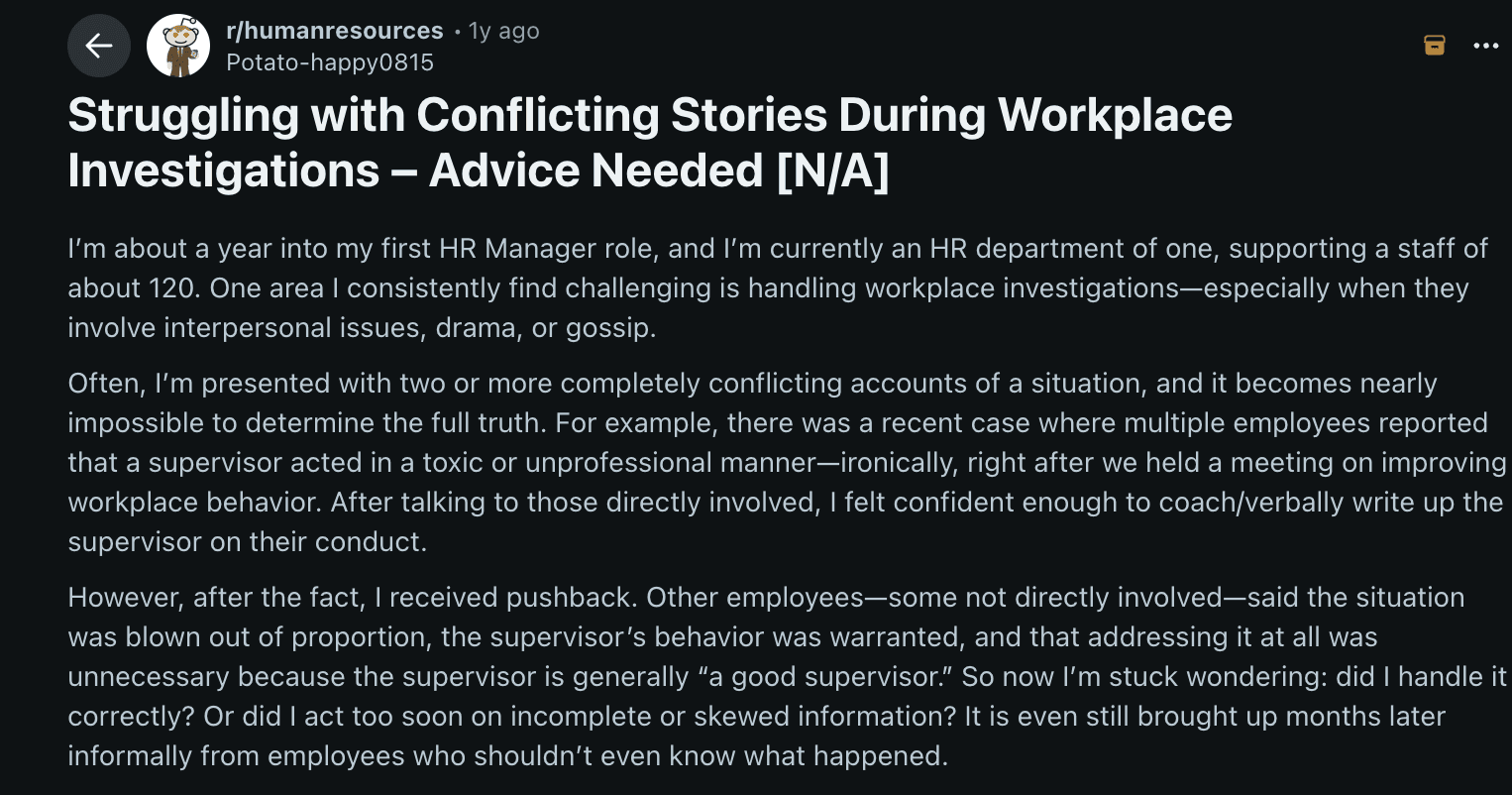
For employers, this is where the quality of the investigation matters. A defensible investigation does not require perfect evidence, but it does require a neutral process, consistent interview questions, credibility assessment, and written findings.
2) "What do we do when an investigation is inconclusive?”
Another r/humanresources thread asked how to handle inconclusive investigations when HR cannot definitively prove what happened.
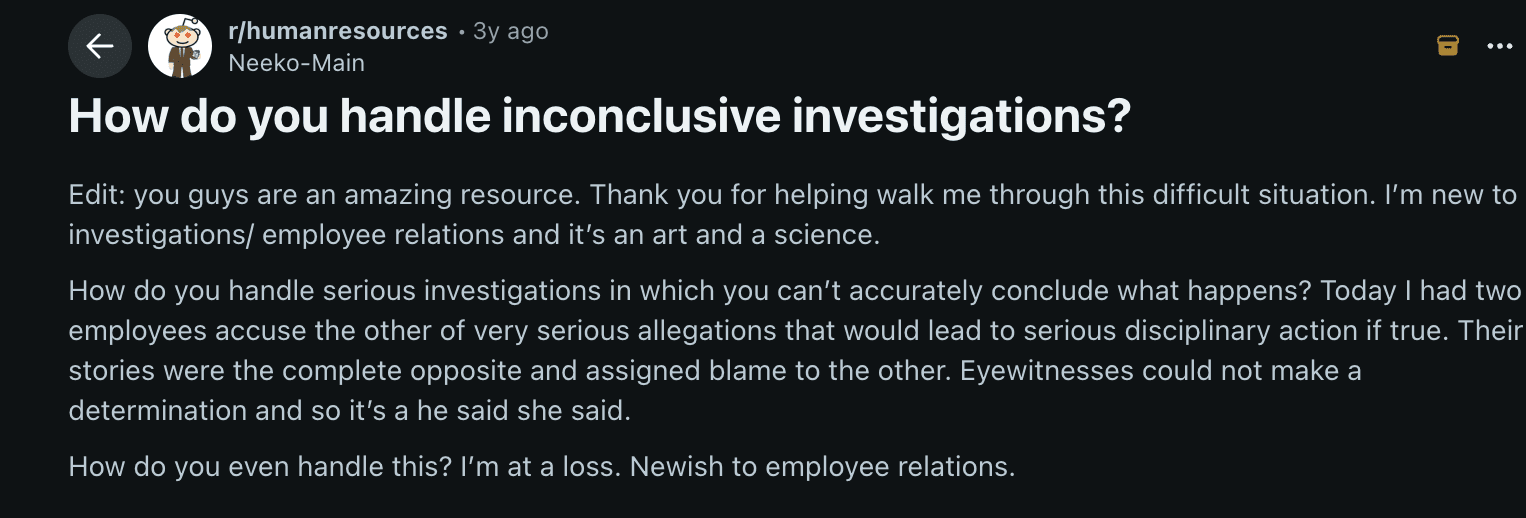
For employers, a "no finding" is not the same as "nothing to do." If the investigation identifies workplace friction, policy gaps, or unprofessional conduct, document the finding and consider corrective or preventive steps.
3) "How do we conduct an investigation when employees refuse to participate?”
In a r/humanresources thread, an HR professional described a team refusing to answer questions during an investigation and asked how to proceed.

For employers, witness noncooperation does not excuse inaction. Document outreach, refusals, anti-retaliation reminders, available evidence, and the basis for any final findings.
The employer takeaway: Harassment complaints are addressed through a process that includes immediate documentation, separation when necessary, impartial investigation, careful handling of witnesses, remedial action when appropriate, and post-investigation monitoring for retaliation.
DefendMyBiz helps California employers respond to harassment complaints, structure defensible investigations, manage manager conduct, and reduce FEHA retaliation exposure before the first response becomes evidence.
Conclusion
A workplace harassment complaint in California starts a legally governed clock. The 72-hour window after you receive a report is where your defense is either built or compromised. California's 2025 CRD Harassment Prevention Guide sets the benchmark against which your investigation will be measured.
Miss the standard on timing, impartiality, documentation, or post-investigation monitoring, and the complaint becomes the easier part of what you're defending.
If you've just received a harassment complaint, get defense counsel involved before you conduct a single interview. The process needs to be right from the first step.
Contact DefendMyBiz for a free 15-minute consultation → | (818) 418-6625
FAQs
What does "immediate" mean under FEHA when a harassment complaint is received?
Can I be liable for harassment by a coworker I didn't know about?
Does a "no finding" in my investigation protect me from a FEHA lawsuit?
Must I still take corrective action if the investigation finds no FEHA violation?
What sexual harassment prevention training does California require?
Disclaimer: The above content is for informational purposes only. This is not legal or tax advice. Laws, IRS guidance, and withholding requirements can change, and outcomes depend on specific facts. You are advised to contact a qualified attorney for any legal advice.


