Travel Time, Security Checks, and Pre-Shift Tasks: When California Employers Owe Wages
Wage & Hour Defense

Your employee leaves home at 6:45 am, stops at the warehouse to pick up tools, drives to the job site, and clocks in at 8:00 am. You are paying from 8:00 am forward. California law may treat some of that pre-shift travel time as compensable depending on whether the employee was under the employer's control.
Travel time pay in California follows rules that are broader than federal law and more specific than most employers realize. The question is never simply "did they travel to work?" It is whether your requirements, your equipment, and your scheduling controlled any part of what the employee did before, during, or between shifts. If the answer is yes, you owe wages for that time.
This guide covers exactly which scenarios trigger a pay obligation under California law, how to calculate it correctly, what the real enforcement risk looks like, and what to fix before a wage claim or PAGA notice forces the conversation.
Key Takeaways
California's "hours worked" definition is broader than federal law and focuses on whether the employer controlled the employee's time.
Job-to-job travel, required equipment pickup, mandatory transportation, security screening, and required pre-shift tasks may be compensable depending on the circumstances.
A regular home-to-work commute is not compensable, but any employer requirement that controls how, where, or when the employee travels can change that
A lower travel time pay rate is allowed but must be at least California's minimum wage ($16.90/hour, 2026), established before travel begins, and properly factored into the weighted average overtime
SB 261 (January 2026) means unsatisfied wage judgments now carry triple-penalty exposure after 180 days. Resolving violations proactively is more important than ever
Why California's Standard Is Different
The federal Fair Labor Standards Act generally excludes ordinary commute time and most pre-shift activities from compensable time. California does not follow that framework.
Under California's IWC Wage Orders, "hours worked" is defined as all time during which an employee is subject to the control of an employer, including all time the employee is suffered or permitted to work, whether or not required to do so. That definition is broader than the federal standard and is the source of most California travel time disputes.
The California DIR has confirmed that an employer is obligated to pay wages for all time the hourly employee is under the employer's control. The control test is the standard. Every travel, security, and pre-shift scenario runs through it.
The Scenarios That Trigger a Pay Obligation
This is the practical core of California travel time pay rules. Each scenario below represents a real enforcement pattern. The question for each is the same: did the employer's requirement control the employee's time?
Scenario 1: Job-to-job travel during the workday
Always compensable. If an employee travels from one worksite to another during their shift, like a plumber moving between client locations, a home health aide visiting multiple patients, or a technician assigned to two facilities, every minute of that transit is hours worked.
Scenario 2: Travel to a different or temporary worksite
When an employer requires travel to a temporary worksite, compensability depends on factors such as the employee's normal commute, the assignment's location, and whether the travel is beyond ordinary commuting. The excess, not the full commute, is what the employer owes.
Scenario 3: Required pickup of equipment, tools, or supplies
This is where the enforcement gap is widest. If an employee must stop at a warehouse, supply depot, or central location to load employer-owned tools or materials before proceeding to the job site, that pickup time and the subsequent travel to the job site are compensable.
Scenario 4: Mandatory employer transportation
If you require employees to use company-provided transportation and prohibit them from traveling independently, that entire transit period is compensable. The fact that employees can read, talk, or use their phones during the ride is irrelevant. Control over the method of travel is enough.
Scenario 5: Security checks and screening
Mandatory security screening may be compensable when required by the employer and performed before the employee can begin work. The California control test does not distinguish between productive activity and waiting in line. Both are compensable when the employer controls the time.
Scenario 6: Pre-shift mandatory tasks
If you require employees to attend a briefing before their shift, complete safety checks on equipment, change into required uniforms that cannot be worn off the premises, or perform any task before the scheduled shift time, that time is compensable.
The IWC standard is simple: suffered or permitted to work means the employer knew about it and allowed it. Required means it triggers compensation regardless of whether timekeeping captures it.
Scenario 7: Mandatory training and meetings at off-site locations
Travel to mandatory off-site training is compensable work time, including travel on a non-scheduled workday. The employer's requirement to attend is the controlling factor.
Scenario 8: Home-based employees traveling to any employer-required location
For remote employees, travel obligations must be analyzed based on the specific work arrangement, assigned locations, and whether the travel is a normal commute or employer-required travel. There is no regular commute to subtract.
Employer Question: "How Should We Handle Travel Time Pay for California Employees Traveling Between Jobs?"
A common HR challenge in California is deciding when employee travel becomes paid time.
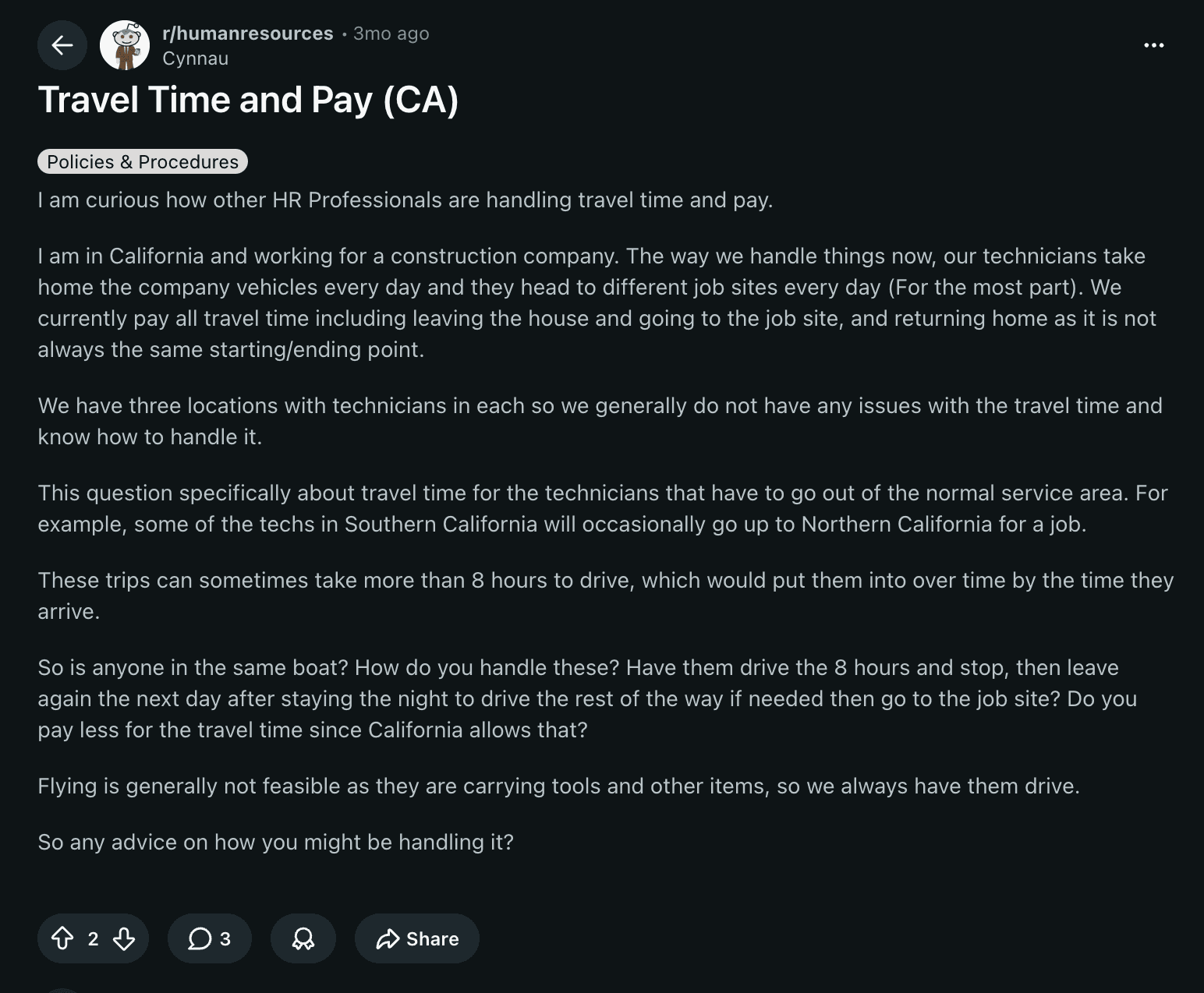
The answer usually depends on what type of travel is occurring:
Regular commute to a fixed workplace: generally not paid
Travel between job sites during the workday: generally paid
Employer-required transportation or equipment pickup: may create wage obligations
The mistake many employers make is creating one blanket travel policy for every employee and every situation.
A better approach is to separate travel scenarios, document expectations, train managers, and ensure timekeeping systems correctly capture compensable travel.
California travel time disputes are often decided by operational details, not just the written policy.
What Is NOT Compensable Under California Law
Scenario | Compensable? | Why |
|---|---|---|
Regular commute from home to a fixed worksite | No | The employer does not control how or when the employee travels |
Employee chooses to answer work emails during commute | No (unless the employer knew or required the work) | Not required by the employer |
Travel during a bona fide meal break (employee is free) | No | Employee is relieved of duties |
Voluntary early arrival before shift starts | No | Not required or suffered/permitted if the employer had no knowledge |
Passenger on an overnight flight after normal work hours | No (generally) | Time the employee is free to use personally |
The line is employer control and employer requirement. When you require it, you own the time.
How to Calculate Travel Time Pay Correctly
California allows employers to pay a lower rate for travel time than the employee's regular hourly rate, but that rate must be at least the state minimum wage ($16.90/hour as of January 1, 2026), and it must be established and communicated to employees before the travel occurs.
When an employee works at multiple pay rates in a single workweek, California requires the weighted average method to calculate overtime:
Step | Action |
|---|---|
1 | Track all hours separately: regular work hours and travel time hours |
2 | Multiply each category by its rate to get total weekly earnings |
3 | Divide total earnings by total hours to get the regular rate of pay |
4 | Pay 0.5x the regular rate for each overtime hour, on top of the base rate already paid |
For example, an employee works 36 hours at $22/hour ($792) and 6 hours of travel at $18/hour ($108). Total earnings = $900. Total hours = 42. Regular rate = $900 ÷ 42 = $21.43. Two overtime hours each require an additional $10.71 half-time premium. Most payroll systems configured for a single rate miss this calculation entirely.
Mileage reimbursement is separate and required.
Under California Labor Code §2802, employers must reimburse employees for all necessary expenses incurred while performing employer-required travel, including mileage, fuel, vehicle wear and tear, and related costs when employees use personal vehicles.
The Real Enforcement Risk in 2026
Non-compliance with California travel-time pay rules does not remain small. Employees can recover unpaid wages going back four years from the date a lawsuit is filed. On top of back wages, the exposure includes:
Waiting time penalties (Labor Code §203):
up to 30 days of daily wages if travel time was not paid at final wages
PAGA civil penalties:
stacked per employee per pay period for each violation, across the entire workforce
SB 261 (effective January 1, 2026):
if a wage judgment is not satisfied within 180 days, courts now impose penalties of up to three times the outstanding amount.
Class action exposure:
a policy that applies the same incorrect travel time practice to a workforce of 30, 50, or 100 employees becomes a systemic violation
For a full picture of how wage and hour violations stack into class action and PAGA exposure, see Defeating Wage and Hour Class Actions in California: An Employer's Defense Guide and One Wage Statement Error Can Trigger a PAGA Claim Against Your Entire Workforce.
Your Pre-Claim Audit Checklist
Run through these questions against your current policies. Every "no" is a gap worth fixing before a wage claim makes it an exhibit.
Travel and pre-shift tasks:
Have you mapped every travel scenario your non-exempt employees perform, including supply pickup, equipment loading, security screening, and job-to-job travel?
Is each scenario documented as compensable or non-compensable, and does your written policy explain why?
Does your timekeeping system capture travel hours as a separate, labeled category?
If you pay a lower rate for travel time, was that rate established and communicated before the travel began?
Calculation and payroll:
Does your payroll system apply the weighted average method for overtime when employees work at multiple rates in a week?
Are mileage reimbursements processed in the same pay cycle as the travel?
Have you confirmed that no travel time falls below the California minimum wage?
Records:
Do you have at least four years of timekeeping records for all non-exempt employees who travel as part of their work?
Do those records reflect actual practice, how work happens in the field, not just what the policy says?
For more on how wage and hour exposure compounds with mileage and expense reimbursement obligations, see California Expense Reimbursement: What Labor Code §2802 Requires from Employers.
When a Travel Time Claim Arrives
Travel time pay claims rarely arrive alone. They surface as part of broader wage-and-hour complaints alongside off-the-clock work allegations, meal break violations, and PAGA notices because plaintiff attorneys pull the full-time record and find every gap at once.
At DefendMyBiz, we represent California employers exclusively. When a wage claim, PAGA notice, or class action complaint includes allegations of travel time pay, we assess your actual exposure based on real timekeeping records and written policies, not the inflated number in the demand letter. We know where California courts draw the line on employer control, and we know how to build a documented, good-faith compliance record that shifts outcomes.
The DefendMyBiz wage-and-hour defense team handles everything from pre-claim policy reviews to full PAGA and class-action defense. Contact DefendMyBiz for a free 15-minute consultation.
If you need further legal guidance on your travel time or pre-shift pay practices, DefendMyBiz also offers 1-hour paid consultations for employers seeking specific legal advice.
FAQ
Does California require employers to pay for travel between job sites during the workday?
Do I have to pay an employee who stops to pick up supplies before coming to the job site?
Can I pay a lower rate for travel time in California?
Does California require mileage reimbursement for work travel?
How far back can an employee go on a travel time pay claim in California?
Disclaimer: The above content is for informational purposes only. This is not legal or tax advice. Laws, IRS guidance, and withholding requirements can change, and outcomes depend on specific facts. You are advised to contact a qualified attorney for any legal advice.


