California's Pay Transparency Law Just Got Stricter. Here's What SB 642 Requires in Every Job Posting
Wage & Hour Defense

A job posting can create legal exposure before you interview a single candidate.
California's pay transparency law requires employers to disclose compensation information during hiring, maintain accurate wage records, and avoid practices that create pay equity concerns.
The challenge for employers is not simply posting a salary range. The real risk is whether that range reflects a legitimate compensation decision supported by documentation.
This guide explains California pay transparency requirements, what employers must include in job postings, how salary disclosure rules interact with equal pay claims, and what businesses should do when a complaint is filed.
Key Takeaways
SB 642 (effective January 1, 2026) revised the definition of "pay scale" to mean a good-faith estimate of the salary or hourly wage range that the employer reasonably expects to pay for the position upon hire.
SB 642 expands the definitions of "wages" and "wage rates" under the California Equal Pay Act to include additional forms of compensation, such as salary, overtime pay, bonuses, stock, stock options, profit sharing, benefits, and other compensation components.
The statute of limitations for equal pay claims has been extended to three years, regardless of willfulness. SB 642 limits the total period for which relief may be obtained to six years.
SB 642 clarifies when an Equal Pay Act violation occurs, including when an alleged unlawful compensation decision or practice is adopted, applied, or affects an employee.
SB 464 made penalties for annual pay data report violations mandatory: $100/employee for the first violation, $200/employee for subsequent violations.
What Is California's Pay Transparency Law?
California's pay transparency framework is built on two statutes working together: the California Equal Pay Act (Labor Code §1197.5) and Labor Code §432.3.
Together, they require employers to:
Post a pay scale in every job listing (employers with 15+ employees)
Provide the pay scale for any position to any applicant or current employee upon request
Prohibit salary history questions at any point in the hiring process
Maintain records of job titles and wage rate histories for each employee for the duration of employment, plus three years after separation.
Report annual pay data to the California Civil Rights Department (employers with 100+ employees)
SB 642, signed by Governor Newsom on October 8, 2025, and effective January 1, 2026, amended both statutes in three significant ways that every California employer needs to understand.
The Biggest Pay Transparency Compliance Risks California Employers Face
Change 1: "Pay Scale" Now Means a Good Faith Estimate of What You Will Actually Pay
Before SB 642, the law required employers to post a "pay scale," but the definition was so vague that broad, theoretical ranges were common, like a range of $70,000–$180,000 for a single role technically complied.
That is no longer acceptable.
SB 642 amends Labor Code §432.3 to define pay scale as "a good faith estimate of the salary or hourly wage range that the employer reasonably expects to pay for the position upon hire," meaning at the time the candidate actually starts work, not a theoretical range covering every possible seniority level across the department.
What this kills in practice:
Old Approach (no longer compliant) | Required Under SB 642 |
|---|---|
One broad posting covering all experience levels: $70k–$180k | Separate postings per level: "Engineer II: $95k–$110k" and "Senior Engineer: $140k–$165k" |
Range spanning the full pay band for the department | Range reflecting what you expect to pay for this specific hire |
Theoretical ceiling set by the highest earner in the role | Realistic floor and ceiling based on the actual hiring budget |
Change 2: "Wages" Now Includes Total Compensation for Equal Pay Claims
For job posting purposes, you only need to disclose the base salary or the hourly wage range. But for equal pay claims, when an employee alleges pay discrimination, SB 642 dramatically expanded what counts as "wages."
SB 642 expands the definition of wages and wage rates to include various forms of compensation, including
Salary
Overtime pay
Bonuses
Stock options
profit sharing
Benefits
Allowance
Reimbursements and other compensation components
This matters because you do not have to list all of these in your job posting, but if an employee brings an equal pay claim, your total compensation package for comparable employees becomes the measuring stick. A pay disparity that looks minor at the base salary level can become significant when bonuses and equity are included.
SB 642 also expanded the definition of "sex" under the Equal Pay Act to cover employees of "another sex," now explicitly including non-binary genders, meaning pay equity obligations apply across all gender identities, not just binary male/female comparisons.
Change 3: The Statute of Limitations and Look-Back Window Both Extended
This is the change with the longest tail for California employers.
Previous Standard | Under SB 642 (Jan 1, 2026) |
|---|---|
2-year statute of limitations (3 years if willful) | 3 years from the date of the last alleged violation, regardless of willfulness |
2-year look-back for back pay recovery | 6-year look-back period for full relief |
Additionally, SB 642 codifies the continuing violations doctrine for equal pay claims. Each paycheck where a pay disparity exists can be treated as a new, separate violation, meaning a pay gap that has existed for years generates fresh causes of action on every pay cycle.
SB 464: The Annual Pay Data Reporting Changes Running Alongside SB 642
SB 642 is not the only 2026 pay transparency development. SB 464, effective January 1, 2026, made the annual pay data reporting obligation significantly more consequential for employers with 100 or more employees.
Three key changes under SB 464:
1.
Demographic data must be maintained separately from personnel files.
Do not combine EEO reporting data with general employee records.
2.
Beginning January 1, 2027,
SB 464 changes pay data reporting classifications by requiring employers to use expanded occupational categories established under the new reporting framework.
3.
Penalties for failure to file are now mandatory on CRD request:
$100 per employee for the first violation; up to $200 per employee for subsequent violations. Previously at the court's discretion, now automatic.
Pay data reports covering the 2025 reporting year were due in May 2026 under California's annual reporting cycle. If you missed that deadline and have 100+ employees, you are already in penalty territory.
A Reddit Query: How Should Employers Handle California Salary Range Requirements for Remote Job Postings?
A recurring employer question is whether California pay transparency requirements apply when a company is headquartered outside California but hires for remote roles.
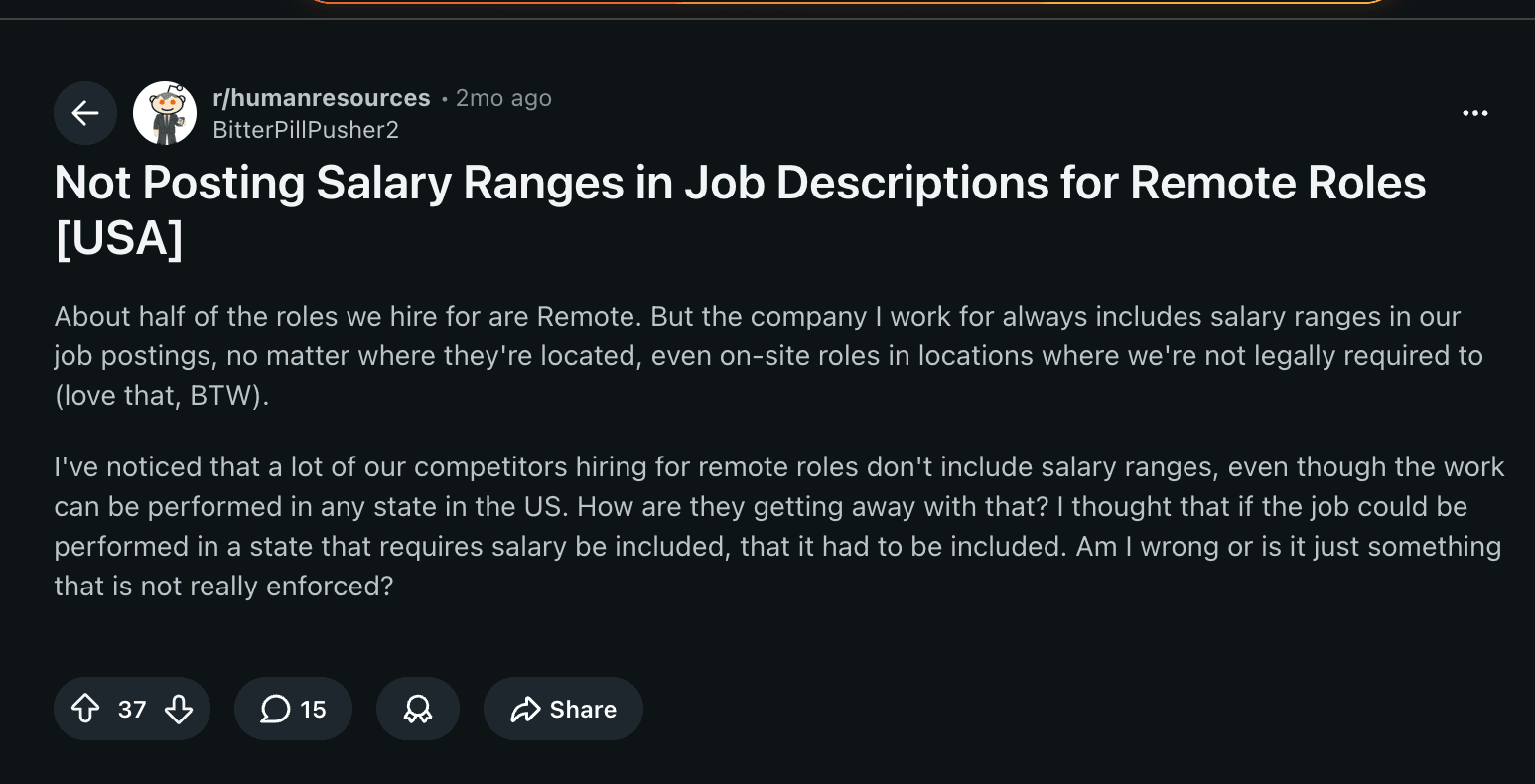
The answer depends on whether the position falls within California's hiring requirements.
Employers should not treat remote hiring as a loophole. If a role may be performed by someone working in California, the safer compliance approach is to:
Include the applicable pay scale in the job posting
Ensure recruiters and third-party staffing partners use the same compensation range
Document how the salary range was determined
Avoid posting artificially broad ranges that do not reflect the actual hiring budget
The biggest compliance mistake is treating the salary range as a marketing number rather than a compensation decision.
A defensible pay transparency process requires consistency between:
the job posting
recruiter communications
offer decisions
internal compensation records
For California employers, pay transparency compliance is ultimately a documentation issue. If a candidate, employee, or agency challenges the posted range, the employer should be able to explain why that range reflected a legitimate compensation expectation.
Your SB 642 Compliance Checklist
Run through these steps before your next job posting goes live.
Job postings:
Every active posting with 15+ employees includes a pay range
The range reflects what you actually expect to pay this specific hire, not a theoretical departmental band
Separate postings exist for different seniority levels within the same job family
Third-party job board postings are verified as compliant. You are responsible regardless of who posts
If a position can be performed in California, employers should assume that California pay transparency requirements apply.
Internal records and pay equity:
Document the legitimate factors behind every pay decision at the time it is made, not retroactively
Review total compensation (salary, bonuses, equity, benefits) for gender equity across comparable roles
Wage rate histories are maintained for all current and former employees (3 years post-separation)
Demographic data for pay reporting is maintained separately from personnel files
Application process:
No salary history question appears in any application form, recruiter script, or email template
Recruiters know they can ask about salary expectations, but cannot use prior salary to set offers
A clear internal process exists for responding to employee or applicant pay scale requests
For employers who have already received a wage-related complaint alongside a pay transparency concern, see Defeating Wage and Hour Class Actions in California: An Employer's Defense Guide and One Wage Statement Error Can Trigger a PAGA Claim Against Your Entire Workforce.
Pay transparency violations frequently travel alongside PAGA notices and equal pay class actions; the same documentation gaps create exposure across all three.
What Happens When a Pay Transparency Violation Is Alleged
The enforcement path for pay transparency violations runs through two agencies: the California Division of Labor Standards Enforcement (DLSE) and the California Civil Rights Department (CRD).
DLSE handles job posting violations.
An employer found in violation of Labor Code §432.3 for missing a pay scale, a range that does not reflect a good-faith estimate, or a salary history inquiry faces civil penalties of $100 to $10,000 per violation. Each non-compliant job posting is a separate violation.
CRD handles equal pay discrimination claims.
Under SB 642, employees have three years from the last alleged violation to file a claim, with a potential six-year recovery period for back pay. Remedies include back pay, front pay, injunctive relief, and attorney's fees.
The employers who face the worst outcomes are not those who acted recklessly. They are the ones who assumed their old compliance approach still worked and never audited their postings after January 1, 2026.
At DefendMyBiz, we represent California employers exclusively. When a pay transparency complaint or equal pay claim arrives, our employer defense attorneys assess your real exposure, the actual numbers based on your workforce data, not the inflated demand letter figure. We identify your strongest defenses and advocate for the resolution that best serves your business.
The DefendMyBiz wage-and-hour defense team handles pay transparency complaints, equal pay claims, and DLSE investigations from initial notice through resolution. Book a free 15-minute consultation if your job postings are not SB 642-compliant or a complaint has already been filed.
FAQ
What is California's pay transparency law?
When did the California pay transparency law go into effect?
What is the penalty for not posting salary ranges in California?
Does California pay transparency apply to remote jobs?
What limits are there to California's pay transparency requirements?
Disclaimer: The above content is for informational purposes only. This is not legal or tax advice. Laws, IRS guidance, and withholding requirements can change, and outcomes depend on specific facts. You are advised to contact a qualified attorney for any legal advice.


