
An Employee Is Claiming Religious Discrimination. Here's What California Employers Must (and Cannot) Do
FEHA / EEO Defense

An employee just handed you a written request to modify their schedule for religious observance. Or a new hire is refusing to wear the required uniform because it conflicts with their faith. Or a recently terminated employee has filed a complaint with the California Civil Rights Department alleging you discriminated against their religious beliefs.
Each scenario triggers specific legal obligations under California law, and the requirements are often more detailed than employers expect.
In 2025, the EEOC filed 11 religious discrimination lawsuits, the highest number in nearly a decade. In June 2026, the California Civil Rights Department issued a new fact sheet on religious discrimination and accommodations, citing hundreds of complaints investigated and over 80 settlements secured for workers since 2020. This is an active enforcement area, and it is accelerating.
This guide covers what religious discrimination means under California law, what you must do when an accommodation request arrives, when you can legally say no, and how to protect your business when a complaint is filed.
Key Takeaways
Religious discrimination under California FEHA covers actual and perceived religious creed, including dress, grooming, and sincerely held moral beliefs.
California and federal law now use different formulations for undue hardship. California FEHA focuses on "significant difficulty or expense," while federal Title VII, after Groff, requires a substantial burden analysis considering the employer's overall business circumstances.
The interactive process is mandatory whenever a conflict over a religious accommodation exists. Skipping it is itself a FEHA violation.
The EEOC filed 11 religious discrimination lawsuits in 2025, its highest in a decade, and the CRD has secured 80+ settlements since 2020.
The intersection of religious expression and LGBTQ inclusion policies is a flashpoint for active enforcement. Focus on conduct standards, not beliefs, and document consistently.
What Is Religious Discrimination and What Does California Law Cover?
Religious discrimination means treating an employee or applicant unfavorably because of their religious beliefs, practices, or observances.
California protects employees based on their actual or perceived religious creed, covering not only organized religions such as Christianity, Islam, Judaism, Buddhism, and Hinduism, but also sincerely held moral or ethical beliefs that function like religion in a person's life. An employee does not need to belong to a recognized religious institution. Non-belief and atheism are also protected.
The California Workplace Religious Freedom Act of 2012 (WRFA) expanded those protections further, adding religious dress and grooming practices explicitly to the scope of FEHA protection. That means turbans, hijabs, religious jewelry, beards kept for religious reasons, and similar expressions are protected under California law.
Employers are prohibited from:
Refusing to hire an applicant because of their religious affiliation or perceived religious beliefs
Terminating, demoting, or disciplining an employee for religious reasons
Denying an accommodation request without engaging in a good-faith interactive process
Allowing a hostile work environment based on an employee's religion
Retaliating against an employee who requests an accommodation or reports discrimination
FEHA applies to employers with five or more employees. Federal Title VII applies to employers with 15 or more employees. California's threshold is lower, meaning more California businesses are covered than most realize.
The Accommodation Obligation and Where California Is Stricter Than Federal Law
When an employee's religious practice conflicts with a workplace requirement, California law requires you to provide a reasonable accommodation unless doing so would cause undue hardship to your business.
This is where the California standard diverges from federal law in a way that catches employers off guard.
Standard | Law | Threshold for Denying Accommodation |
|---|---|---|
Federal (Groff v. DeJoy, 2023) | Title VII | Substantial burden in the overall business context |
California | FEHA + WRFA | Significant difficulty or expense |
California's "significant difficulty or expense" standard is higher than the federal substantial burden test. An employer in California cannot deny a religious accommodation based on inconvenience, minor disruption, or theoretical cost. The hardship must be significant and documented with reference to the specific facts of the business.
Examples of what does and does not clear the undue hardship bar in California:
Accommodation Request | Likely Outcome | Why |
|---|---|---|
Schedule adjustment to avoid work on the Sabbath | Must accommodate if feasible | Scheduling alternatives typically exist; cost is not "high" for most employers |
Wearing a hijab in a customer-facing role | Must accommodate | Customer preference does not constitute undue hardship |
Exemption from uniform policy for religious clothing | Must accommodate | Dress policy flexibility generally does not cause a significant hardship |
Time off for religious observance in a short-staffed critical operation | Maybe undue hardship | Operational disruption must be documented and fact-specific |
Modification that requires another employee to assume risk or burden consistently | Maybe undue hardship | Must be more than a minor imposition on co-workers |
Watch: John Fagerholm on a viral workplace religious discrimination controversy and what it reveals about employer rights and responsibilities under California law. Viral Controversy: Workplace Religious Discrimination! — DefendMyBiz YouTube
How to Run the Interactive Process Correctly
When an accommodation request arrives, the interactive process is not optional. Skipping it is itself a FEHA violation even if the underlying accommodation would have been denied on undue hardship grounds.
Here is the required sequence:
Step 1: Acknowledge the request promptly.
Confirm receipt in writing. Set a realistic timeline for response. An unanswered request looks like a denial and creates a paper trail the employee can use.
Step 2: Gather the necessary information.
You generally cannot demand formal proof of religious sincerity. You can ask clarifying questions about what the employee needs and what specific conflict exists. Keep those questions factual and neutral. Questions that probe the validity of someone's religion create independent discrimination exposure.
Step 3: Identify and evaluate accommodation options.
What scheduling alternatives exist? What is the actual operational cost? Who else is affected and how? Evaluate each option against your specific business reality, not against a hypothetical worst case.
Step 4: Propose alternatives if the first request creates genuine hardship.
You are not required to grant the employee's preferred accommodation. You are required to provide a reasonable one. If a schedule swap creates hardship but a shift modification does not, document that analysis and propose the alternative.
Step 5: Communicate the outcome in writing.
Grant or deny in writing with your reasoning. A denial based on undue hardship must reflect your documented analysis. An undocumented denial can create credibility issues and make it harder for an employer to demonstrate that the decision was based on legitimate business considerations.
Step 6: Keep the dialogue open.
Circumstances change. An accommodation that was not feasible six months ago may be feasible now. A periodic check-in demonstrates good faith and limits future liability.
The FEHA/LGBTQ Inclusion Tension: An Active Flashpoint
One area receiving increased attention from the EEOC is the intersection between religious accommodation requests and LGBTQ-inclusive workplace policies.
In 2025, the EEOC sued Rock Snowpark after a company flagged an employee's faith-based social media posts as potentially discriminatory toward LGBTQ+ individuals and terminated the employee.
This scenario puts employers in a genuine bind, and navigating it requires documented consistency rather than judgment calls made in the moment.
The practical approach: focus on employee conduct and behavioral standards, not belief. An employee can hold religious beliefs that differ from company values. An employee cannot direct discriminatory conduct toward coworkers. When those lines are crossed, document the specific conduct, apply your policies consistently to all employees, and consult employer defense counsel before taking adverse action related to a religious expression.
For related guidance on how FEHA discrimination and harassment obligations intersect, see Sexual Harassment Claims Against California Employers: What the Defense Looks Like, and Hostile Work Environment Claims: Defeating Subjective Standards.
An Employer Query: How Should Employers Handle a Religious Accommodation Request Without Creating Discrimination Risk?
A common HR concern is what happens when an employee requests a schedule change, exemption, or workplace adjustment based on religious beliefs.
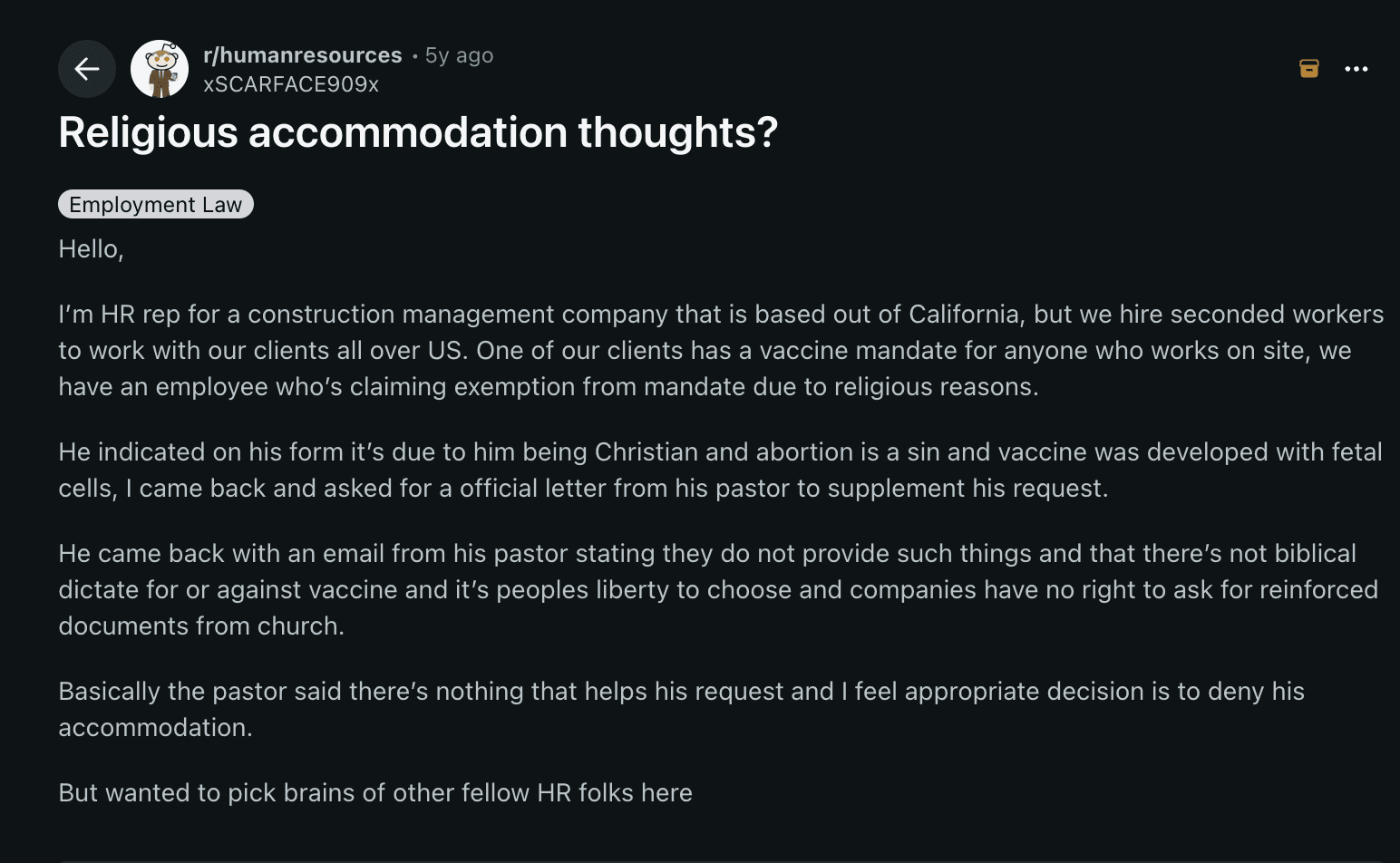
The difficult part for employers is that the answer is not simply a matter of approving or denying the request. California employers must evaluate whether the request conflicts with a workplace requirement and then engage in a good-faith interactive process before making a decision.
Employers should document:
When the accommodation request was received
What workplace requirement created the conflict
What accommodation options were considered
Whether alternative schedules, duties, or processes were available
The specific business impact of each option
One of the biggest mistakes employers make is focusing first on whether they agree with the employee's belief.
The legal question is different. The focus is on whether the belief is sincerely held and whether the employer can provide a reasonable accommodation without creating significant difficulty or expense.
For California employers, religious accommodation decisions should be handled through a consistent process rather than an informal conversation with a manager. A documented interactive process is often the difference between a defensible business decision and a discrimination claim.
What to Do When a CRD Complaint Is Filed
A CRD complaint is the starting line of potential litigation. How you respond in the first 30 days shapes everything that follows.
Immediately secure all relevant documentation.
Emails, HR notes, scheduling records, disciplinary files, and any communication touching the employee or the accommodation request. Stop any routine document destruction schedules that might apply to these records.
Do not contact the employee directly about the complaint.
All communication should flow through the formal CRD process and through your attorney.
Engage employer defense counsel before drafting a response.
Your position statement to the CRD is a legal document. Volunteering information beyond what is requested or framing facts carelessly creates problems that are difficult to walk back from.
Assess your real exposure.
California FEHA claims carry no cap on compensatory or punitive damages, depending on the nature of the claim and applicable remedies. Back pay, front pay, emotional distress, and attorney's fees are all available remedies. Knowing your actual exposure early shapes every decision from settlement evaluation to litigation strategy.
At DefendMyBiz, we represent California employers exclusively. The DefendMyBiz FEHA/EEO defense team handles religious discrimination claims from the moment a request becomes a complaint through resolution, including CRD investigations, EEOC charges, and civil litigation.
What You Can Legally Do and What You Cannot
Employers CAN | Employers CANNOT |
|---|---|
Engage in a good-faith interactive process and propose alternative accommodations | Deny a request without documentation or without exploring alternatives |
Deny an accommodation that creates significant documented operational disruption | Deny based on customer preference, co-worker discomfort, or minor inconvenience |
Apply consistent workplace conduct standards to all employees | Discipline an employee for religious expression while ignoring similar non-religious expression |
Ask clarifying questions about what the employee needs | Demand formal proof of religious belief or probe the validity of someone's faith |
Require employees to follow safety-critical dress or grooming policies | Apply dress/grooming policies that don't account for religious exemptions without engaging the interactive process |
Take adverse action for documented performance or conduct violations | Take adverse action timed to coincide with an accommodation request or complaint |
Book a free 15-minute consultation if a religious accommodation request has arrived, or a complaint has been filed; get direct answers now.
FAQ
What is religious discrimination in the workplace?
What are a California employer's obligations for religious accommodation?
What is the difference between California and federal religious accommodation law?
Can an employer deny a religious accommodation in California?
What happens when a religious discrimination complaint is filed with the CRD?
Disclaimer: The above content is for informational purposes only. This is not legal or tax advice. Laws, IRS guidance, and withholding requirements can change, and outcomes depend on specific facts. You are advised to contact a qualified attorney for any legal advice.


