On-Call and Standby Shifts in California: When You Owe Pay and When You Don't
Wage & Hour Defense

Your employee wasn't called in. They never left their house. You're assuming you owe them nothing.
California may see that situation very differently.
On call pay, California rules do not follow federal law. The state applies its own stricter standard, one that focuses on how much control your scheduling requirements place on your employees' personal freedom. Misclassifying compensable on-call time can create exposure for unpaid wages, waiting-time penalties, PAGA claims, and attorneys' fees.
This guide covers exactly how California determines whether on-call time must be paid, the eight factors courts use, the scenarios most likely to trigger a claim, and what you can do right now to reduce your exposure.
Key Takeaways
California uses the "control test" to determine whether on-call time is compensable, not physical presence, or whether a call was actually made
Eight factors determine compensable status: response time, geographic restrictions, behavioral restrictions, call frequency, ability to trade shifts, device requirements, disciplinary consequences, and sleep interruption
On-site on-call time is compensable even during sleep; mandatory call-in requirements can trigger reporting time pay obligations
Compensable on-call time must be paid at least the applicable California minimum wage or higher if a local ordinance applies.
The most common employer mistakes are copying federal policies without California adjustments and failing to document the actual on-call arrangement in writing
California's On-Call Pay Standard Is Not the Federal Standard
Under the federal Fair Labor Standards Act, on-call time is generally compensable only when an employee must stay on or near the employer's premises. If they can go home and use their time freely, federal law typically does not require payment.
California courts apply a broader employee-control analysis.
The IWC Wage Orders define "hours worked" as any time during which an employee is subject to an employer's control, whether or not the employee is actively performing work. That one phrase is where most California on-call wage claims originate. Control, not physical presence, is the deciding factor.
If your on-call policy creates meaningful restrictions on what your employees can do during that period, you may owe wages for every hour of it.
The 8 Factors California Courts Use to Determine Compensability
No single factor determines whether on-call time must be paid. Courts and the DLSE weigh the totality of the arrangement. These are the eight factors they look at:
Factor | What Courts Examine |
|---|---|
Geographic restrictions | Are employees required to stay within a certain distance of the workplace? |
Required response time | How quickly must they respond when called? Short response windows are a factor courts may consider because they can significantly restrict an employee’s ability to use the time for personal purposes. |
Call frequency | How often are employees actually called in during standby periods? Frequent call-ins may indicate greater employer control and increase the likelihood that the time is compensable. |
Ability to trade shifts | Can employees swap on-call responsibilities freely? Restrictions weigh toward compensability. |
Personal activity restrictions | Are employees prevented from attending personal events, drinking alcohol, or leaving a geographic area? |
Whether a pager or device must be carried | Mandatory device carrying with active monitoring suggests control. |
Employer-imposed consequences | Can employees be disciplined for missing a call or failing to respond fast enough? |
Whether the employee can sleep | Mendiola v. CPS Security Solutions addressed on-site residential security guards and held that the restrictions on their time, including sleep periods during required on-site shifts, made the time compensable. |
The more of these factors point toward employer control, the stronger the claim for compensable on-call time. There is no threshold number. A single severe restriction, such as a five-minute response window with mandatory on-site presence, can be enough on its own.
Controlled vs. Uncontrolled: The Line That Determines Whether You Owe
The clearest way to think about California on-call pay is the distinction between controlled and uncontrolled standby time.
1.
Controlled standby time is compensable.
The employer significantly restricts what the employee can do. The employee cannot freely use that time for personal purposes.
2.
Uncontrolled standby time is not compensable.
The employee is free to come and go, engage in personal activities, and only needs to be reachable if something comes up.
Here is how that plays out in real scenarios:
Scenario | Likely Outcome | Why |
|---|---|---|
Security guard required to stay on-site overnight | Compensable | Geographic restriction, no freedom to leave (Mendiola) |
An IT manager carries a phone, must respond within 2 hours, and can attend family events | Likely not compensable | Long response window, no geographic restriction, personal freedom intact |
Retail worker required to call in 2 hours before shift to confirm if needed | May trigger reporting time pay | Ward v. Tilly's (2019) - call-in requirement qualifies as "reporting to work" |
A healthcare worker on a pager with a 10-minute response window cannot consume alcohol | Very likely compensable | Short response window, behavioral restrictions, and limited personal freedom |
Restaurant employee who keeps their phone on during off-hours, no formal requirement | Likely not compensable | No documented employer requirement or disciplinary consequence |
Watch: John Fagerholm breaks down exactly when California employers owe pay for on-call time and the scheduling mistakes that create wage claims. Do You Have to Pay for On-Call Time? California Says YES! — DefendMyBiz YouTube
An Employer Question: "We Are Creating an On-Call Role. Do We Pay for Standby Time or Only Actual Work?”
A common question California employers face when creating on-call roles is:
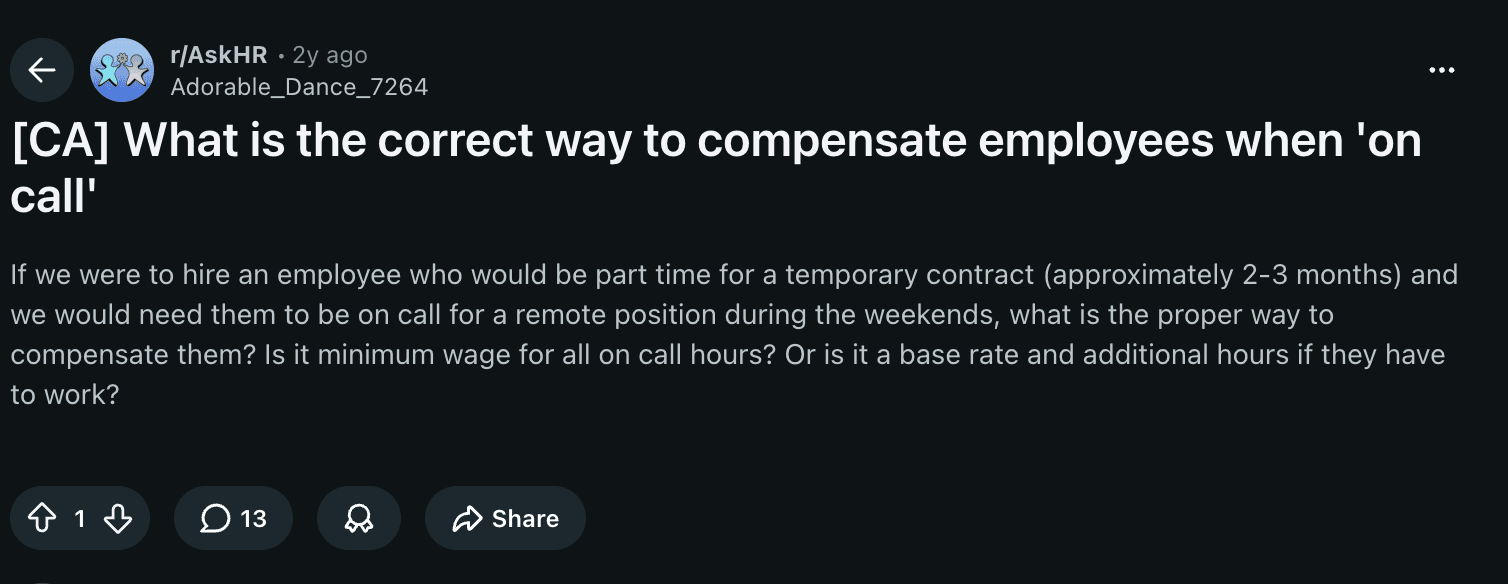
The answer depends on the level of control the employer places over the employee’s time.
An on-call arrangement in which employees are free to use their time for personal activities may be treated differently from one in which the employer requires strict availability, short response times, geographic limitations, or other restrictions.
Before creating an on-call policy, employers should define:
Whether employees must monitor calls, messages, or systems
How quickly they must respond
Whether they can travel or engage in personal activities
Whether missing a call creates discipline or consequences
Whether standby hours and actual work hours are tracked separately
The key issue under California law is not simply whether the employee performed work. The question is whether the employer's requirements significantly restricted the employee's ability to use that time for their own purposes.
A written policy that clearly explains expectations, compensation practices, and timekeeping requirements can help prevent disputes later.
The Most Common On-Call Pay Mistakes California Employers Make
These are the patterns that generate wage claims. Many violations occur because employers apply federal standards or informal practices that do not align with California requirements.
Copying a federal on-call policy without California adjustments.
FLSA standards are narrower. A policy that is perfectly legal under federal law can violate California's control test.
Short response windows without compensation.
Requiring employees to respond within 15 or 20 minutes creates a strong argument for compensable time. The employee cannot commit to any personal matters, as they may need to leave at any time.
Mandatory behavioral restrictions without pay.
Prohibiting alcohol consumption, requiring formal attire to be ready, or restricting travel while on call are all restrictions that courts weigh against you. If you are placing limits on personal behavior, you are exercising control.
No written on-call policy.
Verbal arrangements create documentation gaps. Without a written policy, you cannot demonstrate what the requirements actually were, what employees agreed to, or how the arrangement was supposed to work.
Ignoring how on-call hours stack with regular hours for overtime.
If an employee works a six-hour shift and then covers a four-hour controlled on-call period, those hours may combine toward California's daily or weekly overtime thresholds. Many employers track them separately and miss the overtime calculation entirely.
Treating all on-call arrangements identically.
Your on-site security staff overnight is in a fundamentally different situation from your salaried IT manager, who carries a phone. A single blanket policy applied to both creates exposure for the higher-risk arrangement.
How to Audit Your On-Call Policy Right Now
You do not need to wait for a wage claim to find out whether your policy is defensible. Work through this checklist against your current on-call arrangements:
Step 1: Map your on-call arrangements.
List every role that has an on-call component. For each role, document the actual requirements: response time, geographic restrictions, behavioral restrictions, call frequency, and what happens if someone fails to respond.
Step 2: Apply the control test.
For each arrangement, count how many of the eight factors point toward employer control. If multiple factors indicate significant employer control, the arrangement should be reviewed for potential compensability.
Step 3: Check for call-in requirements.
If employees must contact you before a shift to confirm whether they are needed, review whether that triggers reporting time pay under Ward v. Tilly's.
Step 4: Verify your timekeeping captures on-call hours separately.
If you cannot show how on-call time was tracked, classified, and either paid or determined to be uncontrolled, you have no documentation defense when a claim arises.
Step 5: Confirm the applicable IWC Wage Order.
Different Wage Orders govern the healthcare, retail, hospitality, manufacturing, and security sectors. Each may contain specific provisions that affect your on-call obligations beyond the general control test.
Step 6: Update your written policy to reflect actual practice.
A policy that describes an uncontrolled arrangement while managers are actually texting employees every 30 minutes creates a credibility problem in litigation. What your policy says and what your managers actually do must align.
For context on how wage claims, including on-call disputes, escalate into class actions and PAGA actions, see Defeating Wage and Hour Class Actions in California: An Employer's Defense Guide and California Meal and Rest Break Violations: What the Premium Pay Penalty Actually Costs Employers.
What Happens When an On-Call Claim Is Filed
On-call wage claims in California rarely arrive alone. They typically surface as part of a broader wage and hour complaint that includes meal and rest break allegations, off-the-clock work claims, or a PAGA notice covering your entire workforce.
When a claim lands on your desk, the first priority is calculating real exposure, not the number the plaintiff's attorney put in the demand letter. On-call claims require a fact-specific analysis of your actual arrangements, timekeeping records, written policies, and how managers implemented those policies in practice. The gap between what your policy says and what managers actually do is where claims gain or lose traction.
At DefendMyBiz, we represent California employers exclusively. We do not represent employees. When you bring us an on-call pay concern, we evaluate your specific arrangements against the control test, identify the documentation gaps that create vulnerability, and build a defensible position before litigation escalates.
The DefendMyBiz wage-and-hour defense team handles everything from pre-litigation compliance reviews to full defense when PAGA notices or class-action complaints are filed.
If you're already facing a wage claim or dispute over on-call or standby pay, contact DefendMyBiz for a free 15-minute consultation.
Frequently Asked Questions
Do California employers have to pay employees for on-call time?
Can employees receive pay for on-call time even if they were never called in?
What is the difference between being on call and being on standby in California?
Are you supposed to get paid when you are on call in California?
Does on-call time count toward overtime in California?
Disclaimer: The above content is for informational purposes only. This is not legal or tax advice. Laws, IRS guidance, and withholding requirements can change, and outcomes depend on specific facts. You are advised to contact a qualified attorney for any legal advice.