California's Day-of-Rest Law: What Every Employer Needs to Know About §§551–556
Wage & Hour Defense

Your employee worked Monday through Sunday last week. You're thinking that they didn't complain, they got paid for every hour, and they were happy to pick up the extra shifts. In California, that reasoning doesn't matter.
California's day-of-rest law generally requires employers to provide eligible nonexempt employees with one day of rest during each defined workweek unless a statutory exception applies. An employee's willingness to work alone does not eliminate liability. The key question is whether the employer caused the employee to forgo the statutory day of rest by encouraging, inducing, or requiring the employee to work the seventh day.
Violations may constitute a misdemeanor under Labor Code §553, although enforcement most commonly occurs through civil litigation, Labor Commissioner proceedings, or PAGA actions.
This guide covers exactly how California's day-of-rest rules work, what the Mendoza v. Nordstrom ruling changed, where employers get caught, and how to build a scheduling system that holds up.
Key Takeaways
California Labor Code §§551–552 require one full day of rest per workweek for nonexempt employees measured by the employer's defined workweek, not a rolling seven-day calendar
Mendoza v. Nordstrom (2017) confirmed: an employee can legally work up to 12 consecutive days spanning two workweeks without a violation, as long as each workweek contains a rest day
"Causing" an employee to work seven days means motivating or inducing them to do so. Offering a bonus or higher wage for seventh-day work is a per se violation
The §556 hours-based exception is narrow: it applies only when an employee never works more than six hours on any single day of the workweek
If a seventh day of work does occur, §510(a) requires 1.5× for the first 8 hours and 2× beyond 8 separately from daily and weekly overtime
Violations carry civil penalties of $50–$100/employee/pay period, PAGA exposure, and criminal misdemeanor charges
The Statutory Framework: §§551–556 and What Each Labor Code Section Requires
California's day-of-rest requirements are set forth in Labor Code sections 550 through 556. Each section plays a specific role, and employers who know only the headline rule "one day off in seven" miss the nuances that generate claims.
Section | What It Says | What It Means for Employers |
|---|---|---|
§551 | Every person employed in any occupation of labor is entitled to one day's rest in seven | The employee's right, affirmative entitlement |
§552 | No employer shall cause employees to work more than six days in seven | The employer's obligation; focus is on "cause" |
§553 | Violation is a criminal misdemeanor | Personal criminal exposure for responsible managers |
§554 | Exceptions for emergencies, protection of life or property, and continuous operations | Narrow defenses require specific documentation |
§555 | Agricultural worker provisions | Industry-specific carve-out |
§556 | No obligation when total hours do not exceed 30/week OR 6 hours on any one day | Part-time safe harbor, but narrower than most employers think |
The most important word in the entire framework is in §552: "cause."
California's Supreme Court held that an employer "causes" an employee to work the seventh day when it motivates or induces the employee to do so. Simply permitting an employee who independently chooses to work does not violate the statute, but the distinction between permitting and inducing is often difficult to distinguish in practice.
Mendoza v. Nordstrom Case and Why It Matters for Scheduling
The Mendoza v. Nordstrom Case answered three questions California employers had been litigating for years. The answers directly shape how you schedule your workforce.
Question 1: Is the day of rest measured per workweek or on a rolling seven-day basis?
Answer: Per employer-defined workweek. The seven-day period is anchored to your fixed, regularly scheduled workweek. If your workweek runs Sunday through Saturday, the rest day obligation resets every Sunday. An employee can legally work up to 12 consecutive days if those days span the end of one workweek and the beginning of the next, because each workweek includes a rest day.
Practical implication: Employees who work Tuesday through Sunday of week one and Monday through Friday of week two have technically worked 12 consecutive days, but if each workweek contains one rest day, no violation has occurred. Your workweek definition controls everything.
Question 2: What does the §556 hours-based exception actually cover?
Answer: The exemption applies only when the employee works six hours or less on every single day of the workweek, not just one day.
Nordstrom argued that having at least one six-hour day in a workweek exempted the whole week. The California Supreme Court rejected this. If an employee works more than six hours on any single day of a workweek and their total hours exceed 30, they are entitled to a rest day that week regardless of their schedule on other days.
Practical implication: The §556 exception is narrower than most employers assume. A part-time employee who works four days at five hours and one day at seven hours exceeds six hours on that one day, and the exception no longer applies.
Question 3: What does "cause" mean under §552?
Answer: To motivate or induce the employee to forgo rest to which they are entitled. Employers should avoid encouraging, pressuring, or incentivizing employees to forgo their statutory day of rest.
The Inducement Line: Where Employers Cross It Without Realizing
This is where most day-of-rest violations occur. Employers genuinely believe they are permitting voluntary work. Courts and the DLSE see inducement.
What crosses the line:
Offering bonuses or additional compensation specifically to persuade employees to work their statutory rest day
Asking employees to work their rest day without informing them of their right to decline
Creating scheduling pressure through understaffing that leaves employees feeling they have no choice
Any communication that implies a negative consequence for declining to work the seventh day
Concealing the employee's entitlement to a rest day
What does NOT cross the line:
Informing an employee of an available shift and allowing them to accept or decline freely
Filling the shift with a different employee who has not yet worked six days
Accepting a voluntary request from an employee who approaches you to work their rest day, provided no inducement was offered
The CalChamber confirmed in September 2025 that even a bonus offered for seventh-day work constitutes an unlawful inducement. The dollar amount is irrelevant. The offer itself is the violation.
Seventh-Day Overtime: The Pay Obligation That Runs Alongside the Rest Requirement
When a nonexempt employee does work all seven days within a defined workweek, whether voluntarily or through a compliant exception, a separate pay obligation immediately applies under Labor Code §510(a):
Hours Worked on Seventh Day | Required Pay Rate |
|---|---|
First 8 hours | 1.5× regular rate of pay |
Hours beyond 8 | 2× regular rate of pay |
This seventh-day overtime calculation is separate from daily and weekly overtime. It applies because the employee worked the seventh day of the workweek, not because of total weekly hours or daily hours on that day.
Payroll systems that are not configured for California's seventh-day overtime rules frequently calculate premiums incorrectly. The system may apply a standard 1.5× calculation for all overtime hours on day seven rather than switching to 2× after eight hours. Each underpayment is a separate wage violation, and across a workforce of 20 or 50 employees, the compounding exposure becomes significant.
For context on how wage calculation errors stack into class action and PAGA exposure, see One Wage Statement Error Can Trigger a PAGA Claim Against Your Entire Workforce and Defeating Wage and Hour Class Actions in California: An Employer's Defense Guide.
A Reddit Query: Can California Employers Legally Schedule an Employee to Work Seven Consecutive Days?
A recurring question in employment-law forums is whether scheduling an employee to work seven consecutive days automatically violates California's day-of-rest law.
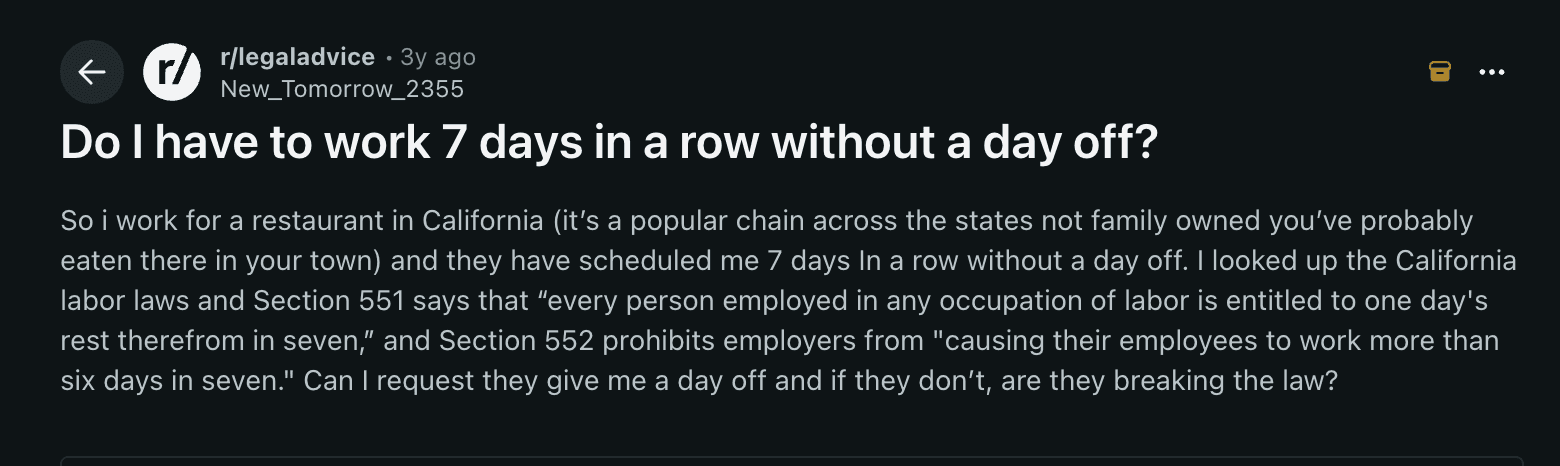
The answer depends on how your company defines its workweek.
Under Mendoza v. Nordstrom, California measures the day-of-rest requirement by the employer's established workweek, not by seven consecutive calendar days. As a result, an employee may legally work up to 12 consecutive days if those shifts span two different workweeks and each workweek includes at least one day of rest.
To reduce compliance risk, employers should:
Define the workweek in writing and apply it consistently.
Ensure payroll and scheduling systems use the same workweek definition.
Review schedules before publication for potential seventh-day issues.
Avoid changing workweek definitions to reduce overtime or day-of-rest obligations.
The biggest compliance mistake is assuming that seven consecutive calendar days automatically create liability. Under California law, the employer's defined workweek controls the analysis.
Does the Day of Rest Law Apply to Exempt Employees?
§§551 and 552 primarily apply to nonexempt employees. Employees who qualify for a California white-collar exemption (executive, administrative, or professional) and meet the 2026 minimum salary threshold of $70,304/year are generally not entitled to day-of-rest protections in the same way, because their compensation structure is not based on hours worked.
However, three important caveats apply:
1.
The exemption must actually be valid.
A misclassified employee who is labeled "exempt" but does not pass California's strict duties test and salary threshold remains nonexempt, and day-of-rest protections apply to them in full. Any reclassification error creates retroactive liability.
2.
Salaried nonexempt employees are covered.
Not all salaried employees are exempt. Salaried workers who do not meet the duties test are nonexempt and entitled to all wage and hour protections, including the day of rest, overtime, and meal and rest breaks.
3.
Exempt employees can still have contractual claims.
Even where §§551–552 don't apply, an employer that routinely works exempt employees seven days straight with no rest may face claims under public policy or contract theory in some circumstances. Document your scheduling practices for all classifications.
For a deeper look at how misclassification creates layered wage exposure, see Employee Misclassification in California: Independent Contractor vs. Employee.
The Penalties for Violating California's Day of Rest Law
Violations of §§551 and 552 create three separate exposure tracks:
1.
Civil penalties under §558:
$50 per employee per pay period for the first violation
$100 per employee per pay period for subsequent violations
Collectible by the DLSE or through a PAGA representative action
2.
Criminal misdemeanor under §553:
Violations are a criminal misdemeanor. Responsible managers or owners can face personal criminal exposure, not just corporate-level civil penalties.
3.
PAGA representative actions:
One aggrieved employee can file a PAGA notice covering every employee affected by the same scheduling policy. The $50/$100 civil penalties stack per employee per pay period, which means a scheduling practice applied consistently across a 30-person workforce over 12 months creates $18,000+ in PAGA-eligible penalties before any wage underpayment is calculated.
Your Day of Rest Compliance Checklis
Workweek definition:
Your workweek is formally defined as a fixed, seven-consecutive-day period
The start day is documented in your employee handbook and payroll system
The definition is applied consistently, not shifted to avoid triggering seventh-day obligations
Scheduling practices:
Managers are trained that offering incentives to work a seventh day is an unlawful inducement
Employees are informed of their right to a rest day before being offered any seventh-day shift
No employee is pressured, directly or indirectly, to waive their rest day
Voluntary waiver documentation:
When an employee independently requests to work their rest day, that request is documented in writing
The written record confirms no inducement was offered or implied
The record reflects the employee was informed of their entitlement before accepting the shift
Payroll verification:
Your payroll system applies 1.5× for the first 8 hours on the seventh workday
Your payroll system applies 2× for hours beyond 8 on the seventh workday
Seventh-day overtime is calculated and paid separately from daily and weekly overtime
Part-time workforce:
For employees you believe qualify under the §556 exception, confirm their hours never exceed 6 hours on any single day of the workweek, not just on one day
Part-time employees whose total hours exceed 30 per week are not automatically exemp
What Happens When a Day of Rest Claim Is Filed
Day-of-rest claims almost never arrive in isolation. They surface within broader wage-and-hour complaints alongside meal break violations, off-the-clock work allegations, and PAGA notices because plaintiffs' attorneys frequently review the employer's entire scheduling history for additional wage-and-hour violations.
When that happens, the employer who can produce a formal workweek definition, clean scheduling records, documented voluntary waivers, and accurate seventh-day payroll calculations is in a fundamentally different position than the employer who has none of those things.
At DefendMyBiz, we represent California employers exclusively. When a day-of-rest claim or PAGA notice involving scheduling violations arrives, our employer defense attorneys assess your actual exposure based on your records, not the inflated number in the demand letter. Identify every available defense under Mendoza and the statutory framework, and resolve the matter on the best terms available.
The DefendMyBiz wage-and-hour defense team handles day-of-rest claims, seventh-day overtime disputes, and PAGA actions from initial notice through resolution.
If you're already facing a wage claim over scheduling or day-of-rest violations, contact DefendMyBiz for a free 15-minute consultation.
FAQ
What are the penalties for employers who violate California's day of rest law?
Can an employee voluntarily waive their day of rest in California?
Does the day-of-rest law apply to salaried employees in California?
What is the §556 exception and when does it apply?
Can an employer require a seventh day of work in emergency situations?
Is California's day-of-rest law based on the calendar week?
Can an employee legally work 12 consecutive days in California?
Does California's day-of-rest law apply to remote employees?
Disclaimer: The above content is for informational purposes only. This is not legal or tax advice. Laws, IRS guidance, and withholding requirements can change, and outcomes depend on specific facts. You are advised to contact a qualified attorney for any legal advice.


