
California Background Check Rules: What FCRA, Ban-the-Box, and AB 2095 Require Before You Hire
Hybrid / Non-FEHA Claims

Your application asks: "Have you ever been convicted of a crime?" In California, that question on a job application may already be illegal, and it can cost you FEHA-equivalent damages before the candidate ever steps into your office.
California background check rules are among the most complex in the United States because employers must comply with overlapping federal, state, and local requirements. Four separate legal frameworks govern what you can ask, when you can ask it, what you can do with the answer, and how you document every step. One step wrong, and you may experience back pay, emotional distress damages, and punitive damages from a hiring decision you made months or years ago.
This guide covers what every California employer must know: the federal FCRA, California's Fair Chance Act (ban-the-box), the 2023 regulatory updates, the proposed AB 2095 expansion, and the Los Angeles County Fair Chance Ordinance that goes further than state law.
Key Takeaways
California's Fair Chance Act prohibits employers with five or more employees from asking about conviction history before making a conditional offer of employment.
The 2023 regulatory updates require a documented, written individualized assessment before any adverse action based on conviction history.
AB 2095 was introduced in 2026 and later placed on the inactive file. It did not become law, but employers should monitor future legislative proposals that may expand Fair Chance Act obligations.
LA County Fair Chance Ordinance (effective September 3, 2024) and San Diego County FCO (effective October 10, 2024) impose stricter requirements in their unincorporated areas, including coverage of promotion decisions.
Damages for non-compliance track FEHA exposure: back pay, front pay, emotional distress, and punitive damages.
The Four Legal Frameworks Every California Employer Must Know
Before any background check begins, you are operating under four overlapping laws. Each carries its own obligations and its own exposure.
Law | What It Governs | Who It Applies To |
|---|---|---|
FCRA (federal) | Use of Consumer Reporting Agencies: disclosure, authorization, adverse action notices | All employers using third-party background check vendors |
Fair Chance Act / Ban-the-Box (California) | When you can ask about conviction history, the individualized assessment process | Employers with 5+ employees, statewide |
ICRAA / CCRAA (California) | Investigative consumer reports; credit history restrictions | All employers using consumer reporting for hiring decisions |
Stricter local requirements beyond state law | Employers in unincorporated LA County with 5+ employees |
These four frameworks do not replace each other. They stack. The most restrictive requirement at each step applies to your process.
Background checks are only one part of California's hiring compliance risk. A hiring decision that raises concerns about discrimination or retaliation can quickly become a broader employment dispute. Read: Retaliation Claims in California: How Employers Defend Business Decisions
The Hiring Sequence You Must Follow
This is the non-negotiable order of operations for California employers conducting background checks.
Step 1 — Remove criminal history from your application.
The Fair Chance Act prohibits employers with five or more employees from asking about conviction history or initiating a criminal background screening before making a conditional offer. Under proposed AB 2095 (introduced February 2026, ordered to inactive file May 28, 2026), this restriction would have extended to any question that even indirectly signals a background check is coming. AB 2095 did not pass, but the direction of California law is clear. Audit your application now.
Step 2 — Also remove language that discourages applicants.
Job postings cannot include language like "clean background required," "no criminal record," or "background check required." CRD enforcement has flagged job postings as a primary source of violations. California officials found over 500 ban-the-box violations in a single day of enforcement in 2025.
Step 3 — Extend the conditional offer first.
No background check is ordered until after the conditional offer of employment is made and accepted. This is the triggering event.
Step 4 — Provide a standalone FCRA disclosure and obtain written authorization.
The authorization must be a separate document, not buried in an offer letter or employment application.
Step 5 — Order the background check through a compliant CRA.
Under California consumer reporting rules, many employment background reports limit certain adverse information to 7 years. Additional federal and state restrictions apply depending on the type of record and position.
Step 6 — If conviction history appears, conduct a documented individualized assessment.
This is where most employers get into trouble. You must evaluate:
The nature and gravity of the offense
How much time has passed since the conviction or sentence completion
The nature of the job and its specific duties
Evidence of rehabilitation or changed circumstances
The applicant's age at the time of conviction
The assessment must be documented in writing.
Step 7 — Send a pre-adverse action notice before withdrawing the offer.
The employer must provide the required pre-adverse action materials, including the background report and applicable notices. California Fair Chance requirements also require a documented, individualized assessment before taking an adverse action based on conviction history.
Step 8 — Genuinely review the applicant's response.
If they provide evidence of rehabilitation, you must reassess. Sending a form letter and proceeding without real consideration creates exactly the kind of record plaintiff attorneys look for.
Step 9 — Issue a final adverse action notice.
You must issue a final action notice if you proceed with withdrawing the offer.
Watch: John Fagerholm explains exactly how the Los Angeles Fair Chance Ordinance goes further than state law — and the specific mistakes LA-area employers are still making. Are You Violating Los Angeles' Fair Chance Ordinance? — DefendMyBiz YouTube
A Reddit Query: Can a California Employer Rescind a Job Offer After a Background Check?
A common HR question is whether an employer can withdraw a conditional job offer after receiving unfavorable background check results.
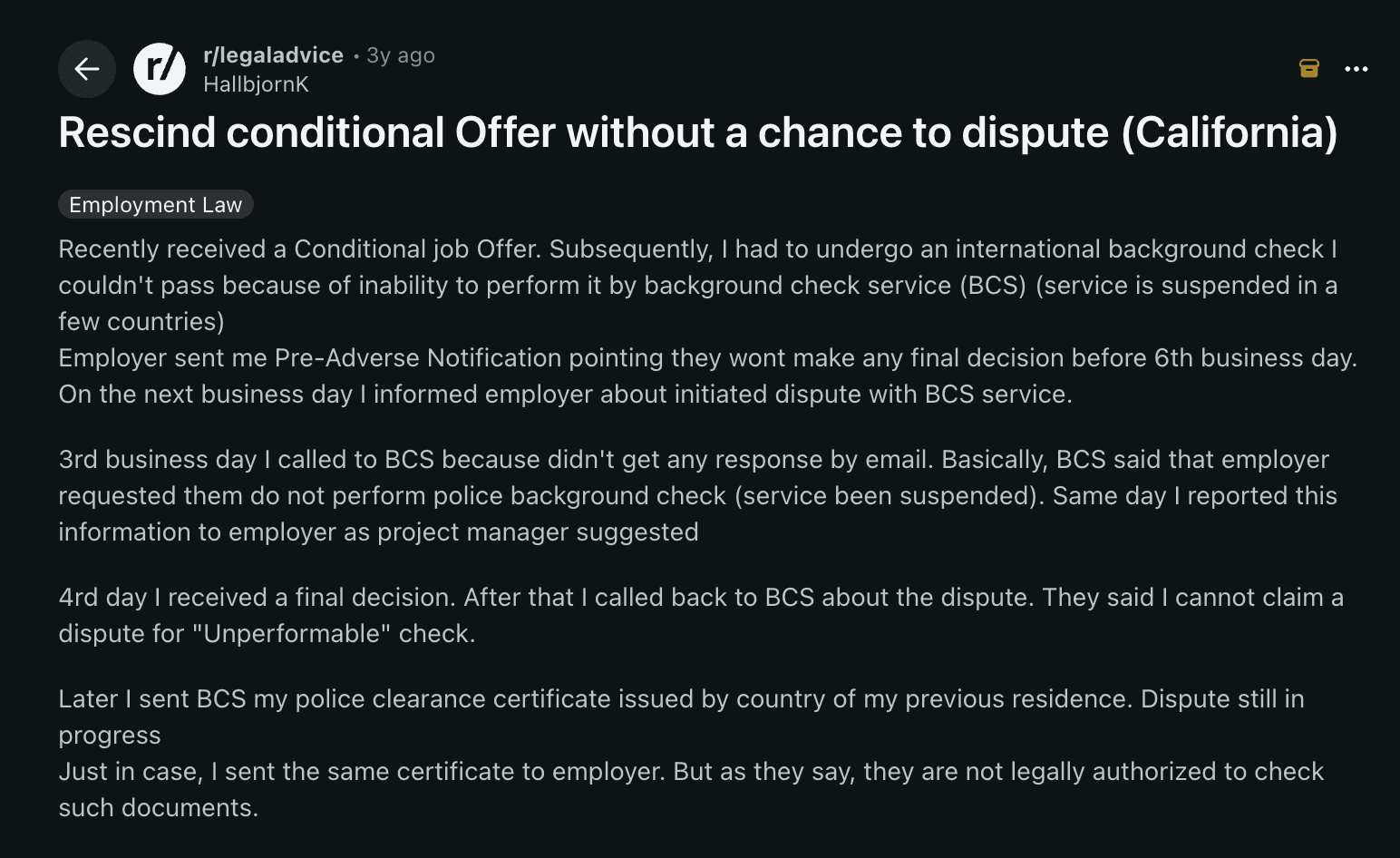
The answer is not simply "yes" or "no."
California employers can rescind a conditional offer after reviewing background check information, but the process matters. A background check result alone does not allow an employer to immediately reject a candidate. California's Fair Chance Act and federal FCRA requirements require employers to follow a specific sequence before making a final adverse decision.
Before withdrawing an offer, employers should document:
that the conditional offer was made before requesting criminal history information
that the background check disclosure and authorization complied with FCRA requirements
what specific information from the report affected the decision
the individualized assessment factors considered:
nature and gravity of the offense
time passed since the offense
relationship between the offense and job duties
rehabilitation evidence
that the candidate received a proper pre-adverse action notice and opportunity to respond
The biggest compliance mistake is treating a background check as an automatic disqualifier.
A candidate's record does not automatically mean an employer can reject them. California requires employers to evaluate whether the conviction history actually relates to the position and whether the decision can be justified based on documented job-related factors.
For California employers, background check compliance is not only about what appears in the report. It is about proving that the hiring decision followed a legally compliant process.
The Los Angeles County Fair Chance Ordinance
If your business operates in the unincorporated areas of Los Angeles County and you have five or more employees anywhere, a separate, stricter ordinance applies to you effective September 3, 2024.
The LA County Fair Chance Ordinance (FCO) goes beyond the state Fair Chance Act in several material ways:
Requirement | State Law | LA County FCO |
|---|---|---|
Employers covered | 5+ employees | 5+ employees anywhere |
Job postings | No discouraging language | Must affirmatively state Fair Chance, employer |
Pre-adverse action notice | 5 business days to respond | Extended response window |
Private right of action | Yes | Yes, with expanded remedies |
Applies to promotions | No | Yes, covers existing employees seeking promotion |
San Diego County enacted its own Fair Chance Ordinance, effective October 10, 2024, with administrative penalties beginning July 1, 2025, that covers the unincorporated areas of the county. Employers operating across multiple California jurisdictions should review whether additional local requirements apply.
What AB 2095 Would Have Done And Why You Should Still Watch
AB 2095 was introduced in February 2026 and ordered to be placed in the inactive file on May 28, 2026. It did not become law. But its provisions signal where California is headed, and employers should monitor for a revised version in the next legislative session.
Had AB 2095 passed, it would have:
Prohibited any background check consent language on job applications
Required employers to provide applicants with a specific list of job duties that could be affected by conviction history before initiating any background check
Established a rebuttable presumption against denial when an applicant has completed their sentence or holds a government-required license for the position
Extended the applicant response window from five to ten business days
Required explicit written individualized reassessment documentation after every applicant response
Added an explicit anti-retaliation provision for applicants who assert rights under the Fair Chance Act
None of this is law today. But the CRD's enforcement posture, the LA County FCO, and the introduction of AB 2095 all point in the same direction.
The Damages That Follow Non-Compliance
The financial consequences of California background check violations extend beyond fines. They track FEHA, the state's broadest employment discrimination framework.
Depending on the legal claim, enforcement mechanism, and facts involved, exposure may include lost wages, statutory remedies, penalties, and other damages available under applicable law.
Local ordinance violations carry their own penalty structures. The LA County FCO's private right of action operates independently of state enforcement. CRD enforcement has become increasingly systematic, with automated monitoring of job postings flagging ban-the-box language violations at scale.
A single defective pre-adverse action notice, one that omits the individualized assessment, or fails to give the applicant adequate response time, can convert a routine rescinded offer into a multi-year legal matter.
Strong defenses start with documentation before a dispute begins. For California employers, record retention and process documentation often determine whether a claim becomes a settlement discussion or litigation exposure. Read: Don't Get Caught Off Guard — 5 Essential Record Retention Reminders
Your Pre-Hire Compliance Checklist
Run through this before your next hire.
Application and job postings:
No criminal history questions on your application
No background check consent language on your application
No discouraging language in job postings ("clean background required," "no felonies")
If in unincorporated LA County, postings affirmatively state fair chance hiring
Background check process:
Conditional offer extended before any background check is ordered
Standalone FCRA disclosure and authorization obtained
Background check ordered through a compliant CRA
Seven-year lookback confirmed for your specific position(s)
Individualized assessment:
Assessment conducted in writing for any conviction history found
Assessment addresses: nature of offense, time elapsed, specific job duties, rehabilitation evidence
Assessment documented and retained
Adverse action process:
Pre-adverse action notice includes: conviction(s), background report copy, assessment copy, response window
Applicant given at least five business days to respond (ten if disputing accuracy)
Response genuinely reviewed and documented
Final adverse action notice issued if proceeding
At DefendMyBiz, we represent California employers exclusively. If you have received a Fair Chance Act complaint, a CRD inquiry, or a demand letter related to your background check process, the DefendMyBiz Hybrid/Non-FEHA Claims defense team provides immediate assessment and defense.
If you're already facing a discrimination or hiring practices claim, contact DefendMyBiz for a free 15-minute consultation. If you'd like a legal review of your hiring process, book a 1-hour paid consultation.
FAQ
What is the 7-year rule for background checks in California?
What is the Fair Chance Act in California?
Can employers ask about criminal history in California?
How far back do background checks go in California for employment?
Can I run a background check before making a job offer in California?
Disclaimer: The above content is for informational purposes only. This is not legal or tax advice. Laws, IRS guidance, and withholding requirements can change, and outcomes depend on specific facts. You are advised to contact a qualified attorney for any legal advice.


