An Old Sexual Harassment Claim Got Revived Against Your Business. Here's What AB 250 Does to Your Exposure
FEHA / EEO Defense

The claim involves conduct that happened years ago. You thought the statute of limitations had run. You may have had a settlement, a separation agreement, or a confidentiality clause. The case was closed.
It is not closed anymore.
Governor Newsom signed California Assembly Bill 250 on October 13, 2025, and it took effect on January 1, 2026. It created a two-year revival window, running through December 31, 2027, during which adult survivors of sexual assault can file civil claims that were previously time-barred.
And the reach of AB 250 is not limited to sexual assault. It also revives related employment claims arising from the alleged conduct. If your business has any history involving a supervisor's sexual misconduct, a settled harassment complaint, or a departure that involved confidentiality provisions, you are operating inside an active liability window right now.
This guide explains exactly how AB 250 works, what triggers employer liability under the cover-up standard, what defenses are available, and what you must do immediately if a revived claim arrives.
Key Takeaways
AB 250 was signed on October 13, 2025, effective January 1, 2026. The revival window runs through December 31, 2027
The law revives time-barred sexual assault civil claims AND related employment claims like sexual harassment, wrongful termination, and retaliation against private California employers
Public entities are explicitly excluded; private employers carry the full exposure
The cover-up requirement for entity liability specifically names NDAs and confidentiality agreements as potential cover-up evidence, even those that were perfectly legal at the time
The cover-up can be of a prior incident by the same perpetrator, not just the specific assault being revived
Available defenses include: ordinary business practice vs. concerted concealment effort, no prior knowledge, attenuated connection of related claims, and revival window eligibility challenges
Employers who assess their historical exposure now before a demand letter forces the conversation are in a significantly stronger position
What AB 250 Actually Does for California Employers
AB 250 amends California Code of Civil Procedure §340.16, a statute that has been amended four times in less than seven years as California has progressively expanded its sexual assault civil litigation framework.
Beginning Jan. 1, 2026, a two-year window has been opened, permitting the filing of lawsuits under section 340.16, a statute that allows plaintiffs to "revive" time-barred sexual assault claims from years ago. The statute also revives any "related claims," including claims for wrongful termination and sexual harassment.
Key parameters:
Element | What It Means |
|---|---|
Who can file | Adults (18+) at the time of the alleged sexual assault |
Filing window | January 1, 2026 – December 31, 2027 |
Who can be named | Individual perpetrators AND private entities that engaged in a cover-up |
Related claims included | Sexual harassment, wrongful termination, retaliation |
Public entities | Explicitly excluded; applies to private employers only |
Prior revival windows | AB 2777 (2022) covered assaults from 2009 forward; AB 250 fills gaps including pre-2009 assaults and missed AB 2777 window |
The "related claims" language is the provision with the broadest practical exposure for most California private employers. A plaintiff who brings a revived sexual assault claim against a former supervisor can attach a sexual harassment claim against the company directly, and that harassment claim travels with the same revival benefit even if the harassment itself would have been independently time-barred.
The Cover-Up Requirement and Why Your Past HR Practices May Qualify
For a private entity to be liable under AB 250, the plaintiff must allege that the entity or its representatives engaged in a cover-up of a previous instance or allegation of sexual assault by the perpetrator.
This is the element that determines whether a revived claim reaches your business. Understanding exactly what it covers is your first line of defense.
The statutory definition of "cover-up":
"A concerted effort to hide evidence relating to a sexual assault that incentivizes individuals to remain silent or prevents information relating to a sexual assault from becoming public or being disclosed to the plaintiff, including, but not limited to, the use of nondisclosure agreements or confidentiality agreements."
What this definition specifically captures:
NDAs and confidentiality agreements in settlement packages, separation agreements, and severance, even those that were perfectly legal at the time of execution
"Passing the trash": transferring an accused employee to a different department or location rather than terminating them
Evidence suppression: destroying personnel files, internal investigation notes, or other records of prior misconduct
Settlement concealment: conditional payments that prevented other employees from learning of the perpetrator's prior conduct
Deceptive departures: framing a termination or resignation in ways that obscured the underlying misconduct
Even agreements that were lawful when executed may later be scrutinized as part of a plaintiff's allegation that an employer engaged in a statutory "cover-up." Whether they actually satisfy AB 250's definition depends on the facts.
What Does NOT Automatically Constitute a Cover-Up
Not every HR practice from the past creates AB 250 cover-up exposure. Understanding the defenses available is as important as understanding the risk.
Legitimate defenses on the cover-up element:
The conduct was an ordinary business practice, not a concerted effort to conceal.
A standard severance agreement with a non-disparagement clause is common employment practice. The question is whether it was deployed as part of a coordinated scheme to prevent information about sexual assault from surfacing. A single agreement, in a single separation, with no pattern of concealment, is a meaningfully different factual scenario from systematic NDA use to suppress multiple complaints.
The entity did not know about prior assault allegations.
The cover-up definition requires a "concerted effort," which implies awareness. An employer who genuinely had no prior complaints or knowledge of the perpetrator's conduct has a strong argument that no cover-up was possible.
The "related claims" connection is too attenuated.
AB 250 revives related claims (sexual harassment, wrongful termination) that "stem from" the original assault. Courts will scrutinize whether the related claim is factually and legally connected to the underlying assault allegation, or whether it is a distinct claim that happens to involve the same plaintiff.
The revival window eligibility criteria are not met.
Was the plaintiff an adult (18+) at the time of the alleged assault? Is the claim properly filed within the January 1, 2026 – December 31, 2027 window? Were the statute of limitations actually already run before January 1, 2026? These are threshold questions courts must answer before reaching the merits.
For broader context on sexual harassment defense strategy, see Sexual Harassment Claims Against California Employers: What the Defense Looks Like and An Employee Just Reported Harassment: What California Law Requires in the Next 72 Hours.
Reddit Insight: A New HR Professional Receives a Sexual Harassment Complaint With Almost No Evidence
One discussion that mirrors a situation many California employers face came from the HR community itself. A new HR professional described receiving a sexual harassment allegation after an employee hinted that misconduct had occurred on a prior project.
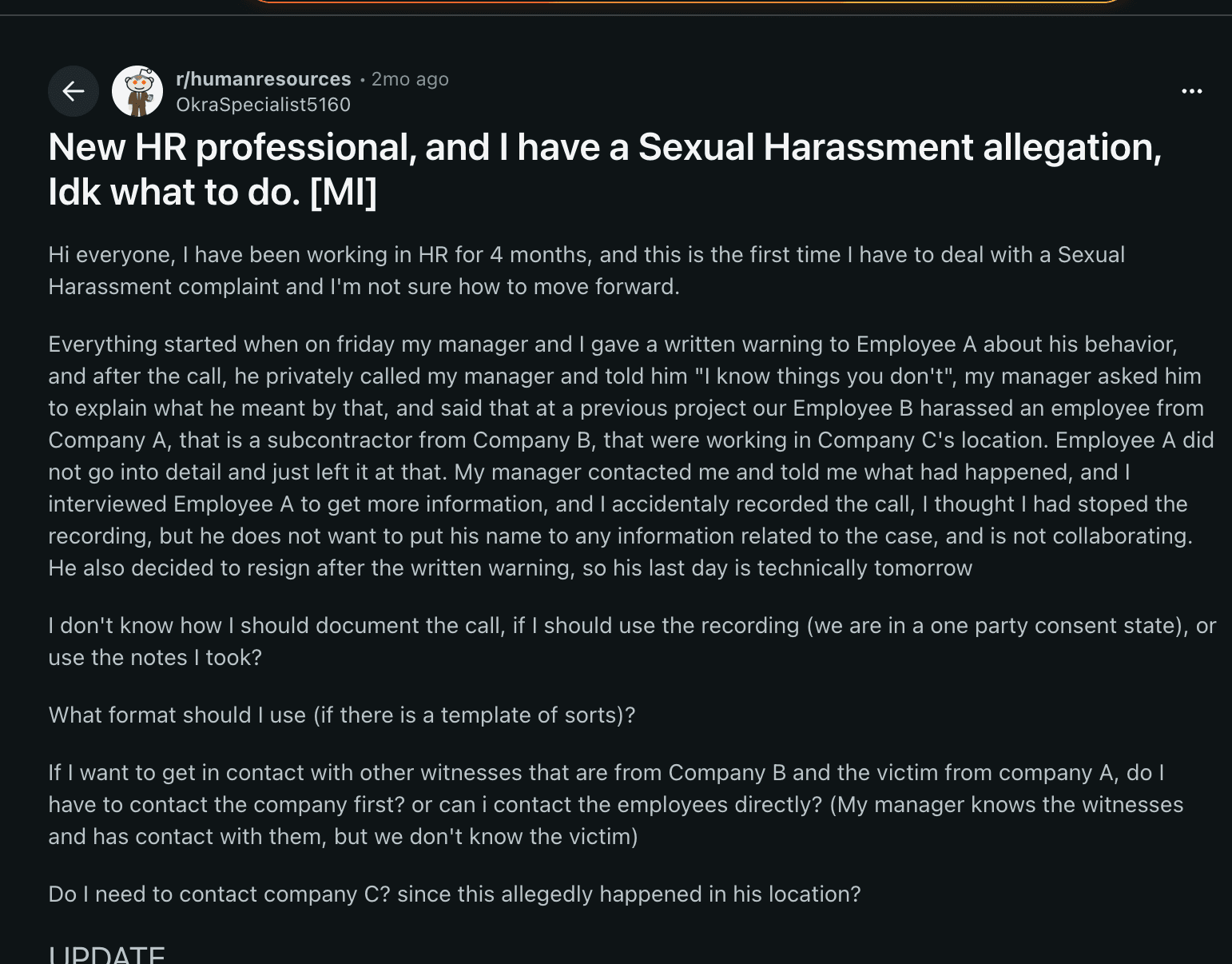
The reporting employee refused to cooperate further, requested anonymity, and resigned shortly afterward, leaving HR with limited evidence and significant uncertainty about how to proceed.
Rather than treating the allegation as something to "close" because the reporting employee left, experienced HR professionals emphasized a different approach:
Treat every sexual harassment complaint seriously, even if the complainant or reporting witness resigns.
Preserve all available evidence immediately, including emails, interview notes, and any lawfully created recordings.
Conduct an impartial investigation based on available facts rather than assumptions or speculation.
Avoid promising confidentiality that cannot legally be maintained during an investigation.
Escalate the matter to experienced employment counsel whenever allegations involve potential liability for the employer.
For California employers, this becomes even more important in light of AB 250. If historical allegations become relevant in revived litigation, an investigation that seemed "incomplete" years earlier may be scrutinized in court.
Employers who can demonstrate that they documented complaints, preserved evidence, and responded in good faith are generally in a stronger defensive position than employers who simply closed a file because a witness stopped cooperating.
Immediate Steps If a Revived Claim Arrives
AB 250 claims do not arrive with advance notice. They arrive as demand letters, DFEH complaints, or civil lawsuit filings, often accompanied by requests for voluminous HR records.
Step 1: Issue a litigation hold immediately.
Stop all routine document destruction. Pull and preserve every employment record, HR file, complaint log, investigation note, email, and separation agreement involving the named perpetrator going back as far as the records extend. Records that previously appeared outside applicable limitation periods may now become relevant to revived claims and should be preserved immediately.
Step 2: Do not respond to demands without counsel.
A letter that seems to call for a simple explanation is a legal document. Any statement made outside the formal legal process can be used against you. Route all communications through employer defense counsel from the moment the claim is identified.
Step 3: Identify every prior complaint involving the named perpetrator.
This is the factual baseline for your cover-up defense. If there were no prior complaints or discipline, your defense of the cover-up element would be significantly stronger. If there were prior complaints that resulted in confidential agreements, assess each one carefully with counsel.
Step 4: Review all agreements involving the named individual.
Pull every separation agreement, settlement, NDA, and non-disparagement clause executed in connection with any complaint involving this person. Each of these documents will be scrutinized for evidence of cover-up.
Step 5: Engage employer sexual harassment defense counsel immediately.
AB 250 claims are a specialized category of litigation. They involve CCP §340.16 revival eligibility challenges, cover-up standard analysis, FEHA harassment defense, and frequently parallel EEOC or DFEH proceedings. The employer who engages experienced defense counsel in the first week is in a fundamentally different position than the one who responds reactively two months later.
If you are facing an AB 250 claim or have received a demand letter suggesting one, the DefendMyBiz FEHA/EEO defense team handles sexual harassment and assault-related employer defense.
Internal Audit: What to Review Before a Claim Arrives
The employers best positioned to defend AB 250 claims are those that assessed their exposure before a demand letter forced the conversation.
Historical complaint audit:
Pull every complaint, investigation, and disciplinary action involving sexual misconduct from the past 10+ years
Map any pattern: same supervisor, same department, overlapping timeframes
Identify any instance where a complaint was resolved with a confidentiality provision
Review the following records:
Archived investigation files
HR emails
Outside counsel communications (where privilege permits review)
Exit interview notes
Board reports involving misconduct
Agreement review:
Review every separation agreement, settlement, and NDA executed in connection with any sexual misconduct complaint
Flag any agreement where a supervisor or manager received a confidential separation after harassment allegations
Assess whether any "passing the trash" scenarios exist, where transfers to different departments or locations rather than termination
Investigation records:
Were complaints investigated promptly and documented?
Were findings written and retained?
Was discipline applied consistently?
Are records still accessible, or have they been destroyed under routine retention schedules?
Current policy alignment:
Is your anti-harassment policy up to date and compliant with California mandatory training requirements?
Do current separation agreements include confidentiality provisions that could be reframed as cover-up conduct under AB 250?
Are your current HR practices documented in ways that demonstrate good faith and adequate response?
At DefendMyBiz, we represent California employers exclusively. We do not represent employees, claimants, or plaintiffs. An employer defense attorney who has only ever represented employers in these disputes understands exactly where AB 250 claims gain or lose traction.
Book a free 15-minute consultation. Whether you have received a revived claim under AB 250, want to assess your historical exposure before the window closes, or need an employment defense attorney for sexual harassment litigation, get a direct assessment of your position now.
Frequently Asked Questions
What is California AB 250?
What types of claims does AB 250 revive?
What is considered a "cover-up" under AB 250?
Does AB 250 apply to public agencies?
Can AB 250 revive a sexual harassment claim by itself?
Does AB 250 invalidate old settlement agreements?
Can an NDA by itself create liability under AB 250?
Disclaimer: The above content is for informational purposes only. This is not legal or tax advice. Laws, IRS guidance, and withholding requirements can change, and outcomes depend on specific facts. You are advised to contact a qualified attorney for any legal advice.