A Disabled Employee Is Requesting Accommodation. See What the Process Demands
FEHA / EEO Defense

An accommodation request is not just the start of a negotiation. Under California's Fair Employment and Housing Act (FEHA), it is a legal trigger that immediately activates mandatory obligations for your business, regardless of how inconvenient or unclear the request may seem.
Employers who respond too slowly, too narrowly, or not at all routinely face failure-to-accommodate, failure-to-engage, and retaliation claims. Sometimes all three can happen from a single request.
Before You Respond, Know What You're Dealing With
FEHA applies to employers with 5 or more employees, with no other threshold.
You have two separate legal obligations: to provide reasonable accommodation where required and to engage in a timely, good-faith interactive process.
California's disability definition is broader than the federal ADA: temporary conditions, mental health diagnoses, and recurring impairments can all qualify.
Denying a request without a documented undue hardship analysis is difficult to defend in court.
Retaliating against an employee for making an accommodation request, even one you denied, is independently unlawful.
Ignoring the request is not neutral. It can become evidence of bad faith.
What FEHA Actually Requires From You
Under Government Code § 12940(m), you must provide reasonable accommodation for the known physical or mental disability of any employee unless it would cause undue hardship to your operations.
Two things employers consistently miss:
You don't have to wait for a formal request. If you are aware of a disability through observation, a third party, or because an employee has exhausted leave, FEHA imposes an affirmative duty to initiate accommodation discussions even without a direct ask.
California's disability definition is wider than you think. FEHA covers physical and mental disabilities that limit a major life activity, at a lower threshold than the ADA. Conditions that wouldn't qualify federally may still trigger your FEHA obligations.
For the full picture of how FEHA claims develop into litigation, see: FEHA / EEO Defense →
The Interactive Process: Two Violations, Not One
Failure to engage in the interactive process is a standalone cause of action separate from whether you actually denied accommodation. An employee can bring a standalone failure-to-engage claim if the employer does not participate in a timely interactive process.
The interactive process is a timely, good-faith dialogue between you and the employee to identify what's needed and whether it's feasible. If the process breaks down because the employer failed to participate in good faith, liability can follow.
What "timely" means depends on the facts, but unexplained delays can become evidence of bad faith. Waiting until the employee hires a lawyer is not a defense.
What breaks the process on your side:
Not responding to the request at all
Rejecting it without any analysis
Terminating the employee while the process is still open
Treating it as a one-time conversation instead of an ongoing obligation
Your defense: If the process broke down because the employee refused to cooperate in good faith, that's documented protection for you. But courts scrutinize employer conduct first. Document every step.
What Counts as Reasonable Accommodation
You don't have to provide exactly what the employee asked for, but what you provide must be effective. The table below shows common accommodation types courts have upheld, along with what employers frequently get wrong about each.
Accommodation Type | What Works | Common Employer Mistake |
|---|---|---|
Schedule modifications | Flexible hours, reduced hours, intermittent leave | Refusing without exploring alternatives |
Remote work | Full or partial WFH where job duties permit | Blanket denial based on company policy |
Leave of absence | Extended leave beyond CFRA/FMLA; no fixed cap under FEHA | Assuming CFRA/FMLA exhaustion ends your obligation |
Job restructuring | Reassigning marginal (non-essential) duties | Claiming all duties are "essential" without analysis |
Reassignment | Transfer to a vacant position for which the employee is qualified | Not canvassing open positions before denying |
Equipment/tools | Ergonomic tools, assistive technology, and modified workstations | Delaying procurement without an interim solution |
The Undue Hardship Defense
You can deny an accommodation if it would cause undue hardship. It is defined as a significant difficulty or expense relative to your resources and operations.
Courts consider the actual cost, your financial resources, the company's size, and the operational impact. What they reject:
Vague claims that something is "too expensive" or "disruptive" without documentation
Prior practice; never having accommodated this before is not a defense
Refusing alternatives without exploring whether cheaper options exist
Employers are expected to exhaust all alternatives before concluding that undue hardship exists. An unexplained rejection of multiple feasible options can support a finding of discrimination.
What Employers Are Discussing Online
Across Reddit's r/legaladvice, r/AskHR, and HR-focused threads, employers are actively asking how far disability accommodation rights go and what counts as employer misconduct. These discussions show the exact fact patterns that turn into FEHA claims.
"My employer refused my accommodation. Can they just deny it?”
A California r/legaladvice thread involved an employee whose employer refused a medical accommodation. The discussion centered on whether the employer had to participate in a back-and-forth process before denying the request.
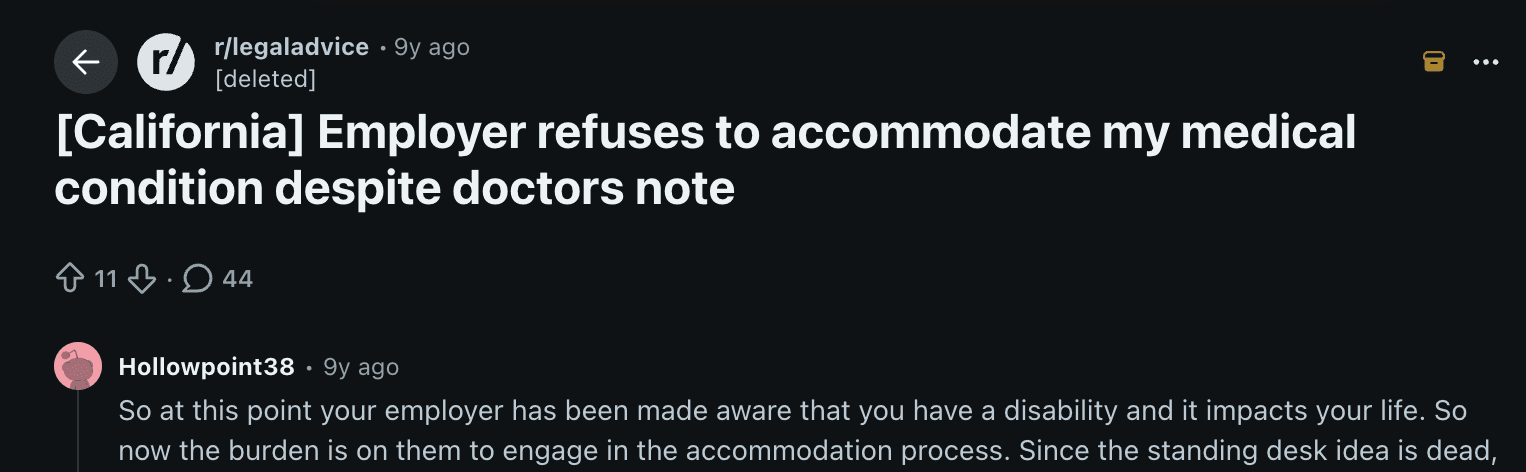
For employers, the takeaway is simple: denying the first requested accommodation is not automatically unlawful, but denying without analysis is risky. You need to show what alternatives were reviewed and why the final decision was reasonable.
“Can I be fired while I'm on disability leave or working through an accommodation?”
In another California AskHR thread, an employee asked whether a company could terminate someone who was on short-term disability and also working through an ADA accommodation issue.
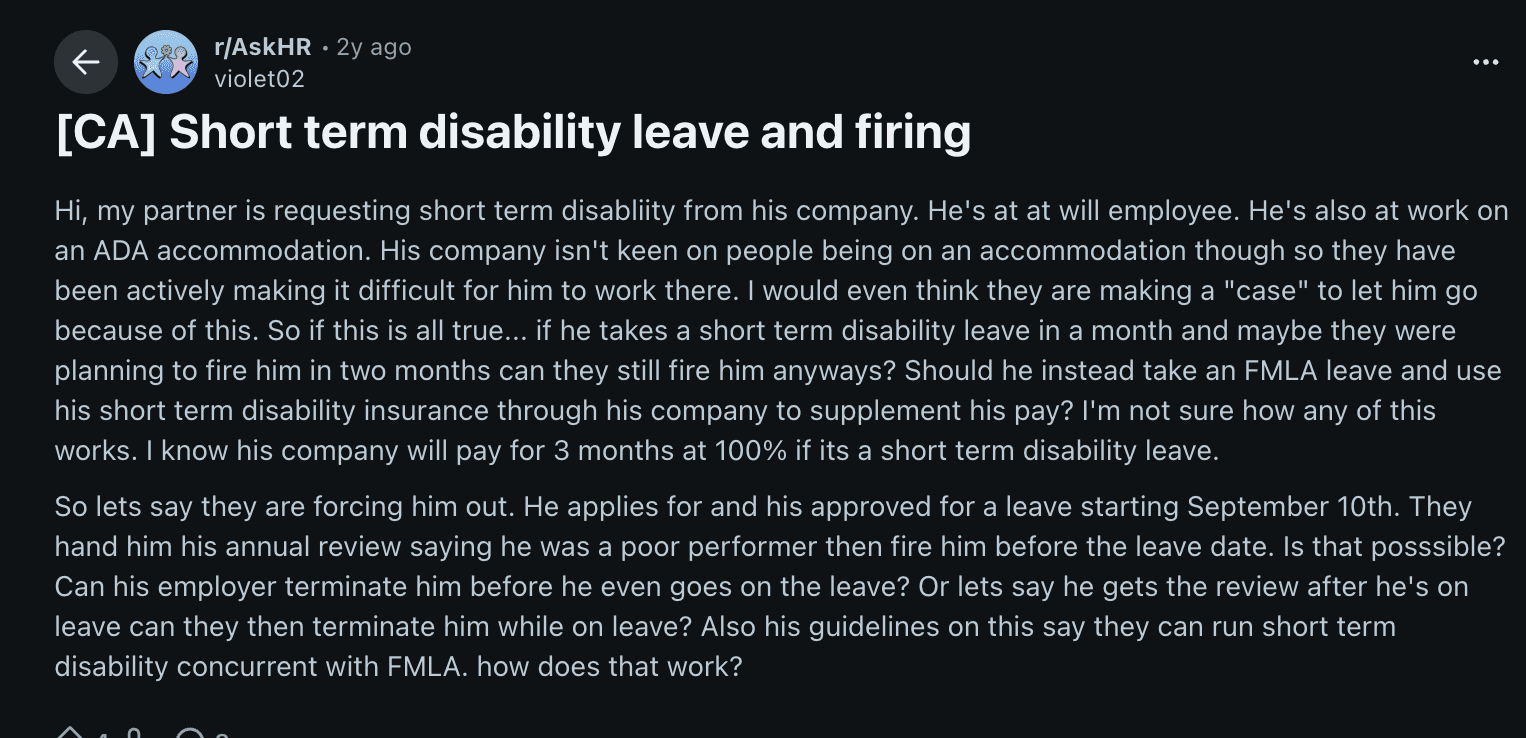
This is one of the most dangerous timing issues for employers. Terminating an employee while an accommodation request or disability leave issue remains unresolved creates a retaliation and failure-to-engage fact pattern that plaintiff-side lawyers know how to use.
So, here's the employer-side lesson:
Employees are documenting delays, denials, termination timing, requests for medical notes, and refusals to work remotely. If your accommodation process is informal, inconsistent, or undocumented, the employee may already have the timeline needed to support an FEHA claim.
DefendMyBiz helps California employers respond to accommodation requests before they become failure-to-accommodate, failure-to-engage, or retaliation lawsuits.
If you're also managing a related retaliation claim, see: Protected Leave Litigation: Defeating Interference and Retaliation Claims
Conclusion
An accommodation request activates a legal clock. The employers who end up defending FEHA claims are often the ones who delayed, documented nothing, or terminated while the process was still open.
If you've received an accommodation request and aren't sure how to respond, or if you're already facing a failure-to-accommodate claim, get defense counsel involved immediately. The process needs to be handled right from the first conversation.
Contact DefendMyBiz for a free 15-minute consultation →| (818) 418-6625
FAQs
Does FEHA require me to give the employee exactly what they asked for?
Can I request medical documentation before providing accommodation?
What if no accommodation is possible and the employee can't perform their essential duties?
Can an employee sue me for failing to engage in the interactive process even if I couldn't have accommodated them anyway?
Does the accommodation obligation end when CFRA or FMLA leave is exhausted?
Disclaimer: The above content is for informational purposes only. This is not legal or tax advice. Laws, IRS guidance, and withholding requirements can change, and outcomes depend on specific facts. You are advised to contact a qualified attorney for any legal advice.