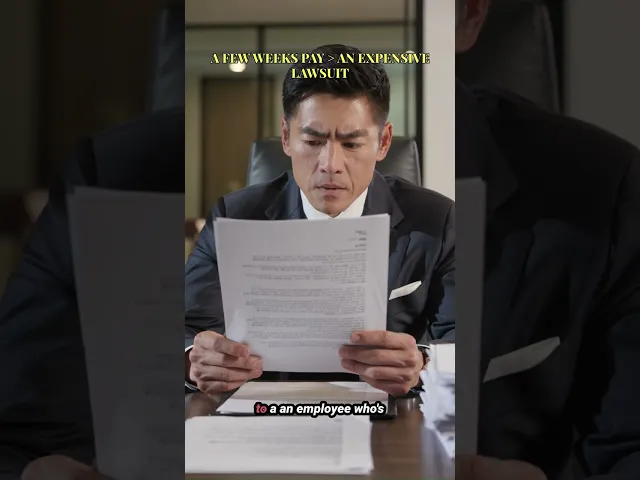
Your Employee Signed a Severance Agreement. Will It Hold Up in California?
Hybrid / Non-FEHA Claims

You offered severance, your employee signed, and you assumed the matter was closed.
In California, that assumption gets employers into serious trouble. A signed severance agreement does not automatically bar a former employee from filing a wage claim, pursuing a PAGA action, or challenging the release entirely. California imposes strict requirements on how these agreements must be drafted, disclosed, and delivered.
Miss any of them and your release may be unenforceable.
Before You Assume Anything, Read This First
Signed doesn't mean settled. Employees can still pursue PAGA claims, earned wages, and EEOC charges after signing
If you miss the 5-business-day review notice or attorney advisement under SB 331, the release can be voided
Is the employee 40+? OWBPA requires a 21-day review and a 7-day revocation. Skip either, and your ADEA waiver fails automatically
One illegal clause, either a PAGA waiver, a non-compete, or a bad no-rehire provision, can take down the entire agreement
No Civil Code § 1542 waiver = unknown claims stay open
What Employers Get Wrong Before the Ink Is Even Dry
Most employers treat a severance agreement like a standard contract: get a signature, write a check, move on. California doesn't work that way.
Under SB 331 (the "Silenced No More Act," effective January 1, 2022), every employer offering a severance or separation agreement must:
Give the employee at least 5 business days to review the agreement before signing
Notify the employee in writing of their right to consult an attorney
Include specific statutory language in any non-disparagement clause, making clear that the employee can still disclose unlawful acts in the workplace
Miss any one of these, and the agreement or key provisions in it can be voided. Courts may not allow employers to fix these defects after the fact.
Watch: John W. Fagerholm, Managing Partner of DefendMyBiz, explains when severance is actually worth offering and when it isn't. Watch here →
What a Signed Release Cannot Extinguish?
This is what most employers don't find out until they're already in litigation.
Earned wages. California Labor Code § 206.5 prohibits conditioning payment of earned wages on signing a release. If wages were owed before the agreement, a release of those wages may be void.
PAGA representative claims. A severance release may resolve the employee's individual claims, but it may not eliminate representative PAGA exposure where the employee still has statutory standing. If there were wage-and-hour violations affecting multiple workers, a single signed severance agreement does not close your PAGA exposure.
EEOC charges and agency investigations. No release can prevent a former employee from filing a charge with the EEOC or participating in a government investigation. It's non-waivable under federal law.
Whistleblower/public policy claims. These can also create post-release exposure, especially when the employee challenges the agreement on the grounds of duress, coercion, fraud, lack of a meaningful choice, or statutory non-waiver protections.
If you're facing a wrongful termination claim alongside a severance dispute, read our guide: Wrongful Termination Defense: Protecting Executive Decisions
The OWBPA Layer: Mandatory Rules for Employees 40 and Older
If your employee is 40 or older and you want to waive age discrimination claims under the ADEA, the Older Workers Benefit Protection Act (OWBPA) adds a separate, non-negotiable layer of requirements.
Requirement | Individual Termination | Group Layoff |
|---|---|---|
Review period | 21 calendar days | 45 calendar days |
Revocation window | 7 days after signing | 7 days after signing |
Written advice to consult an attorney | Required | Required |
Specific ADEA reference in agreement | Required | Required |
Agreement effective date | After a 7-day revocation period | After a 7-day revocation period |
The agreement is not effective until the 7-day revocation window closes. And per the EEOC, a defective OWBPA waiver cannot be cured retroactively. A corrected agreement sent after the fact does not salvage the original release.
What SB 331 Changed and What Employers Still Miss
Non-disparagement clauses now require specific language. Any non-disparagement clause in a severance agreement releasing a FEHA claim must include language along the lines of:
"Nothing in this agreement prevents you from discussing or disclosing information about unlawful acts in the workplace, such as harassment or discrimination, or any other conduct that you have reason to believe is unlawful."
Omit this, and the clause is unenforceable.
No-rehire provisions are restricted. Under Code of Civil Procedure § 1002.5, settlement agreements resolving employment disputes generally cannot include no-rehire provisions that restrict an aggrieved employee from future employment with the employer or related entities.
NDAs covering FEHA claims are severely restricted. Employers cannot require a former employee to sign an NDA preventing them from disclosing facts about harassment, discrimination, or retaliation. This is unless the restriction is part of a settlement of a claim already filed, and the employee had or was given notice of their right to retain counsel.
For a broader picture of FEHA exposure, see: FEHA / EEO Defense
How Courts Void California Severance Agreements
Unconscionability. California courts consider both procedural unconscionability (significant disparity in bargaining power, pressure to sign without adequate time) and substantive unconscionability (one-sided terms). A finding of both gives courts discretion to void all or part of the agreement.
Illegal provisions contaminating the whole agreement. An improper PAGA waiver, void NDA, or illegal no-rehire clause doesn't automatically sever cleanly. Courts have discretion to invalidate the entire agreement if the illegal terms are central to the deal.
Missing the Civil Code § 1542 waiver. A release of "unknown claims" requires an explicit waiver of Civil Code § 1542. Without it, the release may not cover future claims arising from conduct that predates the agreement.
What a Defensible California Severance Agreement Must Include
To give your release the best chance of holding up:
Comprehensive release of known and unknown claims under state and federal law
Explicit Civil Code § 1542 waiver
Full SB 331 compliance: notice, attorney advisement, non-disparagement language
Full OWBPA compliance if employee is 40+: correct review period, revocation window, ADEA reference
No no-rehire clause if the employee made any prior complaint
No attempt to waive PAGA representative standing
No conditioning of earned wage payment on the signature
Genuine consideration - something of value beyond what was already owed
The document and the delivery process both matter. A well-drafted agreement can still be challenged if the process of obtaining the signature was rushed or coercive.
DefendMyBiz handles the broader defense picture when terminated employees return with claims. See: Hybrid / Non-FEHA Claims Defense.
What Are People Discussing Online
On Reddit's r/legaladvice and r/AskHR, former employees in California are actively questioning what their severance agreements actually prevent them from doing. The recurring theme is simple: employees are not assuming the agreement is final. They are checking whether the release has gaps.
“Can my severance agreement stop me from talking about the terms or what happened?”
In this California AskHR thread, commenters pushed the employee to have an attorney review the agreement, and several flagged the language as unusually restrictive
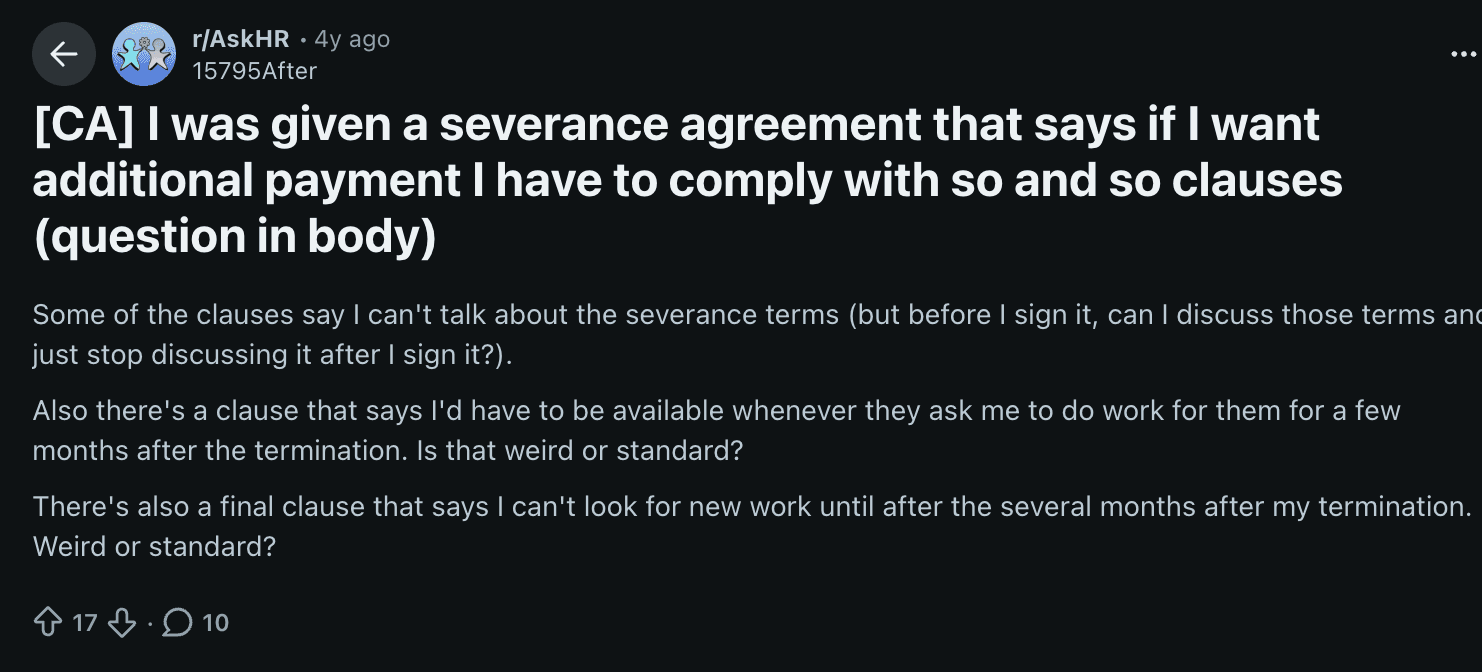
For employers, this is exactly where SB 331 compliance matters. If your confidentiality, non-disparagement, or post-employment restrictions are overly broad, the agreement may invite scrutiny rather than prevent it.
"I signed a non-disparagement clause. Can I still talk about my experience?”
Another California r/legaladvice thread involved an employee who signed a non-disparagement agreement to receive severance, then wanted to write publicly about their experience.
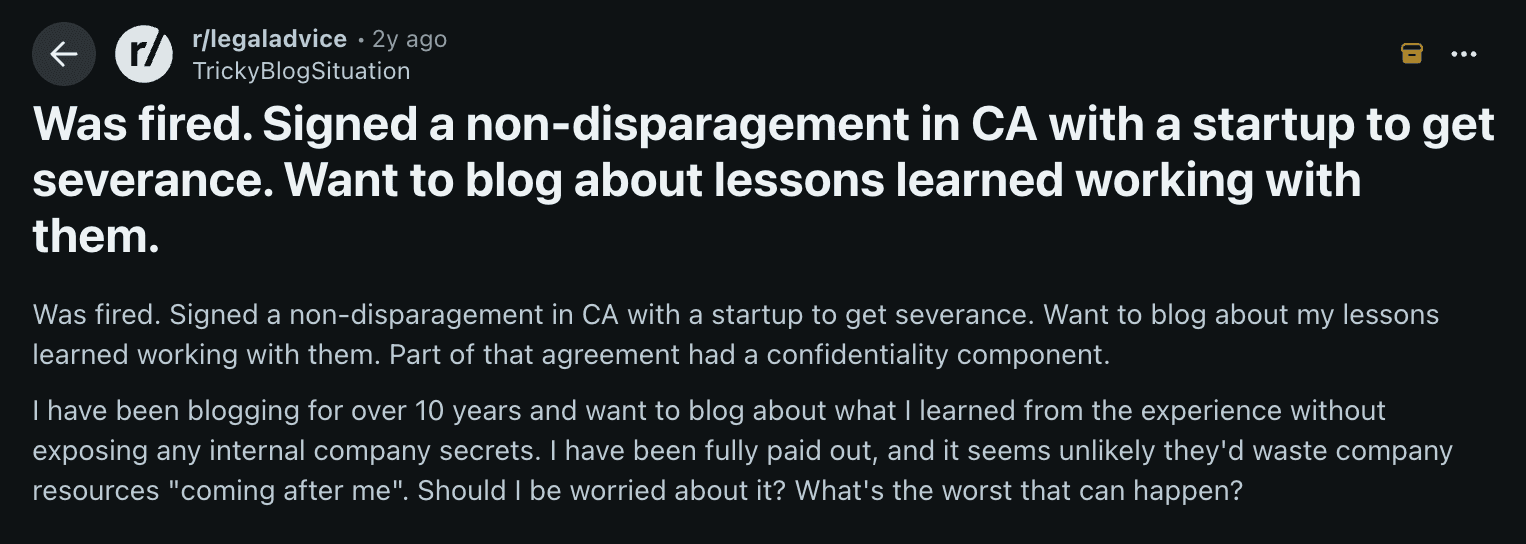
This is the risk with outdated severance templates. California employers need non-disparagement language that clearly preserves the employee's right to discuss unlawful workplace acts. If that carveout is missing, the clause may be unenforceable.
“Can I still pursue unpaid wages before agreeing to release claims?”
A California r/legaladvice thread specifically discussed wage claim negotiations and establishing undisputed wages before signing a release.
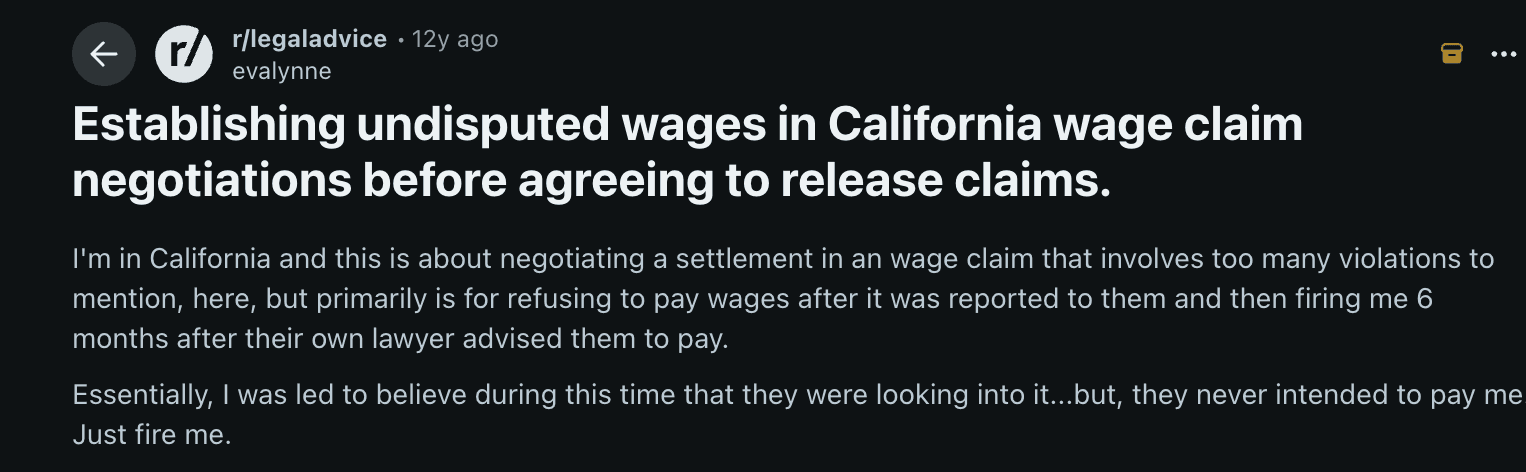
That matters because California Labor Code § 206.5 prohibits employers from conditioning the payment of wages already due on the signing of a release. Severance should be separate from final wages, overtime, commissions, and other earned compensation.
So here's the employer-side lesson:
Employees are reviewing severance agreements more carefully than ever. They are comparing clauses online, asking whether they can still sue, and looking for defects in wage payments, non-disparagement language, review periods, and agency rights carve-outs.
A severance agreement is a litigation-risk document. If it is rushed, overbroad, or based on an outdated California template, it can create the exact dispute it was meant to prevent.
Final Thoughts
A signed severance agreement in California is only as strong as the underlying document and the process used to obtain the signature. Agreements with OWBPA defects, missing SB 331 language, or no § 1542 waiver are easier to challenge and may be voided in whole or in part. And a signed release never closes your PAGA exposure if wage violations affected other workers.
If you've recently offered a severance agreement, are about to draft one, or are dealing with a former employee who signed but is now pursuing claims, get defense counsel involved immediately. The earlier you move, the more options you have.
Contact DefendMyBiz for a free 15-minute consultation → | (818) 418-6625
FAQs
Does California require employers to offer severance pay?
Can an employee sue after signing a severance agreement in California?
What voids a California severance agreement?
Can I include a non-compete in a California severance agreement?
What is the Civil Code § 1542 waiver, and why does my severance agreement need it?
Disclaimer: The above content is for informational purposes only. This is not legal or tax advice. Laws, IRS guidance, and withholding requirements can change, and outcomes depend on specific facts. You are advised to contact a qualified attorney for any legal advice.