Why Plaintiff Attorneys Send Inflated Demand Letters (And How Real Exposure Is Calculated)
Wage & Hour Defense

A demand letter arrives from a plaintiff's attorney. The number is 6-figures, and our first thought is that the figure cannot be right. You have 12 employees, and the claim appears to involve missed meal periods.
That skepticism is reasonable.
When plaintiff attorneys send a demand letter in a California employment case, the number at the top is often an advocacy position rather than the employer's actual exposure. It may assume the longest lookback period, the highest penalty rates, the weakest version of the employer's records, and the absence of viable defenses.
The employer's job is not to react emotionally to the demand. It is to calculate real exposure from payroll data, time records, break records, wage statements, employee files, and any applicable defenses.
This guide explains how inflated demand letters are built, how to calculate a settlement amount from actual exposure data, and what California employers should do before responding.
How Plaintiff Attorneys Build an Inflated Demand Letter
A California employment demand letter is usually an advocacy document, not a neutral accounting of what the employer actually owes. It's a maximum-exposure document designed to anchor the negotiation as far from your real liability as possible.
Here's the standard construction:
Step 1: Identify the base violation.
One unpaid overtime claim. One missed meal break per shift. One misclassified worker. The actual underlying harm is often bounded and specific.
Step 2: Apply the maximum lookback period.
Lookback periods vary by claim. California DIR lists different filing deadlines depending on the claim type, including 1 year for certain penalties, 2 years for some oral wage promises, 3 years for many wage-and-hour claims, and 4 years for written contract claims.
Some plaintiffs also plead California's Unfair Competition Law to argue for a four-year recovery period, but that theory still needs legal and factual support.
Step 3: Stack every possible violation.
A single payroll miscalculation doesn't generate one claim. In a pre-reform or willful-conduct PAGA context, it generates:
Violation | Labor Code Section | Penalty/Exposure |
|---|---|---|
Unpaid overtime | §510 | Back wages + interest |
Failure to pay wages when due | §204 | Additional PAGA penalties |
Wage statement defect | §226 | Up to $4,000/employee |
Failure to pay final wages | §203 | Up to 30 days of daily wages |
Meal break premium owed | §226.7 | 1 hr. premium per missed break |
Expense reimbursement | §2802 | All unreimbursed business costs |
PAGA civil penalties | §2699 | $100–$200 per employee per pay period |
Step 4: Apply maximum penalty rates throughout.
Every calculation uses the $ 200-per-period "subsequent violation" rate, even when the employer has no prior finding. Every meal period is assumed to have been missed or to have been noncompliant. Every wage statement defect is assumed to affect every employee on every pay period.
Step 5: Add attorney fees.
California's one-way fee-shifting rules mean the employer pays the plaintiff's attorneys if the employer loses. Plaintiff attorneys may include an attorney fee estimate or leverage fee-shifting exposure in negotiations. The actual fee risk depends on the statute, claim stage, work performed, and whether the plaintiff prevails.
The result: a demand letter number that represents the theoretical maximum exposure if every allegation is true, every calculation favors the plaintiff, and the employer wins no defenses whatsoever. That number is almost never your actual exposure.
Need the first-response checklist before calculating exposure? Before you respond, review what to preserve, what not to say, and when to involve counsel in our guide to responding to an employee demand letter.
How to Calculate a Settlement Amount: Real Exposure vs. Claimed Exposure
Knowing how to calculate a settlement amount from your actual records is the foundation of your response strategy. Here's the framework:
Step 1: Pull payroll data for the claimed period.
Do not accept the plaintiff's lookback period without analysis. Determine when the alleged violation actually began, what the applicable statute of limitations is for each specific claim, and whether any good-faith dispute arguments reduce the period.
Step 2: Calculate overtime independently.
For each employee named or implicated, calculate what overtime was actually owed under California's daily and weekly rules versus what was actually paid. The gap between those numbers, not the plaintiff's number, is your base exposure.
Step 3: Audit break records.
If your timekeeping records show compliant meal and rest breaks, the claimed premium pay exposure drops significantly or disappears. If records are missing or inconsistent, assume the plaintiff's number for that portion is defensible and calculate accordingly.
Step 4: Apply the correct penalty tier.
For PAGA notices governed by the post-June 19, 2024 framework, the higher $200 penalty is harder to trigger. Employers should not assume the plaintiff's maximum penalty tier is correct without checking whether there was a prior agency or court finding, whether the alleged conduct meets the statutory standard, and whether penalty reductions apply.
Step 5: Apply the derivative stacking rules.
For PAGA notices governed by the amended law, certain derivative penalties under Labor Code §§201–204 and §226 may be limited when they arise from the same underlying unpaid wage violation, unless a statutory exception applies.
Step 6: Calculate the waiting time penalty correctly.
Waiting time penalties under Labor Code §203 generally require a willful failure to pay final wages. A documented good-faith dispute over whether wages were owed can preclude waiting time penalties, but the facts and documentation matter.
Step 7: Apply reasonable-step penalty caps.
If you've taken documented compliance steps (payroll audits, written policies, supervisor training), the 2024 PAGA reform caps your penalties at 15–30% of the default amount. That cap applies to the already-reduced calculation from steps 1-6, compounding the savings.
A worked example:
Category | Plaintiff's Demand | Defensible Exposure |
|---|---|---|
Unpaid overtime (3 employees, 1 year) | $45,000 | $12,000 (records show partial compliance) |
PAGA penalties (stacked, 4 years) | $180,000 | $26,000 (post-reform, no willfulness, 15% cap) |
Waiting time penalties | $35,000 | $0 (good-faith dispute documented) |
Wage statement penalties | $48,000 | Depends on whether this is individual §226 exposure, PAGA civil penalties, or both |
Expense reimbursement | $22,000 | $4,500 (partial policy defense) |
Attorney fee estimate | $130,000 | Not owed unless legally recoverable, but may affect settlement leverage |
Total | $460,000 | $46,400 |
That's a 10:1 ratio between claimed and defensible exposure. This is not unusual in California employment demand letters. The gap is the leverage.
Final-pay disputes often become Labor Commissioner claims rather than just demand-letter negotiations. Read our guide on DLSE litigation strategy and Labor Commissioner proceedings.
What the Demand Letter Is Designed to Make You Do
Understanding the psychology behind how plaintiff attorneys draft demand letters is as important as understanding the math.
The time pressure is deliberate.
A 10-day response deadline on a $400,000 demand is designed to make you feel like you have no time to analyze the numbers carefully. Most demand letters don't have hard legal deadlines; the statute of limitations is years away. The urgency is manufactured.
The number anchors the negotiation.
The first number anchors the negotiation. A high opening demand can make a much smaller settlement feel reasonable, even if the actual exposure is lower.
Attorney fee shifting is the hidden pressure.
The letter will mention that if you lose at trial, you pay the plaintiff's attorneys. What it won't tell you is that this outcome requires them to actually win, and that with strong documentation and employer-side counsel, many claims either settle well below demand or are successfully defended.
Volume filing amplifies the pressure.
In FY 2024–2025, 8,846 PAGA notices were filed, and five law firms accounted for 2,086 of them, nearly a quarter of all filings. These are industrial-scale operations. The demand letter your business received was likely produced from a template, with your company's specific numbers plugged into a formula.
What to Do the Day a Demand Letter Arrives
1.
Do not respond to the demand number or the deadline without a calculated exposure analysis.
The demand letter number is not your negotiating floor. Your defensible exposure calculation is. You cannot negotiate intelligently without first knowing the gap.
2.
Preserve all records immediately.
Payroll records, timekeeping data, break logs, wage statements, personnel files, and related communications. From this moment, you are in a pre-litigation posture regardless of whether you intend to settle.
3.
Identify which claims have merit and which are padding.
Not every violation alleged in a demand letter is real. Examples include wage-statement defects that do not exist, waiting-time penalties tied to disputed final wages, and expense claims for costs already reimbursed. Each padded claim needs to be identified and documented before any settlement conversation begins.
4.
Calculate your real exposure before any response.
The framework above gives you the structure. An employer defense attorney runs this analysis against your actual records, identifies the defensible positions, and tells you what your number actually is.
5.
Consider the DLSE or litigation pathway before settling reflexively.
A demand letter is not a lawsuit. It is a pre-litigation communication. You have time to respond strategically. For claims that are substantially inflated relative to actual exposure, an early counter based on your own exposure analysis may produce a better outcome than immediate settlement.
DefendMyBiz exclusively handles demand letter responses and California employment litigation defense for employers. We run the exposure analysis, identify the defensible positions, and advise on whether to fight, settle, or counter entirely from your side of the table. Our Wage & Hour Defense team has responded to demand letters across every claim type California plaintiff attorneys use.
If a demand letter has arrived, book your complimentary 15-minute consultation or call (818) 418-6625 before responding to anything.
What Employers Are Asking Online About Demand Letters and Settlement Pressure
Demand-letter risk often begins with employer-side uncertainty: "Is this demand real?" "Should I respond?" "Do I need a lawyer?" "Is the number inflated?" "Can I send records without making things worse?"
Reddit discussions from business owners, HR teams, and employers show that demand letters create pressure before any lawsuit is filed.
1) Business owners are asking what to do when a demand letter arrives.
In a small-business Reddit thread, a business owner said they received a letter from an attorney seeking damages against the company and were unsure whether the claim was legitimate. The discussion turned quickly to legal review, response strategy, and whether the demand was a pressure tactic.

A demand letter should trigger an exposure review, not panic. Employers should preserve records, identify the claim type, avoid admissions, and calculate real exposure before responding.
2) HR professionals are asking how often they should involve legal before a dispute escalates.
In an HR discussion, a new HR manager asked whether legal should only be contacted when "things hit the fan." That question matters because demand-letter outcomes often depend on what the employer did before the letter arrived: documentation, discipline records, payroll corrections, and complaint response.
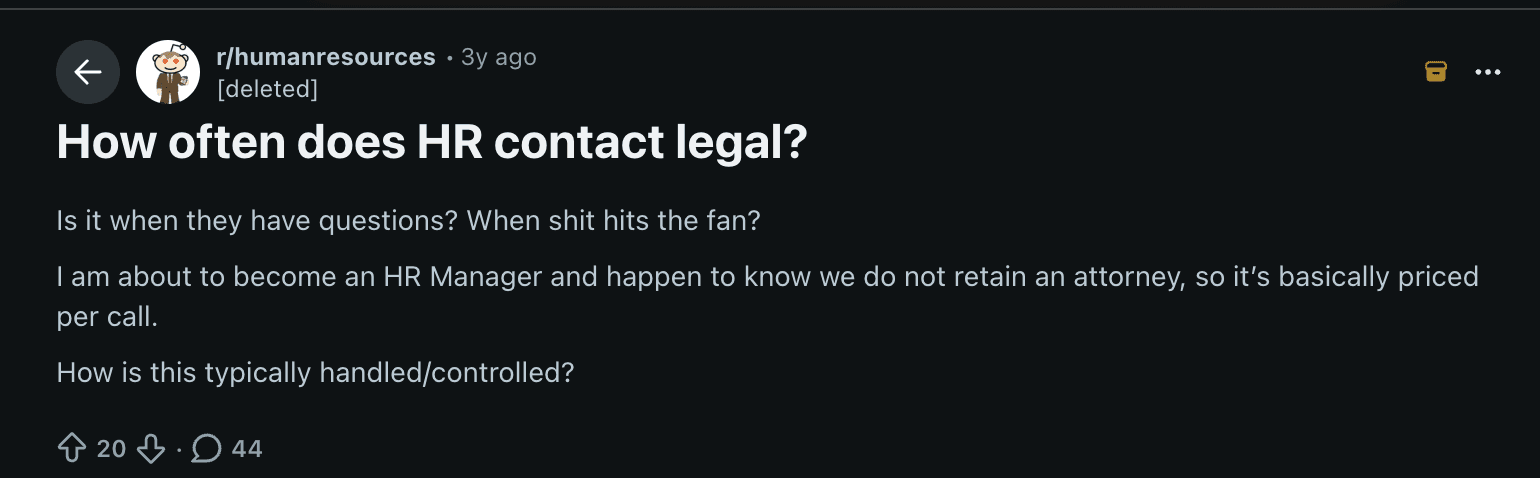
Employers should involve counsel before responding to high-risk letters, producing records, making settlement offers, or denying claims. Early legal review is usually cheaper than trying to repair a bad first response.
The larger lesson for employers: if a demand letter, record request, final-pay dispute, or wage issue is serious enough to ask Reddit, it is serious enough to calculate before responding. The demand number is not the strategy. The employer's actual exposure calculation is.
FAQs
Why do plaintiff attorneys send a demand letter with such a high number?
How do employers calculate a settlement amount after receiving a demand letter?
Is the deadline in an employment demand letter legally binding?
Is a demand letter legally binding?
What should an employer do after receiving a demand letter?
Conclusion
When plaintiff attorneys send a demand letter in California employment cases, the number is intended to provide leverage. Understanding how to calculate a settlement amount from your actual payroll records, break logs, and wage statement data is what converts a $400,000 demand into a defensible $46,000 negotiating position.
The math drives the strategy. Employers who run that calculation before responding consistently reach better outcomes than those who settle reflexively because the number looks overwhelming.
DefendMyBiz represents California employers only. If a demand letter has arrived and you need to know what you actually owe and what you can defend, book your complimentary 15-minute consultation or call (818) 418-6625.
Disclaimer: The above content is for informational purposes only. This is not legal or tax advice. Laws, IRS guidance, and withholding requirements can change, and outcomes depend on specific facts. You are advised to contact a qualified attorney for any legal advice.