FLSA for California Employers: Key Rules, Conflicts, and Risks
U.S. DOL (Federal) Defense
Most California employers know they have to follow California labor law. What catches them off guard is that they're simultaneously subject to the federal Fair Labor Standards Act (FLSA) and, where the two laws conflict, they must follow the stricter of the two.
In California, that almost always means state law wins. But the FLSA still creates independent exposure, independent enforcement, and independent liability. Running afoul of both at once is where costs can multiply.
What's at Stake When You Operate Under Two Frameworks
FLSA is enforced by the U.S. Department of Labor Wage and Hour Division. California law is enforced by the DLSE and the Labor Commissioner.
FLSA violations can carry back wages for up to three years for willful violations, plus liquidated damages equal to the unpaid wages owed.
A misclassified employee generates back pay exposure under both laws simultaneously for the same pay periods
California's exempt salary threshold is nearly double the federal threshold. An employee who clears the FLSA bar may still be non-exempt under California law
California's duties test is stricter than FLSA. An employee satisfying the federal standard may still fail the California test
What FLSA Actually Requires: The Federal Baseline
The Fair Labor Standards Act, enacted in 1938, establishes four federal obligations for covered employers:
Minimum wage: At least $7.25 per hour federally, but California's is $16.90/hour as of January 1, 2026. When state law is higher, state law always applies.
Overtime: Non-exempt employees must receive 1.5x their regular rate for hours over 40 in a workweek. FLSA calculates overtime only on a weekly basis.
Recordkeeping: Payroll records and hours-worked documentation must be retained for at least 3 years; wage computation records for 2 years.
Child labor: Minimum age of 14 for most non-agricultural employment, with restricted hours and prohibited hazardous work for employees under 18.
Coverage threshold: Enterprise coverage applies to employers with annual sales of $500,000 or more, or any employer in a hospital, school, or government entity. Individual coverage applies to any employee whose work involves interstate commerce, which courts interpret broadly.
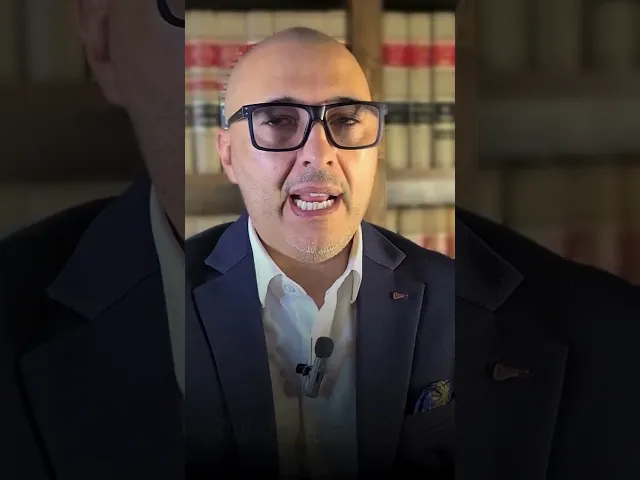
Watch: John breaks down the Fair Labor Standards Act: what it covers, what employers are required to do, and where California-specific obligations layer on top. Watch here →
Where FLSA and California Law Conflict (and What It Costs You)
This is where California employers carry double exposure. When the laws conflict, the employer must follow the one that provides greater protection to the employee, which is almost always California law.
Issue | FLSA (Federal) | California Law | Which Applies |
|---|---|---|---|
Minimum wage | $7.25/hour | $16.90/hour (Jan 1, 2026) | California |
Overtime trigger | 40 hrs/week | 8 hrs/day OR 40 hrs/week | California |
Double time | Not required | After 12 hrs/day or on the 7th consecutive day | California |
Exempt salary threshold | $684/week ($35,568/year) | $1,352/week ($70,304/year), 2x minimum wage | California |
Exempt duties test | "Primary duty" — can be <50% of work tim | Must spend more than 50% of time on exempt duties | California |
Agricultural worker overtime | Largely exempt | Full overtime protections since 2025 | California |
Meal and rest breaks | Not required | Mandatory, with premium pay penalties | California |
The "agricultural worker" point matters:
The FLSA largely exempts agricultural workers from overtime pay. California phased in agricultural overtime protections and, by January 1, 2025, agricultural employers generally had to apply the 8-hour/day and 40-hour/week overtime standard, with double time after 12 hours in a workday.
If you run any agricultural operation in California and rely on the federal agricultural exemption, you're exposed on the state side.
For how misclassification exposure compounds under California's framework specifically, see: Employee Misclassification in California: Independent Contractor vs. Employee.
The Classification Gap: Where Most California Employers Get Burned
One common mistake for California employers is assuming that a federal exempt classification is enough. It isn't.
The salary threshold gap:
The federal exemption threshold currently stands at $684/week after a federal court in Texas vacated the 2024 DOL rule increases in November 2024. California's threshold is tied to 2x the state minimum wage, $1,352/week ($70,304/year) as of January 1, 2026.
An employee earning between $684 and $1,352/week is federally exempt but California non-exempt. That means California overtime, meal break, and rest break obligations all apply.
The duties test gap:
Under the FLSA, the "primary duty" standard allows an employee to spend less than half of their time on exempt work and still qualify for the exemption. California requires that the employee spend more than 50% of their actual working time performing exempt duties. Job descriptions and titles don't satisfy this; actual duties do.
What dual misclassification can look like in practice:
For example, an employee earns $900/week, is classified as exempt, and spends 40% of their time on non-exempt tasks.
Under FLSA: possibly exempt.
Under California: likely non-exempt
The California back-pay exposure covers every overtime hour worked, every missed meal break, every missed rest period going back 3 years. Plus PAGA exposure on top if the error was systemic.
For the full picture on how California wage and hour exposure compounds across your workforce, see: California Employer FAQ: The 10 Most Common Wage & Hour Questions Answered.
For FLSA and California defense: Wage & Hour Defense.
The FLSA's Daily Overtime Blind Spot
California's daily overtime rule is one of the most misunderstood gaps between state and federal law and one of the most expensive.
Under FLSA, overtime kicks in after 40 hours in a workweek. There is no daily overtime trigger under federal law.
Under California Labor Code § 510, overtime is required after 8 hours in a single workday at 1.5 times the regular rate. After 12 hours in a single workday, double time applies (2x). On the 7th consecutive day of a workweek, overtime applies for the first 8 hours and double time thereafter.
The trap: An employer can have an employee work 12 hours on Monday and 4 hours on Tuesday, for a total of 16 hours by Tuesday, without triggering federal overtime. Under California law, the employee earned 4 hours of overtime on Monday, and if they worked 12 hours, double time for the last 2 hours. None of that would appear in a federal-only compliance audit.
Employers who rely on FLSA-compliant payroll systems without a California-specific daily overtime configuration are incurring back pay exposure every pay period.
For how off-the-clock work and overtime claims pile up when daily triggers are missed, see: Off-the-Clock Work Claims in California: How Employers Can Defend Themselves.
A Sneak Peek Into Employers' Queries
Across Reddit's r/humanresources, r/Payroll, and r/smallbusiness, employers and payroll professionals are not just asking what the FLSA requires. They are asking how federal rules interact with California's stricter overtime, exemption, and payroll rules.
1) "How do we calculate overtime correctly in California?"
In one r/Payroll thread, a small California business asked how to calculate overtime for a new hourly employee. The discussion focused on California's daily overtime rules, not just the federal 40-hour weekly standard.
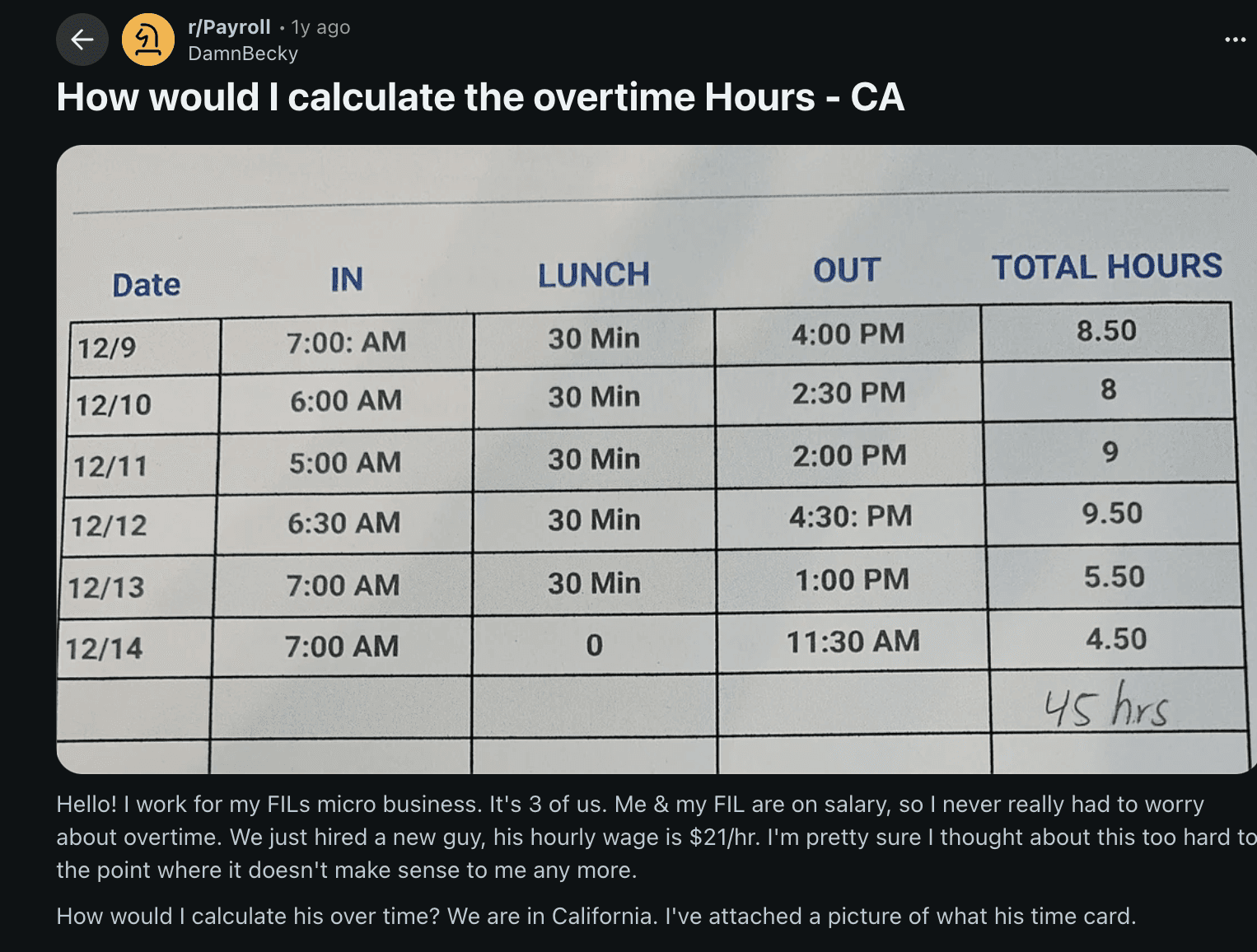
For employers, this is the core risk. A payroll setup that is FLSA-compliant can still be wrong in California if it fails to account for daily overtime, double time, or seventh-day rules.
2) "Can employees voluntarily work extra days without overtime?"
In a r/smallbusiness thread, a California employer asked whether employees could voluntarily work a sixth day for regular wages instead of overtime.
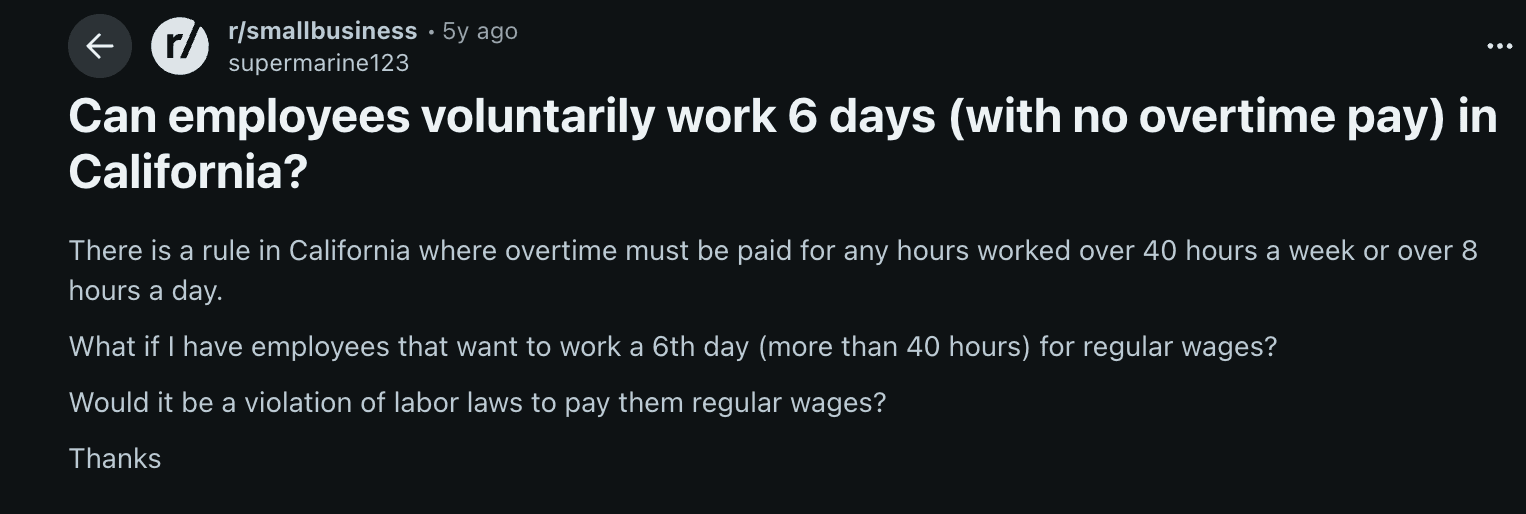
For employers, employee consent does not waive wage-and-hour obligations. If California overtime is triggered, it must be paid even if the employee agreed to the schedule.
The employer takeaway: California employers cannot base payroll or classification decisions solely on FLSA rules. The federal standard is only the floor. Daily overtime, double time, higher salary thresholds, stricter duties tests, meal/rest rules, and state-specific recordkeeping all need a California-specific audit.
DefendMyBiz helps California employers audit FLSA and state-law exposure, fix classification errors, and defend wage-and-hour claims before a federal-only compliance setup becomes a California lawsuit.
Conclusion
FLSA sets the federal floor. California raises it significantly on almost every dimension: minimum wage, overtime triggers, daily double time, exempt salary thresholds, and duties tests. California employers who calibrate their compliance to the federal standard are generating state-side exposure every pay period. And when violations exist under both frameworks simultaneously, the penalties compound from two separate enforcement tracks.
If you're not certain your classification decisions, overtime calculations, and payroll configuration satisfy both FLSA and California requirements, audit it before the DOL or DLSE does.
Contact DefendMyBiz for a free 15-minute consultation → | (818) 418-6625
FAQs
What is FLSA, and does it apply to California employers?
Is FLSA the same as overtime?
If my employee is exempt under FLSA, are they exempt under California law?
What are the penalties for FLSA violations in California?
How does the DOL's blocked 2024 overtime rule affect California employers?
Disclaimer: The above content is for informational purposes only. This is not legal or tax advice. Laws, IRS guidance, and withholding requirements can change, and outcomes depend on specific facts. You are advised to contact a qualified attorney for any legal advice.