Your HR Investigation Could Become a Defamation Lawsuit. Here's How to Protect Yourself
Hybrid / Non-FEHA Claims

You conducted an HR investigation. You interviewed witnesses, documented findings, communicated the outcome, and terminated the employee. You followed your process.
Months later, a defamation lawsuit filed in a California court may arrive alleging that statements made during the investigation, termination process, or employment communications were false and damaging.
This scenario is more common than most California employers realize. Workplace defamation claims frequently arise from statements made during investigations into alleged misconduct, performance reviews, disciplinary actions, and employment references. The employer believes the investigation was thorough and the statements were justified. The employee believes the findings were false and shared too broadly. That gap becomes litigation.
This guide explains how California defamation law applies to employer conduct, what creates and destroys your privilege protections, and the specific investigation protocols that determine whether you are exposed or defended.
Key Takeaways
Workplace defamation claims most commonly arise from HR investigations, disciplinary actions, termination communications, and employment references.
Qualified privilege protects employer statements made in good faith to those with a common interest, without malice. Still, it is defeated by unnecessary disclosure, conclusory language, or evidence of predetermined outcomes.
The five most common investigation mistakes that destroy qualified privilege: oversharing findings, conclusory pre-investigation statements, fact-versus-inference confusion, biased investigation reports, and references that overstate documented conclusions.
California's one-year statute of limitations generally applies to defamation claims, including claims brought against employers and claims employers may bring against others.
What Makes a Statement Defamatory in the Employer Context
Defamation under California law involves a false statement of fact that is published to a third party and causes legally recognizable harm. Statements that are merely opinions, criticisms, or subjective impressions generally are not actionable.
California Civil Code sections 44 through 46 divide defamation into two categories:
Libel - written or permanently recorded false statements (termination letters, investigation reports, emails, performance reviews)
Slander - spoken false statements (verbal communications during witness interviews, statements to a manager, references given by phone)
For employers, the most dangerous category is defamation per se statements that are defamatory on their face and require no additional proof of harm. Under California law, statements that falsely accuse someone of committing a crime, allege professional unfitness, or imply the person has a particular disease qualify as defamation per se.
The five elements a plaintiff must prove in a California workplace defamation claim:
Element | What It Means for Employers |
|---|---|
False statement of fact | Must be stated as fact, not opinion; must be untrue |
Publication | Communicated to at least one third party beyond the subject |
Unprivileged | Not protected by qualified or absolute privilege |
Fault requirement (depends on circumstances) | At a minimum, the employer should have known it was false |
Harm | Reputational damage, economic loss, or, per se, defamation |
The Two Privilege Protections Every Employer Must Understand
California recognizes two categories of privilege that can protect employer statements during investigations, disciplinary actions, and terminations.
1.
Absolute Privilege
Absolute privilege is a complete defense. Even if the statement is false and made with ill will, the employer cannot be held liable. It applies in:
statements made in judicial proceedings
certain government proceedings
legally protected proceedings
If your HR investigation resulted in a mandatory report to law enforcement or a regulatory body (for example, reporting suspected child abuse or financial fraud to a government agency), those specific communications are absolutely privileged. The protection is complete regardless of your intent.
2.
Qualified Privilege
Qualified privilege is the protection most employers actually operate under, and it is the one they most commonly lose.
Under California law, qualified privilege protects statements made in good faith, on a subject in which the communicating party has a common interest, to someone who shares that interest, without malice. In this context, malice generally means a lack of reasonable grounds for believing the statement was true or an improper motive.
Qualified privilege typically covers:
Performance reviews and appraisals
Investigation findings shared with relevant decision-makers
Disciplinary and discharge letters communicated to HR
Internal communications about why an employee was terminated
Employment references given to prospective employers in good faith
Qualified privilege is conditional. It is defeated if the plaintiff can show the employer acted with malice. That means the statement was made with ill will toward the employee, or without reasonable grounds to believe it was true.
Watch: John Fagerholm explains exactly how California defamation law applies to employers and why responding with professionalism and legal counsel matters from the first statement made. Employers and Defamation — DefendMyBiz YouTube
The Investigation Mistakes That Destroy Your Privilege
Most employer defamation liability does not come from intentionally false statements. It comes from qualified privilege being defeated by one of these patterns:
Oversharing investigation findings.
Qualified privilege requires that statements be made only to those with a legitimate need to know. Sharing investigation conclusions with managers outside the relevant chain of command, employees who were not involved, or business partners removes the "common interest" protection. The employer's exposure grows with every unnecessary disclosure.
Conclusory statements before conclusions are established.
Telling a witness mid-investigation that you "know what happened" or that the subject "definitely did this" before findings are documented creates a false statement risk. Investigation communications should describe allegations and evidence, not announced conclusions.
Statements framed as facts that are actually inferences.
"The employee stole merchandise" is a statement of fact. "The evidence indicates merchandise was missing on shifts when the employee was working" is a documented observation. The first is actionable if wrong. The second is defensible.
Investigation reports that reflect predetermined outcomes.
An investigation report that reads like a justification for termination, rather than an impartial factual account, is vulnerable both as a defamation exhibit and as evidence of malice.
Employment references that exceed documented findings.
A former manager who, in a reference call, says an employee "was fired for theft" when the investigation established a policy violation without confirmed theft has stepped outside qualified privilege and into personal exposure.
Written communications using language that implies broader wrongdoing.
Termination letters that describe a "pattern of dishonesty" when only one specific incident was investigated overstate documented facts. Plaintiff's attorneys read these letters carefully.
Your Investigation Protocol Checklist
How you conduct the investigation determines whether qualified privilege holds. These steps build the documented foundation on which your defense rests.
Before the investigation:
Define the investigation scope in writing, including what is being investigated and what is outside the investigation.
Identify who has a legitimate need to know, and limit disclosure accordingly
Document the complaint or trigger event precisely as reported
During the investigation:
Use factual, evidence-based language in all written communications
Frame statements as allegations under investigation, not facts
Interview witnesses separately; document what each said, not your interpretation of it
Avoid using language implying the outcome before it is determined
Retain all notes, recordings (where lawfully obtained), and communications
Investigation findings:
Write findings that track evidence, not conclusions you reached before the evidence was gathered
Have counsel review the report before it is distributed if the outcome involves termination
Distribute findings only to those with a direct role in the employment decision
Post-investigation communications:
Termination letters should reference specific, documented policy violations
Verbal communications about why the employee was terminated should be limited to HR and the direct reporting chain
Reference calls should be limited to confirmed, documented findings
Do not discuss investigation details with employees who were not part of the formal process
If your investigation process currently has gaps in any of these areas, the time to address them is before the next complaint arrives, not during discovery.
For a related look at how investigation failures compound with wrongful termination exposure, see At-Will Employment in California: What Employers Are Actually Protected From and Retaliation Claims in California: How Employers Defend Business Decisions.
When an Employee Defames Your Business
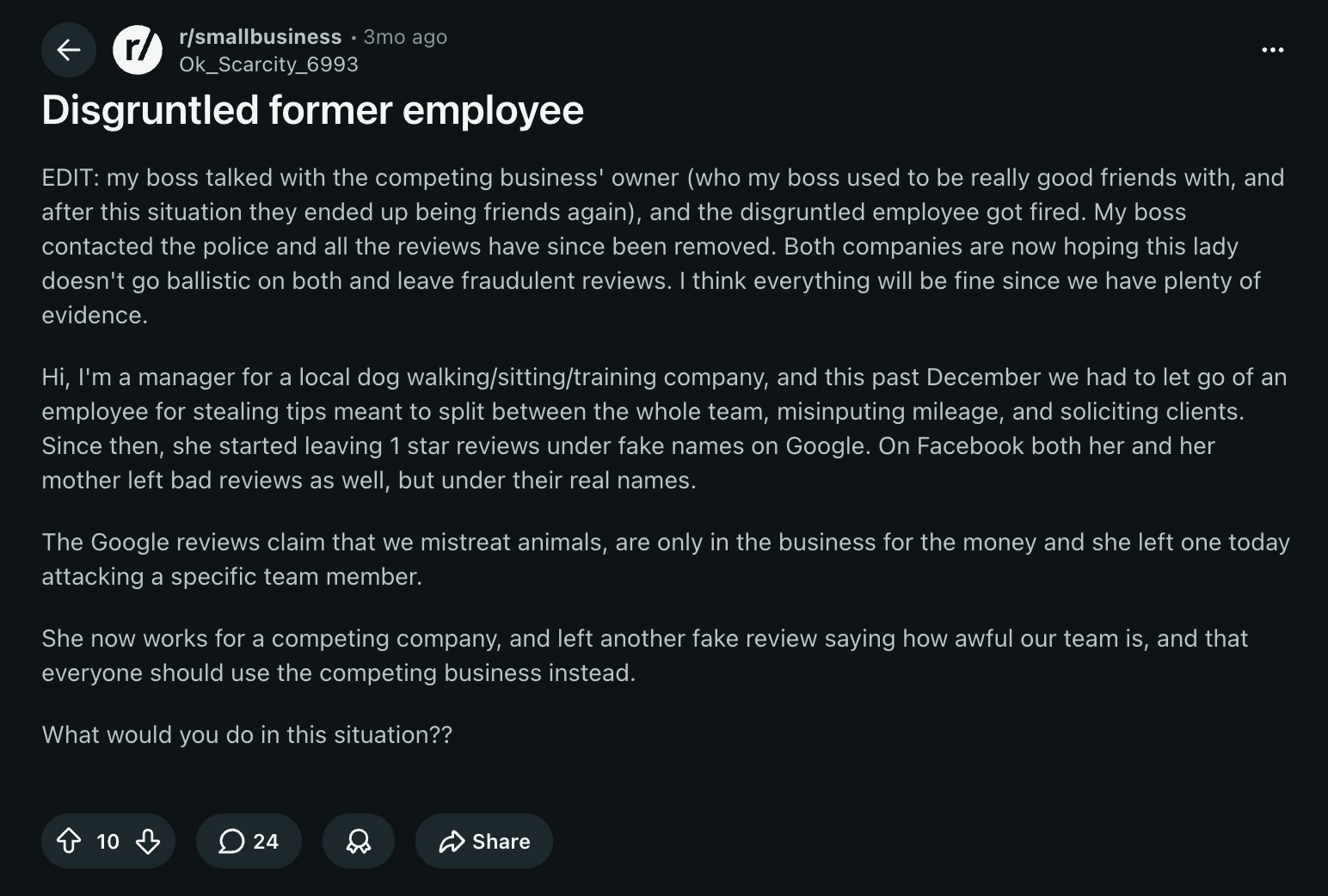
The liability exposure runs in both directions. Employers also face situations where a terminated employee makes false statements about the business to competitors, in Glassdoor reviews, on social media, or directly to your clients.
Here's a real example:
Employer Question: "A Former Employee Is Posting Negative Claims About My Business. When Does It Become Defamation?"
A common concern for California business owners is what happens when a former employee starts posting damaging statements after termination. A negative review or criticism alone is not automatically defamation. Employers need to separate opinions from false statements of fact.
Before responding publicly or sending a legal demand, employers should preserve:
screenshots of the statements
dates and platforms where they appeared
customer or vendor impact
evidence showing why the statement is false
The strongest employer response usually starts with documentation. Reacting emotionally or publicly can create additional risk. A careful review of the statements, evidence, and potential defenses should precede any decision on whether to pursue litigation.
Practical considerations before filing:
Factor | What It Means |
|---|---|
One-year statute of limitations | Must file within one year of the statement's publication (CCP §340(c)) |
Anti-SLAPP risk | If the statement arose from protected activity, the defendant can move to dismiss and seek attorney's fees against you |
Opinion vs. fact distinction | "This company is poorly managed" is an opinion. "This company defrauded its clients" is a factual claim. Only the latter is actionable. |
Cost of litigation | Filing fees, discovery, and trial can exceed $50,000–$100,000 before verdict. Cease-and-desist letters often resolve without litigation. |
Evidence preservation | Screenshots, URLs with timestamps, witness accounts, and records of when you discovered the statement |
A cease-and-desist letter from an attorney is frequently the fastest path to resolution. It puts the former employee on notice, demands retraction, and signals legal readiness without incurring the costs of litigation.
For employers whose business has been targeted by false statements that include misuse of proprietary information alongside defamatory claims, see Trade Secret Protection Without Non-Competes: What California Employers Can Actually Enforce.
How to File a Defamation Lawsuit in California Against a Former Employee
A terminated employee is telling your clients you committed fraud. A bad Glassdoor post is costing you candidates. Here is how to move.
Step 1. Confirm it's actually actionable.
The statement must be a false fact, not an opinion. "This company mistreated me" is an opinion. The claim "This company falsified payroll records" is factual. If it's ambiguous, have an attorney evaluate it before spending anything on litigation.
Step 2. Preserve evidence immediately.
Screenshot every instance with the URL, platform, and date visible. Posts get deleted. Do it now, not after you consult someone. Document any business harm, clients who mentioned it, deals that fell through, and hires that didn't accept.
Step 3. Send a cease-and-desist letter first.
Most cases end here. A letter from your attorney demands retraction, signals you are prepared to litigate, and costs a fraction of a lawsuit. Allow a reasonable time for response before deciding whether further legal action is appropriate.
Step 4. Check your anti-SLAPP exposure before filing.
California's anti-SLAPP statute (CCP §425.16) lets defendants move to dismiss defamation claims arising from protected speech, and if they win, you pay their attorney's fees. This analysis must happen before you file, not after.
Step 5. File in the California Superior Court within one year.
The statute of limitations is strict. One year from the date the statement was first published (CCP §340(c)). Miss it, and the claim is gone permanently.
Step 6. Build your harm evidence through discovery.
Lost clients, damaged vendor relationships, documented business impact- this is what drives settlement value and trial outcomes. Most California defamation cases settle before trial.
How Defend My Biz Handles Employer Defamation Defense
At DefendMyBiz, we represent California employers exclusively.
When you bring us a defamation concern, our first step is to assess whether your communications fall within qualified privilege, whether the privilege may have been compromised, and what the realistic litigation exposure looks like. We look at your actual investigation files, your termination documentation, and the specific statements at issue.
Our employer defense attorneys understand both sides of this type of claim. We know what plaintiff's attorneys look for when they allege that an employer's investigation was pretextual or that findings were fabricated. We know where investigation reports and termination letters create vulnerability, and we know how to build the factual record that protects qualified privilege through litigation.
The DefendMyBiz Hybrid/Non-FEHA Claims defense team handles defamation claims as part of a broader employment dispute defense, since defamation rarely arises as a standalone case.
Book a free 15-minute consultation if you have a current investigation underway, a termination being challenged, or a former employee making damaging public statements.
FAQ
Can an employer be sued for defamation in California based on statements made during an HR investigation?
What is qualified privilege, and how does it protect California employers?
What is the difference between libel and slander in a California workplace context?
How long does an employer have to respond to a defamation lawsuit in California?
Can a California employer sue a former employee for defamation based on negative online reviews or social media posts?
Disclaimer: The above content is for informational purposes only. This is not legal or tax advice. Laws, IRS guidance, and withholding requirements can change, and outcomes depend on specific facts. You are advised to contact a qualified attorney for any legal advice.