
2026 California Employment Laws: The Employer's Compliance Checklist
General Defense Resources

California's 2026 employment laws brought far more than another statewide minimum wage increase. Mandatory penalties for pay data failures, a private right of action against certain repayment contracts, and a new notice requirement with civil penalties up to $10,000 per employee are all now live. If you haven't audited your policies, contracts, and payroll practices against this year's changes, the compliance risk is immediate and, in several cases, self-reporting isn't even required to start a claim.
This article covers every major 2026 law that affects your risk and the full compliance checklist to work through before an agency or an employee's attorney finds the gap first.
Key Takeaways
SB 294 requires a standalone law-enforcement/immigration rights notice by February 1, 2026, and annually thereafter, with penalties up to $10,000 per employee for certain violations.
AB 692 voids "stay-or-pay" contract provisions for agreements signed on or after January 1, 2026, and creates a private right of action with a $5,000-per-employee statutory floor.
SB 464's mandatory pay data reporting penalties ($100/$200 per employee) are already in effect; the 23-category expansion doesn't begin until the 2027 reporting cycle.
The 2026 exempt salary threshold is $70,304/year, calculated as twice the $16.90 statewide minimum wage for full-time work.
SB 642 (equal pay) and FEHA's AI/ADS regulations are two of the most consequential 2026-adjacent compliance areas.
The 2026 Laws at a Glance
Before the deep dive, here's the complete picture on what changed, when, and what it actually costs to get wrong:
Law | Effective Date | What It Requires | Penalty for Non-Compliance |
|---|---|---|---|
Statewide minimum wage | Jan 1, 2026 | $16.90/hour for all employers | Wage claims, PAGA exposure |
Exempt salary threshold | Jan 1, 2026 | $70,304/year minimum for exempt status | Loss of exemption; retroactive overtime liability |
SB 294 (Workplace Know Your Rights Act) | Notice by Feb 1, 2026; annually thereafter | Standalone written notice of law-enforcement/immigration rights; emergency contact designation | Up to $500/employee per violation, up to $10,000/employee for certain violations |
AB 692 ("Stay-or-Pay" Ban) | Contracts signed on/after Jan 1, 2026 | Voids debt-repayment clauses tied to training, relocation, or separation | Private right of action: actual damages or $5,000/employee (whichever is greater), plus attorney's fees |
SB 464 (Pay Data Reporting) | Penalties mandatory now; 23-category expansion begins 2027 | Separate storage of demographic data; accurate California Civil Rights Department (CRD) filing | $100/employee (first failure), $200/employee (subsequent failures) |
SB 642 (Equal Pay Act) | Jan 1, 2026 | Extended statute of limitations; broadened "wages" and "sex" definitions | Back pay exposure up to 6 years per claim; broader comp structures now in scope |
SB 590 (Paid Family Leave) | Jan 1, 2026 | Expands qualifying care recipients to include a "designated person" | Standard PFL enforcement |
Reacting to each law individually, one compliance sprint at a time, isn't a strategy.
If you're looking to build a broader risk-management framework around this year's changes rather than checking items off one by one, our guide on building a strategic risk-management approach for California's 2026 employment law landscape covers how to prioritize these changes based on actual exposure rather than on which law made headlines first.
SB 294: The Notice Requirement
SB 294, the Workplace Know Your Rights Act, is frequently summarized as a generic notice law. It isn't.
The standalone written notice must specifically inform employees of their rights during law-enforcement interactions and immigration-related workplace inspections, be delivered by February 1, 2026, and be provided annually thereafter, using the model notice published by the Labor Commissioner, once available. Employers must also allow every employee to designate an emergency contact to be notified if the employee is arrested or detained at work.
Non-compliance carries civil penalties of up to $500 per employee for each violation, and up to $10,000 per employee for certain violations. For a business with even a modest headcount, a missed rollout can result in a five-figure exposure calculated per employee.
AB 692: Why "Stay-or-Pay" Contracts Are Now a Litigation Risk
AB 692 bars employers from requiring, as a condition of employment, any contract provision that requires an employee to repay a "debt," such as training costs, relocation expenses, or signing bonuses, if they leave before an agreed-upon time. It also prohibits initiating or resuming debt collection tied to a departure and bars penalties, fees, or costs imposed solely because the employment relationship ends.
This applies only to contracts entered into on or after January 1, 2026. It isn't retroactive.
What most coverage of this law misses is the enforcement mechanism: AB 692 creates a private right of action. An employee can sue directly and recover their actual damages or $5,000 per employee, whichever is greater, plus reasonable attorney's fees, costs, and injunctive relief. That statutory floor means even an employee with minimal actual damages has a guaranteed minimum recovery if a court finds a violation, which is precisely the kind of provision that makes this law worth a contract audit now before the first demand letter arrives.
If you're weighing whether a specific contract dispute is worth fighting once it's already been filed, our recent breakdown of settling versus fighting employment litigation in California is worth reading alongside this discussion.
SB 464: The Pay Data Reporting Timeline
SB 464 covers employers with 100 or more employees who file annual pay data reports with the California Civil Rights Department. Two separate compliance obligations often get confused:
1.
The mandatory penalty structure is already in effect:
$100 per employee for a first failure to file, $200 per employee for each subsequent failure, applied by courts upon CRD request. There's no more discretionary "warning" phase.
2.
The expansion from 10 to 23 job categories does not take effect until January 1, 2027:
It's a 2027 reporting-cycle change. Employers who conflate this with the current filing cycle risk either making unnecessary operational changes or, worse, assuming they have more time than they actually have on the parts of SB 464 that are already binding.
SB 464 also now requires employers to store demographic data collected for reporting purposes separately from personnel records. A recordkeeping change needs to be built into your HRIS setup now.
Watch: California Labor Crisis 2026: 4 New Laws That Could Cost Employers Thousands - a look at how this year's combination of new laws and a cooling labor market is raising real financial stakes for California employers across the board.
SB 642 and the AI Compliance Law
These are two of 2026's most consequential changes:
1) SB 642 rewrote the Equal Pay Act's statute of limitations, replacing the old 2-year/3-year willful distinction with a flat 3-year filing window, plus a 6-year damages lookback once a claim is filed. It also broadened what counts as "wages" (now including bonuses, stock, and benefits, not just salary) and "sex" (now covering nonbinary employees).
If your compensation structure leans on equity or bonuses to close pay gaps, or your pay scale postings haven't been reviewed against the new "good faith estimate" standard, that's worth auditing rather than waiting.
2) FEHA's Automated Decision System regulations, active since October 2025, aren't technically a 2026 law but remain one of the most commonly overlooked compliance gaps heading into this year. If you use any AI-assisted hiring, screening, or performance-evaluation tools, you're required to maintain 4 years of ADS-related records, and you remain fully liable for discriminatory outcomes even when a vendor built the tool.
Beyond these, 2026 also brought smaller but real changes worth a mention: AB 406 expands job-protected leave for crime victims and their family members, and SB 513 adds new training-record retention requirements. Neither carries the financial exposure of SB 294 or AB 692, but both belong on a complete compliance audit.
What California HR Teams Are Discussing About 2026 Compliance Changes
California HR professionals aren't just asking what the new laws say. They're asking how to operationalize them without creating unnecessary legal risk.
In one Reddit discussion, an HR professional asked how other employers were handling AB 692's new restrictions on stay-or-pay agreements, particularly for sign-on bonuses that historically included repayment obligations.
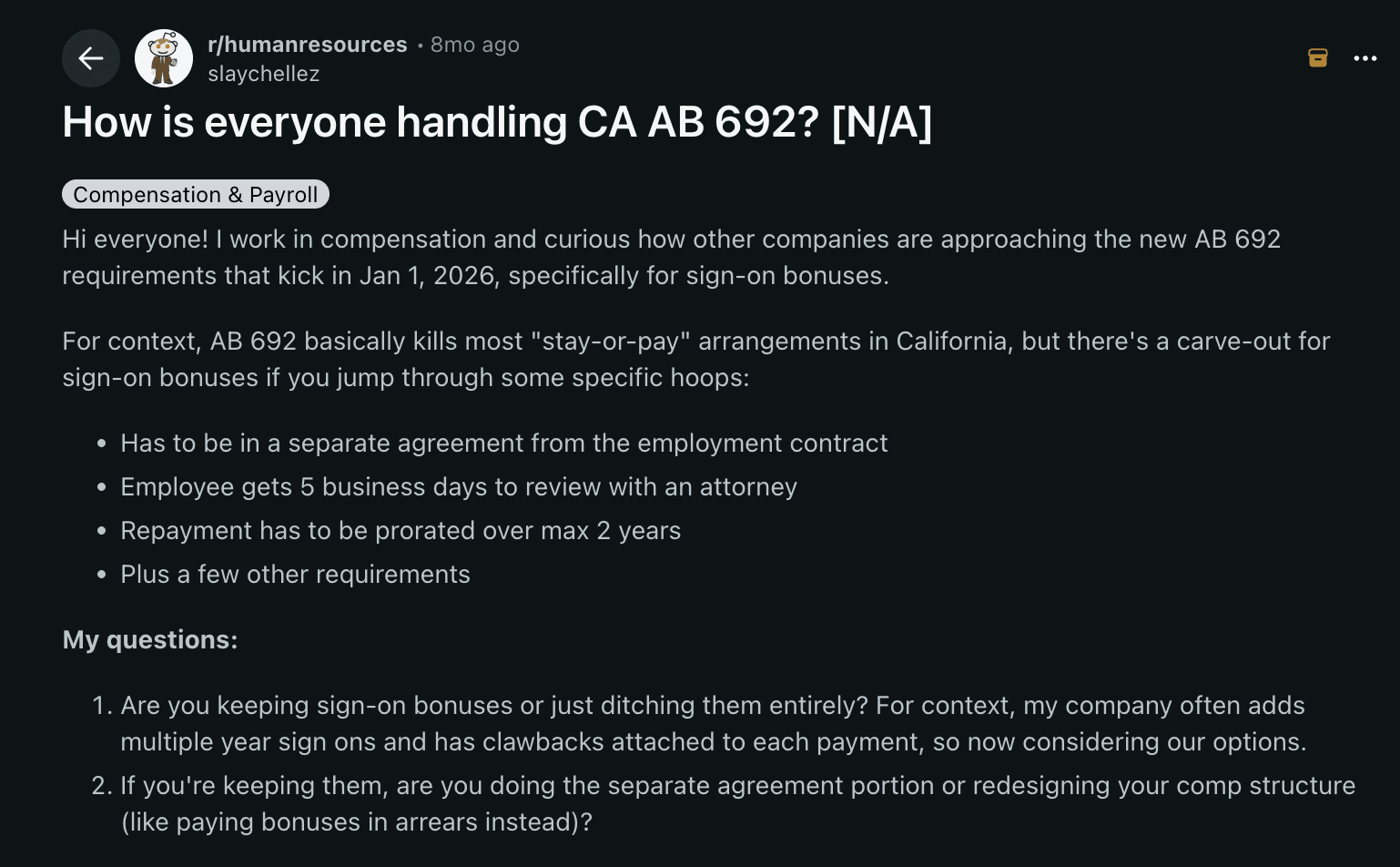
Rather than debating whether the law applied, the conversation focused on practical implementation: whether to eliminate repayment clauses, move bonuses into separate agreements that satisfy the statutory exceptions, or redesign compensation packages altogether.
A separate discussion focused on SB 294's new annual notice requirement.
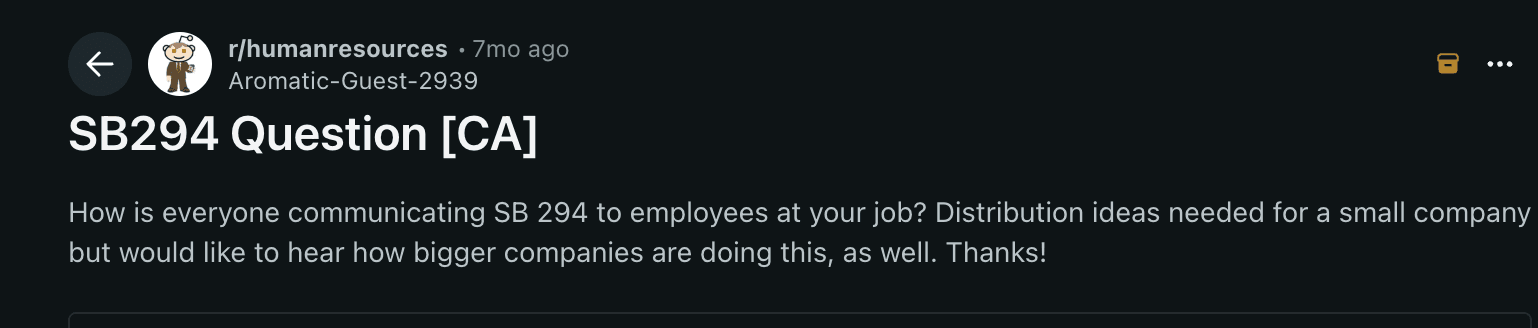
Instead of asking what the notice should contain, HR teams compared how they were documenting compliance. Some employers required employees to acknowledge receipt through their HRIS or employee self-service portal, while others adopted third-party compliance platforms because their existing systems couldn't easily track acknowledgments or emergency contact designations.
The common theme is that experienced HR teams are treating these laws as documentation and process challenges rather than simply legal updates. Whether the issue is contract templates, employee acknowledgments, or onboarding workflows, employers are looking for ways to create records that demonstrate compliance before a dispute arises.
That is the real compliance question for 2026. It is not only, "Do we know what the law requires?" It is, "Can we prove we followed it if the Labor Commissioner, the Civil Rights Department, or an employee's attorney asks six months from now?"
Your 2026 Compliance Checklist
None of this requires an overnight overhaul. It requires working through each obligation systematically and documenting that you did:
Confirm wage compliance. Every non-exempt employee at $16.90/hour or the applicable local rate; every exempt employee at $70,304/year or above.
Distribute the SB 294 notice as a standalone document, not folded into a handbook or general email, and set an annual recurring reminder.
Build the emergency contact designation process into onboarding and existing-employee workflows.
Pull every offer letter, training agreement, and relocation contract and strike any stay-or-pay language before using the template again.
Confirm your SB 464 filing practices meet the current mandatory-penalty standard, and separate demographic data storage from personnel files now, ahead of the 2027 category expansion.
Review your pay scale postings and comp documentation against SB 642's updated definitions.
Audit any AI-assisted hiring or evaluation tools for FEHA ADS compliance if you haven't already.
If this checklist uncovers gaps you're not sure how to prioritize, that's exactly what a structured internal audit is for. And if any of these gaps have already led more than one employee to raise the same issue, that's the point where a single complaint risks becoming something bigger.
Our guide on defeating a wage-and-hour class action in California walks through exactly how a compliance gap like this widens once more than one employee is affected, and what documentation actually defeats certification before it gets that far.
Conclusion
California's 2026 employment laws introduced real financial exposure beyond routine compliance updates: SB 294 carries civil penalties up to $10,000 per employee for notice failures, AB 692 creates a private right of action with a $5,000-per-employee statutory floor for stay-or-pay violations, and SB 464's mandatory pay-data penalties are already in effect, independent of the 2027 category expansion.
Treating these as a single annual checklist item rather than three (or more) distinct compliance projects is where most employers lose track of what's actually enforceable now versus what's still a year out. Audit against the current effective dates specifically.
If you haven't audited your 2026 compliance yet, DefendMyBiz can review your notices, contracts, and pay practices against all the laws above. Book a free 15-minute consultation with our employer defense team.
Frequently Asked Questions
What is the new minimum wage in California for 2026?
What 2026 laws do I need to know for HR in California?
How do "stay-or-pay" contracts change in California in 2026?
What are the new requirements for employee notices in California for 2026?
Does SB 464's job category expansion apply in 2026?
Disclaimer: The above content is for informational purposes only. This is not legal or tax advice. Laws, IRS guidance, and withholding requirements can change, and outcomes depend on specific facts. You are advised to contact a qualified attorney for any legal advice.