
Your Sales Rep Is Claiming Unpaid Commission. Here's How to Defend It
Wage & Hour Defense

Your former sales rep is claiming you owe unpaid commissions. In California, a commission dispute is not just a contract dispute. Once a commission is earned, it is treated as wages. Earned commissions are wages under Labor Code § 200, which means waiting-time penalties, attorney fee-shifting, and PAGA exposure all apply.
The good news is that these claims are defensible. But the defense depends entirely on what you documented, what your agreement says, and how fast you move.
Before You Respond, Know What You're Dealing With
Labor Code § 2751 requires commission arrangements to be in writing, signed by the employer, and specific about how commissions are computed and paid.
Once a commission is earned, you cannot withhold, reduce, or claw it back without explicit written authorization
Earned commissions not paid at termination trigger waiting time penalties under § 203, up to 30 days of daily wages
Commission disputes can proceed before the Labor Commissioner or in civil court, and unpaid-wage litigation may carry attorney-fee exposure under Labor Code § 218.
An employer without a compliant written agreement may have difficulty enforcing commission limitations, conditions, or chargebacks against the employee.
What Your Written Agreement Must Say
Labor Code § 2751 is the foundation of every commission defense. Effective January 1, 2013, it requires every commission arrangement to be:
Documented in a written contract signed by the employer
Specific about how commissions are calculated
Specific about when commissions are paid
Accompanied by a signed receipt from the employee confirming they received a copy
The statute applies to all California employees receiving any portion of their compensation as commission, regardless of role or whether they also receive a base salary.
When the agreement expires: If a commission agreement lapses and the employee keeps working, California holds that the expired agreement's terms remain in effect until a new contract is signed or employment ends. You cannot retroactively impose different terms on work already performed.
For how wage and hour claims scale when documentation is missing, see: California Employer FAQ: The 10 Most Common Wage & Hour Questions Answered.
For more guidance and information on employer-specific topics, check DefendMyBiz blogs.
How to Defend the Claim — Step by Step
This is where most employers either build a case or lose one. Work through this in order.
Step 1: Pull your written commission agreement.
This is your primary evidence. It needs to be signed, specific about how commissions are calculated, and specific about when they are paid. Under Labor Code § 2751, an employer without a signed written agreement cannot enforce any limitation or condition on the commissions being disputed. If your agreement doesn't exist or was never signed, your first task is understanding what you're defending without it.
Step 2: Determine when the commission was "earned."
Everything turns on this. California courts determine when a commission is earned based on the written agreement. If your agreement says commissions are earned "upon customer payment received," and the customer paid before termination, that commission is a wage owed in the final paycheck. If the agreement is silent or ambiguous, the employer loses leverage, and the ambiguity may be construed against the drafter.
Step 3: Audit the calculation.
Compare the claimed commissions against your records: what was sold, what rates applied, and what payments were received. The employee's demand is almost always their best-case number. Your documented calculation is your counter. If there is a gap, understand it before the hearing, demand response, or deposition.
Step 4: Evaluate the chargeback or withholding basis.
If you withheld or reduced commissions, identify the exact written authorization for it. Labor Code § 221 prohibits taking back wages once earned. Deducting commissions for returned sales or canceled accounts without explicit prior written authorization signed before the commission work is an unlawful wage deduction. If that authorization doesn't exist in the agreement, assess the exposure now.
Step 5: Check the overtime regular rate.
If the claimant was non-exempt, commissions must be included in the regular rate of pay for overtime calculation. Employers who calculate overtime based solely on base salary are underpaying during every commission period. That error compounds across the three-year statute of limitations.
Step 6: Address the timeline for the final paycheck.
Labor Code § 201 requires immediate payment of all earned wages upon involuntary termination, including commissions. "Still calculating" is not a defense if commissions were already earned before the last day. Waiting-time penalties accrue at the employee's daily wage rate for up to 30 days and begin on the day after the deadline. If there's exposure here, quantify it before the other side does.
Watch: John breaks down the Hirdman v. Charter Communications ruling and what it means for employers with commissioned outside sales employees. Watch here →
For how these claims escalate into PAGA territory when they involve multiple reps, read PAGA Litigation 2026: Strategic Defense in the Post-Reform Era.
What Wins and What Loses These Cases
Defense Position | Holds Up | Falls Apart |
|---|---|---|
Commission not yet "earned" at termination | A written agreement defines the earning event clearly | Agreement is silent or ambiguous; courts fill the gap for the employee |
Chargeback was authorized | Signed authorization predates the commission work | Deduction applied retroactively or based on an informal understanding |
Commissions weren't owed at all | Documented calculation shows no amount due | No records, defense relies on credibility contest |
Overtime was correctly calculated | Regular rate included commission earnings | Overtime calculated on base salary only |
Final paycheck was timely | All earned commissions are included on the last day | Employer says commissions were "still calculating" without a clear contractual basis |
The IBM example is the cautionary version of this table: IBM credited one sales rep with over $3 million in commissions, then retroactively reversed 90% with no written agreement specifying the adjustment mechanism. Without a documented methodology, the defense becomes much harder.
For how final paycheck obligations work in parallel with commission disputes, see: Final Paycheck Disputes: Minimizing Waiting Time Penalty Exposure.
One Recent Win Employers Should Know About
In Hirdman v. Charter Communications (August 4, 2025), the California Court of Appeals held that properly classified exempt outside salespersons may have paid sick leave calculated under Labor Code § 246(l)(3), using the same method the employer uses for other forms of paid leave. The court excluded commission earnings from paid sick leave because it used the same base-rate method for other paid leave, and it sided with Charter.
The win only holds if the outside sales classification is correct. Misclassified reps flip the entire outcome. But for employers with properly classified outside sales teams, this is a meaningful employer-side precedent in the commission pay space.
DefendMyBiz defends commission pay disputes at every stage, from the first demand letter through DLSE hearings and civil litigation. See: Wage & Hour Defense and DLSE Defense.
What Employers Are Saying Online & What It Signals
Across Reddit's r/humanresources, r/SalesOperations, r/smallbusiness, and r/sales, employers and sales leaders are asking the same practical question: when can we withhold, adjust, or recover commissions without creating a wage claim?
1) "Do we have to pay commissions after termination?”
In one r/humanresources thread, an HR professional asked how other companies handle commission payments after a sales employee is terminated, including whether commissions should be paid only for deals closed within a certain window or held for later payout.
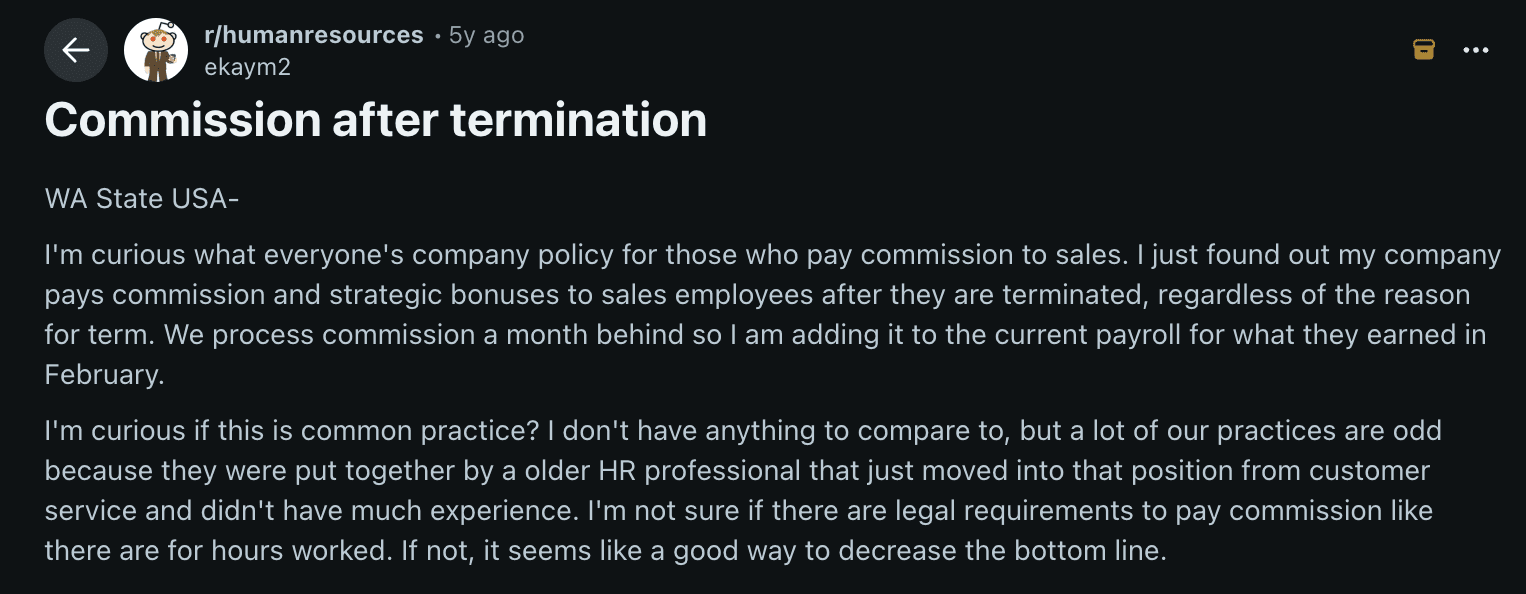
For employers, this is where commission disputes start. If the agreement does not clearly define when a commission is earned and what happens upon termination, the company may be forced to defend against the dispute under California wage-law rules rather than clear contract language.
2) "Can we change how commissioned employees' PTO or paid leave is calculated?”
In a California r/humanresources thread, an employer asked about changing PTO payout calculations for fully commissioned employees to reduce cost.
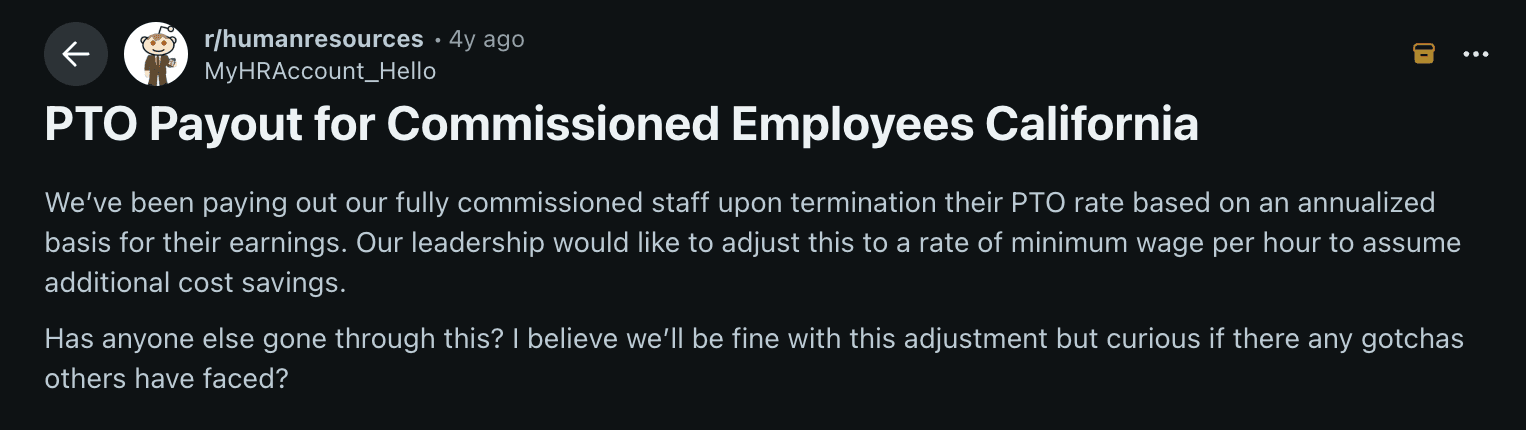
For employers, commission pay affects more than commission checks. It can touch PTO, sick leave, final pay, overtime regular-rate calculations for non-exempt employees, and waiting-time penalty exposure.
The employer takeaway: Commission disputes usually come from preventable drafting and payroll gaps: unclear earning events, weak chargeback language, retroactive plan changes, final-pay delays, and inconsistent records.
DefendMyBiz helps California employers defend commission claims by tightening the written agreement, documenting when commissions are earned, auditing payout calculations, and responding before a compensation dispute becomes a wage-and-hour claim.
Conclusion
A commission pay dispute is winnable. But the defense is built on documentation such as a signed written agreement that defines when commissions are earned, explicit chargeback authorization, accurate overtime calculations, and a timely final paycheck. Employers who have those four things move into this fight with leverage. Employers who don't are defending on the other side's terms.
If you've received a commission pay claim or demand letter, or if your current agreements wouldn't hold up to scrutiny, get defense counsel involved before the other side locks in their position.
Contact DefendMyBiz for a free 15-minute consultation → | (818) 418-6625
FAQ
Does California require commission agreements to be in writing?
Can an employer deduct commissions for returned sales or canceled accounts?
Are earned commissions due in the final paycheck?
Must commissions be included in overtime calculations?
What's the statute of limitations on a commission pay dispute?
Disclaimer: The above content is for informational purposes only. This is not legal or tax advice. Laws, IRS guidance, and withholding requirements can change, and outcomes depend on specific facts. You are advised to contact a qualified attorney for any legal advice.


