Whistleblower Defense Under Labor Code §1102.5: The Prima Facie Reversal Problem
Hybrid / Non-FEHA Claims

An employee makes a complaint, and days later the company is considering termination. Under California Labor Code §1102.5, that timing can fundamentally change how you defend the case.
Unlike the McDonnell Douglas framework used in many employment retaliation cases, §1102.5 operates under Labor Code §1102.6. Once an employee shows that protected activity contributed to the adverse action, the employer must prove by clear and convincing evidence that it would have taken the same action for legitimate, independent reasons.
That makes the decision timeline, contemporaneous documentation, and consistency of treatment critical. Here's how the §1102.6 framework works, what counts as protected activity, and what California employers should document before taking adverse action.
Key Takeaways
§1102.5 claims run under Labor Code §1102.6's burden-shifting framework, not McDonnell Douglas, confirmed unanimously in Lawson v. PPG Architectural Finishes (2022).
The employee's initial burden is low (preponderance of the evidence that protected activity was a "contributing factor"); the employer's burden is high ("clear and convincing evidence" of a legitimate, independent reason).
Unlike most employment claims, §1102.6 has no final pretext stage. Once the employer presents its evidence, the employee has no additional step to further unravel it.
Garcia-Brower v. Kolla's (2023) confirmed protection applies even if the employer already knew about the reported misconduct.
SB 497 creates a rebuttable presumption of retaliation when covered adverse action occurs within 90 days of protected activity. That presumption can substantially ease the employee's initial showing and put the employer's evidence under scrutiny early in the case.
AB 1947 added a one-way attorney's fee provision for prevailing employees, increasing the financial stakes of litigating rather than resolving these claims early.
What Does California Labor Code §1102.5 Prohibit?
Section 1102.5 is California's general whistleblower protection statute, applying across every industry, private and public. It prohibits retaliation against an employee who discloses information based on a reasonable belief that a state or federal law, regulation, or rule has been violated.
The employee doesn't need to be correct, and the disclosure doesn't need to reach a government agency. Internal reports to a supervisor qualify. Refusing to participate in conduct the employee reasonably believes is unlawful also qualifies.
Two recent developments meaningfully expanded this exposure:
People ex rel. Garcia-Brower v. Kolla's, Inc. (2023): the California Supreme Court held that an employee remains protected even if the employer already knew about the reported misconduct before the disclosure. Knowing about the problem beforehand doesn't strip the disclosure of its protected status.
SB 497 (effective January 1, 2024): created a 90-day rebuttable presumption of retaliation for any adverse action following a protected disclosure. Our guide on defending retaliation claims after a wage complaint covers this presumption and how to rebut it in depth, since it applies to §1102.5 claims the same way it applies to wage-complaint retaliation.
Why Is the Burden of Proof So Different Here Than in Other Employment Cases?
Most employment retaliation and discrimination claims follow the McDonnell Douglas framework: the employee establishes a prima facie case, the employer offers a legitimate reason, and the case turns on whether the employee can then prove that reason was pretextual, a three-step dance where the burden lands back on the employee at the end.
In Lawson v. PPG Architectural Finishes, Inc. (2022), the California Supreme Court unanimously held that §1102.5 claims are not governed by McDonnell Douglas. They run entirely under Labor Code §1102.6, a framework the Legislature added in 2003 specifically for these claims:
Step | Standard | Who Carries It |
|---|---|---|
1. Show protected activity was a "contributing factor" | Preponderance of the evidence (just over 50%) | Employee |
2. Show the action would have happened anyway for legitimate, independent reasons | Clear and convincing evidence, a much higher bar | Employee |
3. Employee shows employer's reason was pretext | No such step exists under §1102.6 | - |
That missing third step is the real reversal. Once the employee establishes the required contributing-factor showing, the employer must affirmatively establish the same-decision defense by clear and convincing evidence.
Watch: One Complaint. Multiple Lawsuits. - a direct look at how a single termination frequently generates FEHA, whistleblower, wrongful termination, and workers' comp retaliation claims simultaneously, which is exactly the pattern §1102.5 claims tend to travel alongside.
What Meets the "Clear and Convincing" Standard?
This is the practical question that matters most, since "clear and convincing evidence" isn't just a phrase. It requires a specific kind of documentation, built before the dispute, not after:
Contemporaneous performance records:
created at the time issues occurred, not reconstructed after a complaint or termination decision.
A documented decision timeline
showing the adverse action was planned or already in motion before the protected disclosure occurred.
Consistency across similarly situated employees:
if others with comparable performance issues weren't terminated, that gap undermines a "legitimate, independent reasons" defense significantly.
Evidence the same outcome was inevitable regardless of the disclosure:
not just that a legitimate reason existed, but that it was strong enough to have produced the same result on its own.
Documentation assembled after a complaint arrives reads as reconstructed, and given there's no pretext stage to fall back on if your evidence falls short of "clear and convincing," the quality of your existing record matters more here than in almost any other employment claim type.
Where Does the 90-Day Presumption Fit Into This?
SB 497's 90-day presumption interacts directly with this framework, and it's worth being precise about the sequence: if an adverse action falls within 90 days of a protected disclosure, retaliation is presumed, which effectively satisfies the employee's initial "contributing factor" burden for you.
You move straight to needing clear and convincing evidence, without the employee having to independently prove the contributing-factor element at all. That's a meaningfully faster path to the hardest part of the case for you, which is exactly why the timing of any adverse action relative to a known disclosure deserves legal review before it's finalized.
What California HR Professionals Are Asking About Whistleblower Retaliation
The practical questions employers face are often less about the definition of a whistleblower and more about what management should do when a complaint overlaps with a personnel decision.
In a recent discussion among HR professionals, one California HR professional described an employee who raised complaints to the CEO and later faced non-renewal and severance. The HR professional asked whether to escalate the matter proactively because of the potential retaliation implications.
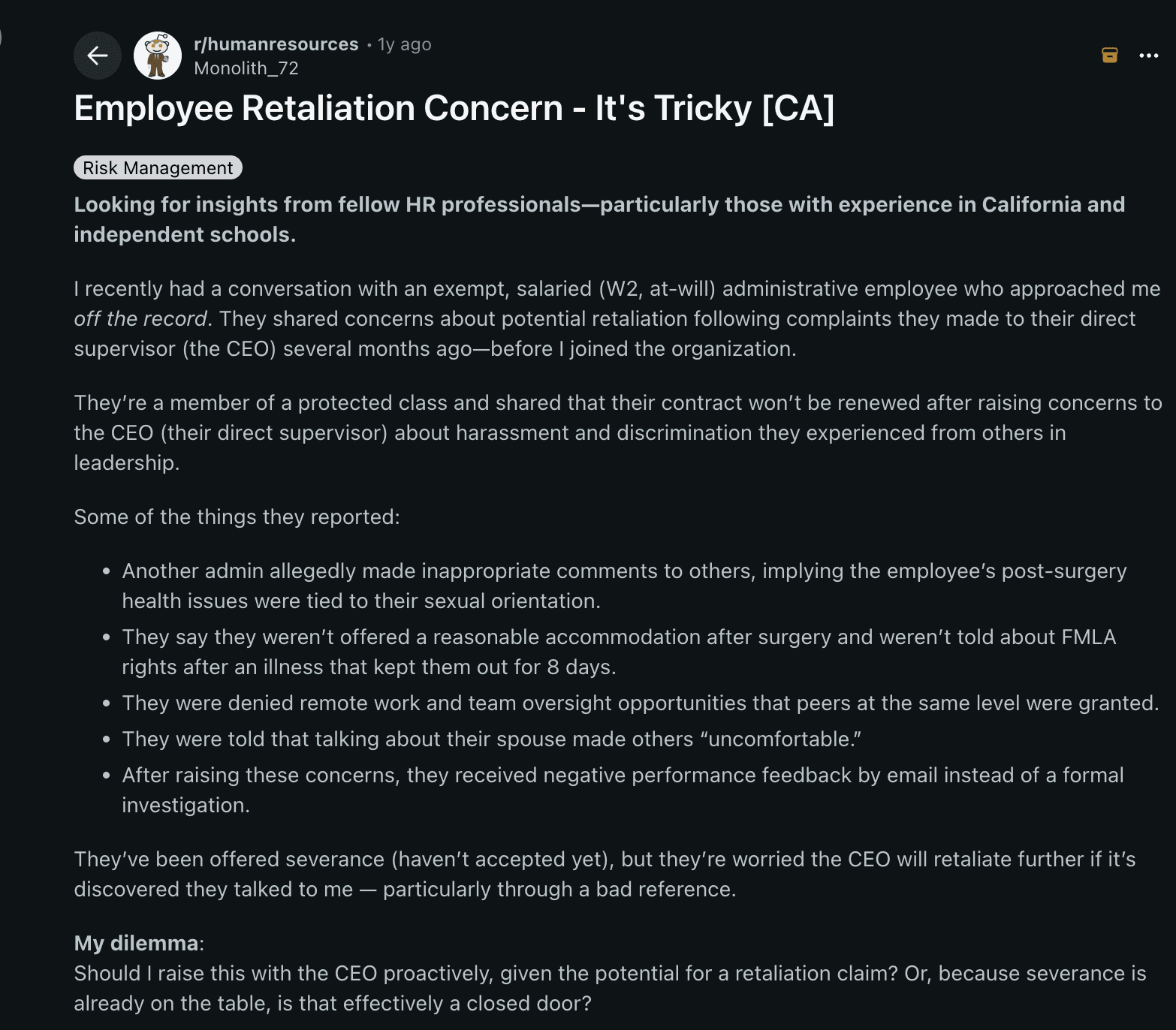
That question captures the practical problem employers face under Labor Code §1102.5: the personnel decision itself may be legitimate, but the timing, documentation, decision-makers, and history surrounding the employee's complaint can become central evidence.
Another HR professional asked a broader question about termination.
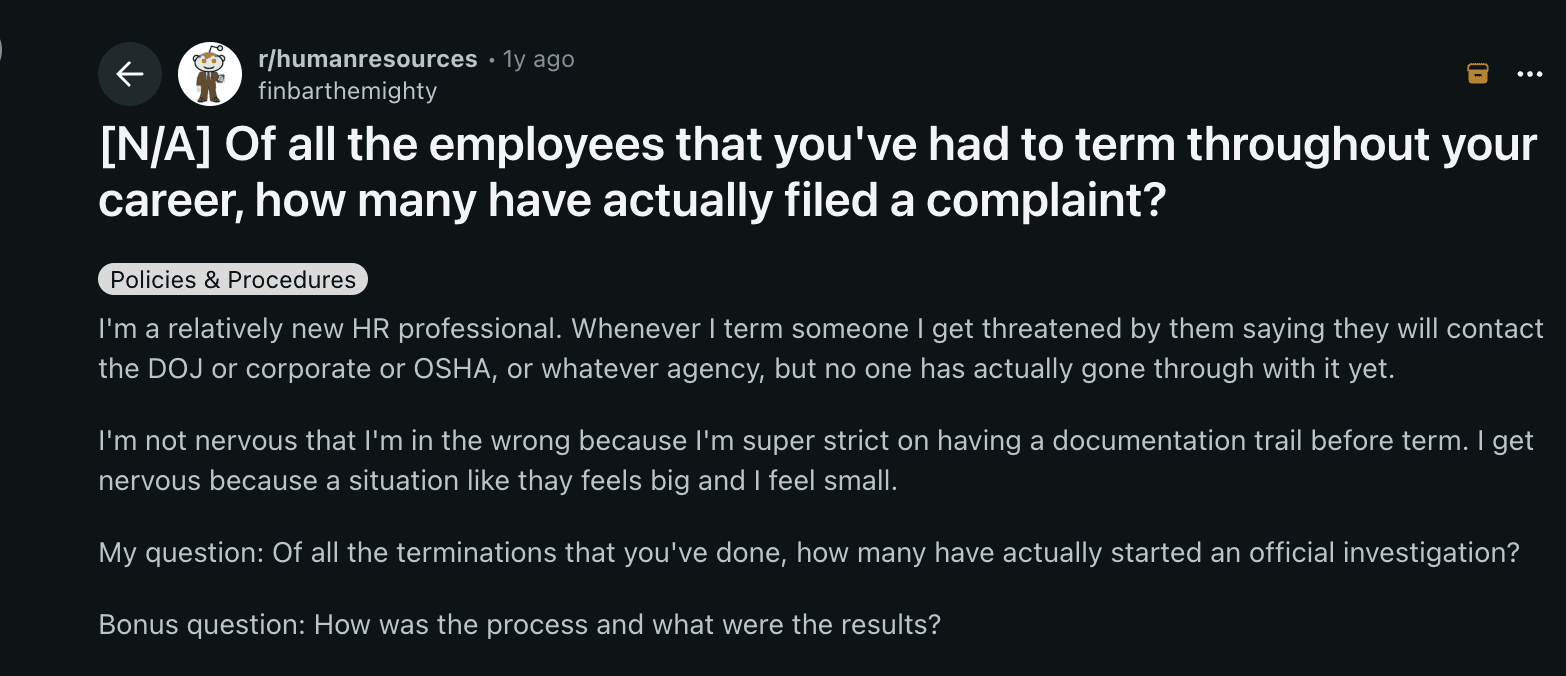
The discussion specifically focused on documentation and what happens when terminated employees threaten regulatory or legal complaints.
The recurring HR concern isn't simply whether an employee complained. It's whether the company can show why it made the employment decision, when it developed, who made it, what documentation existed beforehand, and whether it treated comparable employees consistently.
That is precisely the evidentiary record an employer may need when §1102.6 puts the clear-and-convincing burden on the company.
Building a §1102.5 Defense Before a Complaint Ever Arrives
Document performance and conduct issues in real time, not retroactively. This is the single factor that determines whether your evidence can plausibly meet "clear and convincing" later.
Apply discipline consistently across comparable employees. An inconsistency here is exactly what undermines a "legitimate, independent reasons" defense at the higher evidentiary bar.
Flag any pending adverse action within 90 days of a known internal complaint or disclosure and route it through legal review before finalizing it. Given SB 497, the presumption is often already working against you by the time you file a claim.
Train supervisors to recognize internal disclosures as protected activity, even informal ones that never reach a government agency or use the word "whistleblower."
Post the current California whistleblower notice required by Labor Code §1102.8. Since January 1, 2025, AB 2299 requires employers to prominently display the required rights-and-responsibilities notice, and the Labor Commissioner's Office provides a model posting that satisfies the requirement.
Get counsel involved the same day you consider a termination or other adverse action against an employee who has recently made an internal complaint, given how little room the §1102.6 framework leaves to correct course once you take action.
If a complaint has already surfaced and a personnel decision is pending on that same employee, that's exactly the fact pattern where the timing and documentation questions above become urgent rather than theoretical. Our Harassment, Discrimination & Retaliation Defense team reviews this specific overlap before a decision is finalized.
Conclusion
California Labor Code §1102.5 whistleblower claims run under Labor Code §1102.6. Once an employee shows their protected activity was merely a "contributing factor" in an adverse action, the burden shifts to the employer to prove by clear and convincing evidence that the same outcome would have occurred anyway, with no subsequent pretext stage where the case could still turn back in the employer's favor.
Contemporaneous, consistent documentation is one of the strongest defenses under this framework. Build that record before a complaint exists, because there's very little room to build it convincingly afterward.
If you have an active whistleblower complaint or a pending personnel decision involving an employee who recently raised a concern, DefendMyBiz offers a free 15-minute consultation. Book a call with our employer defense team today.
Frequently Asked Questions
What qualifies as protected activity under California Labor Code §1102.5?
How is the burden of proof different for §1102.5 claims compared to other retaliation claims?
Does it matter if the employer already knew about the reported misconduct?
What does the 90-day presumption under SB 497 mean for §1102.5 claims?
What evidence actually meets the "clear and convincing" standard under §1102.6?
Disclaimer: The above content is for informational purposes only. This is not legal or tax advice. Laws, IRS guidance, and withholding requirements can change, and outcomes depend on specific facts. You are advised to contact a qualified attorney for any legal advice.