Protect Your Business Information When an Employee Leaves: An Offboarding Checklist
Hybrid / Non-FEHA Claims

When an employee walks out the door, your legal exposure doesn't leave with them. A complete employee offboarding checklist is what stands between a routine departure and a wage claim, a data breach, or a trade secret dispute you can't prove in court.
This article covers what shows up in employer defense cases: the final pay deadline you can't move, the access window that stays open too long, and the one legal tool California actually gives you to protect confidential business information after someone leaves.
Key Takeaways
The employee offboarding process covers four phases: before the last day, the final day, the first 30 days, and ongoing monitoring, each with distinct legal exposure.
California final pay deadlines are strict: immediate for involuntary termination, within 72 hours (or on the last day with notice) for resignation.
Missed COBRA election notices carry both an IRS excise tax (up to $100/day per beneficiary) and separate DOL penalties (up to $110/day per beneficiary).
Non-compete and most non-solicitation agreements are void in California under §16600. Don't rely on them to protect business information.
Confidentiality agreements, NDAs, and trade secret protection under CUTSA are the tools that actually hold up in California.
Fast, documented access revocation strengthens both your data security and any future trade secret claim.
What Is the Employee Offboarding Process?
The employee offboarding process is the structured sequence of legal, administrative, and security steps a business completes when an employment relationship ends, whether by resignation, termination, layoff, or retirement. It covers four things at once: final pay compliance, continuation of benefits (COBRA), revocation of system access, and documentation of the separation itself.
Most businesses treat this as paperwork. It isn't. Every step in the process may later become evidence in litigation.
The Employee Offboarding Checklist: Four Phases
A defensible process moves through four phases, each carrying distinct legal weight.
Phase 1: Before the Last Day
Document the resignation or termination decision in writing
Confirm the final workday and transition timeline
Notify payroll of the separation date and applicable final pay deadline
Inventory every account, credential, and system the employee can access
Begin knowledge transfer with the employee's manager
Phase 2: The Final Day
Conduct a formal exit interview and document it
Collect all company property: laptop, phone, badge, keys, any equipment
Revoke system access immediately: email, VPN, SSO, and every connected SaaS platform
Process the final paycheck per California's final pay deadlines (below)
Document the condition of returned property
Phase 3: Within 30 Days
Remove the employee from active benefit plans.
Send COBRA election paperwork to the former employee and covered dependents.
Archive work files and email per your data retention policy.
Review any confidentiality or trade secret protections that survive the employment relationship.
Phase 4: Ongoing
Monitor for unauthorized access attempts using former credentials.
Confirm the final paycheck cleared without dispute.
Retain separation documentation per your state's recordkeeping requirements.
Why Non-Competes Won't Protect Your Business Information in California (and What Will)
Generic templates tell you to "review non-compete and non-solicitation agreements for enforceability." In California, that review usually ends the same way: they're void.
California Business and Professions Code §16600 voids nearly every contract that restrains someone from working in their profession. That includes:
Restriction type | California status |
|---|---|
Non-compete agreements | Void, with narrow exceptions only for business sale or partnership dissolution |
Customer non-solicitation clauses | Void under AMN Healthcare v. Aya Healthcare (2018), unless narrowly tied to protecting an actual trade secret |
Employee non-solicitation ("no-poach") clauses | Legally shaky post-AMN; several federal courts have invalidated these too |
NDAs and confidentiality agreements | Enforceable: this is your real tool |
Trade secret protections under CUTSA | Enforceable: California's Uniform Trade Secrets Act |
Since SB 699 and AB 1076 took effect, attempts to enforce a void non-compete or non-solicit agreement have failed. It can expose you to a lawsuit from the former employee, with attorney's fees on the table. So if "protect your business information" is the goal, the restrictive covenant in your standard employment agreement almost certainly isn't doing that job.
California employers generally rely on:
Confidentiality agreements and NDAs, which remain fully enforceable in California.
Trade secret protection under CUTSA requires you to show that the information was actually treated as secret. Access controls, need-to-know limits, and documented offboarding all support this.
Access revocation timing, since a trade secret claim is much harder to prove if a former employee had open access to your systems for days after departure.
If you're building or reviewing agreements around confidential information and want to know where your current templates actually stand, our Hybrid / Non-FEHA Claims team handles exactly this. Trade secret and unfair competition matters that fall outside standard wage or discrimination claims.
For the bigger picture on how these claims work, see "What Non-FEHA & Hybrid Claims Are and Why They Matter in California."
The Legal Risks Hiding in a Rushed Offboarding
Risk | Common Trigger | Consequence |
|---|---|---|
Wage claims | Late or incomplete final paycheck | Waiting-time penalties, attorney's fee |
COBRA violations | Missed or late election notice | IRS excise tax up to $100/day per beneficiary ($200/day per family); separate DOL penalties up to $110/day per beneficiary |
Data breach liability | Failure to revoke system access | Civil liability, regulatory exposure |
Wrongful termination | No documentation of the termination basis | Litigation costs, settlements |
For involuntary terminations specifically, documentation is everything, and it's also where employers most often shoot themselves in the foot without realizing it.
Watch: Avoid These 2 Termination Practices to Prevent Lawsuits: a quick breakdown of the termination habits that quietly build a wrongful termination case against you, worth watching before your next involuntary separation.
What Employers Are Asking About Employee Offboarding
One recurring concern came from an IT leader responsible for improving employee departures across the organization.
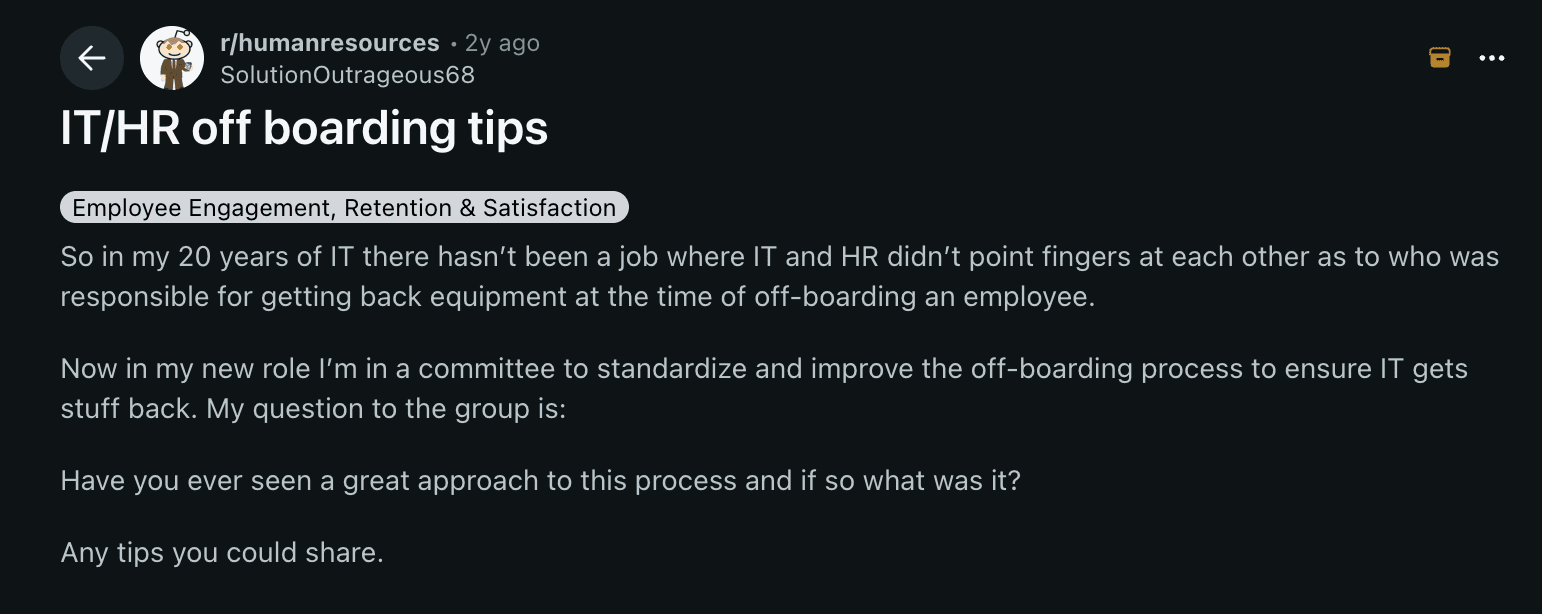
Their biggest concern wasn't paperwork. It meant ensuring former employees lost system access immediately, recovering all company equipment, and HR and IT stopped relying on informal communication.
Several experienced administrators emphasized assigning a single owner for the offboarding process, maintaining a complete inventory of company assets, documenting every returned device, and automating account deactivation wherever possible.
These conversations reinforce the same legal risks California employers face. A rushed offboarding process increases the risk of final-pay disputes, data security incidents, trade secret litigation, and documentation issues if a later employment claim arises.
Your Offboarding Checklist Starting Point
Audit your current process. No written checklist means you're relying on institutional memory, not a defensible position.
Assign clear ownership. Every step needs a named person and a deadline, not a shared assumption someone will handle it.
Build California's final pay deadlines into your payroll workflow now, not the day of the next separation.
Revoke IT access on the effective date of separation, not after equipment is returned.
Document everything: the signed resignation or termination notice, exit interview notes, the returned-equipment log, and the COBRA notice timestamp.
Have counsel review your confidentiality agreements. If your current template leans on a non-compete or broad non-solicit to protect business information, it's likely not doing what you think it's doing in California.
If you're building or reviewing your offboarding process, DefendMyBiz offers a free 15-minute consultation. Book a call with our employer defense team today.
Frequently Asked Questions
What is the employee offboarding process?
What should be in an employee offboarding checklist?
Can I use a non-compete to stop a former employee from taking clients or information?
What happens if I miss the COBRA notice deadline?
Does the offboarding process change for an involuntary termination?
Disclaimer: The above content is for informational purposes only. This is not legal or tax advice. Laws, IRS guidance, and withholding requirements can change, and outcomes depend on specific facts. You are advised to contact a qualified attorney for any legal advice.


