California Trade Secret and Non-Solicit Enforcement: What Employers Can Still Protect in 2026
General Defense Resources

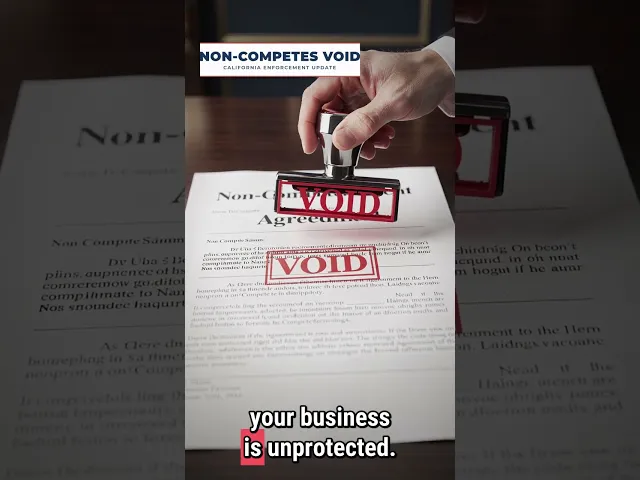
If your business is trying to protect customer lists, pricing models, or proprietary processes after an employee leaves, California's trade-secret and non-solicitation landscape for 2026 isn't as settled as much of the guidance suggests. Traditional employee noncompetes are generally void in California, subject to narrow statutory exceptions.
What's genuinely uncertain is whether the old workaround, tying a non-solicit clause to trade secret protection, still survives at all after 2024's amendments. Getting this wrong doesn't just mean an unenforceable clause. It can mean a direct lawsuit against your business. Here's what's actually settled, what's genuinely in flux, and what to do about it right now.
Key Takeaways
AB 1076 and SB 699 (2024) strengthened California's non-compete ban and created a private right of action under §16600.5 for damages and attorney's fees when an employer attempts to enforce a void clause.
Employee and customer non-solicitation clauses face the same §16600 analysis as non-competes and are generally void unless narrowly tied to a genuine trade secret.
Whether the "trade secret exception" to §16600 survived the 2024 amendments is genuinely unresolved. Some firms now advise against including trade-secret justification language in restrictive covenants at all.
Pure confidentiality agreements that restrict the disclosure of specific information carry far less §16600 risk than non-solicitation clauses justified by trade-secret protection.
A trade secret under CUTSA must have independent economic value attributable to its secrecy and be subject to reasonable efforts to protect it. General industry knowledge doesn't qualify.
Does California Still Ban Non-Competes in 2026?
Yes, and more firmly than before. Business and Professions Code §16600 voids any contract that restrains a person from engaging in a lawful profession, trade, or business. It is a rule the California Supreme Court read broadly in Edwards v. Arthur Andersen LLP (2008), rejecting any case-by-case "reasonableness" exception.
Two 2024 laws tightened this further:
AB 1076 codified the broad Edwards interpretation into statute. It required employers to send individualized written notice by February 14, 2024, to any current or former employee (hired after January 1, 2022) whose contract contained a void non-compete clause.
SB 699 added Business and Professions Code §16600.5, extending California's ban to out-of-state agreements and creating a private right of action. An employee can sue directly for actual damages, injunctive relief, and attorney's fees if an employer attempts to enforce a void restrictive covenant.
That private right of action is the detail that changes the risk calculus for everything that follows.
Is Your Non-Solicitation Clause Enforceable?
No, if it's written the way most templates are. California courts apply the same §16600 analysis to non-solicitation clauses as they do to non-competes:
Employee non-solicits (restricting a departing employee from recruiting former coworkers) were struck down in AMN Healthcare, Inc. v. Aya Healthcare Services, Inc. (2018), which held that limiting who a departing employee can hire restrains their ability to build a workforce and practice their profession squarely within §16600's prohibition.
Customer non-solicits face the same scrutiny and are generally void unless narrowly tied to protecting an actual, documented trade secret.
Both categories share the same failure pattern: generic language such as "do not solicit any company client or employee" is struck down. One potential path to defensibility has historically been to demonstrate that the restriction is necessary to protect genuine trade secrets or confidential proprietary information.
Is the "Trade Secret Exception" Still Valid?
For years, employers relied on a narrow, court-recognized idea: that a restrictive covenant tied specifically to protecting a genuine trade secret might survive §16600 scrutiny, since trade secret misappropriation is an independent legal wrong.
But the California Supreme Court has never actually confirmed this exception exists. It explicitly declined to address it in Edwards (2008). And after 2024's amendments added §16600.5, employment law firms are now flagging a genuine, unresolved risk: it's unclear whether the Legislature's changes preserved, narrowed, or effectively eliminated whatever trade secret exception previously existed.
Courts haven't resolved the question, and it will likely take a future decision by the California Supreme Court to settle it.
How to Protect Trade Secrets Without These Risks?
This is where the distinction that most articles blur together actually matters: trade secret protection and non-solicitation clauses are not the same tool, and one carries far less risk than the other.
Tool | What It Restricts | §16600 Risk |
|---|---|---|
Non-solicitation clause "justified" by trade secrets | Who a former employee can contact or hire | High: contested exception, §16600.5 exposure if unenforceable |
Pure confidentiality/NDA prohibiting disclosure of specific trade secrets | Sharing or disclosing defined confidential information | Low: long upheld as not violating §16600, per Fowler v. Varian Associates (1987) |
Trade secret misappropriation claim under CUTSA | Actual use or disclosure of stolen trade secrets, litigated after the fact | No §16600 issue: an independent legal doctrine, not a restraint on future employment |
Watch: California Employers: What Can You Protect If Non-Competes Are Unenforceable? - a direct rundown of what's actually still protectable once you set aside the non-compete and non-solicit framework entirely.
What Employers Are Actually Worried About
Employer discussions about California restrictive covenants tend to focus less on the wording of a non-solicit clause and more on what happens after an employee leaves: competitors approaching employees, attempts to obtain vendor or customer information, and uncertainty about what the former employee can legitimately take or use.
In one small-business discussion, an owner described a competitor allegedly offering employees money for vendor information and photographs of invoices and vendor lists.

Employer discussions about California restrictive covenants tend to focus less on the wording of a non-solicit clause and more on what happens after an employee leaves: competitors approaching employees, attempts to obtain vendor or customer information, and uncertainty about what the former employee can legitimately take or use.
In one small-business discussion, an owner described a competitor allegedly offering employees money for vendor information and photographs of invoices and vendor lists.
What Qualifies as a Trade Secret Under California Law?
Under the California Uniform Trade Secrets Act (Civil Code §§3426 et seq.), information qualifies as a trade secret only if it meets both of these conditions:
It derives independent economic value from not being generally known or readily ascertainable by others who could profit from it.
It has been subject to reasonable efforts to maintain its secrecy, such as access controls, confidentiality agreements, and documented handling practices, rather than just an internal label calling it "confidential."
Information that typically qualifies: proprietary customer data with pricing or purchase history not publicly available, unique formulas or algorithms, internal financial projections, and confidential product roadmaps. What doesn't qualify is general industry knowledge, publicly available customer information, or skills an employee simply developed on the job.
What This Means If You're Drafting or Reviewing Agreements Right Now
Reconsider whether your non-solicit clauses need trade-secret justification language at all, given the current uncertainty and the §16600.5 exposure it creates if a court later disagrees.
Separate your confidentiality obligations entirely from any competition or solicitation restrictions. A clean NDA restricting disclosure of specifically identified information carries far less risk than a hybrid clause trying to do both.
Confirm your AB 1076 notice obligations were actually met. Plaintiffs' attorneys may pursue these claims the same way they litigate wage-and-hour class actions. If a claim like this scales the same way, our guide on how employment class actions build in California covers the mechanics of how a single procedural gap can become a case that covers an entire workforce.
Invest in operational protection, not just contract language: access controls, need-to-know data restrictions, and documented handling procedures are what actually satisfy CUTSA's "reasonable efforts" requirement, regardless of how your agreements are worded.
Have every existing agreement reviewed in light of current uncertainty, since a template drafted before 2024 almost certainly doesn't reflect this risk.
If you're facing an active dispute over a departing employee's use of confidential information, or an enforcement attempt is already being challenged, our Class Action Defense team handles exactly this kind of overlapping exposure.
If you want your current agreements reviewed proactively before any dispute arises, that's a paid one-hour consultation. Reach out to discuss scope.
Conclusion
California courts have recognized circumstances in which restrictions tied to protecting genuine trade secrets may be defensible, but the California Supreme Court has never squarely defined the scope of that principle. The 2024 amendments make the consequences of relying on a void restrictive covenant more significant, so employers should not treat 'trade secret' language as a safe harbor."
Separate your confidentiality protections entirely from any restraint on future employment, rely on CUTSA's actual misappropriation remedies rather than pre-emptive restrictive covenants, and treat operational safeguards as your primary trade secret protection going forward.
If your business is facing a trade secrets dispute or a challenge to a restrictive covenant, DefendMyBiz offers a free 15-minute consultation. Book a call with our employer defense team today.
Frequently Asked Questions
Can California Employers Enforce a Trade-Secret-Based Non-Solicit in 2026?
What is a trade secret under California law?
How do California employers protect trade secrets without a non-compete?
What changed with California's non-compete law for 2026?
What remedies does an employer have if a former employee misappropriates a trade secret?
Disclaimer: The above content is for informational purposes only. This is not legal or tax advice. Laws, IRS guidance, and withholding requirements can change, and outcomes depend on specific facts. You are advised to contact a qualified attorney for any legal advice.