California's Paid Sick Leave Rules Changed Again. Here's What Employers Are Getting Wrong
Wage & Hour Defense

Most California employers updated their sick leave policy in 2024 and moved on. But many did not account for the next wave of changes: expanded paid sick leave use under AB 406 in 2025 and 2026, the updated DLSE paid sick leave poster for 2026, or payroll-rate errors that can occur when sick leave is paid at the base hourly rate rather than the legally required rate
California paid sick leave has changed repeatedly in recent years, and each round has created new compliance gaps showing up in PAGA notices and Labor Commissioner claims.
Before You Assume You're Compliant, Read This First
SB 616 (Jan 1, 2024): Minimum raised from 3 days to 5 days/40 hours. Accrual cap raised to 80 hours. Wage statement balance requirement continues in full force.
SB 1105 (Jan 1, 2025): Agricultural workers gained the right to use sick leave during smoke, heat, or flooding emergencies.
AB 406 (Oct 1, 2025): Expanded permitted uses to include crime victims using leave for medical care, protective orders, judicial proceedings, and all covered employers.
30-day retaliation presumption: Any adverse action within 30 days of sick leave use creates a rebuttable presumption of retaliation. The burden shifts to you immediately.
RROP miscalculation is now the most common PAGA trigger tied to sick leave. Paying at the base hourly rate when commissions or bonuses are involved is a systematic underpayment every pay period.
Watch: John explains California's Paid Sick Leave Law: what it requires, how it works, and what employers are still getting wrong. Watch here →
What Employers Are Actually Getting Wrong
1) Wrong RROP calculation.
Sick leave pay for nonexempt employees must be calculated using one of California's approved methods: the regular non-overtime rate for the workweek in which sick leave is used, or a 90-day lookback calculation that divides total non-overtime compensation by non-overtime hours worked.
If the employee earns nondiscretionary bonuses, shift differentials, or commissions, a base-rate-only calculation can underpay sick leave.
2) Missing sick leave balance on wage statements.
Every pay stub must show the employee's available sick leave balance separately from vacation or PTO. This requirement predated SB 616 and remains in full force with the new higher balances. Missing it is a § 226 violation every pay period, every employee.
For how wage statement errors cascade into PAGA claims, see: California Wage Statement Requirements: What Must Be on Every Pay Stub.
3) Assuming the state minimum satisfies local obligations.
SB 616 sets the statewide floor, but several California cities impose local paid sick leave rules that may be more generous or more specific.
City | Paid Sick Leave Issue to Check |
|---|---|
Los Angeles | Local ordinance may exceed or differ from state minimum requirements |
San Francisco | Rules vary by employer size and local ordinance requirements |
Berkeley | Local accrual/use rules may exceed the state floor |
Oakland | Local paid sick leave rules may be more generous than state law |
Santa Monica | Local rules may exceed the state minimum |
California statewide | Five days / 40 hours minimum under SB 616 |
Employers in these cities who track only the state minimum are out of compliance on the local side.
4) Denying leave for "no coverage" or documentation reasons.
California employers cannot deny a sick leave request because no one is available to cover the shift. Do not deny paid sick leave solely because the employee did not provide a doctor's note for a short absence. California treats paid sick leave as available upon the employee's oral or written request, subject to reasonable notice procedures when the need is foreseeable.
Watch: John addresses whether employers in California are required to honor mental health sick days and what happens when they don't. Watch here →
5) Taking adverse action within 30 days of sick leave use.
Labor Code § 246.5(c) creates a rebuttable presumption of retaliation if any adverse action is taken against an employee within 30 days of the employee's request or use of sick leave. The burden immediately shifts to you to prove the action was legitimate and unrelated. A write-up, a shift cut, a schedule change within that window is presumptively retaliatory.
For how retaliation claims compound once an employee files and how to defend, read: Protected Leave Litigation: Defeating Interference and Retaliation Claims.
What Non-Compliance Costs
Under Labor Code § 248.5, penalties for paid sick leave violations:
$50 per employee per day the violation occurred, up to an aggregate of $4,000 per employee in liquidated damages
3x the dollar amount of sick leave unlawfully withheld or $250, whichever is greater
PAGA penalties on top: $100 per employee per pay period for initial violations across the entire workforce
A systematic RROP miscalculation across 50 employees over 26 biweekly pay periods amounts to $130,000 in PAGA penalties alone before the sick leave underpayment is calculated.
The good faith defense: An isolated, unintentional payroll error by an employer with otherwise compliant policies will not be penalized. "We didn't know about AB 406" doesn't meet that standard.
For learning more on the PAGA defense framework, once a notice arrives, read PAGA Litigation 2026: Strategic Defense in the Post-Reform Era.
What You Need to Audit Right Now
Before a notice arrives, work through this:
Policy: Does your written sick leave policy reflect the current 40-hour minimum, the AB 406 permitted uses (crime victims, judicial proceedings), and any applicable local ordinance exceeding the state floor?
RROP calculation: Are you calculating sick leave pay at the regular rate of pay, including non-discretionary bonuses and commissions in the 90-day lookback?
Wage statements: Is the available sick leave balance on every pay stub, separately from vacation and PTO?
2026 poster: Is the updated HWHFA poster displayed in your workplace? The January 2026 version is current. The 2024 version is not.
Manager training: Do your managers know they cannot deny sick leave for coverage reasons, cannot require documentation for a single day, and cannot take any adverse action within 30 days of sick leave use?
Records: California requires sick leave accrual and usage records to be retained for at least 3 years. These are the first things a Labor Commissioner investigator requests.
For how California leave obligations overlap with wrongful termination exposure: Wrongful Termination Defense in California: What Employers Need to Know.
DefendMyBiz defends employers when sick leave violations escalate into Labor Commissioner claims, retaliation lawsuits, and PAGA actions. See: Wage & Hour Defense →
What Employers Are Discussing Online
Across Reddit's r/humanresources, r/Payroll, and r/smallbusiness, employers are not just asking whether California paid sick leave exists. They are asking how to administer it without exposing attendance, payroll, or wage statements.
1) "Can we hold employees accountable when sick leave affects department goals?”
In one r/humanresources thread, a California supervisor asked whether using sick leave can affect appraisal goals when same-day absences cause the department to miss daily targets.
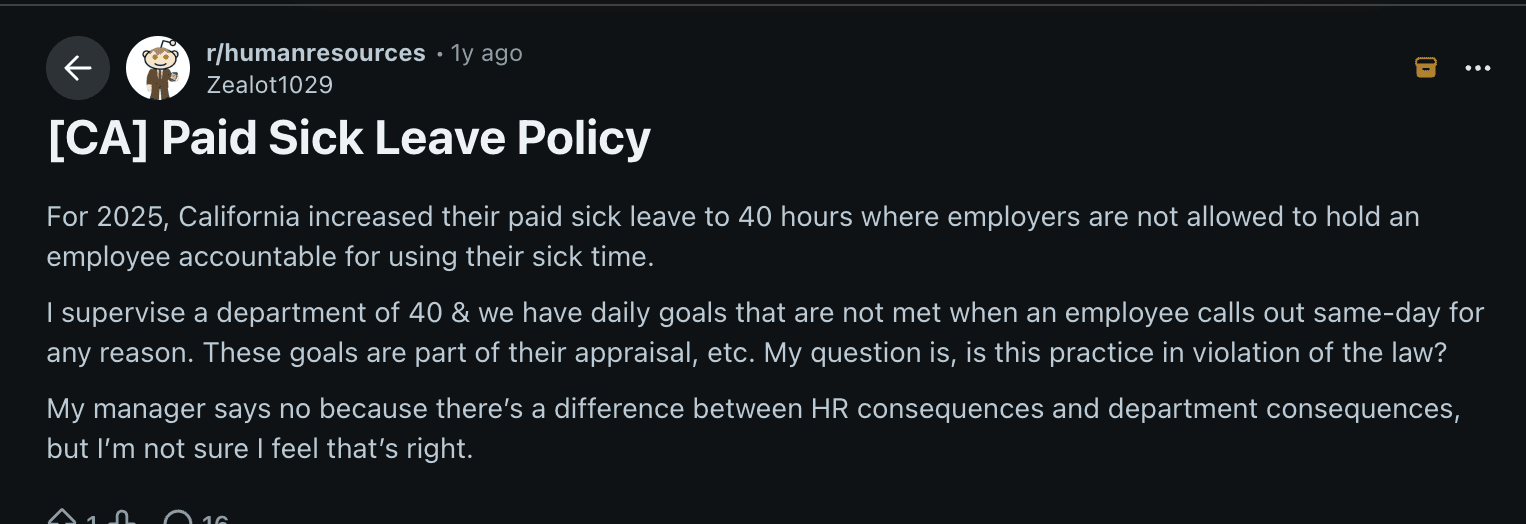
For employers, this is the retaliation-risk problem. Attendance and performance systems need to be configured so that protected sick leave use is not counted against the employee in a way that looks disciplinary.
2) "Can we require a doctor's note for California sick leave?"
In a California r/humanresources thread, an employer asked about doctor-note requirements for paid sick leave. The discussion focused on whether an employer can require medical certification for sick leave.
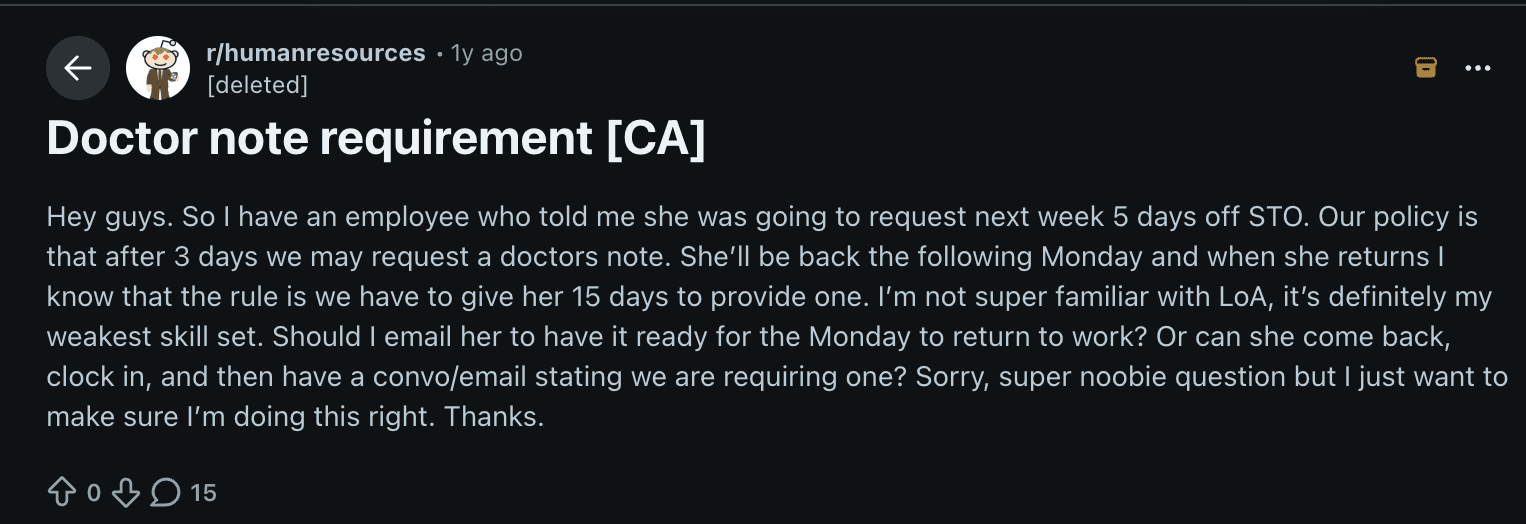
For employers, documentation rules are a common compliance trap. Policies should not deny paid sick leave solely because a short absence lacks a doctor's note.
3) "Should California sick leave and vacation/PTO be kept in separate banks?”
In one r/humanresources thread, a small California business owner asked how to create a compliant PTO/accrual policy under the updated 40-hour sick leave rules without tracking two separate pools.
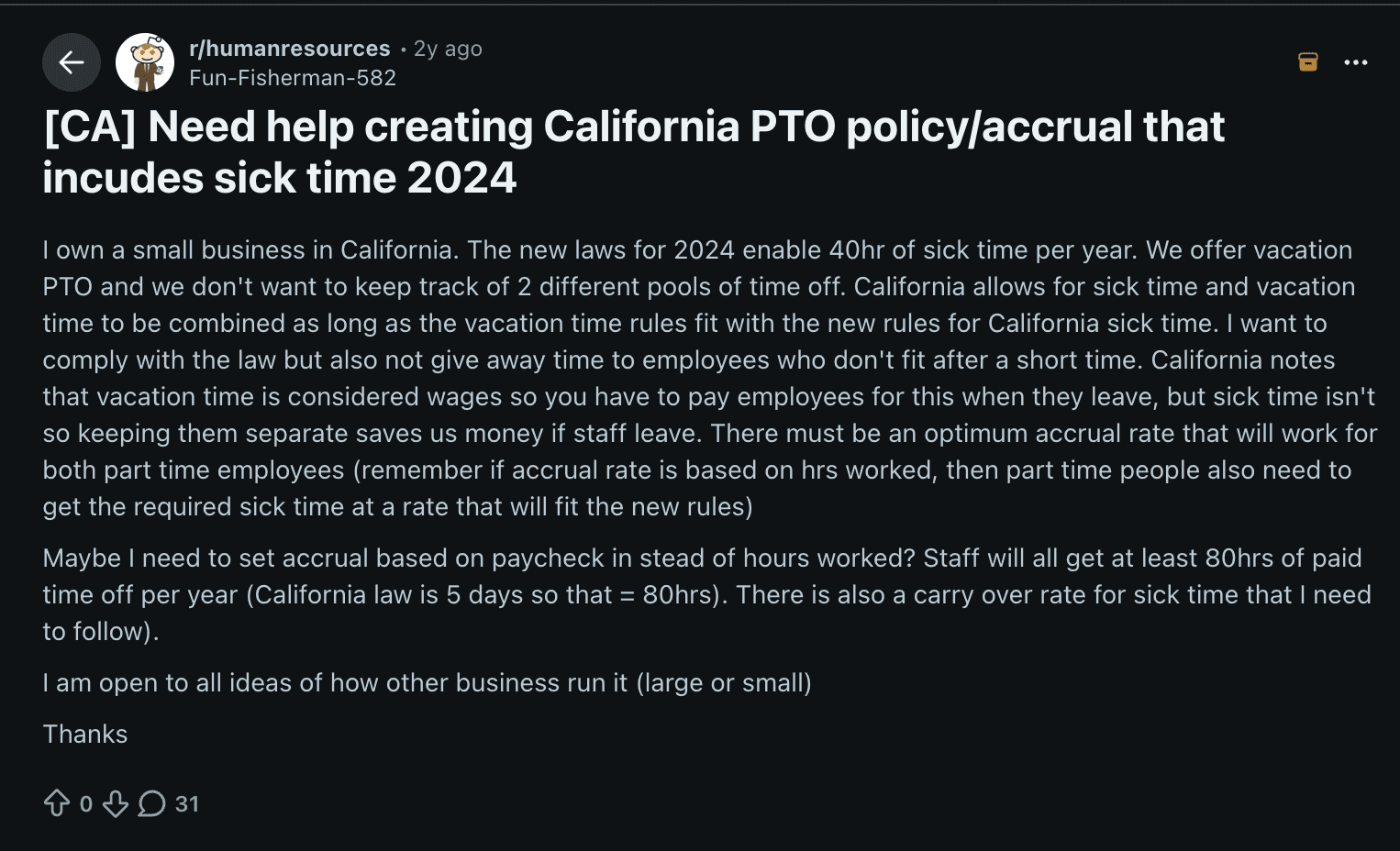
For employers, combined PTO creates payout and tracking risk. Separate banks often make compliance cleaner because vacation is treated as earned wages, whereas unused sick leave is generally not paid out at termination.
The employer takeaway: Paid sick leave claims often start with policy design, manager training, and payroll setup: counting sick days against performance, requiring documentation too aggressively, combining PTO banks without understanding payout rules, or displaying the wrong balance on wage statements.
DefendMyBiz helps California employers audit paid sick leave policies, payroll calculations, wage statements, and retaliation risk before routine attendance decisions become Labor Commissioner, PAGA, or wrongful termination claims.
Conclusion
California paid sick leave has been amended in 2024, 2025, and 2026. Each round has created compliance gaps showing up in PAGA notices and Labor Commissioner claims. RROP miscalculations, missing wage statement balances, retaliation risk, and local ordinance gaps are the mistakes feeding sick leave claims right now.
Audit your policy, payroll configuration, and manager training before a notice forces the conversation. Contact DefendMyBiz for a free 15-minute consultation → | (818) 418-6625
FAQs
Do part-time employees get 40 hours of sick pay in California?
When did 40 hours of sick leave start in California?
What are the penalties for California paid sick leave non-compliance?
Can an employer require documentation before approving sick leave?
Is unused sick leave paid out at termination?
Disclaimer: The above content is for informational purposes only. This is not legal or tax advice. Laws, IRS guidance, and withholding requirements can change, and outcomes depend on specific facts. You are advised to contact a qualified attorney for any legal advice.