AB 1949 Made Bereavement Leave Mandatory in California. Here's What Employers Need to Know About It
Hybrid / Non-FEHA Claims

Since January 1, 2023, California bereavement leave has been a legal obligation for covered employers, not just a workplace courtesy. AB 1949 requires employers with five or more employees to provide up to five days of job-protected leave when a qualifying family member dies.
Refuse it, mishandle the documentation, or take adverse action afterward, and you're facing a CRD complaint, retaliation claim, and civil litigation exposure. And the law may expand again if pending legislation advances.
Everything About AB 1949
It applies to any employer with 5 or more employees
An employee must have 30 days of service before taking leave
No annual cap is stated in the statute; each qualifying death may trigger a separate leave entitlement.
Leave is unpaid, but you must allow the employee to use accrued PTO, vacation, or sick time if they request it. Blocking them from applying accrued leave is a separate violation
Runs separately from CFRA, does not reduce the employee's 12-week CFRA entitlement
Covered family members: spouse, child, parent, sibling, grandparent, grandchild, domestic partner, parent-in-law. Employer policy cannot narrow this statutory list.
The Employer Traps Inside a Bereavement Request
Documentation timing. You may request documentation, such as a death certificate, obituary, or burial/memorial verification, but the employee has up to 30 days from the first day of leave to provide it. Do not delay or deny the leave solely because documentation is not available before the leave begins.
Confidentiality. Any documentation submitted must be kept confidential and separate from the general personnel file. Do not keep it in general HR records accessible to managers.
Retaliation. AB 1949 is codified under CFRA. Any adverse action, such as discipline, demotion, or a schedule change, taken in close proximity to a bereavement request creates a retaliation claim. The timing becomes the evidence.
Existing policy doesn't protect you if it's weaker. If your policy offers fewer than five days or excludes any AB 1949-covered family member, state law overrides it. Employees get whichever standard is more favorable.
To understand how retaliation claims develop once a protected leave complaint escalates, here's a quick read on Retaliation Claims in California: How Employers Defend Business Decisions.
A Critical Obligation Employers Are Missing: Reproductive Loss Leave
AB 1949 and reproductive loss leave are separate laws with distinct entitlements, and employers frequently overlook the second entirely.
Leave Type | Law | Trigger | Duration |
|---|---|---|---|
Bereavement leave | AB 1949 / Gov. Code § 12945.7 | Death of a covered family member | Up to five days per qualifying death |
Reproductive loss leave | SB 848 / Gov. Code § 12945.6 | Miscarriage, stillbirth, failed adoption, failed surrogacy, or unsuccessful assisted reproduction | Up to five days per event; no more than 20 days in 12 months |
Both apply to employers with 5+ employees. Both run separately from CFRA. Both are independently actionable. An eligible employee may take up to five days of reproductive loss leave per qualifying event, including miscarriage, stillbirth, failed adoption, failed surrogacy, or unsuccessful assisted reproduction.
If more than one reproductive loss event occurs within a 12-month period, the employer is not required to provide more than 20 days total. If your policy covers bereavement but not reproductive loss leave, you have a gap in a separately enforceable law.
For how protected leave violations connect to wrongful termination claims, read Wrongful Termination Defense in California: What Employers Need to Know.
A Litigation Issue Employers Often Miss
Once a bereavement leave dispute escalates to civil litigation, the situation can take unexpected turns. If the employee pursuing the claim passes away during the lawsuit, the case does not automatically end, and the employer's exposure may continue through the estate.
Watch: John explains exactly what happens when an ex-employee dies during an active lawsuit against their employer and what it means for you. Watch here →
What's Coming: SB 1149 and the "Chosen Family" Expansion
California Senator María Elena Durazo introduced SB 1149 in February 2026.
If passed, it would add a “designated person" category to bereavement leave, allowing an employee to designate someone with a close association equivalent to a family relationship. Current bill language may allow employers to limit employees to one designated person per 12-month period.
Defense litigators have flagged that the "equivalent of a family relationship" standard is subjective. Employers would have no clear mechanism to assess whether a claimed relationship qualifies, without risking exposure to retaliation if they question it.
Current status: SB 1149 is pending in the Senate Committee on Labor, Public Employment, and Retirement as of May 2026. It has not passed. But given California's trajectory on leave expansions, employers should monitor developments and be ready to update their policies if the expansions advance.
What a Compliant Policy Must Include
Eligibility: All employees with 30+ days of service, any employment status.
Duration: Up to 5 days per qualifying death, non-consecutive, within 90 days.
Pay: Unpaid — unless employee elects to use accrued PTO, vacation, or sick leave.
Documentation: Requested only after leave commences; kept confidential and separate from personnel file.
CFRA interaction: Runs separately — does not reduce CFRA entitlement.
Anti-retaliation: Explicit statement that no adverse action will follow a bereavement request.
This policy belongs in your employee handbook and must be distributed to all current and incoming employees. A policy written before January 2023, or no written policy at all, creates avoidable risk.
For how leave policy gaps interact with FEHA obligations: FEHA / EEO Defense →
What Employers Are Discussing Online
Across Reddit forums, HR professionals and employers are asking how to update bereavement policies, whether to require proof, how to handle multistate employees, and how California's leave rules interact with PTO and reproductive loss leave. These are the same issues that create employer-side exposure when policies are outdated or applied inconsistently.
1) “Should we rewrite our bereavement policy to comply with California?”
In one r/humanresources thread, an HR professional with employees in multiple states asked whether to consolidate the company’s bereavement policy around California's five-day standard.
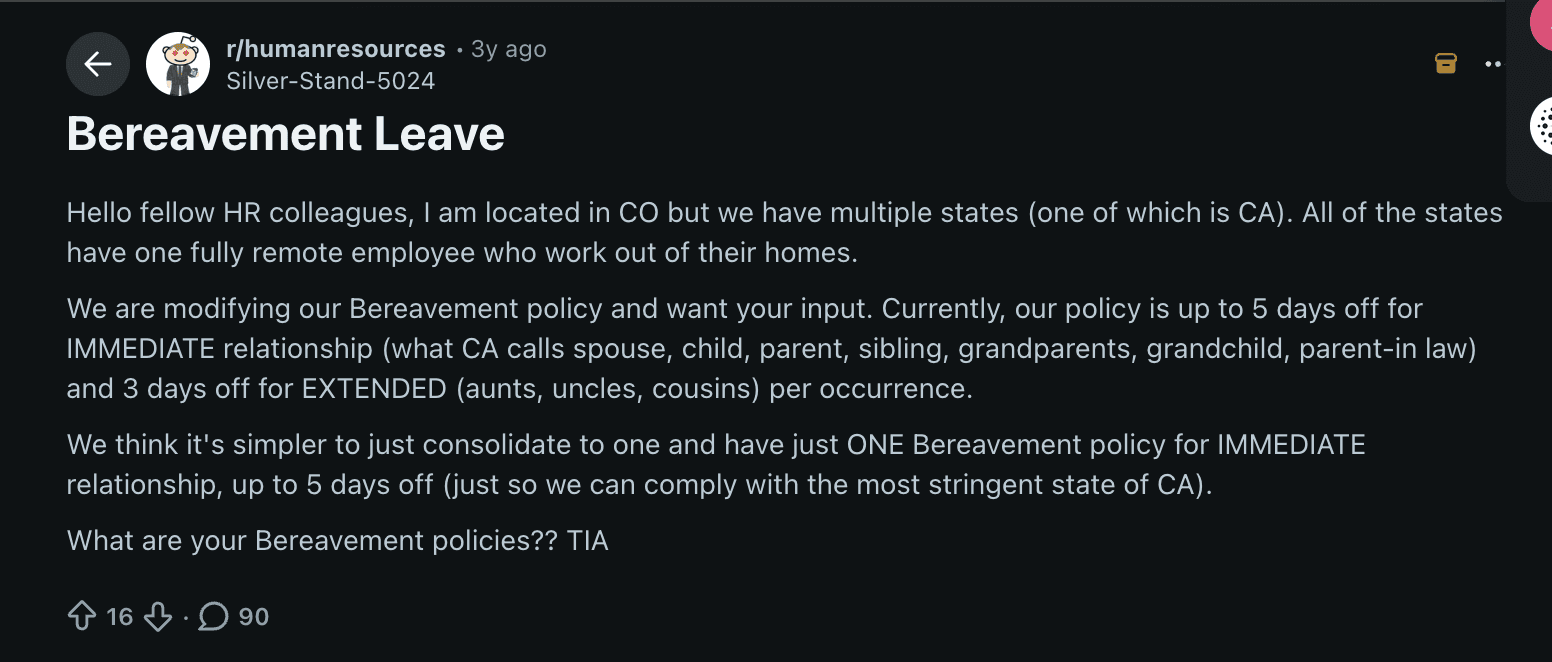
For employers, this is the policy-design issue. If a company has California employees, the handbook must meet California's minimum standard and cannot exclude covered family members listed under AB 1949.
2) “Can we require proof for bereavement leave?”
In another r/humanresources thread, an HR professional asked whether it is standard practice to require proof when employees use bereavement leave. The discussion specifically mentioned California’s five-day bereavement leave requirement.
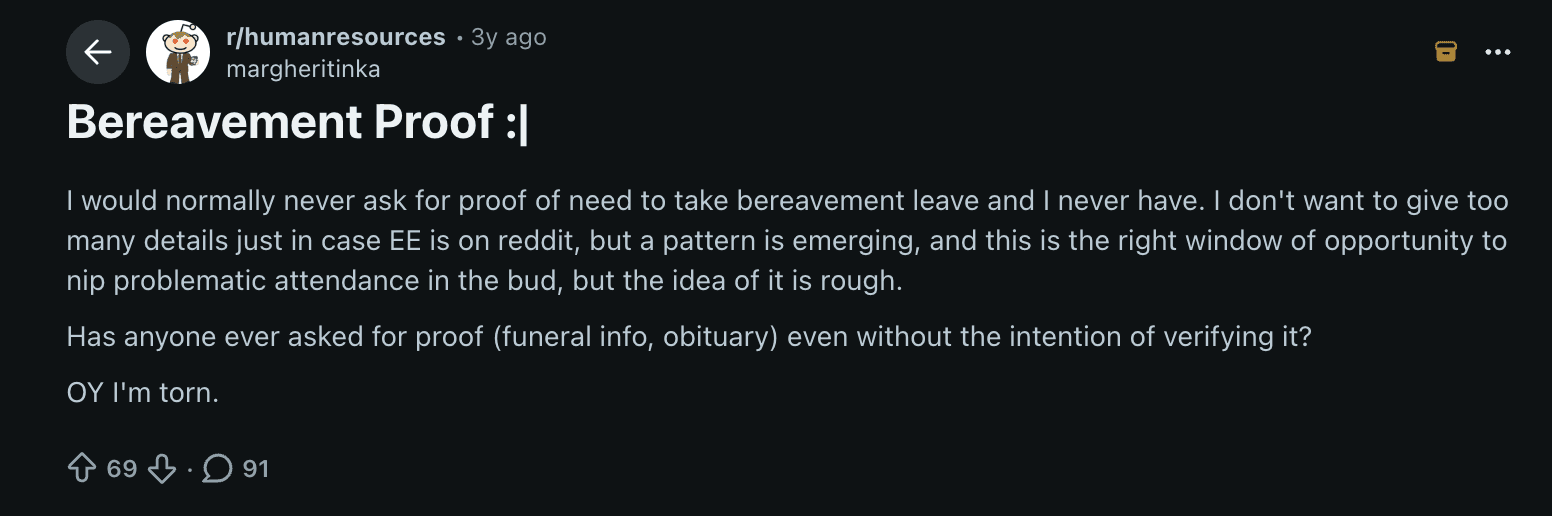
For employers, documentation is allowed, but timing and confidentiality matter. California employees have up to 30 days from the first day of leave to provide documentation if requested, and any documentation must be kept confidential.
3) “What California leave issues should employers prepare for when expanding into the state?”
In a r/humanresources thread about expanding into California, HR users flagged leave compliance, including bereavement and reproductive loss leave, as areas employers need to learn about before hiring in the state.
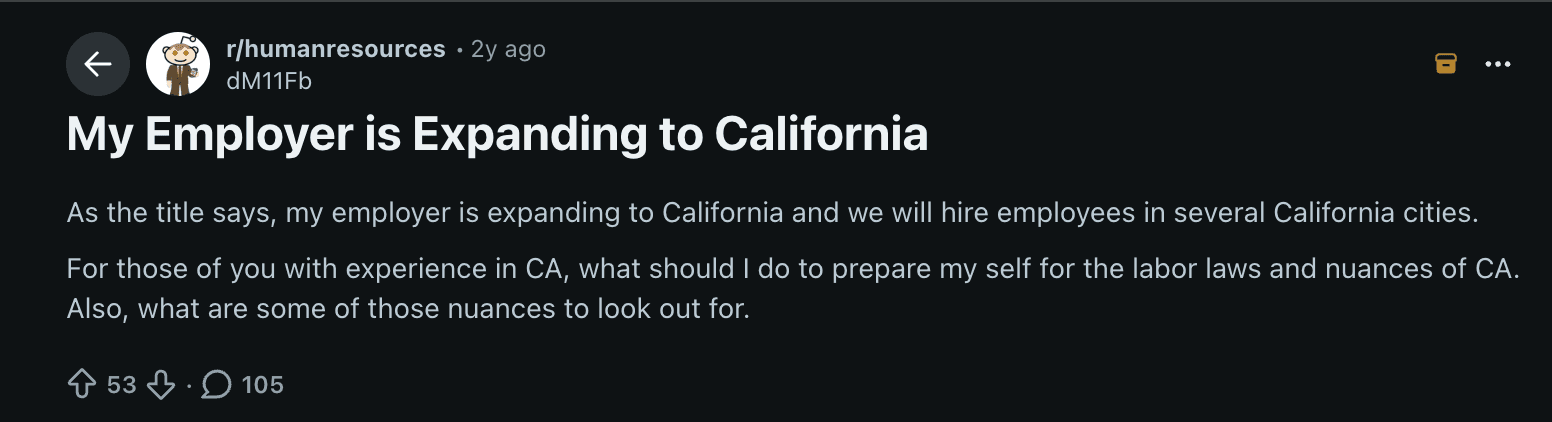
For employers, this is where compliance gaps start. California bereavement leave and reproductive loss leave both apply to covered employers with five or more employees and should be addressed before the first request arrives.
The employer takeaway: Bereavement leave disputes usually stem from preventable policy gaps: outdated handbooks, narrower definitions of family members, documentation requested too early, confidentiality errors, and managers treating protected leave as an attendance issue.
DefendMyBiz helps California employers update bereavement and reproductive loss leave policies, train managers on documentation and retaliation risk, and defend CRD or civil claims before a routine leave request becomes litigation.
Conclusion
AB 1949 is straightforward on paper: five days, eight family members, 90-day window. The liability lives in the execution: conditioning approval on prior documentation, missing confidentiality requirements, taking adverse action near the leave, or having no written policy at all.
And the law is expanding. SB 1149 is pending. Reproductive loss leave is already separately enforceable. Employers who treated this as a one-time update in 2023 are running behind.
Review your policy, train your managers, and get defense counsel involved before a CRD complaint forces the conversation.
Contact DefendMyBiz for a free 15-minute consultation → | (818) 418-6625
FAQ
Is California bereavement leave paid?
Can you require documentation before approving bereavement leave?
Does bereavement leave affect CFRA entitlement?
What if our existing policy already provides bereavement leave?
What can an employee do if bereavement leave is denied?
Disclaimer: The above content is for informational purposes only. This is not legal or tax advice. Laws, IRS guidance, and withholding requirements can change, and outcomes depend on specific facts. You are advised to contact a qualified attorney for any legal advice.


