SB 617 Cal-WARN Rewrite: New Notice Requirements for California Layoffs
General Defense Resources

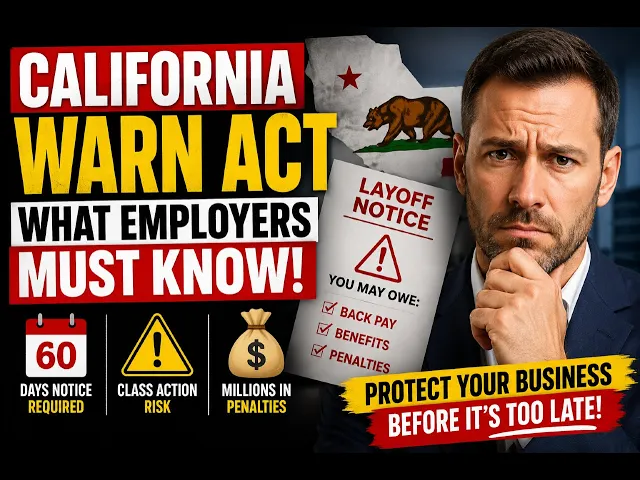
If your business is planning a layoff, relocation, or closure in California, the Cal-WARN Act 2026 rules require more than simply providing the 60 days' notice. Senate Bill 617 added new mandatory disclosures to every Cal-WARN notice starting January 1, 2026.
A notice that is missing one or more required disclosures may be deemed legally deficient, exposing employers to the same statutory remedies, including civil penalties and back pay, that apply to other WARN Act violations. Here's exactly what changed, what your notice must now say, and where employers are most likely to overlook.
Key Takeaways
SB 617 left Cal-WARN's coverage thresholds and 60-day notice timeline unchanged. It added five new required disclosures to the notice content itself, effective January 1, 2026.
The five disclosures: service coordination intent, LWDB email/phone, rapid response description, CalFresh information, and the employer's own functioning email/phone.
A California Court of Appeal has confirmed that temporary furloughs, not just permanent layoffs, trigger Cal-WARN notice obligations if 50+ employees are affected within 30 days.
Non-compliance carries civil penalties up to $500/day, plus back pay and benefits capped at 60 days or half the employee's total tenure, whichever is smaller.
WARN violations frequently become class actions, since a template defect affects every notice recipient identically.
What the Cal-WARN Act Requires
California's WARN Act (Labor Code §§1400–1408) requires covered employers to give 60 days' advance written notice before a mass layoff, relocation, or termination. It's broader than the federal WARN Act in several ways that matter:
Requirement | California WARN | Federal WARN |
|---|---|---|
Employer coverage threshold | 75+ employees at a "covered establishment" (full- and part-time counted) | 100+ full-time employees |
Mass layoff trigger | 50+ employees laid off within any 30 days | 500+ employees, or 50–499 if that's 33%+ of the site's workforce |
Covers part-time employees | Yes | No |
Covers relocations | Yes, 100+ miles | Not addressed |
SB 617 didn't touch any of these thresholds. It left the 60-day timeline and coverage rules exactly as they were. What it changed is the content every notice must now contain.
What SB 617 Added to Your Notice
Effective January 1, 2026, SB 617 amended Labor Code §1401 to require these disclosures in every qualifying Cal-WARN notice:
Whether you'll coordinate transition services through your local workforce development board (LWDB) or another entity. You must state your intention either way
A functioning email and telephone number for the LWDB serving your area
A description of the rapid response activities the LWDB offers
CalFresh program information, so displaced workers know food assistance is available
A functioning email and telephone number for your own business: this is the element most summaries leave out, but it's a separate, independent requirement from the LWDB's contact information
Employers correctly include the workforce board's contact details and CalFresh information, then never add their own functioning email and phone number, which, per the statute, is a distinct disclosure the LWDB's contact information doesn't substitute for.
Watch: California WARN Act Explained for Employers - a clear walkthrough of the core WARN obligations before you get into the SB 617-specific disclosure requirements covered here.
What Non-Compliance Actually Costs
A deficient notice, whether it's late, missing, or simply incomplete under SB 617's new content requirements, exposes you to the same underlying penalty structure that's existed under Labor Code §1402 for years:
Liability Type | Exposure |
|---|---|
Civil penalty | Up to $500 per day of violation |
Back pay | Up to 60 days, or half the employee's total days of employment, whichever is smaller |
Benefits reimbursement | Value of lost benefits for the same capped period |
Attorney's fees | Awarded to prevailing employees |
WARN claims are also frequently brought as class actions, since a single procedural gap in the notice affects every employee to whom it was sent identically. Our guide on how employment class actions actually build in California explains how a single defect like this can become a case affecting an entire workforce.
Your SB 617 Compliance Checklist
Update and have counsel review the notice template before the next event, not during one already in motion. SB 617 applies to every notice issued on or after January 1, 2026, regardless of when planning for the layoff began.
Confirm your coverage. Do you have 75+ full- or part-time employees at the location in question, counted over the preceding 12 months?
Confirm the triggering event. A layoff (permanent or temporary) of 50+ employees within 30 days, a closure, or a relocation of 100+ miles all qualify.
Update your notice template to include all five SB 617 disclosure elements: service coordination intent, LWDB email/phone, rapid response description, CalFresh information, and your own business's functioning contact information.
If you elect to coordinate services, arrange them with the LWDB or other entity within 30 days of the written notice.
If this is part of a broader year-end compliance sweep, SB 617 sits alongside several other 2026 changes worth reviewing together. Our employment law compliance guide & checklist covers the full picture beyond just notices.
Conclusion
SB 617 didn't change who Cal-WARN covers or how much notice is required. It added five specific disclosure elements to every notice issued on or after January 1, 2026. A notice missing any one of them, including your own business's contact information, can be deemed legally deficient under the same penalty structure that's applied to WARN violations for years.
Don't assume a temporary furlough sidesteps this. California courts have already confirmed it doesn't, and don't assume including the workforce board's contact information satisfies the requirement to also include your own.
If you're planning a workforce reduction and want your notice template reviewed against the actual requirements of SB 617, DefendMyBiz offers a free 15-minute consultation. Book a call with our employer defense team today.
Frequently Asked Questions
What are the WARN notice requirements for 2026 in California?
Does the WARN Act apply in California?
Does a temporary layoff or furlough trigger Cal-WARN?
What happens if my WARN notice is missing a required disclosure?
What is the 7-minute rounding rule in California?
Disclaimer: The above content is for informational purposes only. This is not legal or tax advice. Laws, IRS guidance, and withholding requirements can change, and outcomes depend on specific facts. You are advised to contact a qualified attorney for any legal advice.