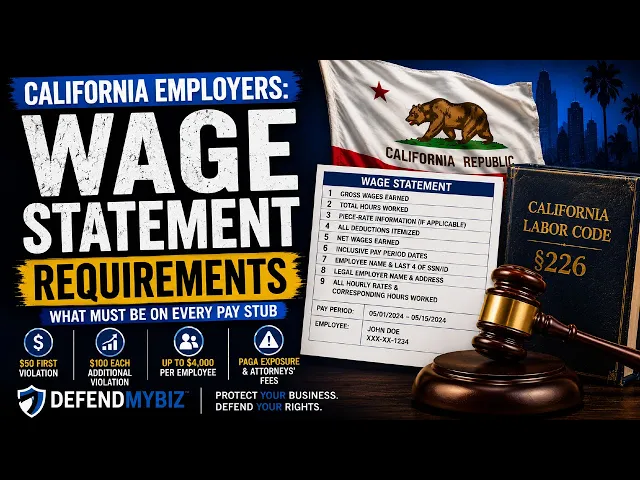
Wage Statement Violations Under §226: The $4,000-Per-Employee Exposure
Wage & Hour Defense

The "$4,000 per employee" figure associated with California wage statement violations is real, but it's also frequently misunderstood, leading employers to underestimate their actual exposure. That cap applies to exactly one legal route: an individual civil action requiring proof that the violation was "knowing and intentional" and that the employee was actually injured.
The same missing field on the same pay stub, pursued as a PAGA claim instead, falls under a completely different penalty structure that isn't capped at $4,000. Here's the full picture, including the statute-of-limitations question that most guidance answers incompletely.
Key Takeaways
The $4,000-per-employee cap under Labor Code §226(e) applies only to individual civil actions that require proof of a knowing and intentional violation resulting in actual injury.
PAGA claims over the same defect are subject to a separate penalty structure (§226.3, plus the 2024 reform's reduced $25/employee/pay-period rate for no-injury wage statement violations) that isn't bounded by the $4,000 figure.
Statutory penalty and PAGA claims are subject to a one-year statute of limitations. Actual damages claims are subject to a three-year statute of limitations. Pairing with a UCL §17200 claim extends the window to four years.
Naranjo v. Spectrum Security Services (2024) allows an objectively reasonable, good-faith belief in compliance to defeat the "knowing and intentional" element of the individual §226(e) penalty specifically.
The most common violations stem from trade-name identifiers, missing hours for salaried non-exempt employees, and unbundled premium pay.
A documented audit trail is what actually supports a good-faith defense; an undocumented review carries little evidentiary weight.
What Must Be on a California Wage Statement
Labor Code §226(a) requires nine specific items on every itemized wage statement:
Gross wages earned
Total hours worked (for non-exempt employees)
All deductions, itemized or as a permitted aggregate
Net wages earned
The pay period's start and end dates
The employee's name and either the last four digits of their SSN or an employee ID number
The employer's legal entity name and address, not a trade name or DBA
All applicable hourly rates in effect during the period, and hours worked at each
Piece-rate units and applicable rate, if paid on a piece-rate basis
Missing or inaccurate information on any single item is a potential violation. Intent isn't required to establish that a violation occurred. It only becomes relevant when determining which penalty structure applies and how much is owed.
The $4,000 Cap: What It Actually Covers
Labor Code §226(e)(1) allows an employee who suffers injury from a knowing and intentional wage statement failure to recover the greater of actual damages or $50 for the first violating pay period and $100 for each subsequent one, capped at $4,000 per employee, plus attorney's fees and costs. This is the number nearly every general overview of §226 leads with, and it's accurate as far as it goes.
What the $4,000 Cap Doesn't Cover: The PAGA Route
The same underlying defect can also be pursued as a PAGA claim under a separate statute, and that route isn't subject to the $4,000 individual-action cap:
Route | Legal basis | Key requirement |
|---|---|---|
Individual civil action | §226(e) | Knowing and intentional failure + injury |
PAGA | §2699 and applicable Labor Code penalty provisions | Individual §226(e) injury requirement does not control |
Wage-statement cure | §2699 | Special 2024 reform rules apply to qualifying violations |
The practical takeaway: "$4,000 per employee" is your ceiling for the individual claim, not for the underlying defect. If the same defect is repeated across a workforce, PAGA can create substantially broader exposure than an individual §226(e) claim.
How Long Does an Employee Have to Bring a Wage Statement Claim?
This depends entirely on which of the available paths is pursued, and the differences are significant:
Statutory penalty claims under §226(e) carry a one-year statute of limitations.
PAGA civil penalty claims under §226.3 also carry a one-year statute of limitations.
A claim for actual damages, rather than statutory penalties, falls within the general Labor Code limitations period, i.e., three years.
Adding a California Unfair Competition Law (§ 17200) claim to the same underlying defect extends the lookback period to 4 years, since the UCL has its own independent limitations period.
A plaintiff's attorney evaluating a systemic wage statement issue will typically look for the path that maximizes both scope and lookback, which is exactly why these claims frequently arrive bundled together rather than as a single, isolated cause of action.
Where These Violations Come From
Most wage statement defects trace back to a handful of recurring, unintentional sources:
Using a trade name or DBA instead of the exact legal entity name as the employer identifier
Failing to list all applicable pay rates when an employee earns both a base and a premium rate. Meal-period premiums are a common miss
Omitting total hours worked for salaried non-exempt employees, based on the mistaken assumption that salaried status exempts the hours field
Rounding discrepancies between the hours listed and the gross wages shown
Missing or incorrect pay period start/end dates
Failing to itemize piece-rate compensation alongside hourly pay when both apply separately
Any one of these, repeated consistently across payroll cycles because of a template or software default, is exactly the kind of systemic pattern that turns a single pay stub error into a workforce-wide PAGA claim.
Watch: California Wage Statement Requirements: 9 Pay Stub Mistakes That Can Cost Employers $4,000 Per Employee - a direct walkthrough of the nine required fields and the specific mistakes that generate most claims.
The Good Faith Defense: What Naranjo Changed
On May 6, 2024, the California Supreme Court held in Naranjo v. Spectrum Security Services, Inc. that an employer's objectively reasonable, good faith belief that its wage statements complied with §226 defeats the "knowing and intentional" element required for the §226(e) individual penalty. A genuine, documented mistake isn't automatically penalized the same way as a knowing violation.
This defense applies specifically to the §226(e) individual-action penalty structure. It's worth being precise that this doesn't necessarily eliminate PAGA exposure on the same facts, since PAGA's civil penalty structure under §226.3 doesn't require the same "knowing and intentional" showing in the first place. A good faith defense is most useful against the capped individual claim.
What actually supports a good-faith defense: documented periodic audits, engagement with qualified counsel or a payroll professional, and prompt correction once an issue is identified, rather than simply relying on default software settings and never checking them.
Three Different Ways a Wage Statement Problem Can Escalate
1.
Individual §226(e) claim
Requires the statutory injury and knowing/intentional elements and carries the $4,000 aggregate statutory-penalty ceiling.
2.
PAGA claim
Evaluates civil penalties under PAGA and applicable Labor Code provisions. The individual §226(e) $4,000 ceiling does not govern the PAGA calculation.
3.
Class/UCL litigation
A systemic defect can also form the basis of a class action or UCL claim, depending on the facts, the pleadings, the limitations period, and the available remedy.
Audit Your Wage Statements Before This Becomes a Claim
Pull a sample of pay stubs across your workforce and check each against all nine required fields, not just the dollar figures.
Confirm your employer identifier is the exact legal entity name, not a trade name or DBA.
Check the hours field specifically for salaried non-exempt employees. This is one of the most common and easily overlooked gaps.
Review how premium pay is itemized. Meal and rest period premiums need their own line item with rate and hours, not a bundled total.
Confirm your recordkeeping meets the three-year retention requirement, and that you can respond to a records inspection request within 21 calendar days.
Document the audit itself. An audit that occurred but left no record does little to support a good-faith defense later.
If your wage statement practices haven't been reviewed recently, that's exactly the kind of gap our guide on running a wage and hour audit before a claim is built to catch. And if a wage statement defect has already surfaced in a PAGA notice, our guide on what to do in the first 65 days after a PAGA notice covers the response window that's already underway.
Conclusion
The widely cited "$4,000 per employee" figure under Labor Code §226(e) applies only to an individual civil action requiring proof of a knowing and intentional violation with actual injury. The same defect pursued as a PAGA claim is subject to a separate penalty structure that isn't subject to that ceiling. The statute of limitations compounds this complexity: one year for the statutory penalty and PAGA routes, three years for actual damages, and four years if an Unfair Competition Law claim is layered on top.
Treat '$4,000 per employee' as the ceiling for the individual §226(e) penalty, not as the ceiling for overall wage-statement exposure. For systemic defects, your exposure analysis must separately evaluate PAGA penalties, potential class claims, actual damages, attorneys' fees, and any related wage claims.
If you're facing a wage statement claim, DefendMyBiz offers a free 15-minute consultation. If you'd like your current pay stub practices reviewed, that's a paid 1-hour consultation. Book a call with our employer defense team today.
Frequently Asked Questions
What are the requirements for California Labor Code 226 pay stubs?
What is the statute of limitations for wage statement violations in California?
How much can a California wage statement violation cost?
Does having a good faith belief in compliance protect an employer from penalties?
Can a single wage statement error become a class-wide claim?
Disclaimer: The above content is for informational purposes only. This is not legal or tax advice. Laws, IRS guidance, and withholding requirements can change, and outcomes depend on specific facts. You are advised to contact a qualified attorney for any legal advice.


